

Southern California family-owned businesses with five to 30 employees may face overlapping disability-related claims, making consistent records, clear job duties, and aligned explanations central to litigation exposure.
- One Decision, Multiple Claims: A termination may support claims for disability discrimination, failure to accommodate, failure to engage in the interactive process, retaliation, and wrongful termination.
- Documentation Shapes the Dispute: Contemporaneous performance, attendance, scheduling, medical-restriction, and accommodation records may clarify whether disability influenced the separation or legitimate concerns drove it.
- Accommodation Requires a Process: FEHA generally requires covered employers to consider reasonable accommodation and engage in a timely, good-faith interactive process unless undue hardship applies.
- Chronology Can Affect Causation: Timing may support an inference, but qualification, essential job functions, prior performance history, inconsistent treatment, and the complete record remain relevant.
- Family Communications Carry Weight: Informal texts, overlapping authority, and differing recollections among relatives may create credibility gaps when witnesses and records offer inconsistent termination explanations.
For owner-managed businesses, a defensible employment decision depends on whether the duties, chronology, communications, and stated reason align across the complete record.
A disability-related termination dispute can expose a Southern California family-owned business to overlapping claims arising from one employment decision. The dispute may test whether disability influenced the separation, whether the business considered a reasonable accommodation, whether the parties engaged in a timely, good-faith interactive process, and whether the stated reason matches the record.
For an owner-managed company with five to 30 employees, scrutiny may reach scheduling records, performance history, attendance data, medical restrictions, and communications among relatives who share management duties. This article provides general information about California employment litigation. It does not provide legal advice or create an attorney-client relationship.
How Disability Allegations and Wrongful Termination Claims Intersect
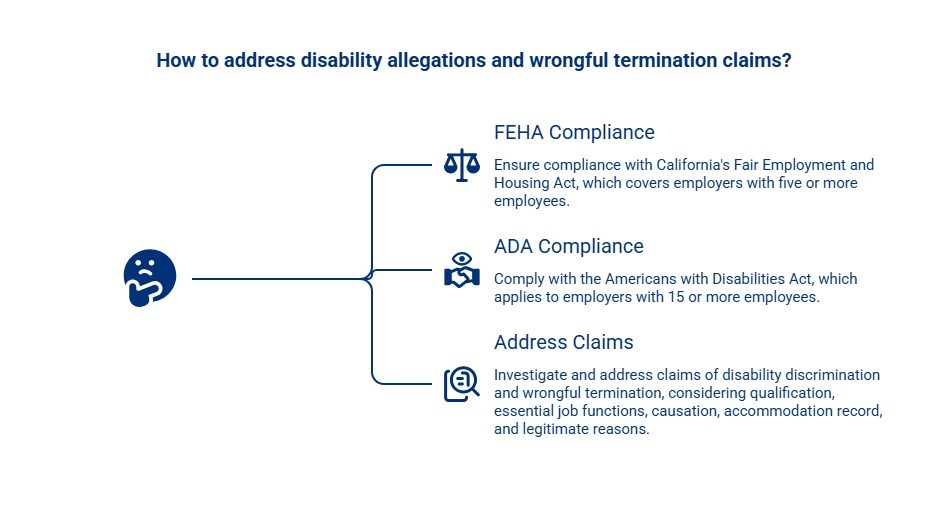
California’s Fair Employment and Housing Act (FEHA) generally prohibits covered employers from discharging or otherwise discriminating against an employee because of an actual or perceived disability. FEHA generally covers employers with five or more employees, while the federal Americans with Disabilities Act generally applies at 15 employees. The applicable law may therefore vary with workforce size and the pleaded claims.
In this setting, a former employee may allege disability discrimination under FEHA and wrongful termination in violation of public policy based on the same separation. One event may also generate multiple employment claims because each cause of action examines a different duty. A medical condition or accommodation request does not, by itself, establish unlawful termination. The litigation usually turns on qualification, essential job functions, causation, the accommodation record, and the employer’s asserted legitimate reason.
Accommodation Allegations and Essential Job Functions
FEHA requires an employer with five or more employees to provide reasonable accommodation for a known physical or mental disability unless the accommodation would impose an undue hardship. California law also treats failure to engage in a timely, good-faith interactive process as a distinct issue. That process concerns the employee’s work-related limitations, the position’s essential functions, and potentially effective accommodations; it does not automatically require the precise measure initially requested.
Performance, attendance, and operating needs remain relevant, but their meaning depends on the position and chronology. A business may contend that a front-line employee could not perform an essential function, even with accommodation, or that documented performance problems caused the separation. A claimant may respond that the concern arose only after disclosure, applied inconsistently, or overlooked a workable adjustment. These explanations make job duties, past practices, and contemporaneous records central to the dispute.
Sequence, Communications, and Family Management
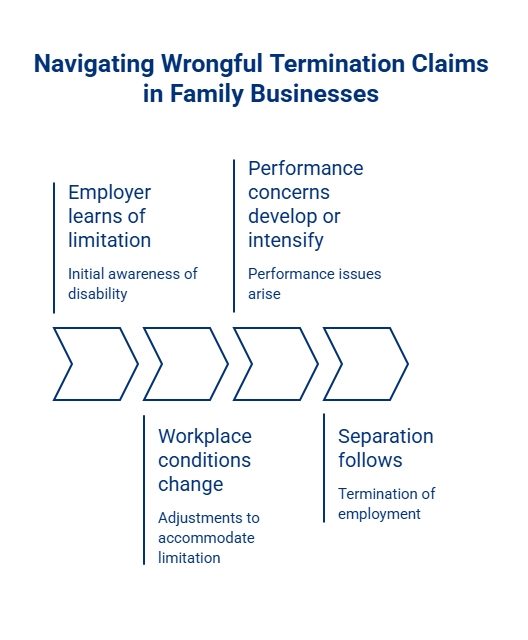
The sequence of events often supplies the litigation narrative: the employer learns of a limitation, workplace conditions change, performance concerns develop or intensify, and separation follows. Temporal proximity can support an inference, but timing alone does not resolve motive. The complete record may show an established performance history, an interrupted interactive process, inconsistent explanations, or several factors operating at once.
Management communications can carry unusual weight in a family-owned company. One relative may supervise daily work, another may control payroll, and a third may communicate the termination. Informal text messages or differing recollections can blur whether a comment reflected a final decision, a preliminary concern, or one manager’s personal view. Litigation may therefore test whether the business’s explanation is consistent across its witnesses and records rather than whether its management style was formal.
Because overlapping management duties can create evidentiary and credibility gaps, contemporaneously documenting performance issues and the interactive process—rather than relying on informal text messages or shifting recollections—serves as a crucial safeguard for family-owned businesses.
Illustrative Example: Attendance Concerns After a Medical Restriction
A family-owned retail business employs a sales associate whose position includes opening the store. After disclosing a medical restriction, the employee requests a temporary later start time. Two relatives discuss coverage by text, while another manager continues documenting late arrivals and eventually communicates a termination based on attendance.
The former employee may allege that the business ended employment because of disability or without completing the interactive process. The business may maintain that reliable opening coverage was an essential function and that attendance problems predated the request. Depending on the facts, the dispute could focus on whether another schedule was feasible, who possessed decision-making authority, and whether the written reasons align with the testimony. The scenario illustrates disputed causation; it does not establish liability or a defense.
Administrative Proceedings, Civil Claims, and Remedies
A disability-discrimination dispute may begin with the California Civil Rights Department (CRD), which evaluates complaints, may investigate accepted matters, and offers dispute-resolution services in appropriate cases. A claimant may also obtain a right-to-sue notice and pursue a civil action. Neither an agency filing nor a civil complaint proves the asserted facts.
A lawsuit may combine disability discrimination, failure to accommodate, failure to engage in the interactive process, retaliation, and wrongful termination in violation of public policy. Available remedies depend on the claims and proof. They may include back pay, front pay, emotional-distress damages, punitive damages where the governing standard is met, and attorney’s fees and costs. This exposure explains why disability-related termination litigation is often more complex than a disagreement over a single decision.
Business Consequences and the Role of Employer-Defense Counsel
For a closely held business, the case may affect several parts of the enterprise at once:
- Owners may lose operating time to interviews, record review, proceedings, and testimony.
- Family members may face credibility challenges when their responsibilities or accounts overlap.
- Defense costs and potential monetary exposure may place pressure on cash flow and planning.
- Employee relations and community reputation may change even while liability remains disputed.
Experienced employer-defense counsel can evaluate the pleaded claims, distinguish allegations from established facts, and place the employment decision within the governing California framework. Counsel may also assess how the evidentiary record, available insurance, procedural posture, and operational demands affect litigation risk and business continuity.
Disclaimer:
This content is for informational purposes only. Laws, definitions, and deadlines change. Verify current requirements through official California sources. This content is not legal advice. No attorney-client relationship is formed through this content. Please consult a qualified attorney in your jurisdiction for legal advice specific to your situation.
Protect Your Business | The Akopyan Law Firm, A.P.C. | Top Gun Employment Defense Lawyers
Have you been sued by an employee? Are you overwhelmed by the complexities of employment law? If so, give us a call. The Akopyan Law Firm, A.P.C. assists small business owners throughout Southern California. Our seasoned employment defense lawyers stand ready to help employers quickly and efficiently resolve employment disputes. We are ready to aggressively and skillfully defend against any employment case, but understand that in most situations avoiding the expense of litigation is in the client’s best interest.
Take the First Step Protecting Your Future: Call us today to speak with one of our experienced employment lawyers.
Contact Us Today:
- Phone: (818) 509-9975
- Office Locations in Southern California: Los Angeles, Bakersfield, Costa Mesa, Temecula, Rancho Cucamonga, Oxnard, Culver City, and San Diego.