
📌 Key Takeaways
Disability-linked terminations in Southern California dental practices may quickly expand into accommodation, interactive process, retaliation, and wrongful termination litigation.
- Claims Can Multiply: A termination tied to disability, medical leave, medical restrictions, or accommodation may trigger overlapping FEHA, ADA, retaliation, and public-policy allegations.
- Communications Become Evidence: Messages about scheduling, chairside coverage, sterilization, billing, or patient flow may later shape the litigation narrative.
- Interactive Process Matters: Disputes often focus on whether the practice communicated about potential accommodations before reaching an employment decision.
- Operations Shape Exposure: Treatment schedules, job duties, payroll records, and witness testimony may influence how a claim is evaluated.
- Small Teams Face Disruption: Dentist-owners, office managers, hygienists, assistants, and front-office staff may become witnesses in a disability-related termination dispute.
In small dental practices, litigation risk often lives in timing, communication, job duties, and the broader employment record.
Southern California dental practice owners facing disability-related termination claims will gain immediate litigation context here, guiding them into the employer-side details that follow.
~ ~ ~ ~ ~ ~ ~ ~ ~ ~ ~ ~ ~ ~ ~ ~ ~ ~
A termination involving disability, medical leave, medical restrictions, or an accommodation request may become a serious employment litigation matter for a Southern California dental practice once an employee asserts a claim. The dispute may not remain limited to the separation decision. It may expand into allegations of disability discrimination, failure to provide reasonable accommodation, failure to engage in the interactive process, retaliation, or wrongful termination in violation of public policy.
Why Disability and Accommodation Allegations Can Complicate Termination Litigation
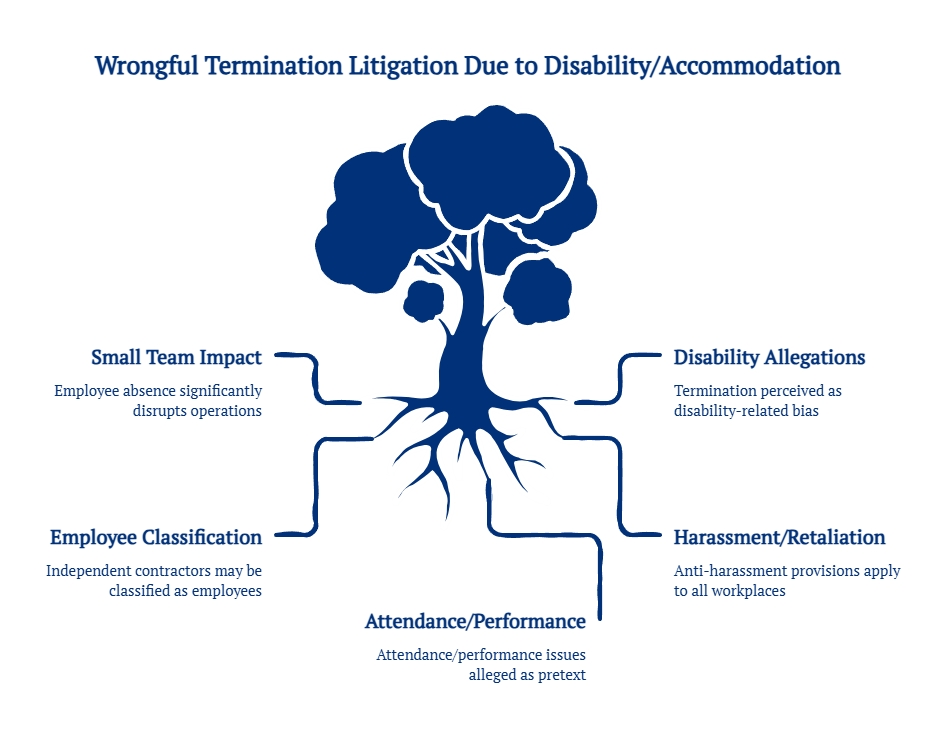
Southern California dental practices often operate with small teams and direct owner involvement. A dental assistant’s absence may affect chairside coverage. A hygienist’s schedule may affect patient flow. A front-office employee’s availability may affect appointment coordination, insurance verification, billing, and patient communication. In a small practice, one employment decision may affect clinical operations, administrative workflows, and staff morale at the same time.
That operational pressure may become legally significant when a former or current employee alleges that termination was connected to a disability, perceived disability, medical condition, accommodation request, modified schedule request, leave issue, or return-to-work dispute.
California’s Civil Rights Department notes that FEHA’s anti-discrimination and reasonable accommodation provisions apply to employers regularly employing five or more individuals, including full-time, part-time, and temporary staff on the payroll. For small practices, this headcount calculation carries an operational risk: under California’s strict ‘ABC test’ for worker classification, independent contractors (such as part-time hygienists or associate dentists) who do not meet rigorous exemption criteria may be legally classified as employees, inadvertently pushing a micro-practice over the five-employee statutory threshold. (Labor Code § 2775). Under this framework, covered dental practices must provide reasonable accommodations for employees with physical or mental disabilities to perform essential job functions, unless doing so creates undue hardship. However, a critical nuance exists for smaller practices: FEHA’s anti-harassment provisions apply to all workplaces with one or more employees, and retaliation claims linked to opposing workplace harassment can similarly protect workers in micro-businesses with fewer than five employees. (Gov. Code § 12940(h),(j))
For dental practice owners, the litigation concern is practical as well as legal. A decision viewed by the practice as based on attendance, performance, scheduling, staffing coverage, or patient-facing responsibilities may later be alleged to reflect disability-related bias, retaliation, or pretext.
Common Allegations in Disability-Related Wrongful Termination Claims
A disability-related wrongful termination claim against a dental practice may involve several overlapping theories. The employee may allege that the practice terminated employment because of a known disability, perceived disability, medical condition, or request for reasonable accommodation. The employee may also claim that the practice failed to engage in the interactive process before making the employment decision.
Common allegations may include:
- The employee alleges that termination followed disclosure of a physical disability, mental disability, medical condition, or disability-related work restriction.
- The employee alleges that a request for modified scheduling, leave, job-duty changes, or return-to-work adjustment was treated negatively.
- The employee alleges that the practice’s stated reason for termination was pretext for disability discrimination or retaliation.
- The employee alleges that the practice failed to engage in a timely, good-faith interactive process.
These allegations may be disputed. Litigation often focuses on timing, contemporaneous records, witness credibility, job duties, stated policies, deviations from established practices, and whether the employer’s explanation remained consistent over time.
Why Accommodation Communications May Become Disputed Evidence
In reasonable accommodation litigation, communications often become central evidence. The EEOC describes reasonable accommodation under the ADA as a change or adjustment that may allow a qualified applicant or employee with a disability to participate in the application process, perform essential job functions, or receive equal employment benefits and privileges. (EEOC)
In a dental office, the record may include emails, text messages, schedule notes, payroll entries, references to medical documentation, internal messages, and conversations involving a dentist-owner, office manager, supervising dentist, or practice administrator. A message about chairside coverage, sterilization duties, room turnover, front-desk scheduling, or patient flow may later be viewed through the lens of a disability-related claim.
The dispute may concern not only the termination itself, but also how a dentist-owner, manager, or administrator communicated before and after the employee raised a disability-related issue.
Why Interactive Process Allegations Often Become Central in Litigation
The interactive process is often a disputed issue in disability-related employment litigation. In general terms, the interactive process concerns communication between employer and employee about potential effective accommodations. California Government Code section 12940 identifies disability discrimination, reasonable accommodation, and interactive process obligations within California’s statutory employment framework.
A former employee may allege that the dental practice reached a conclusion too quickly, dismissed medical information, or failed to consider potential accommodations. The practice may dispute those allegations and contend that the decision was based on legitimate business reasons, staffing realities, role requirements, or performance concerns.
In litigation, the defensibility of an employment decision may depend on how the practice’s stated reason appears in the broader record. The dispute may focus on what was said, who participated, what was documented, and whether the explanation remained consistent.
How Dental Practice Operations May Shape the Litigation Record
Dental practices create distinctive employment records because clinical and administrative duties are closely connected. Treatment-room schedules, hygienist coverage, chairside assistance, sterilization responsibilities, billing workflows, insurance verification, and patient scheduling may all become relevant to the factual narrative.
The litigation record may involve patient schedules, staffing assignments, job descriptions, timekeeping records, payroll records, internal communications, and testimony from owners, managers, dentists, hygienists, dental assistants, and front-office staff. These materials do not automatically prove or defeat a claim. They may, however, influence how a judge, jury, agency, or opposing counsel evaluates the dispute.
In a small dental practice without in-house legal or HR infrastructure, owner and manager communications may receive heightened attention because the same individuals often participate in scheduling, discipline, accommodation communications, and termination decisions.
Essential Job Duties and Patient-Facing Concerns May Be Disputed
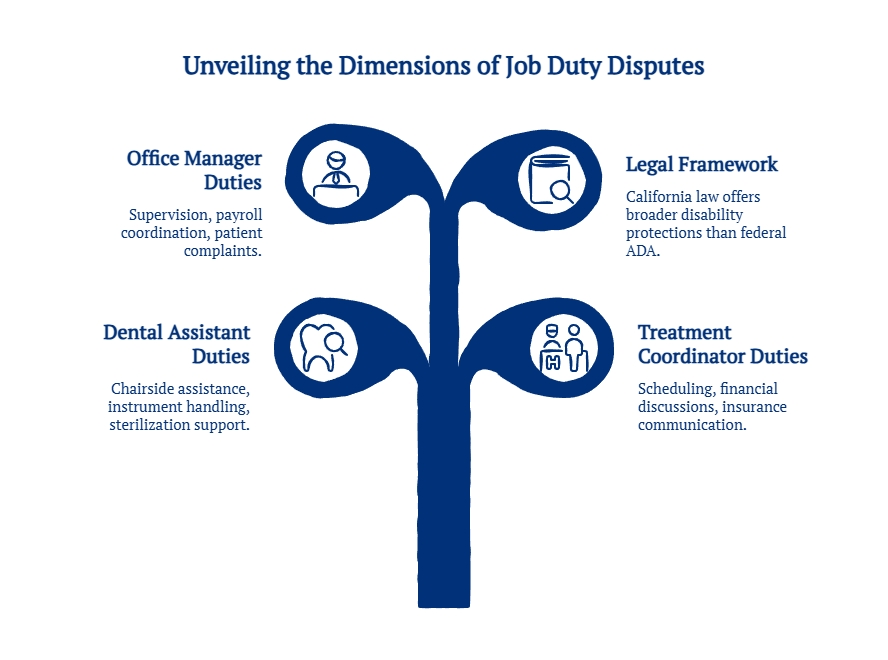
Disability and accommodation claims often involve disagreement about essential job functions. A dental assistant role may involve chairside assistance, instrument handling, sterilization support, room turnover, and patient interaction. A treatment coordinator role may involve scheduling, financial discussions, insurance communication, and patient service. An office manager role may involve supervision, payroll coordination, patient complaints, and daily workflow decisions.
When litigation arises, the parties may disagree about which duties were essential, which duties were marginal, and whether a requested accommodation related to the employee’s ability to perform the job. While federal ADA concepts regarding essential job functions and undue hardship provide comparative guidance, California law establishes a significantly more employee-favorable threshold for defining a disability. (Gov. Code § 12926.1) Unlike the federal ADA, which requires a physical or mental impairment to ‘substantially limit’ a major life activity, FEHA requires only a ‘limitation’ that makes achieving the major life activity difficult, meaning disability status is far broader and easier to establish in California litigation. (Gov. Code § 12926(j)(1), (m)(1); Gov. Code § 12926.1(c)).
Retaliation Allegations Can Follow Accommodation or Leave Issues
A termination that follows an accommodation request, disability-related complaint, medical leave discussion, or return-to-work communication may be framed as retaliation. The employee may characterize the earlier communication as protected activity and may allege that a later termination was causally connected to that activity.
The dental practice may dispute causation and point to separate business reasons. Even then, proximity between protected disability-related activity and adverse employment action may become a central causation issue in retaliation or wrongful termination litigation. Changes in discipline, scheduling, write-ups, tone, or management communications may also be scrutinized.
Privilege and Work Product Concerns After a Claim Is Asserted
Once a lawsuit, agency complaint, demand letter, or attorney communication has been received, internal communications may create additional legal and evidentiary concerns. Employment litigation may involve attorney-client privilege, work product protection, litigation holds, discoverable communications, and witness testimony.
Those issues can be especially sensitive in a small dental practice because owners, managers, and employees often communicate informally. A discussion that began as an operational conversation about staffing or scheduling may later become part of the employment litigation record. The distinction between business communications and protected legal communications may become significant after a formal claim has been asserted.
Why Small Dental Practices May Face Added Business Disruption
A disability-related termination lawsuit can disrupt a dental practice beyond legal expense. Dentist-owners may be pulled away from patients and business operations. Office managers may become witnesses. Hygienists, dental assistants, billing staff, and reception employees may be asked about schedules, communications, duties, and workplace events. Staff morale, patient-facing reputation, and business relationships may become part of the broader disruption.
Disclaimer:
This content is for informational purposes only. Laws, definitions, and deadlines change. Verify current requirements through official California sources. This content is not legal advice. No attorney-client relationship is formed through this content. Please consult a qualified attorney in your jurisdiction for legal advice specific to your situation.
Protect Your Business | The Akopyan Law Firm, A.P.C. | Top Gun Employment Lawyers
Have you been sued by an employee? Are you overwhelmed by the complexities of employment law? If so, give us a call. The Akopyan Law Firm, A.P.C. assists small business owners throughout Southern California. Our seasoned employment defense lawyers stand ready to help employers quickly and efficiently resolve employment disputes. We are ready to aggressively and skillfully defend against any employment case, but understand that in most situations avoiding the expense of litigation is in the client’s best interest.
Take the First Step Protecting Your Future: Call us today to speak with one of our experienced employment defense lawyers.
Contact Us Today:
- Phone: (818) 509-9975
- Office Locations in California: Los Angeles, Bakersfield, Costa Mesa, Temecula, Rancho Cucamonga, Oxnard, Culver City, and San Diego.