📌 Key Takeaways
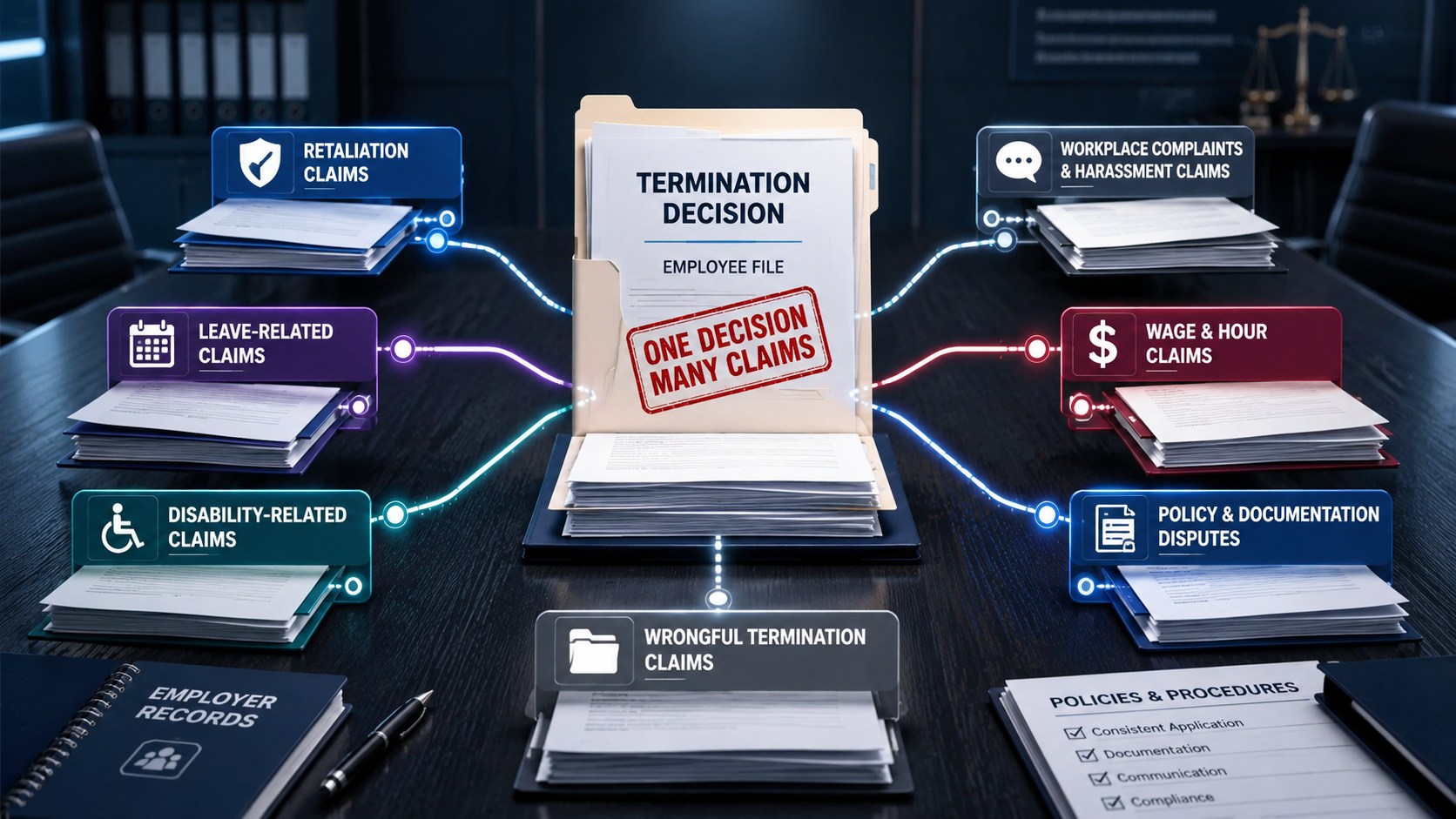
One termination at a California family-owned business may trigger several overlapping employment claims when the same decision is tied to protected activity, protected status, leave, disability, or internal complaints.
- One Decision, Many Claims: A single termination may support wrongful termination, retaliation, leave-related, disability-related, harassment-related, or wage-and-hour theories at the same time.
- Timing Drives Scrutiny: Close proximity between protected activity and termination may strengthen causation arguments and draw sharper attention to motive and sequence.
- Documentation Shapes Exposure: Contemporaneous records, internal communications, and stated reasons may become central when plaintiffs challenge consistency, credibility, or pretext.
- Policies Must Stay Consistent: Uneven policy application or shifting explanations may expand the dispute by inviting comparisons to similarly situated employees.
- Small Businesses Feel It Fast: Family-owned businesses face sharper operational strain, but they may also utilize specific procedural safeguards. For employers with 5 to 19 employees, California’s Small Employer Family Leave Mediation Program requires that leave-related claims (CFRA, bereavement, or reproductive loss leave) be submitted to mandatory mediation before a civil action can proceed, provided the employer or employee requests it (Gov. Code, § 12945.21). This ‘mediation shield’ is designed to resolve multi-theory disputes before they escalate into high-cost litigation.
In multi-theory termination cases, the dispute often turns less on the label attached to the separation and more on timing, consistency, and the surrounding record.
California family-owned businesses, closely held companies, and employer-side decision-makers will gain a clearer view of how one termination may expand into broader litigation, guiding them into the employment-law-specific details that follow.
~ ~ ~ ~ ~ ~ ~ ~ ~ ~ ~ ~ ~ ~ ~ ~ ~ ~
A single termination at a California family-owned business may become the factual center of a much broader employment dispute. Under California law, generally, a former employee may allege that the same decision was connected to protected activity, protected status, disability, job-protected medical leave, protected complaints, or wage-related concerns. When that happens, one termination may support several overlapping claims, each with its own legal standard, evidentiary focus, and potential exposure.
This article provides general information only, does not constitute legal advice, and addresses California employment law at a high level. Employment laws and their interpretation are subject to change.
That pattern appears regularly in wrongful termination disputes. A plaintiff may challenge not only the termination itself, but also the employer’s stated reason, the sequence of events leading to the decision, and the consistency of communications among owners, supervisors, managers, and HR professionals. The case may therefore turn on far more than whether employment ended. It may turn on whether the surrounding facts support multiple statutory or common-law theories arising from the same separation.
How Retaliation, Leave, and Disability Theories May Overlap
Retaliation allegations often drive that expansion. In unlawful workplace retaliation cases, a former employee may allege that the employer terminated employment after protected activity, such as a protected complaint, participation in an investigation, or opposition to allegedly unlawful conduct. In that setting, the dispute may focus on causation. Timing is a critical evidentiary factor, particularly under California’s expanded retaliation protections. Under Senate Bill 497 (the Equal Pay and Anti-Retaliation Protection Act), there is a rebuttable presumption of retaliation if an employer takes adverse action—such as termination—within 90 days of an employee engaging in certain protected activities covered by the Labor Code (Lab. Code, §§ 98.6, 1102.5, 1197.5). In these instances, the burden of proof shifts, requiring the employer to provide a legitimate, non-retaliatory reason for the decision once the initial presumption is established.
Leave-related disputes may broaden the case in a similar way. If a termination follows job-protected medical leave, a request for leave, or a dispute about reinstatement, the employee may allege interference, retaliation, or failure to restore employment. A business may have viewed the decision as routine, yet the employee may frame the same event as part of a larger leave-rights dispute. For businesses with 5 or more employees, the California Family Rights Act (CFRA) provides broad protections, while the federal Family and Medical Leave Act (FMLA) typically applies once a business reaches 50 or more employees within a 75-mile radius. (Gov. Code, § 12945.2; 29 U.S.C. § 2611). Consequently, a family-owned business may be subject to state leave requirements even if it falls below the federal threshold, creating overlapping but distinct legal obligations during a termination.
Disability-related claims often expand even further. If an employer ends employment after discussions about work restrictions, medical certification, or possible workplace adjustments, the employee may allege not only disability discrimination, but also failure to provide reasonable accommodation or failure to engage in the interactive process in good faith. In those cases, the termination may become only one part of the dispute. The litigation may also examine whether the employer fully addressed disability-related obligations before making the final decision.
Other overlapping theories may appear in the same complaint. A plaintiff may combine whistleblower retaliation and harassment allegations with specific wage and hour theories. Beyond waiting time penalties for unpaid final wages (Lab. Code, §§ 201, 203), a 2026 dispute may include claims under Labor Code section 926, which now prohibits ‘stay-or-pay’ clauses—contractual terms requiring employees to repay training or ‘quit fees’ upon separation (AB 692). Furthermore, if the termination was influenced by an Automated Decision Technology (ADS) or AI-driven performance tool, the employee may allege a failure to provide the required notice or a right to ‘human review’ under updated FEHA regulations effective April 2026 (Cal. Code Regs. § 11022).
Why Timing, Consistency, and Documentation Often Matter
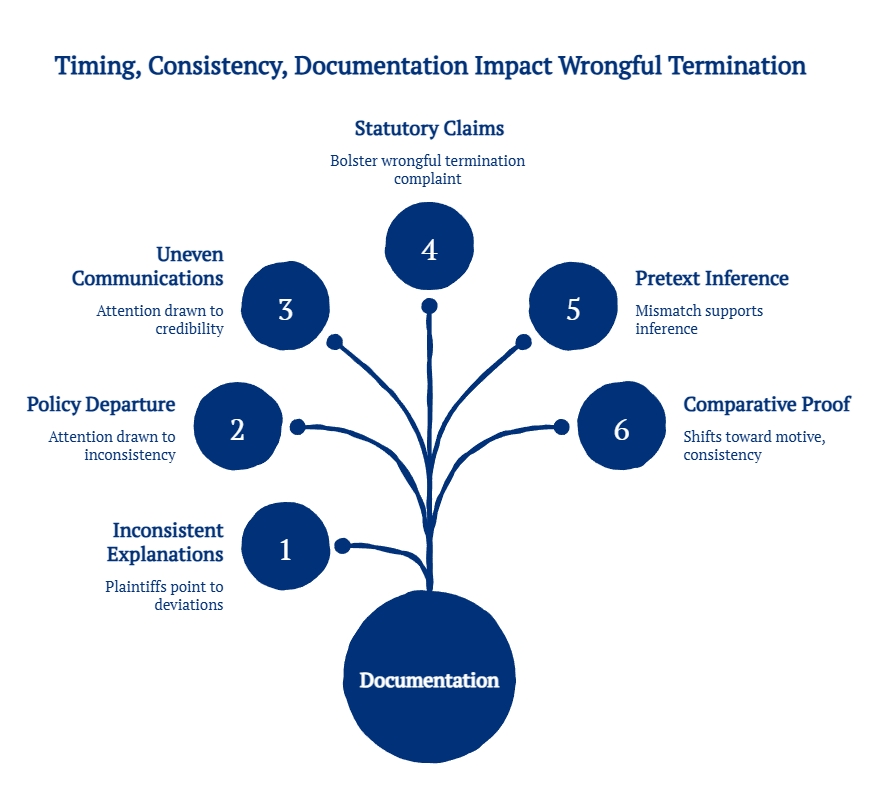
These cases often become larger because plaintiffs do not rely on the termination decision alone. They may also point to inconsistent explanations, deviation from stated policy, shifting accounts among decision-makers, or an incomplete interactive process. A termination that follows closely after protected activity may draw particular attention to timing. A termination that departs from ordinary policy or practice may draw attention to consistency. A termination supported by uneven communications may draw attention to credibility.
That is why documentation often becomes a central feature of the dispute. The issue is not simply whether records exist, but whether the employer has complied with mandatory 2026 notice requirements. Under the Workplace Know Your Rights Act (SB 294), employers must have provided a standalone written notice of constitutional and labor rights to all employees by February 1, 2026. A failure to provide this notice, or a failure to maintain the required three years of performance-related training records, can serve as secondary statutory claims that bolster a plaintiff’s broader wrongful termination complaint (Lab. Code, § 1198.5). In litigation, plaintiffs often argue that a mismatch between the employer’s stated rationale, prior evaluations, internal messages, or policy language supports an inference of pretext. The dispute may therefore focus on whether the employer’s explanation appears defensible as well as facially lawful.
Uniform application of established policies may also become significant. When a plaintiff alleges that similarly situated employees were treated differently, the case may shift toward comparative proof, motive, and consistency. In that posture, the termination may be litigated not as an isolated event, but as one decision within a larger pattern the plaintiff claims was uneven or selective.
Why Family-Owned Businesses May Feel These Pressures More Acutely
Family-owned businesses and closely held companies may experience these disputes with particular intensity. That does not mean every family-run employer operates informally. It does mean that decision-making authority is often concentrated in a smaller group of owners, executives, supervisors, or managers. As a result, the same individuals who made the decision may also become the central witnesses whose communications, judgment, and consistency are examined throughout the case.
The pressure is often operational as well as legal. A single employment dispute may require substantial attention from leadership already responsible for staffing, finances, and day-to-day operations. When one termination expands into several claims at once, the case may become more document-intensive, more expensive, and more disruptive than the original decision may have suggested.
Why Early Legal Review Often Matters in Multi-Theory Cases
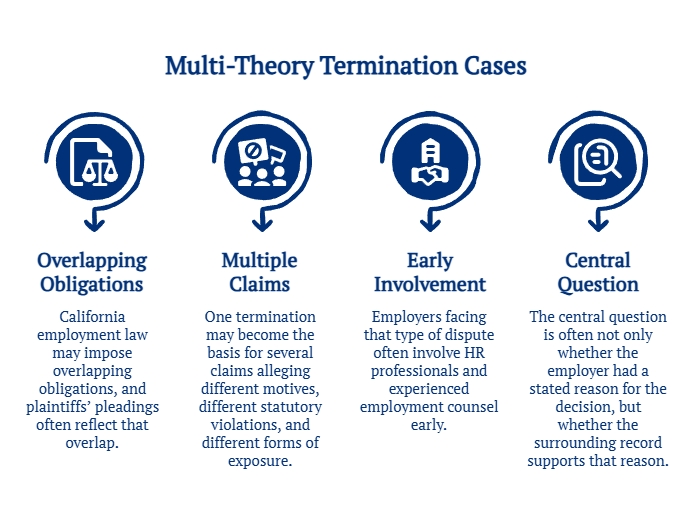
For that reason, these disputes are rarely evaluated through a single label alone. California employment law may impose overlapping obligations, and plaintiffs’ pleadings often reflect that overlap. One termination may therefore become the basis for several claims alleging different motives, different statutory violations, and different forms of exposure.
Employers facing that type of dispute often involve HR professionals and experienced employment counsel early because the analysis may depend on specific facts, timing, documentation, communications, policy application, and the interaction of multiple laws. In a multi-theory termination case, the central question is often not only whether the employer had a stated reason for the decision, but whether the surrounding record supports that reason in a consistent and defensible way.
Disclaimer:
This content is for informational purposes only. Laws, definitions, and deadlines change. Verify current requirements through official California sources. This content is not legal advice. No attorney-client relationship is formed through this content. Please consult a qualified attorney in your jurisdiction for legal advice specific to your situation.
Protect Your Business | The Akopyan Law Firm, A.P.C. | Top Gun Employment Lawyers
Have you been sued by an employee? Are you overwhelmed by the complexities of employment law? If so, give us a call. The Akopyan Law Firm, A.P.C. assists small business owners throughout Southern California. Our seasoned employment defense lawyers stand ready to help employers quickly and efficiently resolve employment disputes. We are ready to aggressively and skillfully defend against any employment case, but understand that in most situations avoiding the expense of litigation is in the client’s best interest.
Take the First Step Protecting Your Future: Call us today to speak with one of our experienced employment lawyers.
Contact Us Today:
- Phone: (818) 509-9975
- Office Locations in California: Los Angeles, Bakersfield, Costa Mesa, Temecula, Rancho Cucamonga, Oxnard, Culver City, and San Diego.