
📌 Key Takeaways
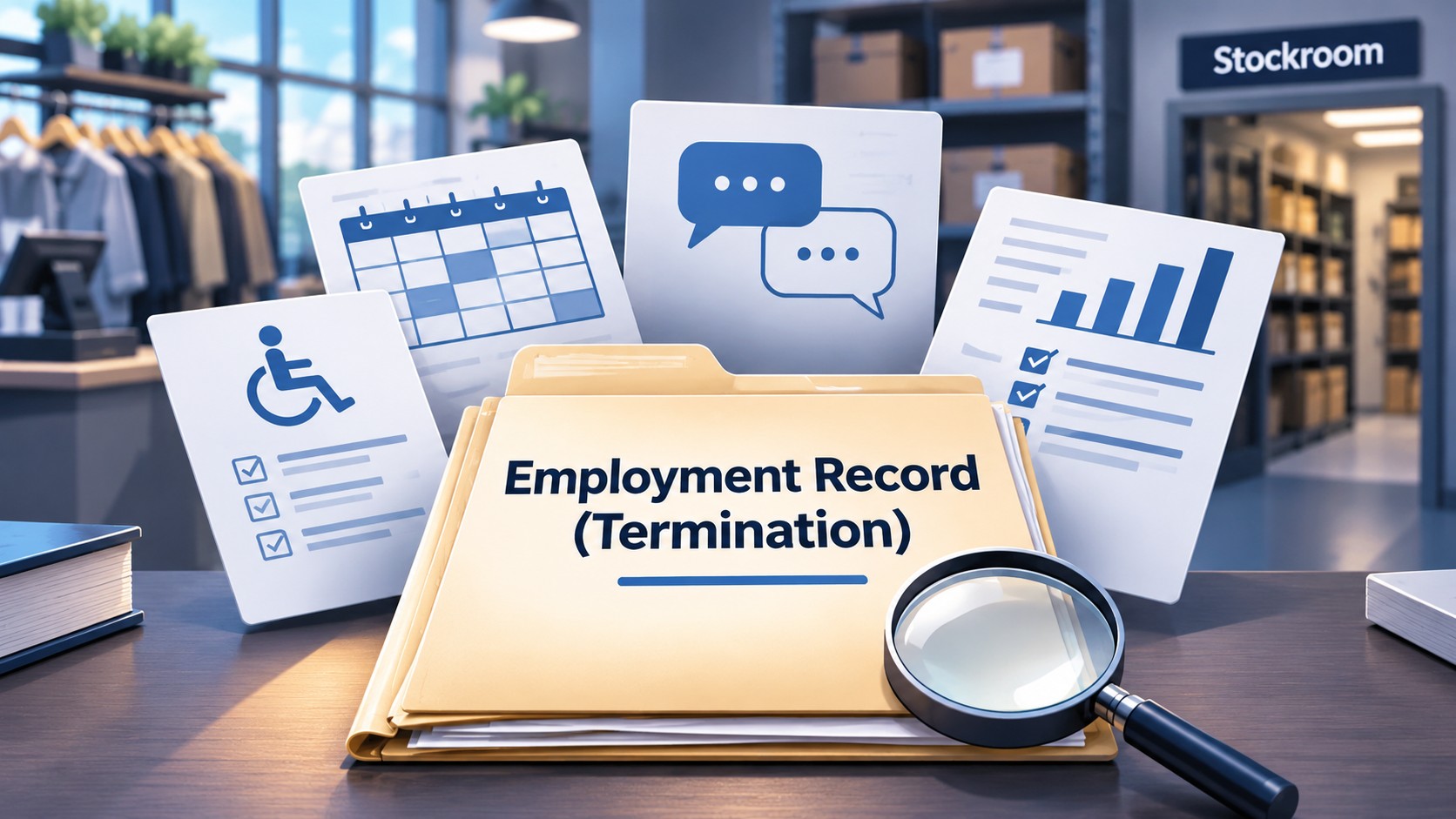
For small Los Angeles retailers facing a claim, disability or reasonable-accommodation issues may broaden a termination dispute beyond the termination itself.
- Allegations Broaden the Dispute: A request for reasonable accommodation may expand the contested facts and legal theories without independently proving wrongful termination or other unlawful conduct.
- Communications Shape the Record: Emails, text messages, and management exchanges may show what decisionmakers knew, although the parties may interpret the same communications differently.
- Operations Become Contested Facts: Attendance, performance, assigned duties, and store coverage may become disputed when an employee connects operational decisions to a disability or accommodation request.
- Multiple Claims May Overlap: A termination may generate distinct allegations involving disability discrimination, reasonable accommodation, the interactive process, or retaliation, depending on the facts.
- Litigation Can Disrupt Business: Active litigation may increase expenses, consume management time, and affect employee relations, morale, reputation, or customer trust, although effects vary.
One termination decision may place the surrounding employment history, management communications, and retail operations in dispute.
~ ~ ~ ~ ~ ~ ~ ~ ~ ~ ~ ~ ~ ~ ~ ~ ~ ~
California’s Fair Employment and Housing Act (FEHA) addresses disability discrimination and reasonable accommodation in employment for businesses that regularly employ five or more individuals. When an employee’s request for reasonable accommodation at a covered business is followed by reduction in hours or pay, demotion, disciplinary action, or termination, the sequence of events may become part of a later claim.
The former employee’s allegations do not establish employer liability. The employer’s stated operational reason does not determine the outcome either. The significance of each account depends on applicable law and the facts established during the proceeding.
Why Disability or Accommodation Issues May Complicate an Unlawful Termination Claim
California’s Fair Employment and Housing Act addresses disability discrimination and reasonable accommodation in employment. When an employee’s request for reasonable accommodation is followed by reduction in hours, reduction in pay, demotion, disciplinary action, or termination, the sequence of events may become part of a later claim.
A lawsuit or administrative complaint may therefore examine conduct that preceded the separation. The former employee may allege that a disability or request for reasonable accommodation influenced the decision. The employer may maintain that attendance, performance, assigned duties, or store operations formed the basis for the termination.
These competing positions create a contested employment matter. A disability-related allegation may expand the facts and legal theories disputed in the proceeding, but the allegation does not independently prove wrongful termination or other unlawful conduct.
How Communications About a Request for Reasonable Accommodation May Become Relevant
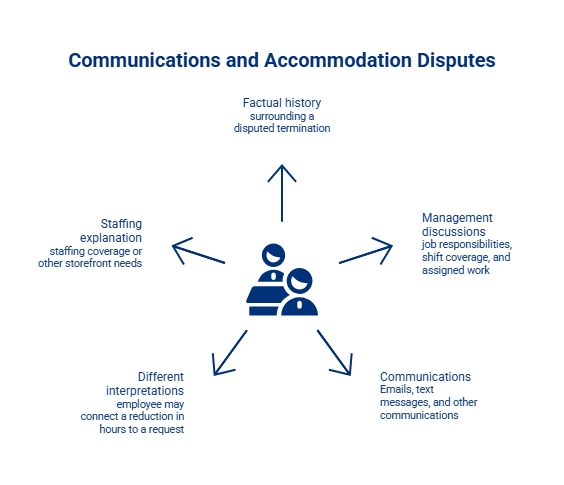
Communications concerning an employee’s request for reasonable accommodation may form part of the factual history surrounding a disputed termination. In a small retail business, an owner or store manager may participate directly in discussions about job responsibilities, shift coverage, and assigned work. The parties may later disagree about what management knew and how subsequent employment decisions related to the request.
Emails, text messages, and other communications may provide context concerning exchanges among the employee, store management, and business ownership. Their significance depends on their content, timing, and relationship to the allegations.
The parties may also interpret the same exchange differently. An employee may connect a reduction in hours to a request for reasonable accommodation, while the employer may attribute the change to staffing coverage or other storefront needs. Neither interpretation becomes an established fact merely because one party asserts it.
Why Retail Staffing and Performance Issues May Become Part of the Termination Dispute
Retail operations create a distinct factual setting. Sales associates, cashiers, inventory workers, and stockroom employees may perform interdependent duties involving customer service, store coverage, opening and closing responsibilities, and inventory handling.
An employer may identify attendance, performance, assigned duties, or coverage requirements as reasons for termination. A former employee may contend that the explanation does not account for the employee’s disability or earlier request for reasonable accommodation. The dispute may then concern the relationship between the operational explanation and the events preceding the termination.
In evaluating these competing explanations, California law distinguishes between essential job functions and marginal duties and examines whether a requested adjustment creates an undue hardship (Cal. Gov. Code § 12940(m); Cal. Code Regs., tit. 2, § 11068). For a small retail storefront with limited headcount, disputes frequently center on whether a physical task (such as lifting stockroom inventory or standing at a register) or a scheduling requirement (such as opening or closing the store alone) is an essential function of the role, and whether accommodations like a cashier stool, temporary duty restructuring, or modified shift schedules were feasible given the store’s size, financial resources, and staffing coverage.
Staffing pressures do not automatically justify a contested decision. A request for reasonable accommodation does not automatically invalidate an employment action. The legal significance of each circumstance depends on applicable law and the facts established in the matter.
Why Disability-Related Termination May Involve Several Employment Allegations
A single termination may generate distinct allegations involving disability discrimination, failure to provide reasonable accommodation, failure to engage in the interactive process, or retaliation. These allegations represent different legal theories, even when they arise from the same sequence of employment events.
A former employee may assert several theories in a demand letter, administrative complaint, or lawsuit. The presence of multiple allegations can expand the disputed issues without establishing that every asserted claim applies or has merit.
For a retailer confronting such claims, disability discrimination defense may present issues different from the defense of reasonable accommodation claims. The differences among these claims depend on California law and the facts of the employment relationship.
Under FEHA, each of these legal theories turns on a distinct legal question:
- Disability discrimination (Cal. Gov. Code § 12940(a)): Focuses on whether the employee’s actual or perceived disability was a substantial motivating reason for the termination, and whether the employee could perform the position’s essential functions with or without reasonable accommodation.
- Failure to provide reasonable accommodation (§ 12940(m)(1)): Examines whether the employer failed to provide a reasonable workplace adjustment for a known disability, unless the employer demonstrates that the adjustment would impose an undue hardship on store operations.
- Failure to engage in the interactive process (§ 12940(n)): Addresses whether the employer participated in a timely, good-faith dialogue with the employee to explore potential accommodations once the need for an adjustment became known.
- Retaliation (§ 12940(m)(2) and § 12940(h)): Evaluates whether the termination or prior disciplinary action was taken because the employee requested an accommodation or opposed unlawful practices, a claim that can proceed even if the underlying disability or accommodation claim is not proven.
How a Disability-Related Termination Claim May Enter Formal Proceedings
An administrative matter may involve agency review or investigation by the California Civil Rights Department (CRD), while civil litigation involves court pleadings and discovery. Although not every dispute undergoes a full agency investigation or reaches court, an employee pursuing statutory claims under FEHA must first file an administrative complaint with the CRD and obtain a Right-to-Sue notice, either after an agency investigation or by requesting immediate notice, before filing a civil lawsuit.
Under current FEHA procedures, an employee generally has three years from the date of the alleged unlawful practice to file an administrative complaint with the CRD, and one year from the date the CRD issues a Right-to-Sue notice to file a civil lawsuit in court. Because of these statutory timelines, a small retailer may receive notice of a formal administrative charge or civil complaint long after the employee’s separation and after store staffing or management has changed.
Administrative filings, civil pleadings, and the parties’ respective positions may frame the issues in dispute. The commencement of a formal proceeding does not make the initial allegations conclusive.
How Active Litigation May Affect a Small Retail Business
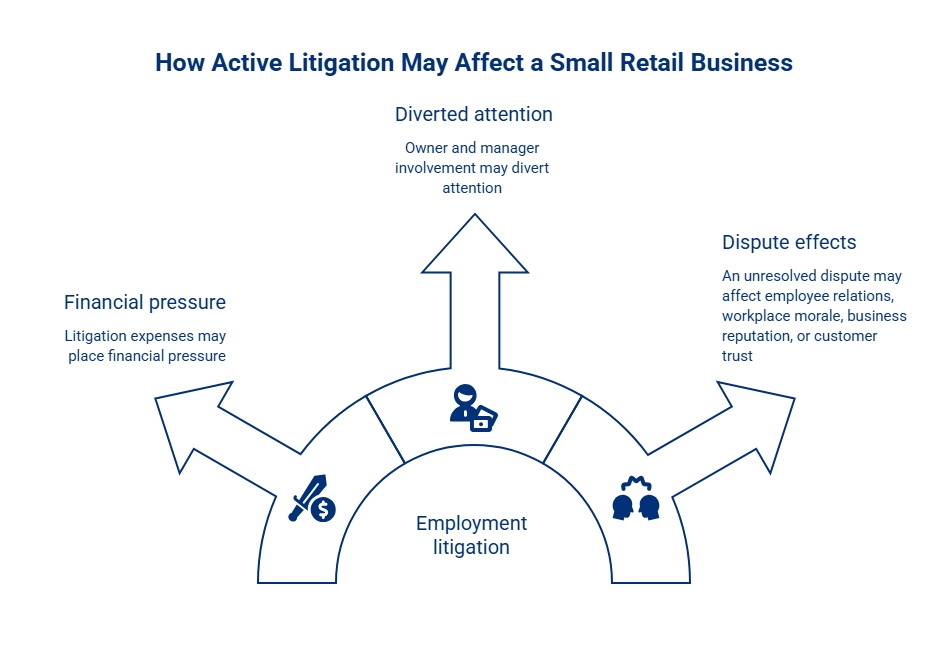
Employment litigation can place demands on an owner who continues to manage staffing, customer service, sales, and inventory. Possible effects may include, among other consequences:
- Litigation expenses may place financial pressure on a retailer that funds its defense directly.
- Owner and manager involvement may divert attention from ordinary storefront operations.
- An unresolved dispute may affect employee relations, workplace morale, business reputation, or customer trust.
These pressures can be significant for a business with a small management team. Their nature and extent depend on the claim, the proceeding, and the retailer’s circumstances.
The Role of Employment Litigation Defense Attorney
California employer-side employment litigation attorney represents businesses in employee lawsuits, demand-letter disputes, and administrative proceedings. In a disability-related termination matter, representation may concern contested termination allegations, related disability or accommodation allegations, disputed communications, and events preceding the separation. The representation addresses the active legal dispute rather than general workplace administration.
Disclaimer:
This content is for informational purposes only. Laws, definitions, and deadlines change. Verify current requirements through official California sources. This content is not legal advice. No attorney-client relationship is formed through this content. Please consult a qualified attorney in your jurisdiction for legal advice specific to your situation.
Protect Your Business | The Akopyan Law Firm, A.P.C. | Top Gun Employment Defense Lawyers
Have you been sued by an employee? Are you overwhelmed by the complexities of employment law? If so, give us a call. The Akopyan Law Firm, A.P.C. assists small business owners throughout Southern California. Our seasoned employment defense lawyers stand ready to help employers quickly and efficiently resolve employment disputes. We are ready to aggressively and skillfully defend against any employment case, but understand that in most situations avoiding the expense of litigation is in the client’s best interest.
Take the First Step Protecting Your Future: Call us today to speak with one of our experienced employment lawyers.
Contact Us Today:
- Phone: (818) 509-9975
- Office Locations in California: Los Angeles, Bakersfield, Costa Mesa, Temecula, Rancho Cucamonga, Oxnard, Culver City, and San Diego.