
For Southern California family-owned businesses, a termination involving Pregnancy Disability Leave (PDL) may draw scrutiny to timing, documented employment history, management explanations, and consistent practices.
- Timing Can Shape Scrutiny: Temporal proximity between protected pregnancy-related activity and termination may affect whether a causal connection becomes part of the dispute.
- Records Support Context: Contemporaneous performance, disciplinary, attendance, scheduling, and communication records may help explain whether employment concerns existed before protected activity occurred.
- Consistency Strengthens Defensibility: Consistent management explanations, established employment practices, and comparable treatment of similarly situated employees may affect how the stated reason for termination is evaluated.
- Pretext May Be Alleged: A former employee may challenge whether the employer’s stated legitimate reason was genuine when discrimination or retaliation allegations accompany the termination.
- Small Businesses Feel Concentrated Effects: Family-owned businesses may experience greater operational disruption because owners and managers often handle employment decisions alongside staffing, customers, and daily operations.
For Southern California family-owned employers, defensibility often turns on how clearly the contemporaneous employment history supports the stated reason for termination.
A termination involving an employee who requested or used Pregnancy Disability Leave may become the subject of a wrongful termination allegation when the employee claims that protected pregnancy-related activity influenced the termination. The employer may maintain that an independent and legitimate employment reason caused the termination instead.
The existence of competing explanations does not establish liability or defense. The significance of the termination depends on the applicable California law and the factual relationship among the employee’s protected activity, the employer’s stated reason for termination, and the surrounding employment history.
Pregnancy Disability Leave Can Become Relevant to a Termination Claim
For employers with five or more employees, California provides employment protections associated with Pregnancy Disability Leave and related protected pregnancy activity. Under the Fair Employment and Housing Act (FEHA), eligible employees can take up to four months of job-protected leave if they are disabled by pregnancy, childbirth, or a related medical condition. Crucially, employers must generally guarantee reinstatement to the same or a comparable position once the leave concludes. When a termination occurs in circumstances involving those protections, a former employee may allege a causal connection between the protected activity and the adverse employment action.
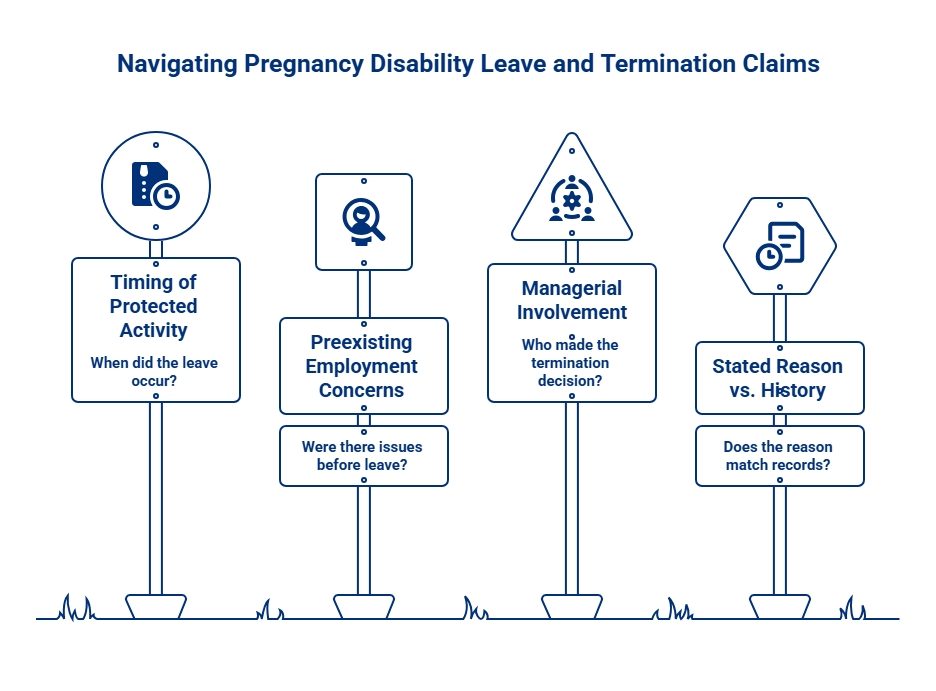
That allegation can place several aspects of the employment relationship in context. Relevant circumstances may include when the protected activity occurred, whether employment concerns existed beforehand, which managers participated in the termination, and whether the employer’s stated reason for termination corresponds with the contemporaneous employment history.
A connection between timing and termination does not itself establish an unlawful motive. The complete factual context determines the significance of those circumstances.
The Employer’s Stated Reason May Become a Central Issue
An employer may terminate an employee for legitimate employment reasons unrelated to pregnancy or protected leave. If the employee later challenges the termination, the stated reason may be compared with the employer’s existing records, prior management decisions, and contemporaneous communications.
In discrimination and retaliation disputes, pretext generally concerns a challenge to whether the employer’s stated legitimate reason was the genuine reason for the adverse employment action. An allegation of pretext does not establish that the employer’s explanation was false or that unlawful discrimination or retaliation occurred.
The factual analysis may therefore consider whether performance concerns existed before the protected activity, whether disciplinary records are consistent with the stated reason for termination, and whether the relevant decision-makers gave materially consistent explanations.
Temporal Proximity May Affect How the Termination Is Evaluated
Temporal proximity refers to the closeness in time between protected activity and an adverse employment action. A termination that follows pregnancy-related protected activity may draw additional attention to whether a causal connection exists between the two events.
Timing remains only one part of the factual record. Earlier performance concerns, attendance issues, disciplinary events, scheduling decisions, or other employment developments may provide additional context.
Family-owned businesses may have several managers with different responsibilities for the same employee. An owner may supervise performance, while another manager handles scheduling or payroll. Those decision-makers may therefore possess different information about the employment history, which can make the consistency of their accounts particularly significant.
Contemporaneous Records and Consistent Practices Can Affect Defensibility
Contemporaneous employment records show what the employer recorded when workplace events occurred. Those records may include performance evaluations, disciplinary documents, scheduling information, attendance records, or communications connected to the stated reason for termination.
Consistency may extend beyond the individual employee. A dispute may examine whether an employer followed its established practices and whether similarly situated employees were treated consistently in comparable circumstances.
A stated legitimate reason does not exist in isolation from the surrounding record. The relationship among contemporaneous documentation, established practices, management explanations, and treatment of similarly situated employees may affect how the employer’s explanation is evaluated if the termination is later challenged.
These considerations do not require a conclusion that a termination was lawful or unlawful. They explain why the defensibility of an employment decision may depend on more than the reason stated at the time of termination.
Illustrative Example: Pregnancy Disability Leave and Preexisting Performance Concerns
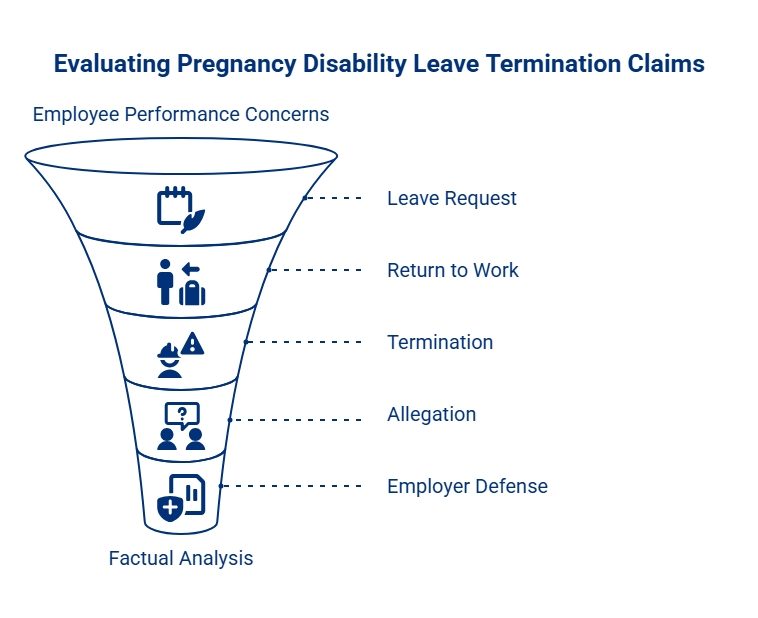
A family-owned Southern California service business documents recurring performance concerns involving a non-executive employee before the employee requests Pregnancy Disability Leave. The employee later uses the leave, returns to work, and is subsequently terminated. The former employee alleges that the leave influenced the termination. The employer maintains that the earlier performance problems caused the decision.
Temporal proximity between the protected activity and the termination may become relevant, but the broader employment history may also matter. The significance of the employer’s position may depend on whether the earlier records genuinely predated the leave activity, whether management’s explanation remained consistent with those records, and whether established employment practices were applied consistently. Those circumstances could affect the factual analysis without establishing either liability or a defense.
Southern California Family-Owned Businesses May Experience Operational Impacts
Family-owned and closely held businesses often operate through compact management structures in which owners participate directly in supervision, scheduling, discipline, and termination decisions.
A serious employment dispute can therefore place substantial demands on the same individuals who remain responsible for customers, employees, staffing, and ordinary operations. Employee-relations concerns may also arise when current staff members have knowledge of events surrounding the termination. Legal expense, management distraction, and reputational concerns may add further business pressure.
These characteristics do not suggest that family-owned businesses face a different legal standard. They explain why one disputed termination may have consequences that extend across several areas of a smaller organization.
A Termination Dispute May Also Involve Pregnancy Discrimination or Retaliation Allegations
A wrongful termination allegation involving Pregnancy Disability Leave may overlap with pregnancy discrimination or retaliation allegations arising from the same employment events. Those legal theories remain distinct even when they depend on the same chronology, communications, performance history, and management explanations.
The overlap can make the factual record more important because the same employment decision may be evaluated from several legal perspectives. The significance of any particular fact depends on the specific claim, the applicable California law, and the complete circumstances. Employment defense counsel can evaluate an active or imminent wrongful termination matter involving Pregnancy Disability Leave in light of the applicable law and factual record.
Disclaimer:
This content is for informational purposes only. Laws, definitions, and deadlines change. Verify current requirements through official California sources. This content is not legal advice. No attorney-client relationship is formed through this content. Please consult a qualified attorney in your jurisdiction for legal advice specific to your situation.
Protect Your Business | The Akopyan Law Firm, A.P.C. | Top Gun Employment Defense Lawyers
Have you been sued by an employee? Are you overwhelmed by the complexities of employment law? If so, give us a call. The Akopyan Law Firm, A.P.C. assists small business owners throughout Southern California. Our seasoned employment defense lawyers stand ready to help employers quickly and efficiently resolve employment disputes. We are ready to aggressively and skillfully defend against any employment case, but understand that in most situations avoiding the expense of litigation is in the client’s best interest.
Take the First Step Protecting Your Future: Call us today to speak with one of our experienced employment lawyers.
Contact Us Today:
- Phone: (818) 509-9975
- Office Locations in California: Los Angeles, Bakersfield, Costa Mesa, Temecula, Rancho Cucamonga, Oxnard, Culver City, and San Diego.