
📌 Key Takeaways
Retaliation allegations may turn a California dental practice termination dispute into a fact-intensive employment litigation matter involving timing, motive, records, and credibility.
- Timing Shapes Scrutiny: Termination after protected activity may draw close attention to causation, decision-maker knowledge, and alleged pretext.
- Records Carry Weight: Payroll records, schedules, timekeeping data, emails, and text messages may influence how the employment decision is evaluated.
- Dental Operations Matter: Patient care, hygienist schedules, treatment-room coverage, billing work, and front-office staffing may all feel the disruption.
- Claims Can Multiply: Wrongful termination and workplace retaliation allegations may overlap with FEHA, Labor Code, wage-and-hour, leave, or accommodation claims.
- Defense Requires Judgment: Employment defense representation may help align litigation strategy with the realities of a small, patient-facing dental business.
One termination can become many disputed facts when protected activity, workplace records, and business reasons collide.
California dental practice owners facing active or threatened employee disputes will gain a clearer view of retaliation-related wrongful termination risk, preparing them for the detailed overview that follows.
A wrongful termination claim against a California dental practice may create additional litigation complexity and potential exposure when a former employee alleges retaliation. A separation decision may become a broader dispute over timing, motive, credibility, schedules, payroll records, text messages, emails, and whether the termination followed a workplace complaint or protected activity.
Why Retaliation Allegations Can Expand a Termination Dispute
A wrongful termination allegation often begins with one employment decision. The claim may expand when the employee asserts that the decision followed legally protected activity. Under California law generally, retaliation concepts may arise when an employee claims that an adverse employment action occurred because the employee complained, reported concerns, requested protected leave, raised reasonable accommodation issues, or opposed conduct the employee believed was unlawful.
In a dental practice, the alleged protected activity may involve several workplace events. A dental assistant may claim that discipline followed complaints about missed breaks. A hygienist may assert that termination followed concerns about unpaid overtime. A front-office employee may contend that reduced hours followed a harassment or discrimination complaint. A billing coordinator may allege that separation followed concerns about unlawful billing practices.
Those allegations do not automatically establish potential exposure. They can, however, change the litigation focus. The dispute may move from whether the practice had a legitimate business reason for termination to whether protected activity, adverse employment action, causation, and alleged pretext are disputed in the record.
Why FEHA May Matter in Dental-Practice Retaliation Claims
In employment matters, FEHA prohibits discrimination, harassment, and retaliation involving protected categories. The California Civil Rights Department explains that FEHA applies to public and private employers, labor organizations, and employment agencies, and that employers with five or more employees may not discriminate against employees or applicants because of a protected category or retaliate against them for asserting rights under the law.
For dental practices, FEHA-related allegations may involve protected characteristics such as race, color, national origin, ancestry, religion, sex, gender, gender identity, gender expression, sexual orientation, disability, medical condition, age, pregnancy-related conditions, marital status, genetic information, or military and veteran status. California’s employment discrimination poster also identifies hiring, promotion, pay, benefits, terms of employment, layoffs, and other employment decisions as areas where protected-category discrimination may be implicated.
A FEHA retaliation theory may arise when an employee alleges that the dental employer took an adverse employment action because the employee complained about discrimination or harassment, participated in a protected process, or asserted rights connected to a protected category. In that circumstance, the claim also focuses the employer’s response to the employee’s complaint of protected activity.
Why Dental Practices Face Distinct Operational Pressure
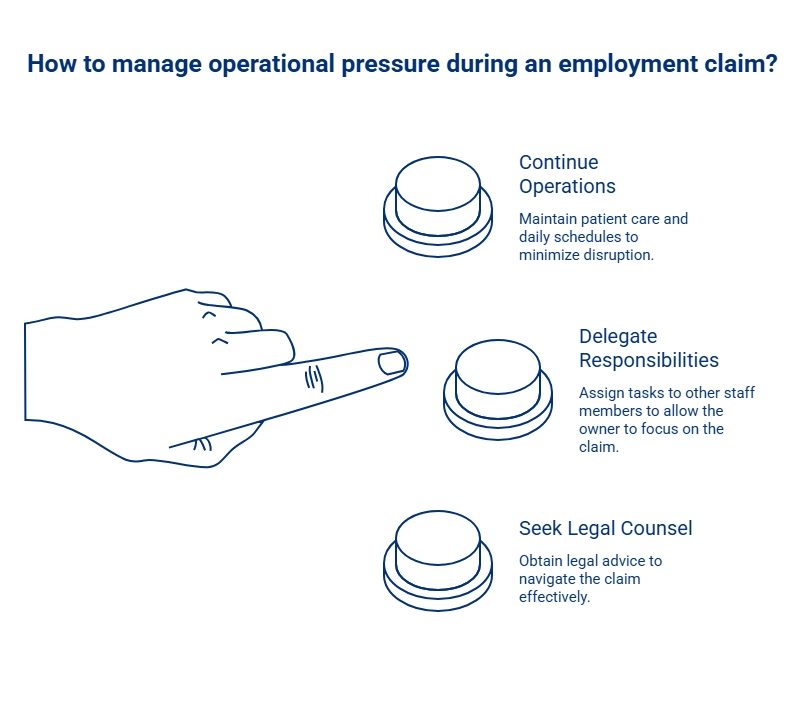
An employment claim usually does not stop a dental practice’s patient care and daily scheduling obligations. Appointments may continue. Hygienist schedules may remain active. Dental assistants may still need to support treatment rooms. Front-office staff may still handle phones, insurance verification, collections, billing questions, and patient flow.
For an owner-operated or closely held dental practice, employment litigation may place unusual pressure on the same decision-makers who manage production, staffing, and patient experience. A dentist-owner may be pulled into meetings, document review, witness issues, agency proceedings, or civil litigation while still managing clinical responsibilities. A practice administrator or office manager with ownership authority may become both an operational leader and a central witness.
That dual role can make retaliation-based wrongful termination allegations especially disruptive. The claim may affect staff morale, scheduling stability, relationships with employee witnesses, reputation, and the owner’s ability to focus on patient care.
How Routine Dental-Office Events May Be Reframed
Retaliation allegations often give ordinary workplace events new significance. A schedule change may be characterized as retaliatory. A disciplinary write-up may be described as a response to a complaint. A reduction in hours may be alleged to follow protected activity. A termination based on attendance, performance, interpersonal conflict, or staffing needs may be challenged as retaliatory.
In the dental-practice context, illustrative and non-exhaustive examples may include the following:
- An employee asserts that a complaint about meal or rest breaks preceded discipline.
- A hygienist alleges that an unpaid overtime complaint preceded termination.
- A front-office employee claims that a harassment or discrimination report preceded reduced hours.
- A billing employee contends that concerns about unlawful billing practices preceded separation.
- An employee alleges that protected medical leave, pregnancy-related issues, or reasonable accommodation discussions preceded an adverse employment action.
These examples show how claims may develop. They do not determine whether any particular allegation is valid, defensible, or supported by evidence.
Example Scenario: Documentation and Defensibility in a Dental Office
Consider an anonymized dental-office scenario. A front-office employee complains about unpaid overtime and later receives a termination notice. In one version, the practice has sparse records, shifting explanations, informal text messages, and no clear connection between the stated reason and prior performance concerns. That record may give the employee more room to argue that the termination followed protected activity and that the stated reason was pretextual.
In another version, the same termination follows contemporaneous attendance records, consistent performance documentation, uniform application of established policies, and communications showing that the decision-maker relied on documented staffing and conduct concerns. That record does not guarantee any outcome. It may, however, provide a more coherent basis for evaluating whether the employment decision was supported by a legitimate business reason.
Implementing a comprehensive, practice-specific employee handbook that clearly outlines grievance procedures and anti-retaliation policies is a critical preventive step. When staff members, from hygienists to front-desk coordinators, sign an acknowledgment of these policies, it establishes a baseline of expectations and provides the practice with a documented framework to reference during a dispute.
Why Records, Communications, and Policy Consistency May Become Central
Retaliation-based wrongful termination litigation often turns on materials created before the dispute became formal. Schedules may show staffing decisions. Payroll records may reflect hours, rates, and timing. Timekeeping data may connect wage allegations to later employment decisions. Emails and text messages may show how supervisors, managing dentists, or front-office leaders discussed the employee before and after the alleged protected activity.
The litigation record may include performance notes, disciplinary records, patient-facing complaints, leave communications, reasonable accommodation communications, manager notes, and witness testimony. Contemporaneous and consistent documentation may affect how a termination decision is evaluated. Inconsistent records, unexplained deviations from established policies, or different treatment of similarly situated employees may become significant when a plaintiff alleges pretext.
In active or threatened disputes, evidence preservation, litigation holds, attorney-client privilege, work product, and discoverable communications may become significant issues. Those issues are especially sensitive when a small practice uses informal communication channels or when owners and managers communicate directly with staff.
Why Timing, Motive, and Credibility Often Drive These Claims
Retaliation allegations frequently rely on circumstantial evidence. The plaintiff may argue that the sequence between a complaint and termination supports a retaliatory motive. The dental practice may contend that the decision arose from a legitimate business reason, including staffing, attendance, conduct, or performance concerns.
That tension makes timing important, but timing alone does not tell the entire story. Decision-maker knowledge, consistency of explanations, uniform application of established policies, treatment of similarly situated employees, contemporaneous communications, and witness credibility may affect how a judge, jury, agency, or trier of fact evaluates the dispute. For a small practice, the same people may supervise, schedule, discipline, and communicate with employees, which can make defensible employment decisions more fact intensive.
The dispute may become more complex when informal conversations become part of the litigation narrative. A quick hallway exchange, a short text message, or a frustrated email may later receive close scrutiny.
How Retaliation Allegations May Overlap with Other Claims
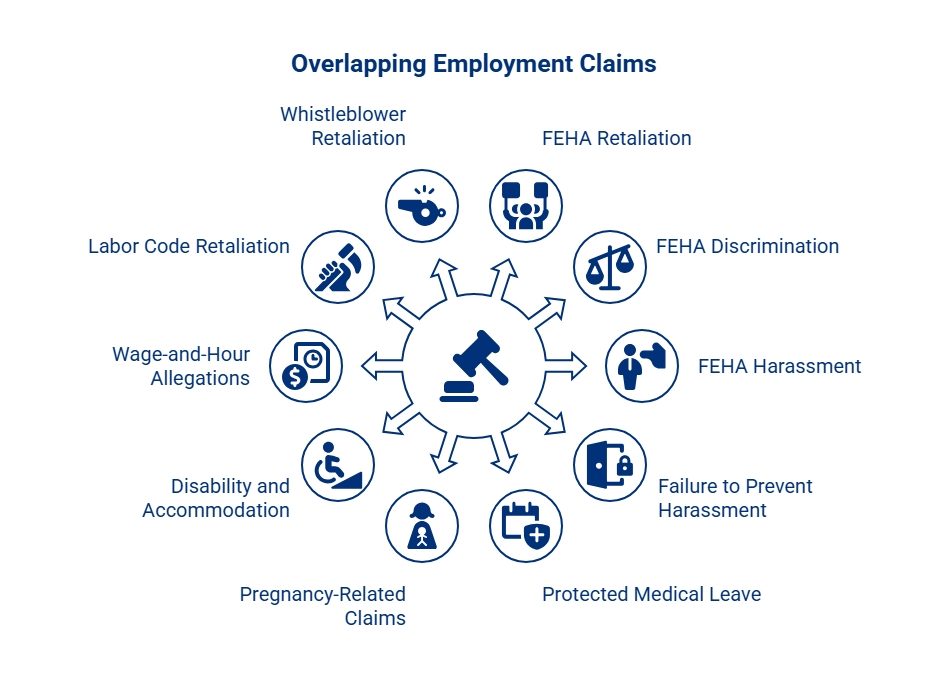
Wrongful termination and workplace retaliation allegations may be pleaded with other employment claims. Depending on the facts alleged and whether the practice meets statutory employee-count thresholds—such as five or more employees for most FEHA discrimination, retaliation, and protected leave claims, or one or more for harassment claims—a complaint may include FEHA retaliation, discrimination, harassment, failure to prevent harassment or discrimination, protected medical leave issues, pregnancy-related claims, or disability and reasonable accommodation issues (California Government Code § 12926(d)). A complaint may also include wage-and-hour allegations, meal and rest break allegations, Labor Code retaliation, or whistleblower retaliation.
For a dental employer, this layering may increase potential exposure and litigation complexity. A single termination may generate several legal theories, each tied to different facts, records, witnesses, and employment-law concepts. Where applicable, allegations involving an employee with a disability or a qualifying medical condition may also place interactive process communications and leave-related events within the dispute. Because employment laws are subject to change, current legal standards require verification through official sources or experienced employment defense counsel.
Why Focused Employment Defense Representation Can Matter
Retaliation-based wrongful termination claims often require litigation judgment, not ordinary workplace administration. The claim may involve pleadings, agency filings, discovery, electronic communications, witness testimony, motion practice, settlement pressure, and facts that affect the business. Defendants in employment litigation can also face strict response obligations. Failure to respond properly can result in serious consequences, including default judgment, sanctions, or additional procedural complications.
For small dental practices, focused employment defense representation can matter because the legal strategy must account for both the employment claims and the operational realities of a patient-facing business. Employment defense attorneys may help evaluate sensitive employment decisions in context, especially when protected activity, reasonable accommodation issues, protected leave, or prior complaints are part of the factual record.
Disclaimer:
This content is for informational purposes only. Laws, definitions, and deadlines change. Verify current requirements through official California sources. This content is not legal advice. No attorney-client relationship is formed through this content. Please consult a qualified attorney in your jurisdiction for legal advice specific to your situation.
Protect Your Business | The Akopyan Law Firm, A.P.C. | Top Gun Employment Lawyers
Have you been sued by an employee? Are you overwhelmed by the complexities of employment law? If so, give us a call. The Akopyan Law Firm, A.P.C. assists small business owners throughout Southern California. Our seasoned employment defense lawyers stand ready to help employers quickly and efficiently resolve employment disputes. We are ready to aggressively and skillfully defend against any employment case, but understand that in most situations avoiding the expense of litigation is in the client’s best interest.
Take the First Step Protecting Your Future: Call us today to speak with one of our experienced employment defense lawyers.
Contact Us Today:
- Phone: (818) 509-9975
- Office Locations in California: Los Angeles, Bakersfield, Costa Mesa, Temecula, Rancho Cucamonga, Oxnard, Culver City, and San Diego.