
📌 Key Takeaways
A wage-and-hour complaint may become central to a wrongful termination dispute when an employee alleges protected activity, causation, and retaliation.
- Timing Shapes Exposure: A termination, discipline, or reduced schedule may draw scrutiny when it follows a wage-and-hour complaint.
- Records Drive Credibility: Payroll records, timekeeping data, manager communications, and performance documentation may shape how the dispute is evaluated.
- Small Teams Face Pressure: Family-owned businesses may face added scrutiny when the same owner or manager handles payroll, scheduling, discipline, and termination decisions.
- Claims Can Expand: A termination dispute may grow into overlapping wage-and-hour, retaliation, wrongful termination, and public policy allegations.
- Defense Requires Context: Defensible employment decisions often depend on consistent documentation, uniform policy application, legitimate business reasons, and fact-specific legal analysis.
Clear records, consistent decisions, and careful legal framing may matter when wage complaints and termination decisions overlap.
A wage-and-hour complaint may become legally significant when a California employee later alleges that the complaint was protected activity and that termination, discipline, or reduced hours, followed because of it. The employer may have had a legitimate, nondiscriminatory reason for the employment decision. The employee’s lawsuit may still allege a causal connection between the wage-and-hour complaint and the later decision.
For family-owned businesses, these disputes often carry operational and personal pressure because ownership, supervision, payroll, and scheduling decisions may overlap. Owners may know the employee directly. A relative may supervise the schedule. The same manager may handle payroll questions, discipline, and staffing coverage. Those facts do not establish liability by themselves, but they can create a more complicated record when an employee alleges wrongful termination or retaliation.
Under California law, generally, employees may assert statutory protections when they complain about unpaid wages or exercise certain Labor Code rights. California Labor Code section 98.6 addresses retaliation connected to wage-related complaints and other protected activity. California Labor Code section 1102.5 may also appear in some disputes when an employee alleges that the complaint involved disclosure of suspected legal violations. Specifically, Section 98.6 prohibits employers from discharging or discriminating against an employee for filing a claim with the Labor Commissioner, while Section 1102.5 protects employees who report suspected state or federal legal violations to a government agency or a supervisor. These references are general only, and the application of any statute depends on the facts, claims, and governing law at the time of the dispute.
Why Wage-and-Hour Complaints May Affect Retaliation Allegations
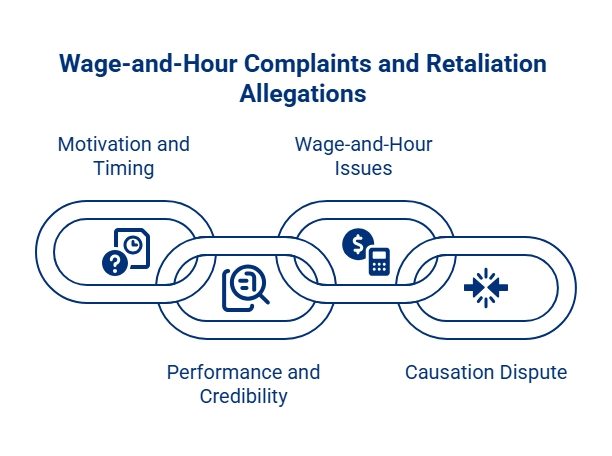
A wrongful termination lawsuit rarely examines the termination decision in isolation. The plaintiff may challenge the employer’s motivation, the timing of the decision, the consistency of performance records, and the credibility of the stated business reason. When a wage-and-hour complaint came first, the employee may argue that the later termination was not merely a personnel decision but retaliation for raising wage-related concerns.
A wage-and-hour complaint may involve issues including, but not limited to, unpaid overtime, missed meal periods, missed rest breaks, minimum wage allegations, off-the-clock work, inaccurate time records, or payroll deductions. In a later termination dispute, those issues may overlap with wrongful termination defense and wage and hour defense. The same witnesses, records, and business explanations may become relevant to both sets of allegations.
Employees may assert statutory rights under wage-and-hour and retaliation laws. Employers may dispute the factual basis, legal theory, or claimed connection between the complaint and the employment decision. That tension often shapes the causation dispute.
Why Family-Owned Small Businesses Face Distinct Pressure
A family-owned business with a small workforce often has limited separation between ownership, supervision, payroll, and scheduling. The owner may approve time records, respond to staffing problems, review performance concerns, and participate in termination decisions. That structure may support efficient operations, but it may also place owners and managers at the center of litigation.
In a larger organization, a wage-and-hour complaint may pass through several departments. In a smaller owner-operated business, the same person may receive the complaint and later make or influence the employment decision. A plaintiff may use that overlap to argue that knowledge of the complaint affected the outcome.
The practical impact may extend beyond the pleaded legal claims. A dispute may strain cash flow, consume management attention, affect employee morale, and create concern about local reputation. For a business built around family relationships, loyal staff, and recurring customers, employment litigation can disrupt more than paperwork.
Why Timing, Records, and Credibility Often Matter
Timing often shapes retaliation allegations. The employee may claim that discipline, reduced hours, or termination occurred close enough to the wage-and-hour complaint to suggest a retaliatory motive. The employer may contend that a legitimate, nondiscriminatory reason explains the decision, such as performance concerns, attendance problems, misconduct, restructuring, or operational needs.
In California, timing is codified as a metric of proof. Under California Labor Code Section 98.6, if an adverse employment action such as termination or shift reduction occurs within 90 days of an employee engaging in protected activity, a rebuttable presumption of retaliation is automatically created. This shifts the initial evidentiary burden to the employer to prove a legitimate, non-retaliatory reason for the decision.
In these disputes, the causation issue often turns on whether the wage-and-hour complaint and the later employment decision appear connected by timing, communications, inconsistent documentation, or deviations from ordinary practice. The parties may dispute the meaning of records such as:
- Payroll records that reflect hours worked, rates of pay, overtime, deductions, or wage adjustments.
- Timekeeping records that reflect clock-in times, meal periods, rest periods, edits, or missed punches.
- Text messages and emails that reflect how managers discussed complaints, staffing, schedules, or discipline.
- Performance records that reflect whether concerns existed before the wage-and-hour complaint.
- Scheduling records that reflect whether reduced hours followed the employee’s complaint.
Consistent, real-time documentation may become important because it can show whether performance concerns, attendance issues, scheduling decisions, or disciplinary steps were recorded before the wage-and-hour complaint and whether similar issues were handled uniformly. No single record necessarily proves or defeats a claim. The trier of fact may be asked to evaluate chronology, consistency, credibility, and the relationship between the wage-and-hour complaint and the later employment decision.
Illustrative Example: Pay Complaint Followed by Reduced Hours and Termination
A family-owned restaurant receives a verbal complaint from a server who claims that overtime and meal periods were not handled correctly. After the complaint, the general manager reduces the server’s shifts, citing customer complaints and attendance concerns. The business later terminates the employee after another scheduling dispute. The employee then asserts unpaid wage, retaliation, and wrongful termination claims.
This example does not establish fault, liability, or a defense. It illustrates how an employee may characterize a wage-and-hour complaint as protected activity and argue that later scheduling or termination decisions were connected to that complaint. The employer may dispute that connection by pointing to legitimate, nondiscriminatory reasons, but timing, consistent documentation, uniform policy application, and treatment of similarly situated employees may still become central issues.
How Wage-and-Hour Issues May Increase Business Exposure
Wage-and-hour allegations can change the economics of a termination dispute. A wrongful termination claim may seek lost wages, emotional distress damages, attorney’s fees, and other remedies depending on the causes of action asserted. Wage-and-hour allegations may add claims for unpaid wages, penalties, interest, attorney’s fees, and scrutiny across multiple pay periods.
Claims involving overtime compensation, meal and rest breaks, or minimum wage compliance may also expand the factual scope of the case. A single employee’s allegations may raise questions about broader payroll practices, even when the employer disputes the allegations.
For small businesses, the disruption may be substantial. Owners may lose time as payroll records, scheduling decisions, management communications, and witness accounts become part of the litigation process. The business must continue serving customers and managing employees while the legal dispute develops.
When a Termination Claim Expands into Wage-and-Hour and Retaliation Allegations
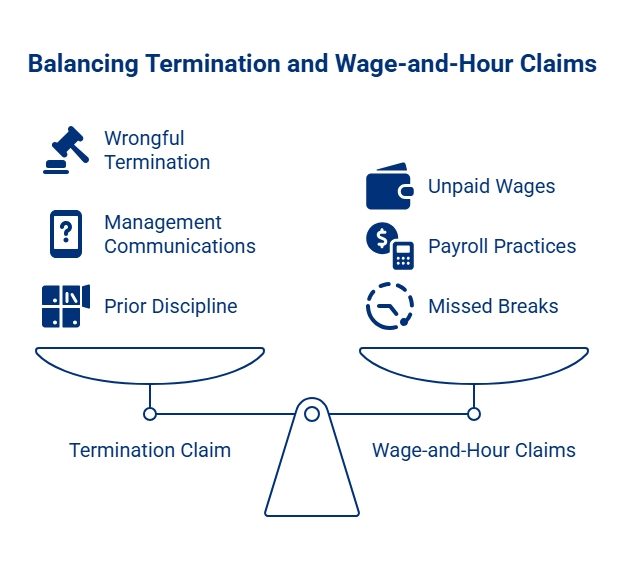
A wage-related termination lawsuit may include several overlapping theories. The complaint may assert wrongful termination in violation of public policy, Labor Code retaliation, unpaid wages, missed breaks, inaccurate wage statements, waiting time penalties, or related claims. Some disputes may also include broader unlawful retaliation claims depending on what the employee alleges.
This layering matters because each theory may place a different part of the business in dispute. The parties may contest payroll practices, management communications, scheduling decisions, prior discipline, and the treatment of similarly situated employees. The termination decision may be examined for consistency with prior records and the employer’s stated legitimate, nondiscriminatory reason.
Why Employment Litigation Experience Matters
Wage-related termination disputes often require fact-specific legal analysis. The potential exposure rarely sits in one document. It usually turns on the relationship between documents, witnesses, timing, business context, and the employer’s stated legitimate business reason.
These disputes are different from routine payroll administration or general workplace compliance. A lawsuit, demand letter, agency complaint, or asserted claim may involve active legal exposure, disputed facts, and litigation risk. When a wage-and-hour complaint overlaps with discipline, reduced hours, or termination, early involvement of an employment defense attorney may help frame the dispute around defensible decision-making, consistent policy application, and the specific facts in the record.
Akopyan Law Firm, A.P.C. represents California employers in employment disputes involving wrongful termination, wage-and-hour claims, retaliation allegations, and related litigation. The firm’s employer-defense practice focuses on helping small businesses address employment claims with attention to legal exposure, business disruption, and the realities of closely held operations.
Disclaimer:
This content is for informational purposes only. Laws, definitions, and deadlines change. Verify current requirements through official California sources. This content is not legal advice. No attorney-client relationship is formed through this content. Please consult a qualified attorney in your jurisdiction for legal advice specific to your situation.
Protect Your Business | The Akopyan Law Firm, A.P.C. | Top Gun Employment Lawyers
Have you been sued by an employee? Are you overwhelmed by the complexities of employment law? If so, give us a call. The Akopyan Law Firm, A.P.C. assists small business owners throughout Southern California. Our seasoned employment defense lawyers stand ready to help employers quickly and efficiently resolve employment disputes. We are ready to aggressively and skillfully defend against any employment case, but understand that in most situations avoiding the expense of litigation is in the client’s best interest.
Take the First Step Protecting Your Future: Call us today to speak with one of our experienced employment defense lawyers.
Contact Us Today:
- Phone: (818) 509-9975
- Office Locations in California: Los Angeles, Bakersfield, Costa Mesa, Temecula, Rancho Cucamonga, Oxnard, Culver City, and San Diego.