

A discrimination allegation can expand scrutiny beyond a termination to earlier discipline, comparative treatment, management communications, existing records, and decision-maker credibility.
- Scrutiny Extends Beyond Termination: Earlier discipline, management communications, comparative treatment, and decision-maker credibility may all become part of the factual dispute.
- Consistency Shapes Credibility: Existing contemporaneous records may support the employer’s stated reason, while materially conflicting explanations may intensify disputes about motive and pretext.
- Comparisons Require Context: Different outcomes for similarly situated employees may draw scrutiny, but surrounding conduct, responsibilities, managers, and employment histories can affect the comparison.
- Decisionmakers Affect Exposure: An owner’s, manager’s, or supervisor’s conduct may shape organizational exposure when the parties dispute authority, remarks, communications, or motive.
- Disputes Disrupt Operations: Active employment disputes may divert management attention, involve employee witnesses, create staff uncertainty, pressure cash flow, and interrupt normal store operations.
For small California retailers without in-house counsel, the discussion ahead centers on how records, participants, and operations intersect while allegations remain contested.
Consistent facts and credible accounts define the dispute’s practical shape.
~ ~ ~ ~ ~ ~ ~ ~ ~ ~ ~ ~ ~ ~ ~ ~ ~ ~
A discrimination allegation can expand scrutiny beyond a termination decision to earlier discipline, the treatment of similarly situated employees, management communications, and decision-maker credibility. Potential exposure arises when an employee alleges that a protected characteristic influenced discipline, termination, or another employment decision.
The California Fair Employment and Housing Act (FEHA) prohibits unlawful employment discrimination based on protected characteristics. An allegation does not, by itself, establish discriminatory motive or liability. The employer and employee may present different accounts, and the surrounding factual record may support, undermine, or complicate those accounts.
Under the California Fair Employment and Housing Act (Gov. Code § 12940 et seq.), anti-discrimination provisions apply to employers who regularly employ five or more individuals. When a former employee files a complaint with the California Civil Rights Department (CRD) or pursues a civil lawsuit after obtaining a Right-to-Sue notice, California courts generally evaluate circumstantial discrimination claims using a three-stage burden-shifting framework. First, the employee must establish an initial (prima facie) case linking the adverse action to a protected characteristic. Second, the employer may rebut that presumption by articulating a legitimate, nondiscriminatory business reason for the termination—such as documented attendance violations or policy breaches. Third, the burden shifts back to the employee to demonstrate that the retailer’s stated reason is pretextual and that discrimination was a substantial motivating factor in the decision.
A Discrimination Allegation Can Expand the Factual Dispute
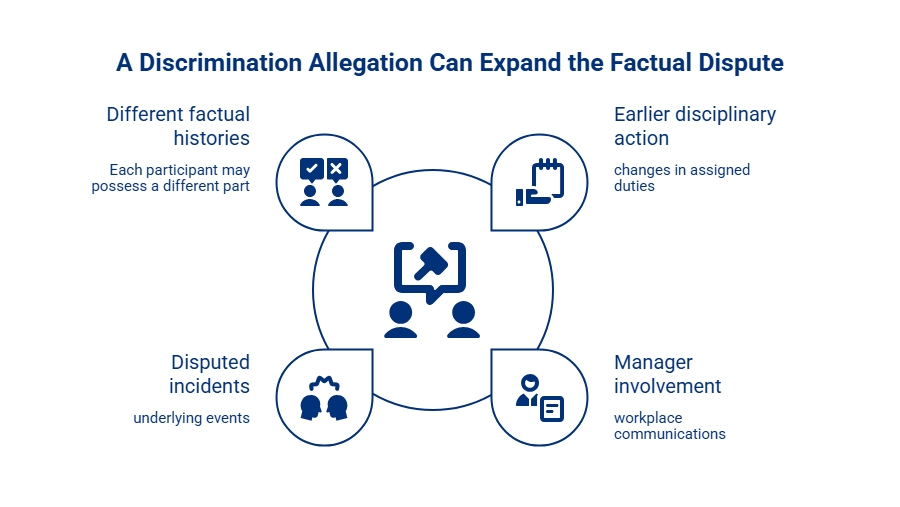
A retailer may terminate an employee after attendance problems, performance concerns, customer interactions, scheduling conflicts, or alleged workplace misconduct. The former employee may later contend that the stated concern did not genuinely motivate the decision and that a protected characteristic influenced the outcome.
That contention can bring earlier disciplinary action, changes in assigned duties, manager involvement, workplace communications, and disputed incidents into the matter. The conflict may therefore concern how the employment decision developed, not only the separation itself.
This broader focus can carry particular significance for a small retailer. An owner may approve the termination, a store manager may recommend it, and a shift lead may have observed the underlying events. Each participant may possess a different part of the factual history.
Inconsistent Management Accounts Can Create Credibility Questions
Small retail businesses often rely on direct conversations, text messages, and shared management responsibilities. Those ordinary communication patterns are not inherently improper. They can nevertheless produce factual disputes when managers recall the same event differently.
An employee may challenge management credibility when the explanation for discipline changes across communications. Informal messages may provide context that differs from a later formal account. Managers may also disagree about who made the decision or which incident carried the greatest weight.
A claimant may characterize a material inconsistency as evidence that the employer’s stated reason was pretextual. The employer may dispute that characterization and identify a legitimate, nondiscriminatory reason for the decision. Existing contemporaneous records that consistently reflect the stated reason may support the employer’s account, while conflicting explanations may intensify the credibility dispute. Neither circumstance automatically determines the outcome.
Treatment of Similarly Situated Employees May Become Contested
An employee alleging discrimination may contend that another employee received different discipline for similar conduct. That contention can place other store-level employment decisions under scrutiny.
Different disciplinary outcomes do not independently establish why the outcomes differed. The incidents may have involved different conduct, employment histories, responsibilities, managers, or surrounding circumstances. The parties may also disagree about whether the employees were similarly situated.
The significance of the comparison depends on the complete facts. A difference in treatment may provide context, but that difference alone does not establish discriminatory motives or disprove the employer’s explanation.
Individual Decisionmakers Can Affect Organizational Exposure
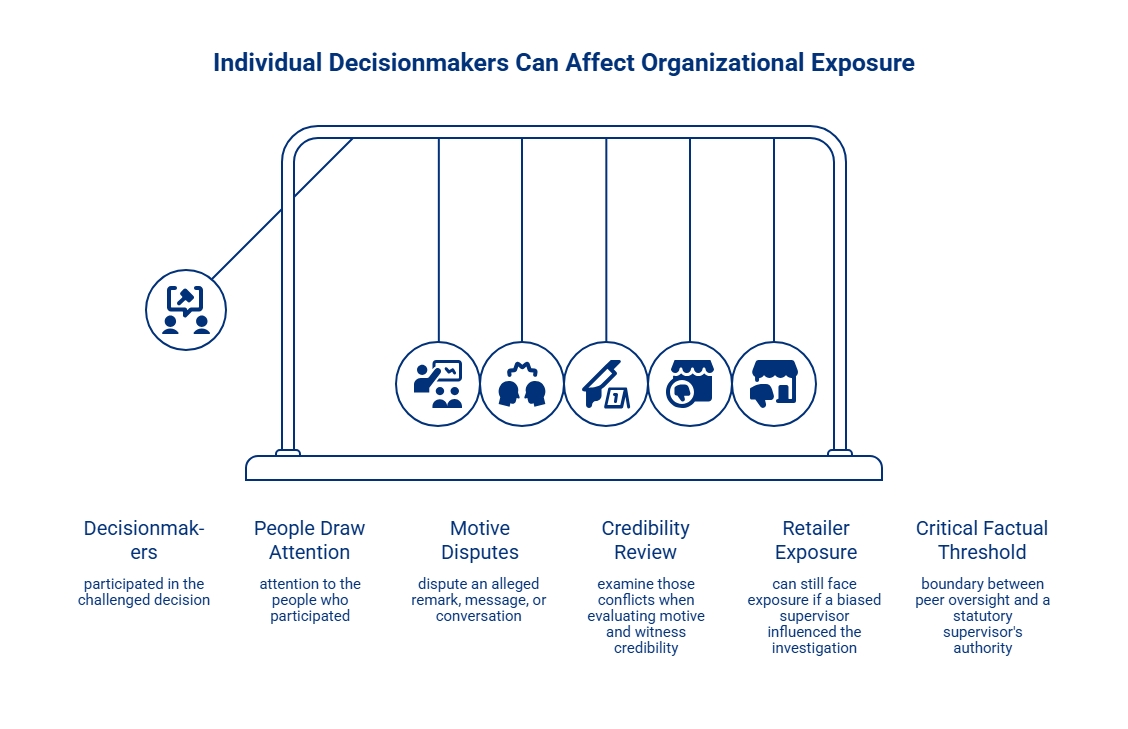
A discrimination-related termination claim may draw attention to the people who participated in the challenged decision. The employee may question whether the owner retained authority, whether the store manager exercised delegated discretion, or whether several managers contributed to the outcome.
The employee may attribute discriminatory motives to a particular supervisor rather than to the business generally. The parties may also dispute an alleged remark, message, or conversation involving that person. A judge, jury, or agency decisionmaker may examine those conflicts when evaluating motive and witness credibility, but the allegation itself does not establish which account is accurate.
In California employment litigation, this dynamic is frequently examined through the “cat’s paw” theory of liability. Under this principle, even if the store owner who signed the final termination paperwork harbored no discriminatory animus, the retailer can still face exposure if a biased supervisor or store manager influenced, initiated, or slanted the investigation that led to the firing. Furthermore, under FEHA, employers face strict liability for unlawful harassment committed by an employee’s supervisor, making the precise boundary between a shift lead’s peer oversight and a statutory supervisor’s authority—such as the power to hire, fire, discipline, or direct daily store work—a critical factual threshold.
Existing Records and Communications May Supply Context
Existing disciplinary records, schedules, timekeeping information, manager notes, customer complaints, performance materials, emails, and text messages may become relevant when they relate to the challenged decision.
No single record automatically proves or disproves discrimination. A customer complaint may explain why management examined an employee’s conduct, but the parties may dispute its significance. A schedule may establish when an event occurred without resolving why management later acted. A message may appear significant in isolation while carrying a different meaning within the complete exchange.
Illustrative Example: Conflicting Accounts of Retail Discipline
A small California retailer disciplines a sales associate after several disputed store-level incidents. The employee later alleges that the disciplinary action and resulting termination were discriminatory. The store manager identifies one incident as the primary reason for the decision, while the owner recalls that another incident carried greater weight. Existing workplace communications provide additional context but do not resolve every disagreement.
The dispute may encompass the reasons for the decision, the roles of the participants, the consistency of their accounts, and the surrounding circumstances. The differing recollections may create credibility questions, but they do not independently establish discrimination or defense. Their significance depends on the complete factual record and applicable law.
An Employment Dispute Can Affect Store Operations
A serious employment dispute can demand substantial attention from a retailer without an internal legal department. Owners and managers may divide their time between the dispute and ordinary responsibilities involving staffing, inventory, payroll, customer service, and sales.
Employees may become witnesses, and the parties may contest management credibility. Staff uncertainty may affect work on the sales floor or in the stockroom. Legal expenses may also place pressure on cash flow. These operational consequences can become significant even while liability remains unresolved.
Discrimination and Wrongful-Termination Allegations May Overlap
The same employment separation may support several disputed allegations. A former employee may claim that discriminatory treatment affected the termination while also challenging the lawfulness of the termination itself.
In practice, plaintiffs’ attorneys frequently pair statutory FEHA discrimination claims with a common-law cause of action for wrongful termination in violation of public policy—often referred to in California as a Tameny claim—as well as separate claims for unlawful retaliation under Government Code § 12940(h) or Labor Code § 1102.5. While a discrimination claim focuses on whether a protected trait motivated the firing, a retaliation claim examines whether the retailer terminated the employee for complaining about suspected bias or requesting a protected accommodation. Because a retaliation claim can succeed even if the underlying discrimination allegation is ultimately unproven, defense counsel must evaluate both the substantive reason for the discharge and the chronological timeline between any internal employee complaints and the disciplinary action.
Employer-side counsel may evaluate the allegations, the decisionmakers’ roles, the competing accounts, and the potential exposure presented by the dispute. No factual pattern guarantees dismissal, settlement, reduced liability, or another result. For more information, se wrongful termination defense and employment law for employers.
Disclaimer:
This content is for informational purposes only. Laws, definitions, and deadlines change. Verify current requirements through official California sources. This content is not legal advice. No attorney-client relationship is formed through this content. Please consult a qualified attorney in your jurisdiction for legal advice specific to your situation.
Protect Your Business | The Akopyan Law Firm, A.P.C. | Top Gun Employment Defense Lawyers
Have you been sued by an employee? Are you overwhelmed by the complexities of employment law? If so, give us a call. The Akopyan Law Firm, A.P.C. assists small business owners throughout Southern California. Our seasoned employment defense lawyers stand ready to help employers quickly and efficiently resolve employment disputes. We are ready to aggressively and skillfully defend against any employment case, but understand that in most situations avoiding the expense of litigation is in the client’s best interest.
Take the First Step Protecting Your Future: Call us today to speak with one of our experienced employment lawyers.
Contact Us Today:
- Phone: (818) 509-9975
- Office Locations in California: Los Angeles, Bakersfield, Costa Mesa, Temecula, Rancho Cucamonga, Oxnard, Culver City, and San Diego.