
📌 Key Takeaways
Direct owner involvement can turn a dental practice termination decision into a broader California employment litigation dispute.
- Owner Decisions Matter: A dentist-owner’s communications, timing, documentation, and stated legitimate, nondiscriminatory reason may become central to termination-related claims.
- Timing Establishes Presumption: Under California’s SB 497, an adverse action taken within 90 days of protected activity triggers a statutory rebuttable presumption of retaliation, automatically shifting the initial burden of proof to the employer.
- Informal Records Count: Text messages, chairside comments, scheduling records, and payroll entries may shape the litigation narrative in small dental practices.
- Related Claims Expand: Wrongful termination allegations may overlap with retaliation, FEHA claims, whistleblower issues, leave-related allegations, accommodation disputes, or wage-and-hour concerns.
- Business Disruption Grows: Employment litigation may strain patient schedules, staff coverage, billing workflows, morale, cash flow, and management credibility.
Direct decisions create direct scrutiny.
Dental practice owners facing termination-related employment disputes will gain a clearer litigation-risk framework, guiding them into the California dental-practice-specific details that follow.
~ ~ ~ ~ ~ ~ ~ ~ ~ ~ ~ ~ ~ ~ ~ ~ ~ ~
When a dental practice owner personally makes, approves, or explains a termination decision, that owner’s role can become central to potential wrongful termination exposure. In California employment litigation, the owner’s communications, timing, contemporaneous documentation, stated legitimate, nondiscriminatory reason, and credibility may all be examined after a former employee files a lawsuit, sends a demand letter, or initiates an agency complaint.
For a small dental practice, the pressure is rarely limited to legal disputes. Patient schedules still need attention. Dental assistant and hygienist coverage still affect production. Front-office workflows, billing systems, payroll records, employee morale, and patient trust may all come under strain while the dispute develops.
Why Owner-Operated Dental Practices Face Distinct Wrongful Termination Risks
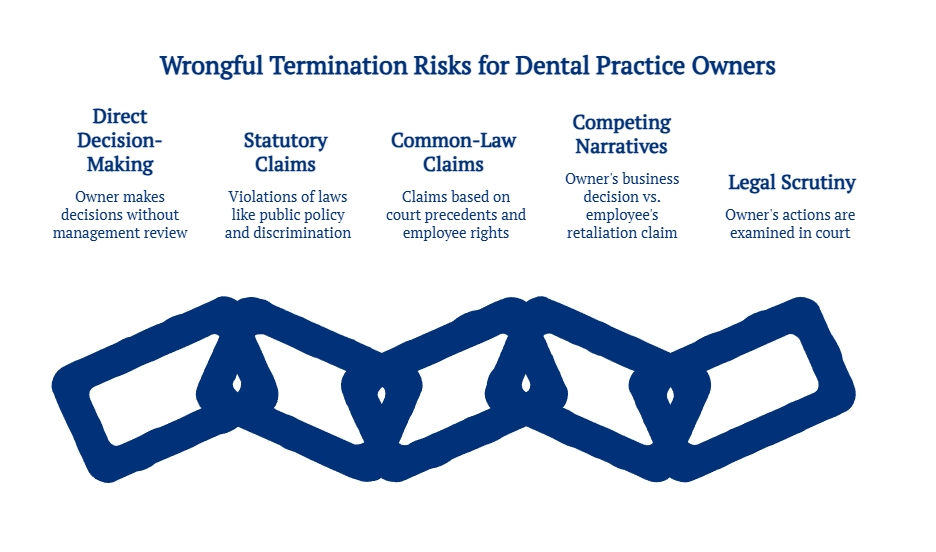
Small dental practices often operate without multiple layers of management review. A dentist-owner may supervise employees, approve schedules, address patient-care issues, respond to staff complaints, and make termination decisions directly. The dental practice acts as the employer, but the dentist-owner’s individual conduct may become important because that owner often serves as the principal decision-maker.
Under California law, generally, wrongful termination claims may involve overlapping statutory and common-law theories. A former employee may allege that a termination violated public policy, followed protected activity, involved protected status, or occurred after a medical leave, disability-related request, wage complaint, harassment complaint, or other legally significant workplace event.
The legal significance of those allegations depends on the facts, the size and structure of the dental practice, the employee’s claims, and the laws that apply. A practice owner may view the termination as a legitimate business decision. The plaintiff may frame the same decision as retaliation, discrimination, constructive discharge, or evidence of pretext. Litigation often places those competing narratives before a judge, jury, or other trier of fact.
How Direct Employment Decisions Become Evidence in Litigation
Direct owner involvement may make the dentist-owner’s reasoning and communications part of the evidentiary record. A plaintiff may argue that the practice’s stated legitimate, nondiscriminatory reason for termination does not align with earlier messages, schedules, disciplinary notes, payroll records, or the treatment of similarly situated employees.
In litigation, the plaintiff may challenge payroll entries, scheduling records, emails, text messages, paper notes, employee complaints, leave communications, and disciplinary records as part of a broader argument about timing, motive, consistency, or pretext. These materials are not usually examined in isolation. They may become part of a larger narrative about whether the employment decision was consistent with prior communications, established policies, and the practice’s treatment of other employees.
That scrutiny can feel personal for dentist-owners because the same person who made the employment decision may also have managed chairside priorities, treatment-room flow, patient expectations, and staffing coverage. A brief chairside conversation, a short text message, or a quick staff-meeting comment may later become significant if the former employee argues that it conflicts with the practice’s later explanation for the termination.
Protected Activity and Timing Issues in Dental Practice Termination Claims
Termination decisions face intense statutory scrutiny when they follow workplace activity characterized as legally protected. Under California’s Equal Pay and Anti-Retaliation Act (SB 497), any adverse employment action taken within 90 days of an employee exercising protected rights under specific Labor Code provisions triggers a formal rebuttable presumption of retaliation (Cal. Lab. Code §§ 98.6, 1102.5, 1197.5). Rather than requiring the former employee to independently establish a causal connection at the outset, this statutory 90-day window legally presumes a retaliatory motive, shifting the initial procedural burden to the dental practice to demonstrate a legitimate, non-retaliatory justification for the termination.
A complaint may claim that the employee raised wage concerns, reported harassment, requested pregnancy-related leave, discussed disability-related restrictions, or raised patient-safety or regulatory concerns. California termination disputes may include retaliation allegations, Fair Employment and Housing Act allegations, whistleblower retaliation, leave-related allegations, disability discrimination claims, or wage-and-hour allegations.
When disability-related communications precede the termination, the former employee may allege that the practice failed to engage in the interactive process or failed to provide reasonable accommodation. When wage complaints are alleged, the dispute may expand into timekeeping, overtime, meal and rest period, or payroll practices. None of these allegations establishes liability by itself. They may, however, broaden the dispute and make credibility, consistency, and contemporaneous records more significant.
Why Informal Management Practices Can Be Scrutinized After a Termination
Owner-operated dental practices often communicate quickly because the workday is built around patients, procedures, emergencies, and coverage needs. A supervising dentist may address a dental assistant between appointments. A practice administrator may resolve staffing coverage by text. An office manager may discuss attendance, billing responsibilities, or front-desk conduct during a busy patient day.
After a termination is challenged, those informal communications can become part of the litigation narrative. The former employee may assert that informal communications show shifting explanations, inconsistent treatment, hostility, or a connection between the termination and protected workplace activity. The dental practice owner may view the same communications as ordinary practice management.
Small-team dynamics can also affect the case. Dental assistants, hygienists, treatment coordinators, billing employees, and front-office staff often work in close proximity. Current employees may become witnesses because they observed interactions, heard explanations, or participated in scheduling and workflow decisions. In a closely held dental business with limited HR support, workplace memory and management credibility may carry substantial weight.
Common Claims That May Accompany Wrongful Termination Allegations
A termination-related dispute may include several related allegations, including but not limited to:
- A former employee may allege retaliation after a leave request, wage concern, reasonable accommodation discussion, or workplace report.
- A complaint may assert FEHA-related discrimination, harassment, retaliation, failure to prevent harassment or discrimination, or disability-related allegations.
- A plaintiff may characterize a resignation as constructive discharge if the employee claims the working conditions effectively forced the resignation.
- A dispute may involve reasonable accommodation or interactive process allegations when disability-related communications preceded the termination.
- A termination claim may include wage-and-hour allegations involving overtime, meal and rest breaks, off-the-clock work, minimum wage issues, or payroll practices.
These related claims can expand the factual scope of the case. The dispute may move beyond the final termination decision and into prior complaints, scheduling patterns, discipline, leave records, accommodation communications, payroll practices, supervisor conduct, uniform application of established policies, and comparative treatment of other employees.
The Business Disruption Created by Wrongful Termination Litigation
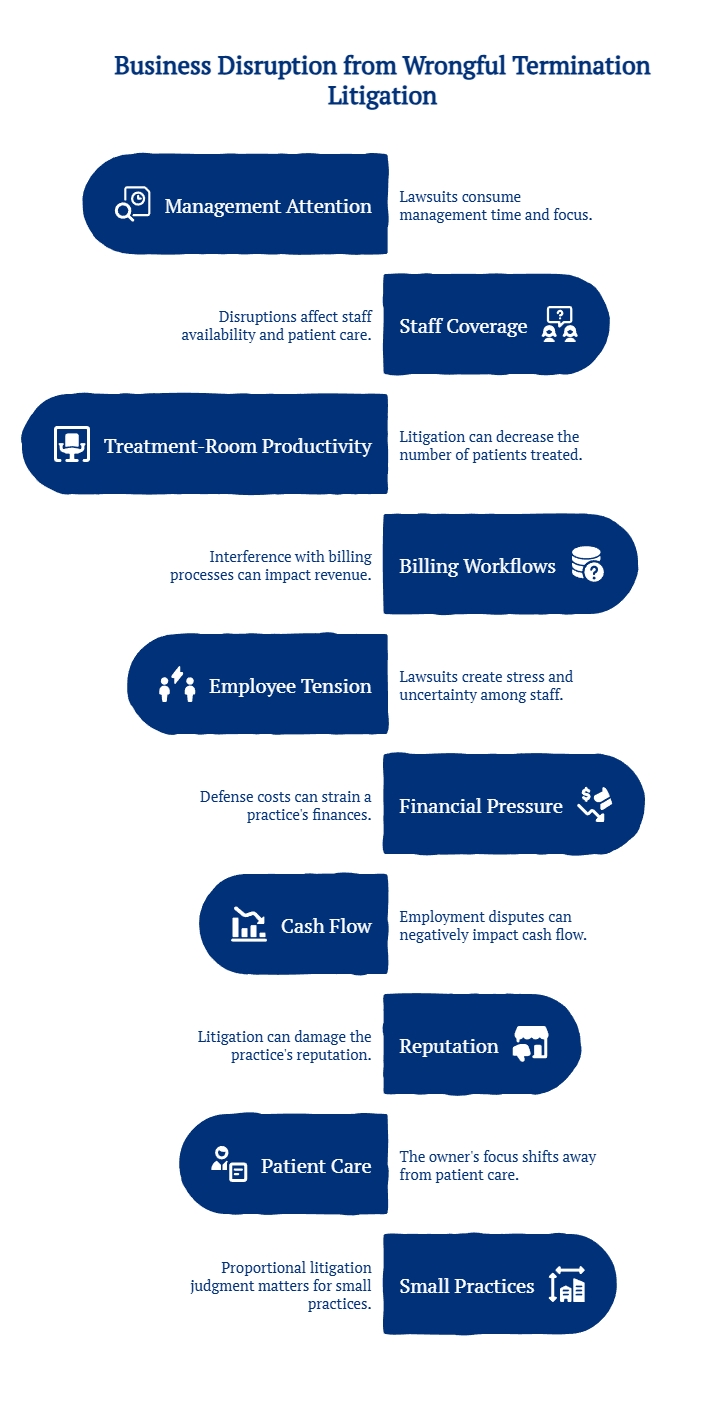
Employment litigation can affect a dental practice beyond the legal pleadings. A lawsuit may consume management attention, disrupt staff coverage, affect treatment-room productivity, interfere with billing workflows, and create tension among current employees. The owner may need to continue leading the practice while also dealing with allegations that challenge management judgment and credibility.
For a self-funded dental practice or a practice with limited insurance support, the cost of defense may create additional pressure. One employment dispute may affect cash flow, morale, reputation, and the owner’s ability to stay focused on patient care. For small practices, proportional litigation judgment matters because the defense itself can affect time, resources, and operations.
Why Litigation-Focused Employer Defense Attorney Matters in Dental Practice Termination Claims
Wrongful termination litigation involving dental practice requires judgment grounded in California employment law, litigation procedure, small-business realities, and the operational structure of dental offices. In litigation, defensible decision-making is often evaluated through consistency, timing, contemporaneous documentation, uniform treatment of similarly situated employees, and the credibility of the stated legitimate, nondiscriminatory reason.
Because the legal significance of a termination dispute depends on the allegations, the record, and the procedural posture, active employment claims generally require attorneys experienced in employment litigation.
Employer-Side Representation for Dental Practices Facing Termination-Related Claims
Akopyan Law Firm, A.P.C. provides employer-side employment litigation representation for Southern California dental practices facing wrongful termination lawsuits, demand letters, agency complaints, retaliation claims, discrimination allegations, whistleblower issues, leave-related claims, accommodation disputes, constructive discharge allegations, and wage-and-hour concerns.
Dental practice owners, dentist-owners, managing dentists, practice administrators, and closely held dental employers facing active termination-related disputes may contact Akopyan Law Firm, A.P.C. to discuss employment litigation representation.
Disclaimer:
This content is for informational purposes only. Laws, definitions, and deadlines change. Verify current requirements through official California sources. This content is not legal advice. No attorney-client relationship is formed through this content. Please consult a qualified attorney in your jurisdiction for legal advice specific to your situation.
Protect Your Business | The Akopyan Law Firm, A.P.C. | Top Gun Employment Lawyers
Have you been sued by an employee? Are you overwhelmed by the complexities of employment law? If so, give us a call. The Akopyan Law Firm, A.P.C. assists small business owners throughout Southern California. Our seasoned employment defense lawyers stand ready to help employers quickly and efficiently resolve employment disputes. We are ready to aggressively and skillfully defend against any employment case, but understand that in most situations avoiding the expense of litigation is in the client’s best interest.
Take the First Step Protecting Your Future: Call us today to speak with one of our experienced employment defense lawyers.
Contact Us Today:
- Phone: (818) 509-9975
- Office Locations in California: Los Angeles, Bakersfield, Costa Mesa, Temecula, Rancho Cucamonga, Oxnard, Culver City, and San Diego.