
One disputed termination may bring years of related employment decisions, communications, and operational circumstances into a Los Angeles retailer’s wrongful termination claim.
For small Los Angeles retail owners facing an active claim, these points explain why the dispute may extend beyond the final termination decision.
- Connections Define Relevance: Earlier decisions may become significant when the allegations connect scheduling, performance, discipline, or employee complaints to the termination.
- Allegations Are Not Findings: Scrutiny of an earlier employment decision does not establish pretext, unlawful intent, employer fault, or legal liability.
- Communications Add Complexity: Emails, text messages, management notes, and differing recollections may complicate disputes over the employer’s stated reason for termination.
- Consistency May Face Scrutiny: A former employee may challenge material differences among earlier decisions, management communications, and the explanation given for the termination.
- Retail Operations Still Continue: Owners and managers may face litigation demands while maintaining customer service, staffing, inventory, and the business’s financial responsibilities.
A single termination may create a much broader factual dispute when earlier employment events connect to the claim.
~ ~ ~ ~ ~ ~ ~ ~ ~ ~ ~ ~ ~ ~ ~ ~ ~ ~
A wrongful termination claim may concern one termination, but the dispute can reach earlier decisions connected to it. For a small Los Angeles retailer, the relevant history may include scheduling changes, performance assessments, disciplinary actions, employee complaints, and management communications.
A former employee may allege that earlier events reveal a causal connection between the termination and a legally protected status or activity. The employer may dispute that connection and rely on a different explanation for the termination. Neither allegation nor scrutiny establishes liability. The claims, facts, applicable law, and type of proceeding determine the significance of the earlier events.
Why a Wrongful Termination Dispute May Extend Beyond the Final Employment Decision
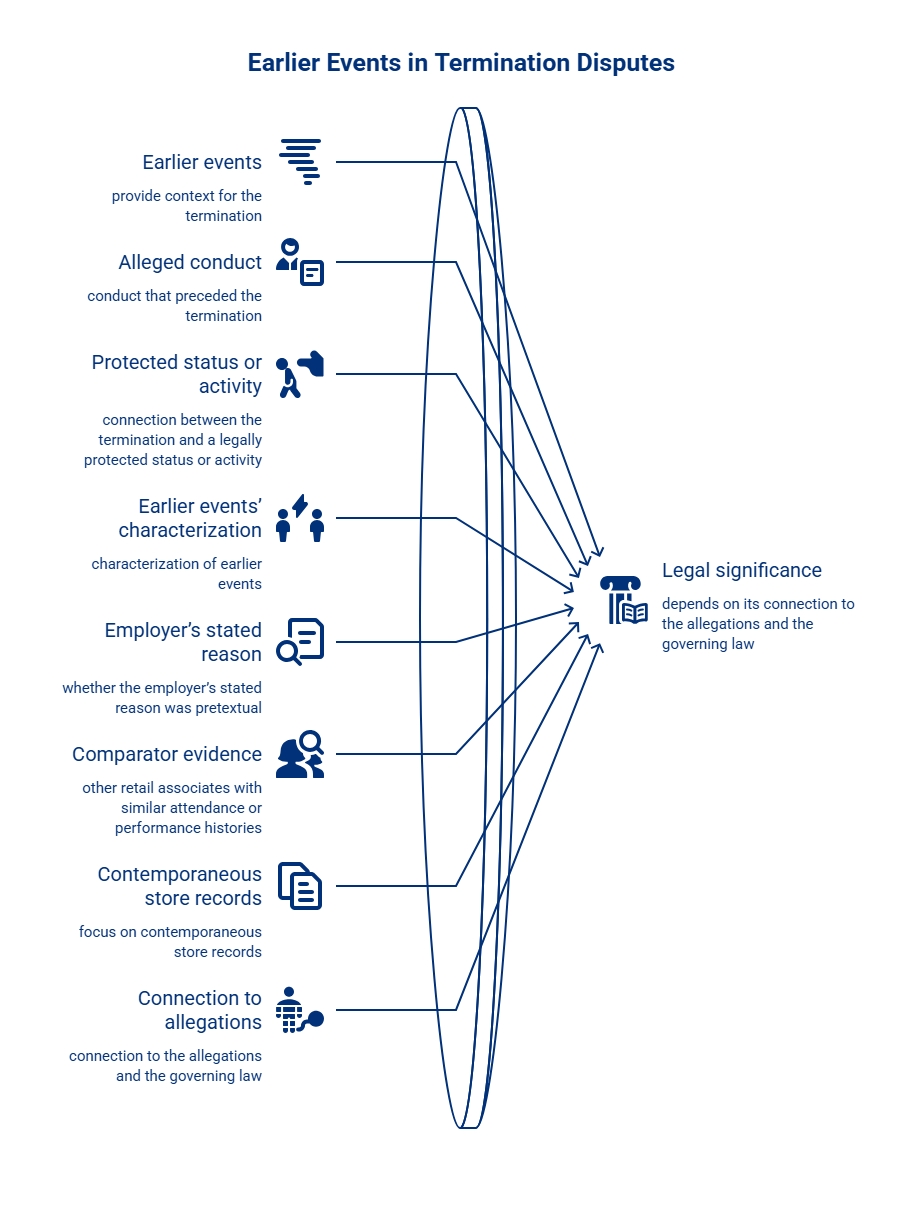
The termination ends the employment relationship, but it may represent only one part of the factual dispute. A former employee may contend that earlier events provide context for the termination or conflict with the employer’s stated reason.
A demand letter, administrative complaint, or civil lawsuit may identify conduct that preceded the termination. The parties may dispute those earlier events when the allegations connect them to the termination. An unrelated management decision does not become legally significant merely because it appears in the employee’s work history.
Some claims may allege a connection between the termination and a legally protected status or activity. While the former employee generally bears the initial burden of proof, California law may shift specific evidentiary burdens or apply a statutory presumption of retaliation depending on the claim and timing requiring the employer to articulate or prove legitimate, independent reasons for its actions. The employer may dispute the alleged causal connection, the characterization of earlier events, or the reason attributed to the termination.
In California, claims alleging discrimination or retaliation under the Fair Employment and Housing Act (FEHA) or whistleblower statutes such Labor Code section 1102.5 often turn on whether the employer’s stated reason was pretextual. Beyond looking at the former employee’s own timeline, a dispute may also examine comparator evidence—whether other retail associates with similar attendance or performance histories received comparable scheduling adjustments or disciplinary measures. Furthermore, when an adverse action occurs within 90 days of certain protected activities under the Labor Code, a rebuttable statutory presumption of retaliation may apply, heightening the focus on contemporaneous store records.
Historical information does not determine its own legal significance. Its importance depends on its connection to the allegations and the governing law.
How Earlier Scheduling, Performance, and Disciplinary Decisions May Become Relevant
Retail managers make employment decisions amid changing customer traffic, inventory demands, employee attendance, and staffing needs. When a termination becomes disputed, earlier operational decisions may form part of the history examined by the parties.
Three categories may carry particular relevance:
- Scheduling and work assignments may include changes in shifts, scheduled hours, assigned duties, or opening and closing responsibilities.
- Performance assessments may concern attendance, customer service, work quality, or completion of assigned responsibilities.
- Disciplinary decisions may include prior actions related to the employer’s stated reason for the termination.
These events derive their potential significance from their relationship to the allegations. A retailer may attribute a scheduling change to customer coverage or a disciplinary action to performance concerns. A former employee may dispute that explanation or its connection to the termination. Neither position becomes conclusive merely because one party asserts it.
Disputes also center on whether the employer’s explanation remained consistent over time; a former employee can point to a material inconsistency as evidence that the stated reason was pretextual. An inconsistency does not independently establish pretext or liability.
Why Earlier Management Communications Can Become Part of the Litigation Record
Independently owned retailers often divide supervision among an owner, store manager, assistant manager, and shift leaders, meaning each decisionmaker observes different parts of the employee’s work history.
When emails, text messages, or management notes document staffing changes, complaints, or performance issues preceding the termination, both sides examine those records if they relate to a disputed issue.
Recollections may also differ. A store manager may remember the reason for a shift change differently from an assistant manager, while an earlier message may describe only one aspect of the event. A former employee may rely on a material difference to challenge the consistency or credibility of the employer’s stated reason.
Differing accounts do not prove dishonesty, unlawful intent, pretext, or liability. Informal communications likewise do not inherently establish improper conduct. Their significance depends on their language, context, and connection to the disputed termination.
Illustrative Example: Attendance Concerns and Earlier Shift Changes
A small Los Angeles retailer terminates a sales associate after a period involving disputed attendance and performance concerns. The former employee later brings a wrongful termination claim that also refers to earlier shift changes and communications involving the store manager.
The former employee may allege that those earlier events conflict with the retailer’s explanation for the termination. The retailer may characterize the same events as separate operational decisions involving scheduling, attendance, and performance. The dispute may therefore concern whether the explanations remain consistent throughout the employment history. The underlying events do not independently establish pretext, fault, or liability.
How Historical Employment Scrutiny May Affect a Small Retail Business
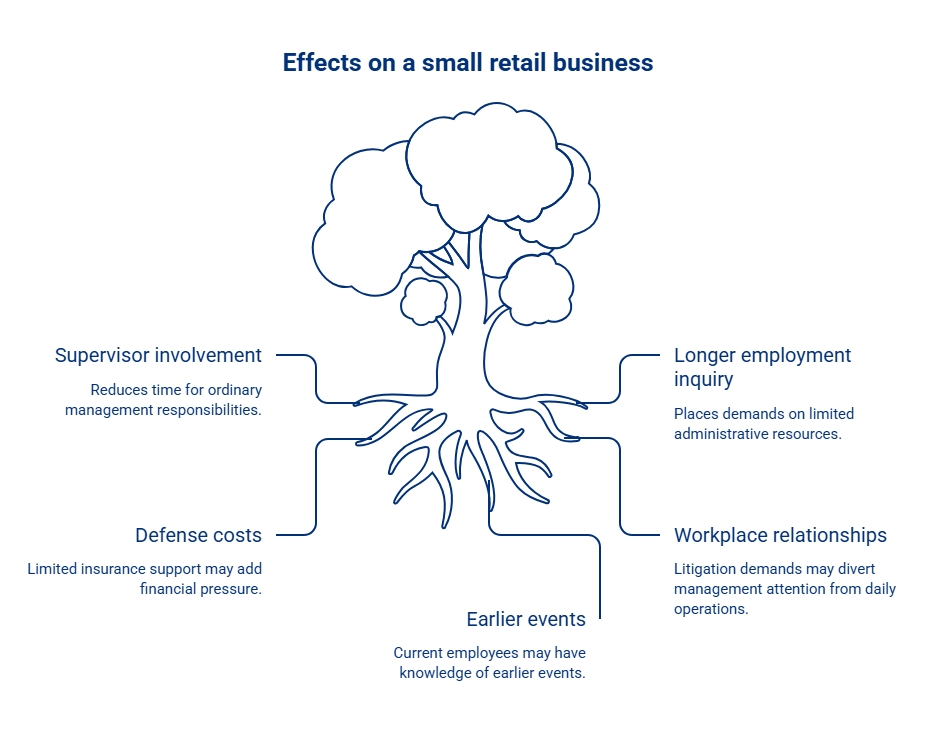
An extended factual inquiry may involve several people who remain responsible for operating the store. Owners and managers may participate in the litigation while continuing to oversee customer service, staffing, inventory, and financial obligations.
Supervisor involvement can reduce the time available for ordinary management responsibilities. Examination of events spanning a longer employment relationship may also place demands on a retailer with limited administrative resources. A business funding its own defense or receiving limited insurance support may experience additional financial pressure.
The proceeding may affect workplace relationships as well. Current employees may have knowledge of earlier events, and litigation demands may divert management attention from daily operations. Depending on the circumstances, the dispute could influence staff stability or the retailer’s reputation.
These consequences are possibilities rather than inevitable results. Their extent depends on the allegations, the scope of the proceeding, the number of participants, and the retailer’s circumstances.
Why Experienced Employment Defense Representation Matters When a Termination Claim Involves Earlier Decisions
A disputed employment history may present interconnected questions about management responsibilities, earlier decisions, communications, and the termination. Wrongful termination defense counsel represents employers when those factual and legal questions arise in an active claim.
When an active claim arises, whether through a pre-litigation demand letter, an administrative complaint with the California Civil Rights Department (CRD) or the Labor Commissioner’s Office, or a civil lawsuit in Los Angeles County Superior Court, early defense work typically centers on assembling and preserving the complete historical record. Identifying where shift schedules, point-of-sale attendance logs, manager text messages, and personnel files reside across store devices helps counsel evaluate how the contemporaneous documentation aligns with the recollections of the managers involved.
Counsel familiar with smaller retail operations can account for the business setting in which the dispute developed. Independent retailers must continue serving customers, managing inventory, covering shifts, and meeting financial responsibilities while proceeding remains active.
Broader employer-side employment litigation representation addresses the claim within that operational context. The relevance of representation arises from the interaction among the termination, the preceding employment history, and the governing law—not from any assumption about the merits or outcome.
Disclaimer:
This content is for informational purposes only. Laws, definitions, and deadlines change. Verify current requirements through official California sources. This content is not legal advice. No attorney-client relationship is formed through this content. Please consult a qualified attorney in your jurisdiction for legal advice specific to your situation.
Protect Your Business | The Akopyan Law Firm, A.P.C. | Top Gun Employment Defense Lawyers
Have you been sued by an employee? Are you overwhelmed by the complexities of employment law? If so, give us a call. The Akopyan Law Firm, A.P.C. assists small business owners throughout Southern California. Our seasoned employment defense lawyers stand ready to help employers quickly and efficiently resolve employment disputes. We are ready to aggressively and skillfully defend against any employment case, but understand that in most situations avoiding the expense of litigation is in the client’s best interest.
Take the First Step Protecting Your Future: Call us today to speak with one of our experienced employment lawyers.
Contact Us Today:
- Phone: (818) 509-9975
- Office Locations in California: Los Angeles, Bakersfield, Costa Mesa, Temecula, Rancho Cucamonga, Oxnard, Culver City, and San Diego.