

Informal supervisor communications may become significant when a small Los Angeles retailer faces a disputed termination because they can add context to the broader factual record.
- Informal Messages Matter: Routine communications about schedules, attendance, performance, or customer incidents may later become relevant to the circumstances surrounding a disputed termination.
- Context Shapes Significance: A supervisor’s role, actual involvement, and connection to disputed events may affect the factual significance attributed to a communication.
- Records Work Together: Informal messages may be considered alongside scheduling information, personnel-related records, business emails, and other contemporaneous materials when facts are contested.
- Inconsistencies Add Complexity: Different supervisor recollections or differences between communications and other records may complicate the sequence of events without independently establishing wrongdoing.
- Small Retailers Feel Disruption: Fact-intensive wrongful termination disputes may divert management attention, involve supervisors and employees as witnesses, and increase operational and administrative demands.
For small retail employers and owner-operators, these dynamics help explain why supervisor communications can become a central factual issue as a wrongful termination claim develops.
Supervisor communications may begin as routine business exchanges but become materially more significant when the circumstances surrounding a termination are disputed.
~ ~ ~ ~ ~ ~ ~ ~ ~ ~ ~ ~ ~ ~ ~ ~ ~ ~
Informal supervisor communications may become significant when a small Los Angeles retailer faces a disputed termination. Messages created for routine operational purposes such as scheduling, attendance, performance concerns, customer incidents, or other store matters, may later be considered together with management recollections and formal business records. Their significance depends on the allegations, the people involved, and the surrounding circumstances; usually a single communication automatically does not establish liability.
For a small retailer, scrutiny of supervisor communications may extend beyond the employment decision itself. Several managers may have witnessed, discussed, or participated in different aspects of the employment relationship. Communications may also be distributed across several people and channels. When the circumstances surrounding a termination are later contested, those differences can make a wrongful termination claim more fact-intensive and may increase the operational demands placed on the business.
Everyday Retail Communications May Become Relevant to a Disputed Termination
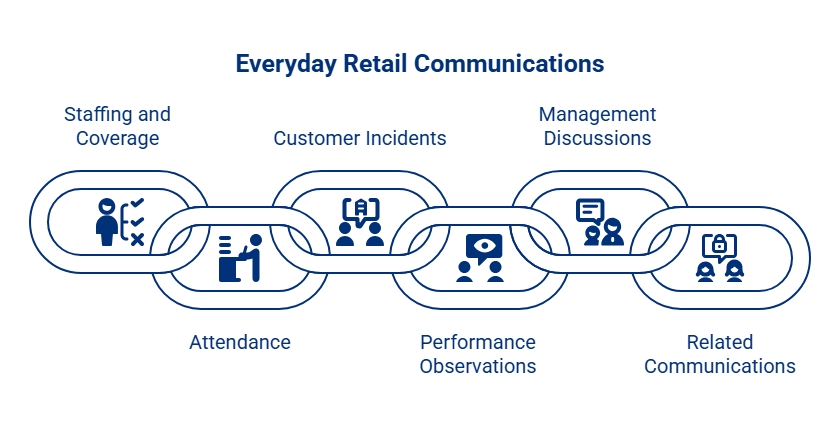
Small retail businesses generate frequent operational communications. Store managers address staffing and shift coverage. Assistant managers discuss attendance. Shift leads communicate about customer incidents. Supervisors exchange observations concerning sales-floor or stockroom performance.
These communications ordinarily serve immediate business purposes. If a termination is later disputed, some of the same communications may provide context for what members of management observed, discussed, or understood in connection with the employment decision.
Relevant communications may include scheduling messages, manager-to-manager discussions, attendance-related communications, messages concerning customer incidents, performance-related exchanges, and group conversations involving several supervisors. Their significance does not arise merely because they are informal. It may arise from their relationship to the events, people, and explanations involved in the disputed termination.
Supervisor Communications May Receive Greater Scrutiny as a Wrongful Termination Claim Develops
A communication created during routine operations may receive closer scrutiny after an employee or former employee challenges a termination. A dispute may begin with an allegation or demand and may later proceed into an administrative matter or civil lawsuit. As the contested factual issues become more defined, communications involving supervisors and managers may be considered in relation to other accounts and business records.
For example, a message about repeated scheduling conflicts may provide context for a later dispute over the circumstances surrounding the termination. A manager-to-manager communication may reflect who participated in an employment decision. For example, a text message reading ‘cut her hours, she complains too much’ can create immediate liability exposure if the complaints involve legally protected rights, whereas a message reading ‘schedule adjusted due to lack of shift coverage’ documents a legitimate business need. A communication concerning a customer incident may become relevant if that incident forms part of the events surrounding the termination.
None of these possibilities means that a particular communication necessarily favors either party. The factual significance of an informal message depends on the surrounding employment events, the people involved, and the records connected to the disputed termination.
Informal Messages May Be Considered with Formal Business Records
A wrongful termination claim may involve multiple sources of information rather than a single definitive record. Informal communications may exist alongside scheduling information, timekeeping data, personnel-related records, business emails, customer-incident records, and other contemporaneous business materials.
The relationship among those sources may become relevant when the employer and former employee dispute the events surrounding the employment decision. A supervisor’s message may describe an event differently from another record, or one record may provide context that is absent from another. The difference between records does not necessarily establish wrongdoing, but it may increase the complexity of the factual issues under examination.
For a small retailer, that dispersion can make the factual history harder to reconstruct when the termination is later challenged.
Different Supervisor Accounts May Complicate the Factual Record
Different managers may witness, discuss, or participate in different aspects of the same workplace event. A store manager may participate directly in an employment decision, while a shift lead may know only about some of the preceding events. An assistant manager may also remember a workplace discussion differently from another participant.
Contemporaneous communications can add further factual context. Language used during routine operations may differ from terminology used later when the employment decision is formally described. Several managers may also have had different levels of involvement.
These differences do not necessarily establish improper motivation, pretext, or any other legal conclusion. They may, however, make the sequence of events and the factual basis of the disputed termination more difficult to evaluate.
A Supervisor’s Role and Actual Involvement May Affect the Significance of a Communication
A communication may carry different factual significance depending on what responsibilities the speaker actually held and how that person participated in the disputed events.
A store owner may have participated in the final employment decision. A store manager may have supervised the employee directly. An assistant manager or shift lead may have handled frequent day-to-day interactions without controlling the termination decision. Another employee may have witnessed an event without exercising management authority.
Job titles alone do not determine the legal or factual importance of a statement. The surrounding circumstances and the person’s actual involvement may provide a more meaningful context.
Small Retail Management Structures May Produce Fragmented Communications
Small retail operations often divide responsibilities among a limited number of people. One manager may prepare schedules while another supervises the sales floor. An owner may participate directly in some employment decisions but have little involvement in others. Shift leads may interact with employees more frequently than the owner does.
Evening, weekend, and holiday coverage may involve different supervisors. Employment-related discussions can therefore occur across multiple shifts. Individuals with management responsibilities may also perform ordinary operational duties, while limited administrative support may leave communications distributed among several participants.
These characteristics do not, by themselves, indicate improper conduct by the employer. They may simply increase the number of people, records, and communications connected to the disputed termination.
Supervisor Communications May Become Relevant to Credibility Disputes
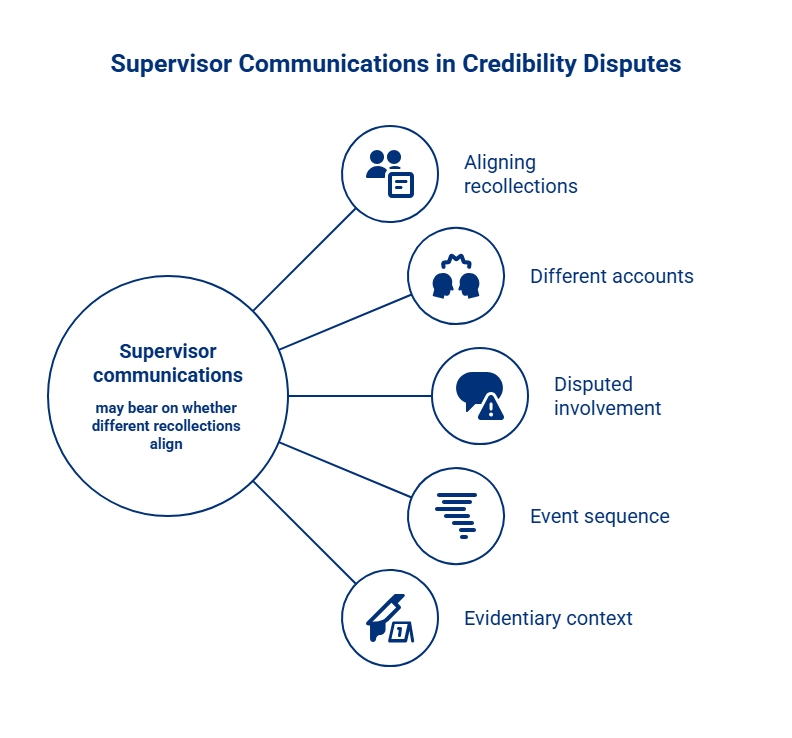
Wrongful termination litigation may involve competing accounts of the events surrounding the termination and the employer’s stated basis for the employment decision. In that context, supervisor communications may bear on whether different recollections align with one another and with contemporaneous business records.
One manager’s recollection may differ from another supervisor’s account. A communication may reflect a level of involvement that later becomes disputed. The employer and former employee may also disagree about the sequence of events leading to the termination.
Such circumstances do not independently establish whether a witness is credible or whether an employment decision was unlawful. They instead contribute to the evidentiary context in which disputed facts may be assessed.
A Fact-Intensive Wrongful Termination Dispute May Disrupt Small Retail Operations
To minimize these risks, small retailers should mandate that all shift management and personnel discussions occur on a single, company-controlled platform rather than on supervisors’ personal text messages.
For a small retailer, a wrongful termination claim involving several supervisors and competing records may affect ordinary operations. Management attention may shift away from staffing, customers, inventory, and store performance. Supervisors and employees may become involved as witnesses, while administrative demands increase for owners operating with limited support.
Depending on the circumstances, the dispute may also affect shift coverage, employee relations, litigation expense, and customer-facing reputation. These consequences are not inevitable, but they illustrate why a disputed termination can create both legal and operational burdens for a small retail business.
Because the significance of supervisor communications depends on the allegations, the participants, and the surrounding records, a fact-intensive wrongful termination dispute may warrant review by an attorney experienced in employer-side employment litigation.
Disclaimer:
This content is for informational purposes only. Laws, definitions, and deadlines change. Verify current requirements through official California sources. This content is not legal advice. No attorney-client relationship is formed through this content. Please consult a qualified attorney in your jurisdiction for legal advice specific to your situation.
Protect Your Business | The Akopyan Law Firm, A.P.C. | Top Gun Employment Defense Lawyers
Have you been sued by an employee? Are you overwhelmed by the complexities of employment law? If so, give us a call. The Akopyan Law Firm, A.P.C. assists small business owners throughout Southern California. Our seasoned employment defense lawyers stand ready to help employers quickly and efficiently resolve employment disputes. We are ready to aggressively and skillfully defend against any employment case, but understand that in most situations avoiding the expense of litigation is in the client’s best interest.
Take the First Step Protecting Your Future: Call us today to speak with one of our experienced employment lawyers.
Contact Us Today:
- Phone: (818) 509-9975
- Office Locations in California: Los Angeles, Bakersfield, Costa Mesa, Temecula, Rancho Cucamonga, Oxnard, Culver City, and San Diego.