
For Los Angeles retail owners, a direct termination decision may place the owner’s knowledge and communications at the center of a wrongful termination dispute.
- Involvement Is Not Liability: Direct owner involvement may become significant evidence without independently establishing wrongful termination or personal liability.
- Communications Shape the Record: Existing texts, emails, informal communications, and testimony may reveal what the owner knew about the contested termination.
- Discrepancies Require Context: A factual discrepancy may raise credibility questions, but it does not independently establish discrimination, retaliation, pretext, or wrongful termination.
- Legal Roles Remain Distinct for Business Entities: When a retail business operates as a corporation or limited liability company, an owner’s evidentiary importance remains separate from the business entity’s potential liability and any narrow grounds for individual liability under California law.
- Litigation Competes with Operations: Active litigation may demand attention while the owner continues managing customers, staffing, inventory, finances, and other storefront responsibilities.
Direct decision-making may connect the owner to the evidence, but the evidence and applicable law determine the claim’s significance.
~ ~ ~ ~ ~ ~ ~ ~ ~ ~ ~ ~ ~ ~ ~ ~ ~ ~
A retail owner’s direct involvement in an employee’s termination can become a central factual issue when the former employee challenges the decision. The owner may possess firsthand knowledge, exercise final authority, and manage the storefront where the relevant events occurred.
That involvement does not, by itself, establish wrongful termination or personal liability. The dispute may instead involve competing factual accounts, existing communications, the employee protections implicated by the allegations, and the law governing the asserted causes of action.
Why an Owner’s Direct Participation May Matter
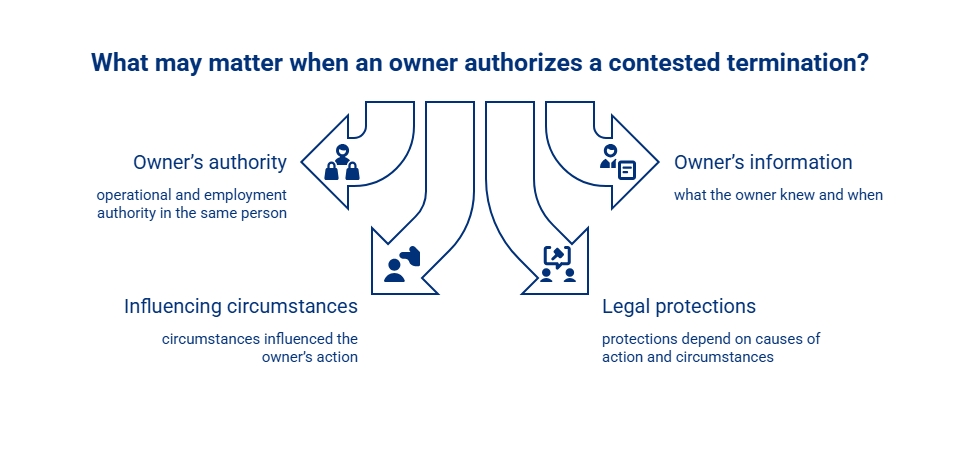
Small retail businesses often place operational and employment authority in the same person. An owner may supervise sales associates, cashiers, or stockroom employees while overseeing inventory, staffing, customer relationships, and business finances.
When the owner authorizes a contested termination, the owner may become an important source of information about the decision. The factual inquiry may address what the owner knew, when the owner obtained that information, and which circumstances influenced the owner’s action.
A former employee may allege that the termination conflicted with legal protections against unlawful employment actions. The retail business may dispute that allegation. The protections relevant to the claim depend on the causes of action asserted and the circumstances surrounding the contested termination.
How Existing Communications May Enter the Factual Record
A wrongful termination claim may involve more than the final conversation in which the employee learned about the termination. Existing communications may provide context for the owner’s knowledge, the information supplied by a store manager, and the circumstances surrounding the employee’s departure.
The factual record may include, among other materials, text messages exchanged by the owner and the store manager. Emails may describe events connected to the termination. Informal communications may reflect what the owner or former employee understood at the time. Testimony may provide additional accounts from people who witnessed relevant events.
Contemporaneous communications and later accounts may not describe the circumstances in identical terms. A discrepancy may raise questions about factual consistency or credibility, but it does not independently establish discrimination, retaliation, pretext, or wrongful termination.
The former employee may claim that the decision was connected to legally protected circumstances, while the business may contest that characterization. The significance of each communication depends on its content, context, and relationship to the termination.
Why Factual Involvement and Legal Liability Remain Distinct
An owner’s participation in a termination and the employing business’s potential liability present separate considerations. The owner may have made or communicated the decision, while the retail business may appear as the defendant in the resulting employment claim.
Direct participation does not automatically determine whether the business is liable. It also does not independently establish individual liability for the owner. Under California law, individual owners, managers, and supervisors of a corporate or LLC employer cannot be held personally liable for common-law wrongful termination, discrimination, or retaliation under the Fair Employment and Housing Act or Labor Code section 1102.5, though personal liability may still be alleged through separate companion claims, such as unlawful harassment or specified wage-and-hour violations.
A person may therefore become important to the evidence without that evidentiary role alone establishing personal liability. Similarly, a lawsuit, demand letter, or administrative complaint presents allegations for examination; it does not convert those allegations into legal findings.
How a Disputed Termination May Become a Formal Claim
A former employee may challenge a termination through an attorney demand letter, an administrative complaint, or a civil lawsuit. The available path and resulting proceedings depend on the nature of the allegations and applicable law.
Formal proceedings may involve employment records, communications, and testimony concerning the owner’s decision. A store manager’s account may become relevant when the manager supplied information to the owner or witnessed events associated with the termination.
Not every dispute follows the same sequence. Some matters begin with correspondence, while others reach the business through an agency or court proceeding. In each setting, the parties may contest both the underlying events and the legal significance attributed to them.
Litigation Can Compete with Storefront Responsibilities
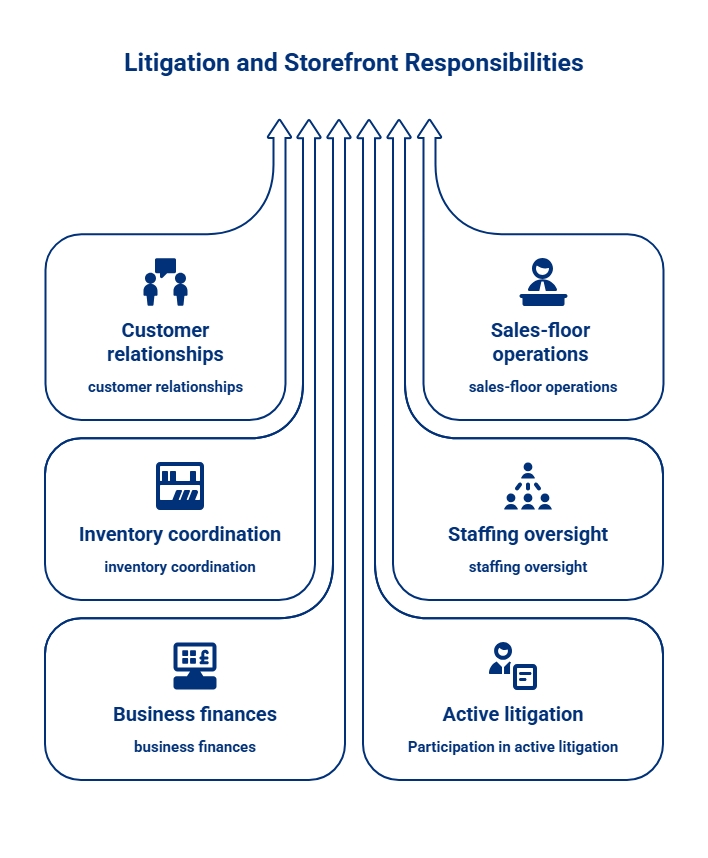
An owner who possesses relevant knowledge may remain responsible for customer relationships, sales-floor operations, inventory coordination, staffing oversight, and business finances. Participation in active litigation can compete with those continuing responsibilities.
Depending on the circumstances, a dispute may affect the owner’s availability and the business’s legal expenditure. The dispute may also affect employee relations, business reputation, or operational continuity. These consequences are not inevitable, and their extent varies among businesses.
Even allegations that are not ultimately established may require substantial attention because the owner serves as both the principal decisionmaker and a central source of factual information. This overlap can place significant demands on a closely held business with limited administrative support.
Representation When the Owner Made the Contested Decision
An active claim involving the owner’s direct decision may present competing factual accounts, relevant communications, and questions about employer or individual liability. The business may face those issues while continuing to operate its storefront.
Experienced wrongful termination defense lawyer can evaluate the allegations and evidence within the context of the specific claims. Akopyan Law Firm’s employment lawyers for small businesses represent California employers facing wrongful termination lawsuits and related legal proceedings.
Disclaimer:
This content is for informational purposes only. Laws, definitions, and deadlines change. Verify current requirements through official California sources. This content is not legal advice. No attorney-client relationship is formed through this content. Please consult a qualified attorney in your jurisdiction for legal advice specific to your situation.
Protect Your Business | The Akopyan Law Firm, A.P.C. | Top Gun Employment Defense Lawyers
Have you been sued by an employee? Are you overwhelmed by the complexities of employment law? If so, give us a call. The Akopyan Law Firm, A.P.C. assists small business owners throughout Southern California. Our seasoned employment defense lawyers stand ready to help employers quickly and efficiently resolve employment disputes. We are ready to aggressively and skillfully defend against any employment case, but understand that in most situations avoiding the expense of litigation is in the client’s best interest.
Take the First Step Protecting Your Future: Call us today to speak with one of our experienced employment lawyers.
Contact Us Today:
- Phone: (818) 509-9975
- Office Locations in California: Los Angeles, Bakersfield, Costa Mesa, Temecula, Rancho Cucamonga, Oxnard, Culver City, and San Diego.