

Family-owned businesses facing retaliation claims should expect scrutiny of protected activity, decision-maker knowledge, causation, and legitimate independent reasons for termination.
- Protected Activity Requires Legal Concern: Section 1102.5 may protect disclosures based on a reasonable belief that conduct violates a statute, rule, or regulation.
- Causation Drives the Claim: An employee must show protected activity contributed to the termination before the employer faces the heightened same-decision burden.
- Independent Reasons Need Proof: The employer must establish by clear and convincing evidence that legitimate, independent reasons would have produced the same termination decision.
- Consistent Records Strengthen Context: Contemporaneous warnings, stable explanations, comparative treatment, and a clear chronology may support the asserted performance basis for discharge.
- Family Overlap Invites Scrutiny: Shared ownership and supervision may intertwine knowledge, motive, communications, and decision-making without creating any presumption of retaliation.
For owners and managers of closely held Southern California businesses, these principles frame factual questions likely to shape a safety-complaint termination dispute.
Timing matters significantly—a discharge within 90 days of a complaint creates a statutory presumption of retaliation—though evidence ultimately determines whether the employer can prove the same decision would have occurred independently.
A Southern California family-owned business may face a wrongful termination or whistleblower-retaliation claim when an employee alleges that a discharge followed a safety or regulatory complaint. The sequence can attract scrutiny, and under California law, an adverse action taken within 90 days of a protected complaint now creates a statutory rebuttable presumption of retaliation. However, family ownership itself creates no presumption of wrongdoing. These disputes usually turn on whether the employee engaged in protected activity, whether a decision-maker knew about it, whether the activity contributed to the termination, and whether the business would have made the same decision for legitimate, independent reasons.
When a Complaint May Qualify as Protected Activity
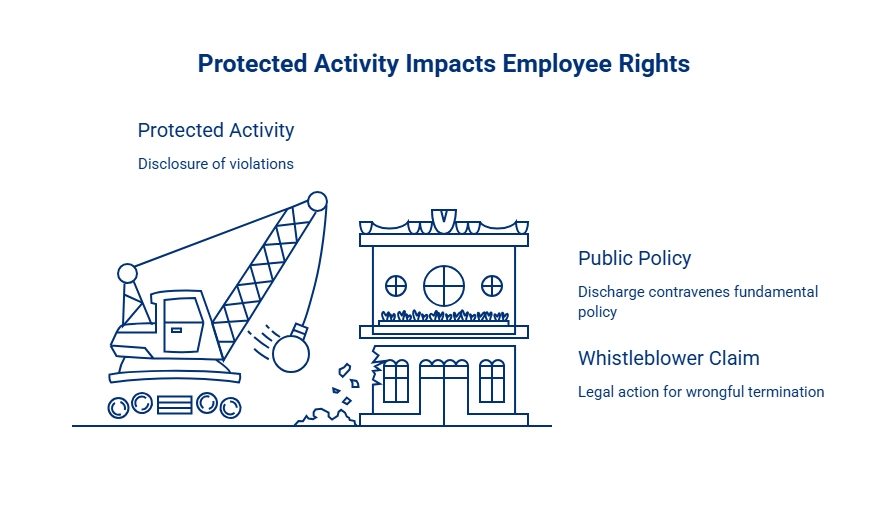
California Labor Code section 1102.5 protects certain disclosures by employees who reasonably believe the information reveals a violation of a state or federal statute or noncompliance with a local, state, or federal rule or regulation. Protection may extend to a disclosure made to a government or law-enforcement agency, a supervisor, or another employee with authority to investigate or correct the suspected violation. The statute also protects certain refusals to participate in conduct that would violate such a legal requirement.
Not every workplace disagreement constitutes protected activity. A generalized objection to a business decision may differ from a report that identifies suspected unlawful conduct. The employee need not ultimately prove that the reported violation occurred, however; the statutory inquiry includes whether the employee had reasonable cause for the belief underlying the disclosure.
For example, if a warehouse employee reports a supervisor routinely bypassing forklift safety inspections to speed up shipping, that report likely constitutes protected activity, even if a formal safety violation is never ultimately proven.
A statutory whistleblower claim may accompany a tort claim for wrongful termination in violation of public policy. The tort theory generally requires a discharge that allegedly contravenes a fundamental public policy grounded in a constitutional or statutory provision. The two claims may arise from the same separation, but each retains its own legal character.
Why Causation Becomes the Central Dispute
California Labor Code section 1102.6 supplies the burden-of-proof framework for a section 1102.5 claim. The employee must demonstrate by a preponderance of the evidence that protected activity was a contributing factor in the challenged employment action—a burden now aided by a rebuttable presumption of retaliation if the action occurs within 90 days of the protected activity. If that showing is made, the employer must prove by clear and convincing evidence that the action would have occurred for legitimate, independent reasons even without the protected activity.
The evidence often centers on four connected questions:
- The chronology may show how the complaint, performance events, operational changes, and termination relate in time.
- Decision-maker knowledge may establish whether the person responsible for the discharge knew about the complaint.
- Consistency may reveal whether the stated reason remained stable across communications, testimony, and business records.
- Comparative evidence may illuminate whether similar conduct received similar treatment under comparable circumstances.
- Documentation may demonstrate whether performance warnings were recorded contemporaneously, countering claims of sudden or retaliatory discipline.
Under section 1102.6, pretext is not a separate element that an employee must prove through the traditional McDonnell Douglas framework. Even so, evidence that challenges the accuracy or consistency of an employer’s explanation may affect whether protected activity was a contributing factor or whether the same-decision burden has been met. This distinction frequently shapes whistleblower-retaliation litigation for employers.
Why Family-Owned Businesses May Face Added Factual Scrutiny
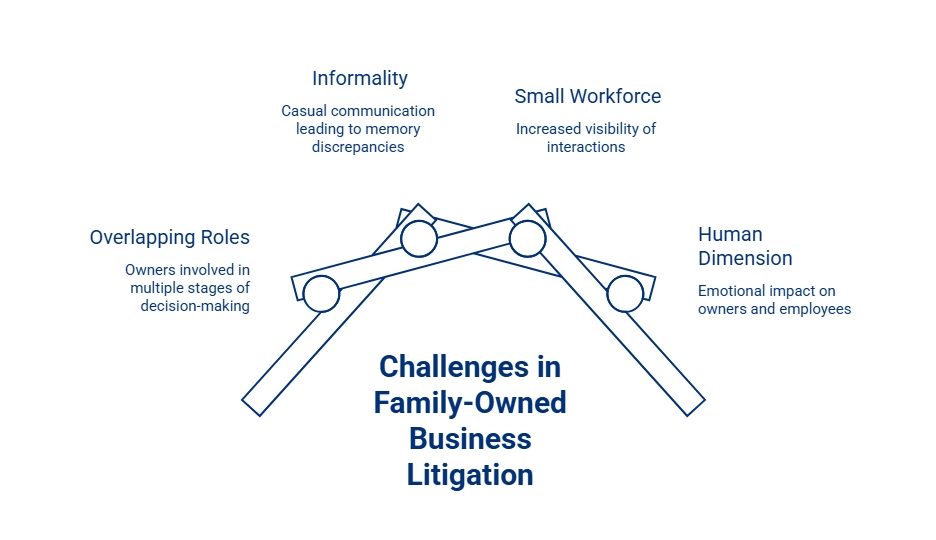
Family-owned businesses often combine ownership and day-to-day supervision. One owner may receive the employee’s complaint, another relative may evaluate performance, and both may participate in the separation decision. That overlap can make knowledge, motive, and responsibility factually intertwined.
Informality carries similar evidentiary consequences. Conversations may occur quickly among relatives and supervisors, while participants later remember the same exchange differently. A small workforce may also give employees greater visibility over who knew about the complaint and when. These features do not prove retaliation; they can simply expand the number of communications and witnesses examined during wrongful-termination litigation involving informal management practices.
Family relationships can add a human dimension as well. Owners may experience a lawsuit as both a business threat and a challenge to personal credibility. Employees may view direct access to ownership as evidence that senior decision-makers knew about the report. Litigation then tests the evidence behind both narratives under the governing legal standards.
Illustrative Example: A Safety Report Followed by a Performance-Based Discharge
A front-line employee reports to an owner-supervisor that a routine operating practice may violate a workplace-safety rule. Several weeks later, another owner approves termination based on recurring performance concerns. The employee alleges retaliation, while the business maintains that the same decision would have occurred regardless of the report.
The dispute may turn on whether the report reflected a reasonable belief about legal noncompliance, whether the terminating owner knew of it, whether it contributed to the decision, and whether the asserted performance basis qualifies as a legitimate, independent reason supported by clear and convincing evidence. The sequence permits competing inferences but does not dictate an outcome.
How a Single Claim Can Affect a Closely Held Business
A formal demand, administrative matter, or lawsuit may draw owners, relatives, supervisors, and employee witnesses into discovery and testimony. Management attention can shift from ordinary operations to disputed events and recollections. Legal expenses, morale concerns, reputational pressure, and disruption to customer relationships may develop even before liability is resolved. A termination dispute can also combine wrongful termination, unlawful retaliation, and whistleblower theories arising from one employment decision.
Disclaimer:
This content is for informational purposes only. Laws, definitions, and deadlines change. Verify current requirements through official California sources. This content is not legal advice. No attorney-client relationship is formed through this content. Please consult a qualified attorney in your jurisdiction for legal advice specific to your situation.
Protect Your Business | The Akopyan Law Firm, A.P.C. | Top Gun Employment Defense Lawyers
Have you been sued by an employee? Are you overwhelmed by the complexities of employment law? If so, give us a call. The Akopyan Law Firm, A.P.C. assists small business owners throughout Southern California. Our seasoned employment defense lawyers stand ready to help employers quickly and efficiently resolve employment disputes. We are ready to aggressively and skillfully defend against any employment case, but understand that in most situations avoiding the expense of litigation is in the client’s best interest.
Take the First Step Protecting Your Future: Call us today to speak with one of our experienced employment lawyers.
Contact Us Today:
- Phone: (818) 509-9975
- Office Locations in Southern California: Los Angeles, Bakersfield, Costa Mesa, Temecula, Rancho Cucamonga, Oxnard, Culver City, and San Diego.