

📌 Key Takeaways
A single termination may become a broader California employment dispute when the surrounding record makes motive, timing, and consistency easier to challenge.
- One Decision Expands: A termination may be pleaded through wrongful termination, retaliation, whistleblower, leave, or accommodation theories when the same facts support multiple claims.
- Informality Leaves Gaps: Verbal warnings, brief texts, and undocumented conversations may weaken the employer’s record when later scrutiny demands a clear and consistent explanation.
- Timing Triggers Presumptions: Under California Senate Bill 497 (The Equal Pay and Anti-Retaliation Protection Act), a ‘rebuttable presumption’ of retaliation is created if an employer takes an adverse action, such as termination, within 90 days of an employee engaging in protected activity. This includes internal complaints about wages, reporting suspected legal violations, or discussing equal pay. While this presumption does not automatically establish liability, it significantly lowers the plaintiff’s initial burden of proof, requiring the employer to immediately come forward with a ‘legitimate, non-retaliatory reason’ for the decision to avoid an early loss in the dispute.”
- Consistency Supports Credibility: Selective discipline, policy deviations, and different treatment of similarly situated employees may be used to argue pretext and undermine the employer’s position.
- Structure Affects Exposure: In family-owned businesses, overlapping owner, supervisor, and payroll roles may complicate documentation, decision-making history, and the overall defense posture.
Defensible employment decisions often depend on contemporaneous documentation, uniform policy application, and explanations that remain stable when a claim becomes formal.
Family-owned business owners in Southern California facing active or imminent employment disputes will gain immediate clarity here, guiding them into the dispute-specific details that follow.
~ ~ ~ ~ ~ ~ ~ ~ ~ ~ ~ ~ ~ ~ ~ ~ ~ ~
For many family-owned businesses in Southern California, an “unjust firing” accusation may become much broader than a dispute about one separation. Under California law, generally, a single termination may be framed through overlapping theories involving wrongful termination claims, retaliation claims, whistleblower-related claims, leave-related allegations, or reasonable accommodation and interactive-process disputes. In a formal claim, a plaintiff may challenge not only the termination itself, but also the employer’s documentation, timing, consistency, and stated rationale. In a formal claim, California courts apply a burden-shifting framework. Once a plaintiff establishes a prima facie case, the business must provide a legitimate, non-discriminatory reason for the termination. A judge, jury, or agency will then evaluate whether that explanation is a ‘pretext’ for an unlawful motive. If the business’s explanation shifts—varying between emails, texts, and official personnel records—courts may interpret these inconsistencies as evidence that the stated reason is disingenuous, thereby undermining the employer’s credibility and increasing litigation exposure.
Why a Termination Dispute May Expand Beyond the Separation Decision
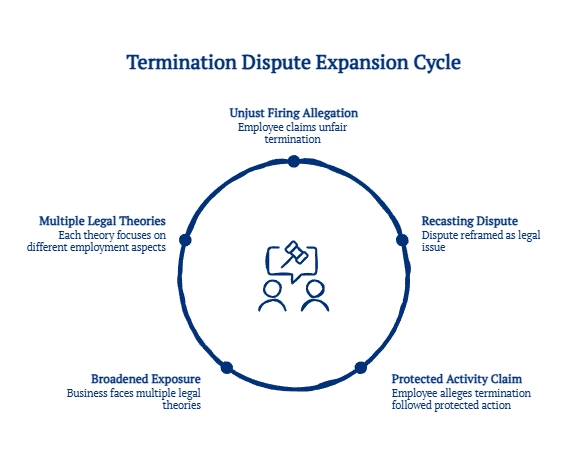
“Unjust firing” is a colloquial phrase, not a formal California legal standard. In practice, the same employment decision may be recast as a dispute about motive, protected activity, protected status, or compliance obligations. A plaintiff may allege that the termination followed a protected complaint, a leave request, a disclosure of suspected wrongdoing, or a discussion about disability and reasonable accommodation. That overlap may broaden potential exposure because one separation may generate several legal theories at once, each focused on a different part of the employment record.
How Informal Management Practices May Create Evidentiary Problems
Family-owned businesses often depend on speed, trust, and direct owner involvement. Those qualities may support operations, but they may also leave gaps in the record when a dispute becomes formal. A supervisor may give a verbal warning without a contemporaneous write-up. An owner may send a short text that later appears incomplete or inconsistent. Management may reach a decision through a brief conversation that is never fully reflected in the personnel file.
Those facts do not establish liability by themselves. The concern is narrower and more practical. Informal decision-making may make it harder to show that the business acted for a legitimate business reason, followed established policies uniformly, and made a defensible employment decision based on a record that remained consistent over time.
Why Documentation, Policy Consistency, and Timing Often Matter
California employment disputes often turn on whether the employer’s explanation appears coherent from beginning to end. A plaintiff may argue that the business applied discipline selectively, departed from stated policy, or treated similarly situated employees differently. A short email, a text exchange, or a missing performance record may then be offered as evidence of pretext.
Timing may also receive close scrutiny. When a termination closely follows protected activity, such as an internal complaint, a leave request, a whistleblower disclosure, or an accommodation discussion, the employer may face a stronger argument that the sequence itself deserves attention. Under California law, generally, that does not mean the employment decision was unlawful. It does mean that proximity between protected activity and termination may become a central issue in the dispute, especially where contemporaneous documentation is thin or explanations appear to shift.
Why Family-Owned Business Structure May Complicate the Defense Posture
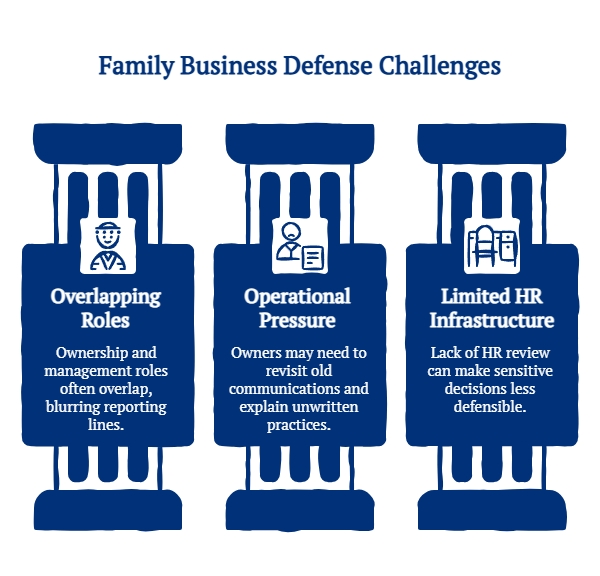
In a closely held business, ownership and management roles often overlap. A family member may supervise staff, manage schedules, approve payroll, and participate in discipline. Long-standing personal relationships may also blur reporting lines. When a formal claim later asks who made the decision, when the decision became final, what information management reviewed, and whether the same standards were applied to other employees, that structure may complicate the defense posture.
The operational pressure may be significant. Owners may need to revisit old communications, explain unwritten practices, and account for differences between what the business did, what supervisors understood, and what the file actually shows. In businesses with limited HR infrastructure, sensitive decisions may later appear less defensible where HR review, legal review, or both were absent from the record at an early stage.
Why These Cases May Escalate Quickly
A termination dispute may expand quickly because the separation often becomes only one part of the case narrative. A plaintiff may connect the decision to disability-related discussions, the interactive process, job-protected leave, internal complaints, or prior workplace conflict. Once that occurs, the dispute may no longer center on a single event. It may instead focus on whether management communicated consistently, documented concerns contemporaneously, followed policy in a uniform manner, and preserved a clear basis for its decisions.
For a family-owned business, that shift may create more than legal pressure. It may consume management time, disrupt operations, affect employee morale, and increase the cost of responding to the claim. The business risk often comes not from one isolated conversation, but from the way multiple small decisions look when assembled into a formal record.
A family-owned business does not face exposure merely because it operates informally. The greater concern is that informal practices may leave an incomplete record at the very moment a formal dispute demands precision. Under California law, generally, defensible employment decision-making often depends on contemporaneous documentation, uniform application of policy, and a record that remains consistent when protected activity, leave, accommodation, or other sensitive issues are later examined.
Disclaimer:
This content is for informational purposes only. Laws, definitions, and deadlines change. Verify current requirements through official California sources. This content is not legal advice. No attorney-client relationship is formed through this content. Please consult a qualified attorney in your jurisdiction for legal advice specific to your situation.
Protect Your Business | The Akopyan Law Firm, A.P.C. | Top Gun Employment Lawyers
Have you been sued by an employee? Are you overwhelmed by the complexities of employment law? If so, give us a call. The Akopyan Law Firm, A.P.C. assists small business owners throughout Southern California. Our seasoned employment defense lawyers stand ready to help employers quickly and efficiently resolve employment disputes. We are ready to aggressively and skillfully defend against any employment case, but understand that in most situations avoiding the expense of litigation is in the client’s best interest.
Take the First Step Protecting Your Future: Call us today to speak with one of our experienced employment lawyers.
Contact Us Today:
- Phone: (818) 509-9975
Office Locations in California: Los Angeles, Bakersfield, Costa Mesa, Temecula, Rancho Cucamonga, Oxnard, Culver City, and San Diego.