
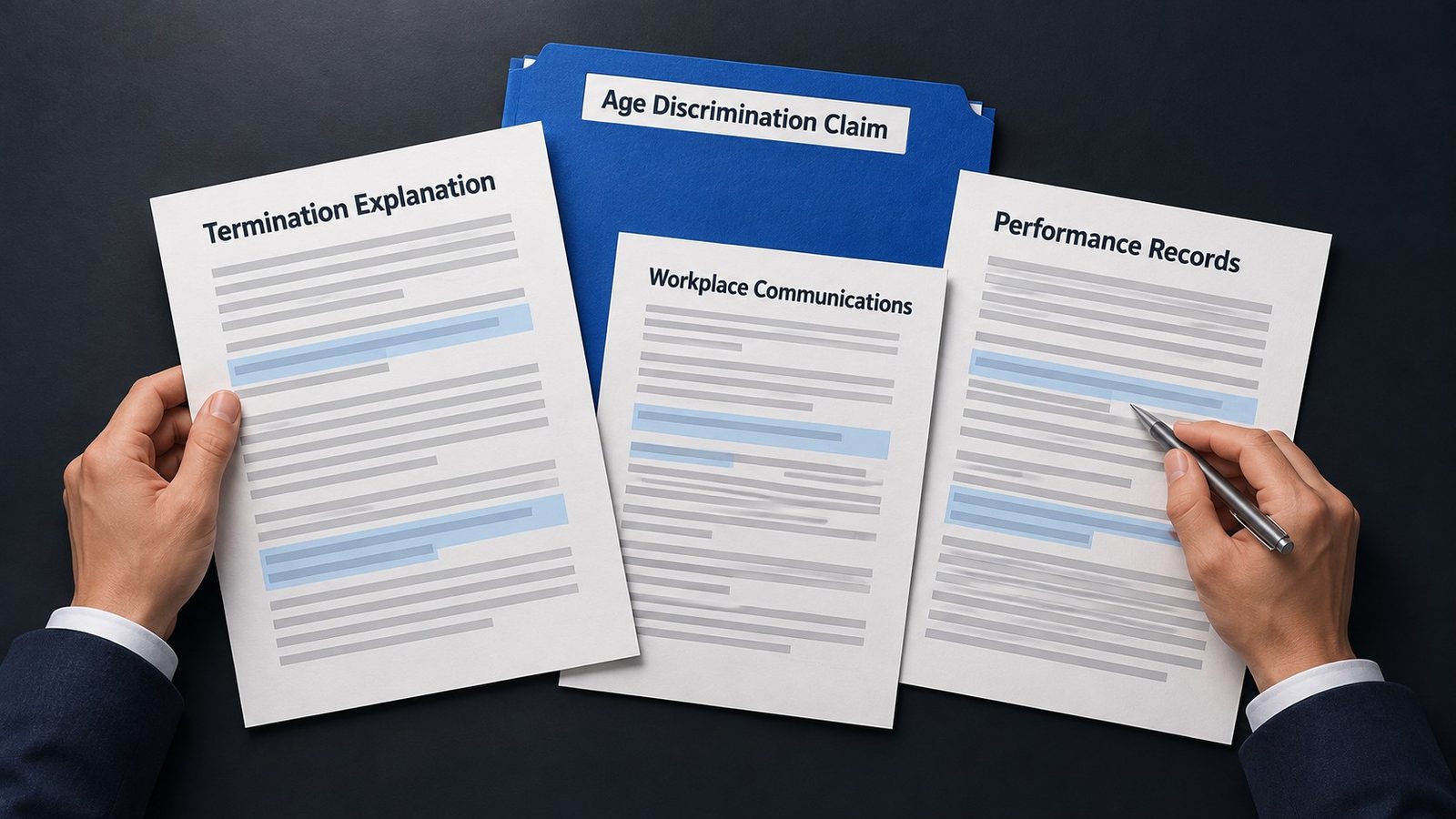
Age-discrimination termination disputes can become credibility disputes when an employer’s stated reason conflicts with contemporaneous records, communications, or decision-maker recollections.
- Consistency Shapes Credibility: Material differences between the employer’s legitimate, nondiscriminatory reason and existing evidence may become relevant to an allegation of pretext.
- Contemporaneous Records Matter: Performance-related records, disciplinary history, and other preexisting records may affect how a trier of fact evaluates the stated termination reason.
- Decision-Maker Accounts Matter: Owners, managers, and supervisors may hold different knowledge about the termination, and material differences can create additional factual questions.
- Age-Related Evidence Matters: Age-related assumptions or remarks may become relevant when their context, source, timing, and connection to the termination support scrutiny of alleged motive.
- Operational Demands Can Grow: Credibility disputes may divert owners and managers from staffing, supervision, customer service, and financial responsibilities while the employment dispute remains active.
For California family-owned employers facing these allegations, the evidentiary record may shape how the stated termination reason is evaluated as the dispute develops.
A wrongful termination claim involving age discrimination can become a credibility dispute when an employer identifies a legitimate, nondiscriminatory reason for terminating an employee and the former employee alleges that age influenced the decision. The factual question may then focus on whether the employer’s stated reason aligns with contemporaneous records, workplace communications, established employment practices reflected in the existing record, and the recollections of the people involved in the decision.
For a family-owned Southern California business, that scrutiny may involve owners, managers, or supervisors who participated directly in the termination while continuing to manage daily operations. Material inconsistency does not itself establish unlawful discrimination. Depending on the evidence, however, an inconsistency may become relevant to an allegation that the stated reason for termination was pretextual. In legal terms, ‘pretext’ simply means a false reason given to hide the true, underlying motive for the firing.
California Age Discrimination Law Provides the Legal Context
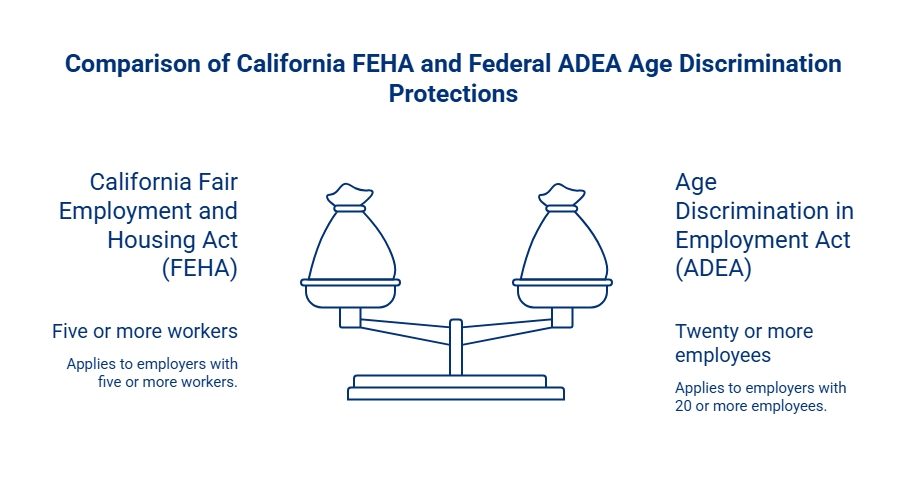
For employers with five or more workers, California’s Fair Employment and Housing Act (FEHA) prohibits unlawful age discrimination against employees aged 40 and older in employment. The federal Age Discrimination in Employment Act (ADEA), which protects workers aged 40 and older, may also apply to employers with 20 or more employees when its requirements are satisfied.
An employee may allege that age influenced a termination, while the employer may maintain that performance concerns or another legitimate, nondiscriminatory reason caused the employment decision. A wrongful termination claim involving those competing explanations can place the employer’s stated reason and the surrounding evidentiary record under close scrutiny.
Why the Employer’s Stated Reason May Become a Credibility Issue
When motive is disputed, a trier of fact may consider whether the employer’s stated reason is consistent with evidence created before the dispute arose.
Contemporaneous records, workplace communications, and testimony from people involved in the termination may provide different perspectives on the same events. If those sources materially conflict with the asserted legitimate, nondiscriminatory reason, the former employee may characterize the differences as evidence of pretext.
That does not mean every discrepancy carries the same significance. Minor differences in recollection may have little bearing on the underlying allegation, while more substantial differences concerning why the employee was terminated may receive greater attention.
Direct Owner and Manager Involvement Can Expand the Evidentiary Record
A family-owned business may have an owner who participated directly in the termination. A manager may have evaluated the employee’s performance, while a supervisor may have observed separate events that contributed to the decision.
The employer provides the stated reason for termination. Individual owners, managers, and supervisors may provide evidence concerning what they personally knew, observed, communicated, or contributed to the decision.
Those accounts do not necessarily have to be identical. Material differences concerning the basis for termination, however, may create additional factual questions about whether the employer’s stated explanation accurately reflects the reason for the employment decision.
How Contemporaneous Records May Affect the Credibility of the Stated Reason
Records created before a dispute may provide evidence concerning events that later become contested. Depending on the circumstances, the existing record may include performance materials, disciplinary history, relevant attendance or scheduling information, emails, text messages, and communications among owners, managers, or supervisors.
A trier of fact may consider whether those materials are consistent with the employer’s asserted legitimate, nondiscriminatory reason. A material conflict between the existing record and a later explanation may become relevant to an allegation of pretext.
The existing record may also show how the employer handled materially comparable employment situations. When an established practice is reflected in that record, a material departure from the practice may receive scrutiny if the employer’s explanation for the termination is later challenged.
Ordinary Workplace Communications May Become Relevant to Alleged Motive
Routine emails, text messages, and direct conversations may provide evidence of what decision-makers understood at the time of the termination.
If age-related assumptions or remarks appear in the existing record, their legal significance may depend on their content, context, source, timing, and connection to the people involved in the termination decision. Such evidence may become relevant to an allegation that age influenced the adverse employment decision. For example, passing emails noting that the company needs ‘fresh blood,’ or performance reviews repeatedly describing an older employee as ‘inflexible’ or ‘resistant to new technology,’ can be weaponized in a dispute.
The existence of age-related language does not automatically establish discrimination. Its significance depends on the surrounding facts and its relationship to the challenged termination.
Performance-Based Terminations Can Still Produce Pretext Disputes
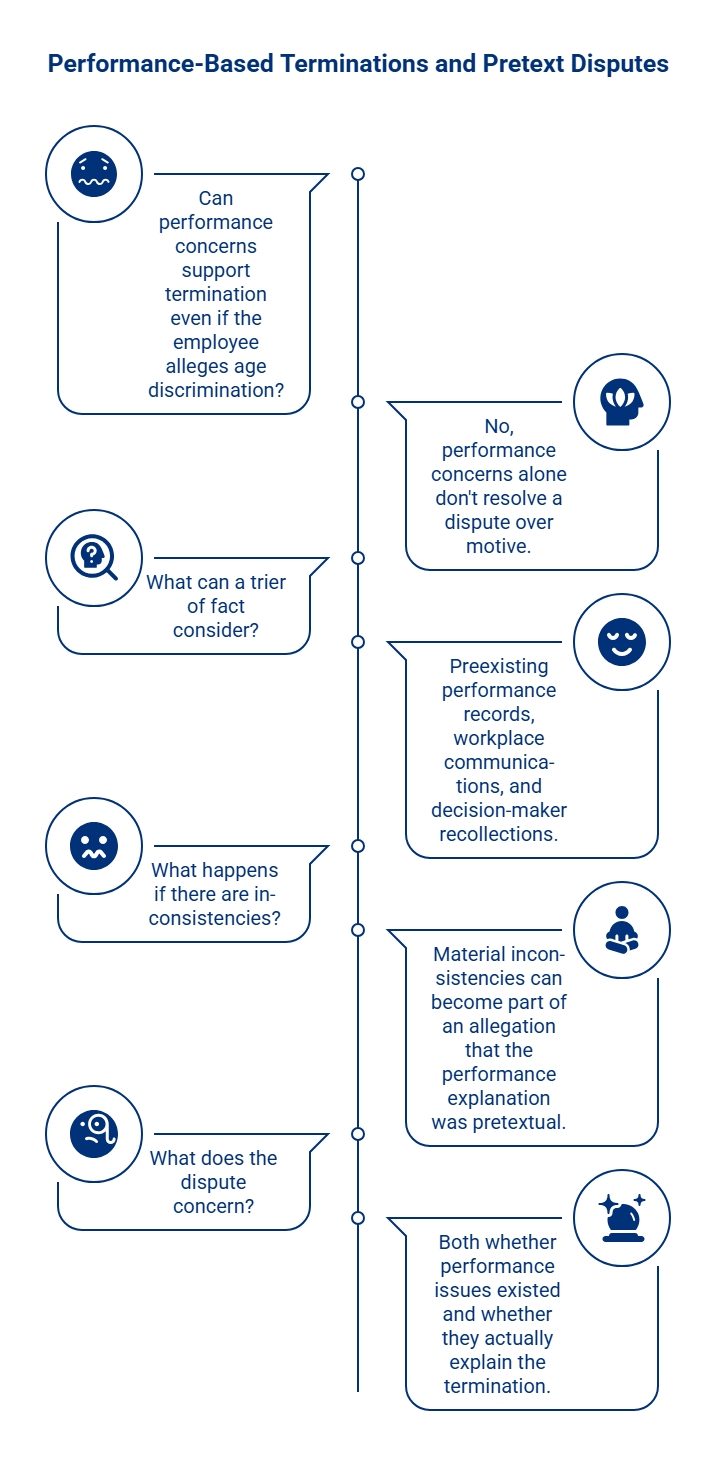
An employer may conclude that performance concerns support termination while the employee alleges that age played an unlawful role. The existence of performance concerns does not by itself resolve a dispute over motive.
A trier of fact may consider whether preexisting performance records, workplace communications, and decision-maker recollections align with the employer’s asserted legitimate, nondiscriminatory reason. Material inconsistencies among those sources may become part of an allegation that the performance explanation was pretextual.
The resulting dispute may therefore concern both whether performance issues existed and whether those issues actually explain the termination.
Illustrative Example: Performance-Based Termination
A family-owned Southern California service business terminates a long-serving, non-executive employee after management concludes that ongoing performance concerns support the decision. The former employee later alleges that age influenced the termination.
Preexisting performance records and workplace communications may be considered alongside the employer’s stated legitimate, nondiscriminatory reason and the recollections of the owner and supervisors who participated in the decision. If those sources materially conflict, the differences may become relevant to an allegation of pretext. The discrepancies do not themselves establish age discrimination or determine whether the employer has a valid defense.
Credibility Disputes May Affect Business Operations
A disputed termination may require substantial attention from people who remain responsible for operating the business. Owners and managers may need to address questions concerning existing records, their own involvement in the employment decision, and the information known to other employees.
For a smaller business without an in-house legal department, those demands may compete with staffing, supervision, customer service, and financial responsibilities. The extent of any disruption depends on the circumstances of the particular dispute.
General Information and Professional Referral
This content provides general information only. It does not constitute legal advice and does not create an attorney-client relationship. Employment laws vary by jurisdiction, may change over time, and may apply differently depending on specific facts and circumstances. Employment claims and administrative matters may also be subject to deadlines that vary according to the circumstances.
Southern California employers facing an active or imminent wrongful termination dispute involving age discrimination allegations may obtain a professional evaluation of the factual record, potential exposure, and applicable legal issues from experienced employment defense counsel. No particular result or outcome can be guaranteed.
Disclaimer:
This content is for informational purposes only. Laws, definitions, and deadlines change. Verify current requirements through official California sources. This content is not legal advice. No attorney-client relationship is formed through this content. Please consult a qualified attorney in your jurisdiction for legal advice specific to your situation.
Protect Your Business | The Akopyan Law Firm, A.P.C. | Top Gun Employment Lawyers
Have you been sued by an employee? Are you overwhelmed by the complexities of employment law? If so, give us a call. The Akopyan Law Firm, A.P.C. assists small business owners throughout Southern California. Our seasoned employment defense lawyers stand ready to help employers quickly and efficiently resolve employment disputes. We are ready to aggressively and skillfully defend against any employment case, but understand that in most situations avoiding the expense of litigation is in the client’s best interest.
Take the First Step Protecting Your Future: Call us today to speak with one of our experienced employment defense lawyers.
Contact Us Today:
- Phone: (818) 509-9975
- Office Locations in California: Los Angeles, Bakersfield, Costa Mesa, Temecula, Rancho Cucamonga, Oxnard, Culver City, and San Diego.