
📌 Key Takeaways
Wrongful termination litigation may disrupt a small California dental practice by turning an employee separation into a broader dispute over records, timing, credibility, and business operations.
- Disruption Extends Practice-Wide: A termination claim may affect patient scheduling, treatment-room productivity, staff morale, payroll workflows, and management attention.
- Records Shape Disputes: Payroll records, schedules, timekeeping entries, communications, and disciplinary notes may become central to how allegations are evaluated.
- Timing May Matter: Close timing between protected activity and termination may create factual disputes involving retaliation, accommodation, leave, or wage-related allegations.
- Informality Creates Scrutiny: Direct communication and flexible office practices may become harder to explain when litigation examines consistency and business reasons.
- Defense Requires Proportionality: Small dental practices may face legal spending, reputational concerns, and operational strain when litigation is not managed proportionally.
A termination dispute can become a business-continuity problem before it becomes a courtroom problem.
California dental practice owners facing employee lawsuits, demand letters, or agency complaints will gain immediate clarity here, guiding them into the wrongful-termination-litigation-specific details that follow.
~ ~ ~ ~ ~ ~ ~ ~ ~ ~ ~ ~ ~ ~ ~ ~ ~ ~
Wrongful termination litigation can affect a small Southern California dental practice far beyond the employment decision that triggered the dispute. For an owner-operated dental office with lean staffing, full patient schedules, limited administrative support, and direct owner involvement in employee decisions, a former employee’s lawsuit, demand letter, or agency complaint may become both a legal dispute and a business-continuity concern.
A dentist-owner may still need to supervise patient care, manage treatment-room flow, support front-office scheduling, oversee payroll issues, and maintain staff morale while serious employment allegations are pending. Active litigation and agency matters can involve strict obligations and serious consequences if ignored, but this discussion is general information only. It is not legal advice and does not create an attorney-client relationship.
Why a Wrongful Termination Claim Can Affect the Entire Practice
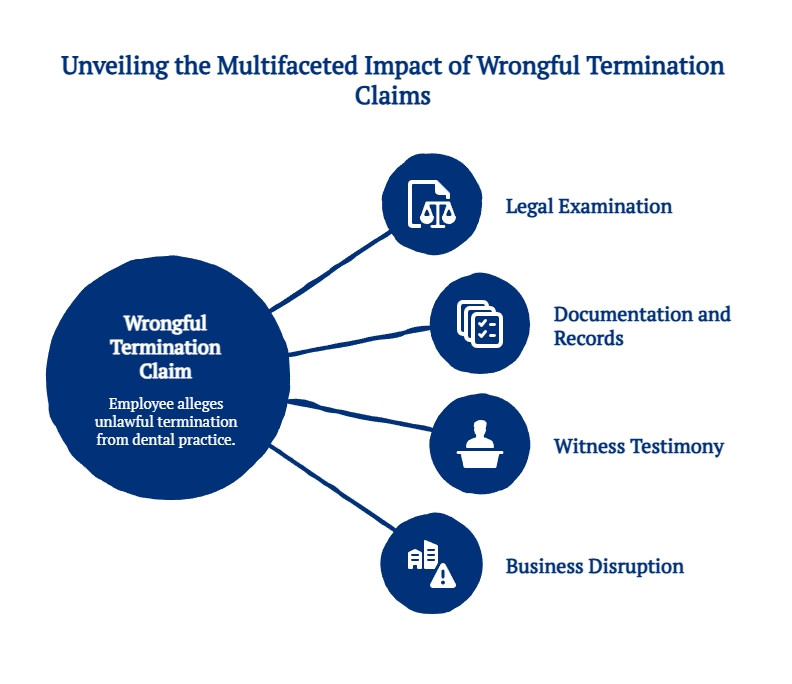
A wrongful termination claim may begin with an employee’s separation from employment, but the dispute often expands into the circumstances surrounding that decision. A former employee may allege that the termination followed a workplace complaint, a medical leave issue, an accommodation discussion, a scheduling dispute, a wage concern, a harassment complaint, or other protected activity.
Under California law generally, at-will employment does not necessarily prevent claims where an employee alleges that termination occurred for an unlawful reason. In that setting, litigation may examine the practice’s stated business reason, the timing of the employment decision, the consistency of prior documentation, the uniform application of established policies, and communications involving owners, managers, or supervisors.
The issue is not whether every allegation is valid. The practical concern is that the dental practice may need to address disputed narratives, employment records, witness testimony, and credibility issues while continuing to operate a patient-facing business.
Why Small Dental Practices Face Distinct Operational Pressure
Small dental practices often rely on a tightly coordinated team. One dentist-owner, one office manager, several dental assistants, hygienists, billing staff, and front-office employees may carry the daily workload. When litigation involves people in those roles, the disruption may be felt quickly.
Employment litigation may affect a dental practice in several ways, including but not limited to the following:
- Patient appointments may become harder to manage when the owner or key staff members are distracted by litigation-related obligations.
- Treatment-room productivity may suffer when staffing uncertainty affects hygienist availability, dental assistant coverage, or chairside support.
- Staff morale may decline when current employees become aware of allegations involving a former coworker.
- Patient trust, referral relationships, and community reputation may feel more vulnerable when employment allegations create internal stress.
These concerns do not mean the practice violated the law. They reflect the reality that a small dental office may have fewer administrative buffers than a larger healthcare organization.
Employment Records and Communications May Become Central Issues
Wrongful termination litigation often involves more than testimony about the final termination decision. The dispute may place employment records and communications under scrutiny, especially where the former employee claims that the stated reason for termination was inconsistent, incomplete, retaliatory, discriminatory, or connected to protected activity.
For a dental practice, relevant information may include payroll records, work schedules, timekeeping entries, emails, text messages, disciplinary notes, accommodation communications, leave-related records, supervisor notes, performance documentation, and communications involving staff coverage. If the allegations overlap with wage-and-hour issues, scheduling and payroll practices may receive additional attention.
Contemporaneous and consistent documentation may become significant because wrongful termination disputes often focus on what the employer knew, what decision-makers said, and whether the business reason for the employment decision is supported by the available record. Inconsistent documentation, unexplained deviation from stated policy, or close timing between protected activity and termination may become disputed issues in litigation.
Informal communication may also matter. A text message about a shift change, a brief note about chairside performance, or an email about front-office coverage may later be viewed in a litigation context. Informality does not automatically create potential exposure, but the surrounding facts, consistency, and business context may affect how the dispute develops.
Informal Dental Office Practices Can Become Litigation Issues
Many small dental practices operate through direct communication and practical flexibility. A dentist-owner may speak with employees in person, adjust schedules quickly, or address performance concerns without multiple layers of human resources review. That structure may help the practice function efficiently, but it can also become difficult to explain after an employment dispute arises.
A former employee may allege that discipline was inconsistent, expectations were unclear, complaints were not handled evenly, or scheduling decisions were connected to protected activity. When an owner, office manager, or supervising dentist participates in discipline, scheduling, accommodation discussions, leave communications, or termination decisions, litigation may examine the stated business reason, timing, documentation, witness accounts, and consistency of that decision.
Dental offices also have operational realities that differ from many other small businesses. Patient safety, sterilization workflows, treatment-room timing, billing accuracy, and coordinated chairside support may all provide important business context when employment decisions are later disputed. Where a dental practice has HR support or employment counsel involved in sensitive employment decisions, that involvement may also affect how the decision-making process is evaluated.
Wrongful Termination Claims May Overlap With Other Allegations
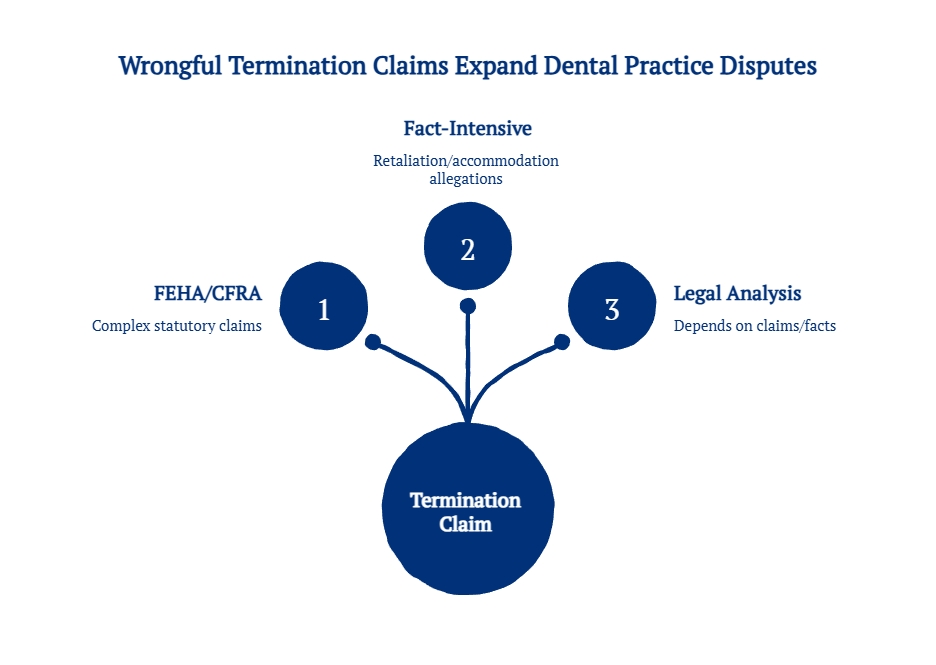
A termination-related dispute may include related allegations of retaliation, harassment, wage-and-hour violations, or termination in violation of public policy, which apply to all California workplaces regardless of size. For dental practices that regularly employ five or more people, these disputes can also expand to include complex statutory claims under the Fair Employment and Housing Act (FEHA) and the California Family Rights Act (CFRA)—such as formal discrimination, medical or pregnancy-related leave interference, and a failure to provide reasonable accommodations or engage in the interactive process.
For example, a former employee may assert that termination followed a complaint about unlawful harassment or discrimination, a concern about pay practices, a request for disability-related accommodation, or a leave-related communication. Where retaliation or reasonable accommodation allegations appear, the case may become more fact-intensive. Timing, protected activity, protected status, communications, and witness accounts may all become part of the dispute.
Employment laws are subject to change, and legal analysis depends on the claims asserted, the facts alleged, the available evidence, and the applicable California and federal law.
Litigation Costs and Management Distraction Can Become Business Risks
For a small dental practice, employment litigation may create pressure beyond potential legal exposure. Legal spending, management distraction, staff disruption, cash flow concerns, and patient-facing reputation may all become part of the business impact.
A litigation approach that is not proportionate to the dispute may create additional financial pressure. At the same time, underestimating a serious employment claim may also create risk. Dental employers facing active wrongful termination litigation may benefit from representation that accounts for both the legal dispute and the practical need to keep the practice operating.
Employer Defense Representation for Southern California Dental Practices
Wrongful termination litigation may involve credibility, documentation, witness testimony, timing, consistency, protected activity, protected status, and business context. For dental employers, those issues may also involve patient schedules, treatment-room coverage, office workflows, payroll records, and small-team dynamics.
Akopyan Law Firm, A.P.C. provides employment law representation for employers in California employment disputes, including wrongful termination claims and related allegations. The firm’s employer-side litigation experience may be relevant for small dental practices that lack in-house employment-law infrastructure and need direct attention from experienced employment litigators.
California dental practice owners facing an employee lawsuit, demand letter, or agency complaint may contact Akopyan Law Firm, A.P.C. to discuss employer-defense representation in a wrongful termination matter.
Disclaimer:
This content is for informational purposes only. Laws, definitions, and deadlines change. Verify current requirements through official California sources. This content is not legal advice. No attorney-client relationship is formed through this content. Please consult a qualified attorney in your jurisdiction for legal advice specific to your situation.
Protect Your Business | The Akopyan Law Firm, A.P.C. | Top Gun Employment Lawyers
Have you been sued by an employee? Are you overwhelmed by the complexities of employment law? If so, give us a call. The Akopyan Law Firm, A.P.C. assists small business owners throughout Southern California. Our seasoned employment defense lawyers stand ready to help employers quickly and efficiently resolve employment disputes. We are ready to aggressively and skillfully defend against any employment case, but understand that in most situations avoiding the expense of litigation is in the client’s best interest.
Take the First Step Protecting Your Future: Call us today to speak with one of our experienced employment defense lawyers.
Contact Us Today:
- Phone: (818) 509-9975
- Office Locations in California: Los Angeles, Bakersfield, Costa Mesa, Temecula, Rancho Cucamonga, Oxnard, Culver City, and San Diego.