
📌 Key Takeaways
Wrongful termination claims may create operational, financial, and litigation pressure for Southern California dental practices without in-house legal departments.
- Disruption Starts Early: A wrongful termination claim may affect patient scheduling, staff coverage, management focus, and day-to-day dental-practice operations.
- Records Shape Scrutiny: Payroll records, schedules, disciplinary notes, emails, and text messages may become relevant to timing, consistency, and credibility.
- Protected Activity Matters: Allegations involving protected status, wage complaints, harassment, or retaliation can quickly broaden a dispute. For dental practices with five or more employees, statutory accommodation or leave-related claims may further expand litigation complexity.
- Small Teams Add Pressure: Close working relationships may make witness issues, morale concerns, and management credibility more sensitive in dental employment claims.
- Trial Readiness Matters: Experienced employment defense attorney may help evaluate evidence, potential exposure, business disruption, and litigation risk without guaranteeing outcomes.
Strong records, consistent decisions, and litigation-focused judgment may help dental practices understand the seriousness of a wrongful termination claim.
California dental practice owners facing employee claims will gain immediate clarity here, guiding them into the wrongful-termination-specific details that follow.
~ ~ ~ ~ ~ ~ ~ ~ ~ ~ ~ ~ ~ ~ ~ ~ ~ ~
A wrongful termination claim may become a serious operational and litigation concern for a Southern California dental practice that does not have an in-house legal department. The dispute may begin with a former employee’s termination, but it may quickly place the practice’s records, communications, staffing decisions, management credibility, and patient-facing operations under scrutiny. For a dentist-owner, the pressure can be immediate because the practice must continue treating patients while responding to an employment-law claim.
Under California law, wrongful termination allegations may involve claims that an employment decision was connected to protected status, protected activity, disability accommodation, medical leave, wage complaints, harassment complaints, whistleblower activity, retaliation, or public policy. California’s Civil Rights Department identifies employment protections involving discrimination, harassment, reasonable accommodation, and retaliation, and the California Labor Commissioner recognizes retaliation protections tied to labor-law rights.
A Wrongful Termination Claim Can Disrupt Dental-Practice Operations
Dental practices depend on appointment flow, clinical staffing, front-office coordination, patient confidence, and predictable revenue. A wrongful termination lawsuit, demand letter, or agency complaint may interfere with those priorities because the matter may require attention from the same people who keep the practice operating.
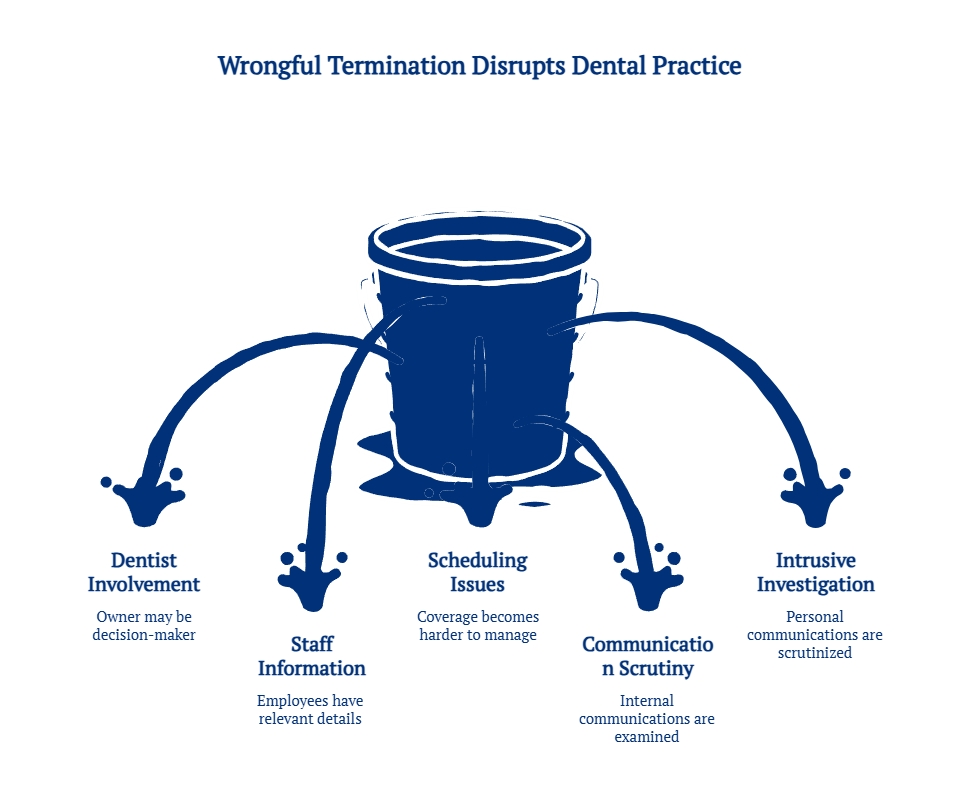
The disruption may affect the practice in several ways:
- A dentist-owner may have participated in, approved, or communicated the challenged employment decision.
- A supervising dentist, office manager, billing coordinator, treatment coordinator, dental assistant, or hygienist may have information relevant to the dispute.
- Patient scheduling and staff coverage may become harder to manage when current employees are connected to the facts alleged.
- Internal communications may receive attention because the claim may involve timing, protected activity, consistency, motive, or workplace context.
For an owner-operated dental practice, the claim may be unusually intrusive. The person responsible for patient care may also be the decision-maker whose emails, text messages, conversations, or documentation are being examined.
Why the Lack of an In-House Legal Department Can Increase Pressure on Dentist-Owners
A dental practice without in-house employment litigation counsel often relies on a small administrative team to manage payroll, scheduling, personnel files, billing workflows, and day-to-day employee issues. Those internal functions are different from managing an active employment dispute.
Once a former employee asserts wrongful termination, the practice may face questions involving payroll records, schedules, timekeeping entries, disciplinary notes, leave communications, accommodation communications, emails, text messages, and agency or court documents. These materials may become relevant because they may reflect what occurred before and after the challenged termination.
In that setting, outside employer-side employment defense representation may provide litigation-focused evaluation that differs from ordinary office administration. The issue is not whether the practice administrator or office manager is capable. The issue is that active litigation may involve potential exposure, court or agency consequences, and legal judgment that fall outside ordinary dental-office operations.
How Wrongful Termination Allegations May Reach Beyond the Termination Decision
A wrongful termination claim rarely concerns only the final separation decision. A former employee may assert that the termination followed a protected complaint, an employee’s request for medical leave, a disability-related reasonable accommodation discussion, a pregnancy-related issue, a wage complaint, a harassment complaint, or a report of suspected legal noncompliance.
The practice’s broader employment history may then receive attention. A dispute may involve performance evaluations, disciplinary write-ups, schedule changes, complaint history, leave communications, accommodation communications, or the treatment of similarly situated employees. Close proximity between protected activity and the termination may increase scrutiny of the employer’s stated rationale. A former employee may also allege pretext if the stated reason appears inconsistent with contemporaneous records, prior evaluations, or established policies.
The dental practice may view the employment decision differently. Even so, the claim may require careful evaluation because employment litigation often turns on documents, timing, credibility, consistency, and competing narratives. California wrongful termination law also recognizes public-policy theories in certain circumstances, which can further expand the scope of the dispute.
Why Employment Records and Informal Communications May Become Part of the Dispute
Small dental practices often communicate informally because the workplace is fast-moving and patient-facing. A dentist-owner may send a quick text about a schedule change. An office manager may email about attendance, coverage, billing delays, or front-desk performance. A supervising dentist may discuss clinical staffing concerns in a brief message rather than a formal memorandum.
Those ordinary communications may take on significance when a former employee alleges wrongful termination. The dispute may examine how the practice described performance concerns, how supervisors responded to complaints, whether timing created potential exposure, and whether records reflect consistent application of established policies.
Contemporaneous, consistent documentation may affect how the employer’s stated business reason is evaluated. A departure from established policy, inconsistent disciplinary records, or unexplained differences in the treatment of similarly situated employees may become part of the former employee’s theory.
Some wrongful termination allegations may overlap with other employment-law issues. A wage complaint may connect the matter to wage-and-hour defense. For practices employing five or more individuals, a disability-related allegation may implicate statutory reasonable accommodation concepts under the Fair Employment and Housing Act (FEHA), and a leave-related allegation may involve family and medical leave issues under the California Family Rights Act (CFRA) (Cal. Gov. Code § 12926(d); § 12945.2). While micro-practices with fewer than five employees are exempt from these specific statutory leave and discrimination frameworks, they remain subject to California’s strict anti-harassment laws—which cover all workplaces regardless of size—as well as common-law public policy claims.
Small Dental Teams Can Make Witness and Credibility Issues More Sensitive
Dental practices often operate through close working relationships. The dentist-owner may work directly with the office manager. Dental assistants and hygienists may interact daily with the same supervisors. Front-office employees may have direct knowledge of scheduling, patient communications, billing concerns, and staff conflicts.
When a former employee asserts wrongful termination, current employees may later be identified as witnesses or sources of information. That can affect morale, workplace trust, and management focus. It can also make the dispute more sensitive because small-team employees may remember conversations differently or interpret the same event through different roles.
From a litigation-risk perspective, credibility may be evaluated alongside contemporaneous records, timing, and consistency. A small dental practice may not have multiple management layers to separate ownership, supervision, documentation, and witness involvement. That structure may make the claim more disruptive even when the practice believes the employment decision had a legitimate business reason.
Financial Pressure Can Shape the Litigation Burden for Dentist-Owners
A wrongful termination claim may create financial pressure before the matter is resolved. The practice may continue paying rent, payroll, supply costs, laboratory expenses, equipment obligations, and insurance-related business expenses while also dealing with defense costs and operational disruption.
For dentist-owners, the burden is practical as well as legal. Patient appointments must continue. Staff members must remain scheduled. Revenue must support the business. A serious employment claim may compete with all of those obligations at once.
This is why proportionality matters in employment litigation. The burden of a claim may be shaped by potential exposure, disruption to patient care, defense costs, and the need to evaluate whether the challenged employment decision appears consistent with contemporaneous records and established policies.
Why Trial-Ready Employment Defense Counsel Matters in Serious Claims
Wrongful termination claims may require judgment about potential exposure, protected activity, credibility, documentary evidence, settlement pressure, and trial risk. A dental practice without in-house legal counsel may be facing those issues while also managing patient care and a small team.
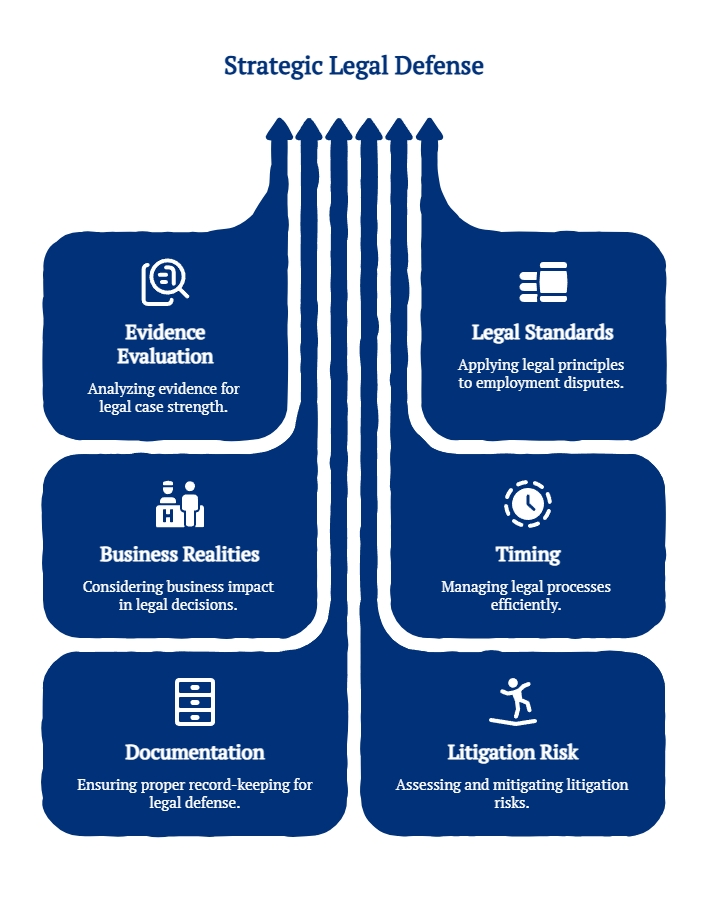
Trial-ready employment defense counsel does not guarantee any result. It may, however, help evaluate the dispute through the lens of evidence, legal standards, business realities, timing, documentation, and the practical risks of prolonged litigation. For a dental practice, that perspective may be especially significant when the owner is directly involved in the events being challenged.
Akopyan Law Firm, A.P.C. represents Southern California employers in employment disputes, including wrongful termination claims and related litigation. The firm’s employer-side practice focuses on helping businesses address serious employee claims efficiently while remaining mindful of business disruption, cost, and litigation risk. Dental employers facing specific claims can consult qualified employment defense attorney for guidance based on the facts of the dispute.
Disclaimer:
This content is for informational purposes only. Laws, definitions, and deadlines change. Verify current requirements through official California sources. This content is not legal advice. No attorney-client relationship is formed through this content. Please consult a qualified attorney in your jurisdiction for legal advice specific to your situation.
Protect Your Business | The Akopyan Law Firm, A.P.C. | Top Gun Employment Lawyers
Have you been sued by an employee? Are you overwhelmed by the complexities of employment law? If so, give us a call. The Akopyan Law Firm, A.P.C. assists small business owners throughout Southern California. Our seasoned employment defense lawyers stand ready to help employers quickly and efficiently resolve employment disputes. We are ready to aggressively and skillfully defend against any employment case, but understand that in most situations avoiding the expense of litigation is in the client’s best interest.
Take the First Step Protecting Your Future: Call us today to speak with one of our experienced employment defense lawyers.
Contact Us Today:
- Phone: (818) 509-9975
- Office Locations in California: Los Angeles, Bakersfield, Costa Mesa, Temecula, Rancho Cucamonga, Oxnard, Culver City, and San Diego.