
📌 Key Takeaways
Wrongful termination litigation can quickly disrupt a small Southern California dental practice when a termination claim expands into overlapping employment allegations.
- Claims Often Expand: Wrongful termination disputes may grow beyond the separation decision into retaliation, discrimination, accommodation, leave, wage-and-hour, or whistleblower allegations.
- Records Shape Litigation: Payroll data, schedules, time records, emails, texts, disciplinary notes, and accommodation communications may become significant in disputed termination claims.
- Timing Creates Scrutiny: Termination soon after protected activity may support allegations of retaliation or pretext, even when the practice asserts a legitimate business reason.
- Small Practices Feel Pressure: Owner-operated dental practices may face legal exposure, staff disruption, patient-scheduling strain, and operational stress at the same time.
- Defense Judgment Matters: Experienced employment defense counsel may help small practices evaluate allegations through defensible decision-making, evidentiary consistency, and proportionality.
Litigation pressure grows when employment decisions, records, and operations collide.
Southern California dental practice owners facing wrongful termination claims will gain immediate clarity here, preparing them for the detailed overview that follows.
Wrongful termination litigation can create immediate pressure for a small Southern California dental practice. A claim involving a former dental assistant, dental hygienist, receptionist, treatment coordinator, billing coordinator, office manager, or other staff member may begin with a termination decision, but it often expands into allegations involving retaliation, whistleblower activity, wage-and-hour disputes, or workplace complaints. For practices that employ five or more individuals, these disputes frequently encompass statutory claims for discrimination, harassment, disability accommodation, and job-protected medical leave [Cal. Gov. Code § 12940; Cal. Gov. Code § 12945.2]. However, even micro-practices with fewer than five employees face exposure under broad whistleblower protections and common-law public policy claims [Cal. Lab. Code § 1102.5].
Why Wrongful Termination Claims Can Disrupt a Small Dental Practice
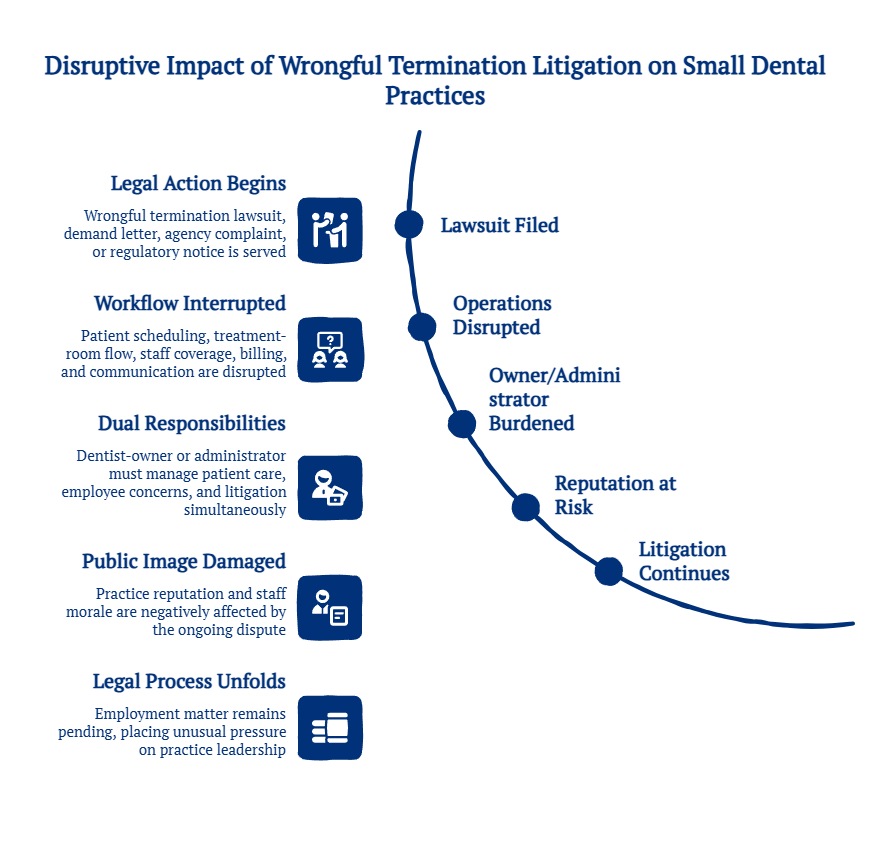
A small dental practice depends on reliable patient scheduling, treatment-room flow, staff coverage, billing continuity, insurance coordination, and front-office communication. A wrongful termination lawsuit, demand letter, agency complaint, or regulatory notice can disrupt those operations quickly.
For an owner-operated practice, the dispute may affect more than the employment file. A dentist-owner or practice administrator may need to continue managing patient care, current employee concerns, staff morale, payroll issues, and reputation-sensitive communications while the employment matter remains pending. Litigation can place unusual pressure on dentist-owners and practice administrators who must continue operating the practice while responding to a dispute involving their own employment decisions.
How Wrongful Termination Allegations Commonly Arise in Dental Practice Employment Disputes
In many employment disputes, the plaintiff alleges that the termination was connected to a legally protected reason. The dental practice may have identified performance concerns, attendance issues, scheduling conflicts, restructuring, patient-flow problems, or workplace conflict. The practice may assert a legitimate business reason for the termination, while the former employee may argue that the stated reason was pretext for retaliation, discrimination, or another prohibited motivation.
Under California law, wrongful termination claims may arise under statutory or common-law theories, including claims alleging termination in violation of public policy.
Why California Wrongful Termination Claims Often Overlap With Other Employment Allegations
Wrongful termination litigation is often not limited to whether the final employment decision was justified. Depending on the allegations, overlapping claims may include, among other issues:
- A former employee may allege retaliation after raising a wage complaint, safety concern, or compliance issue.
- A former employee may allege discrimination based on disability, pregnancy, race, sex, national origin, religion, age, or another protected category.
- A former employee may allege that a termination followed an employee’s request for job-protected medical leave or other legally protected leave.
- A former employee with a disability may allege failure to engage in the interactive process or failure to provide reasonable accommodation.
- A former employee may allege harassment or a hostile work environment as part of the broader termination narrative.
These allegations matter because protected status and protected activity can affect how a termination decision is evaluated, especially when the plaintiff challenges the employer’s stated reason as pretext. For dental practices that employ five or more individuals, discrimination, retaliation, and reasonable accommodation allegations are formally analyzed under the statutory framework of the Fair Employment and Housing Act (FEHA) [Cal. Gov. Code § 12940]. Critically, however, FEHA’s anti-harassment provisions apply to all employers with one or more employees [Cal. Gov. Code § 12940(j)(4)(A)]. This means that even a micro-practice with fewer than five employees faces direct statutory liability for harassment under FEHA, whereas other claims like discrimination or failure to accommodate fall under common-law tort claims for wrongful termination in violation of public policy. Conversely, whistleblower retaliation allegations involve California Labor Code section 1102.5, which applies to all employers regardless of headcount [Cal. Lab. Code § 1102.5]. Rather than a strict liability standard, these claims are evaluated under a highly protective ‘contributing factor’ burden-shifting framework established under Labor Code section 1102.6 and clarified by the California Supreme Court in Lawson v. PPG Architectural Finishes, Inc. Once an employee demonstrates by a preponderance of the evidence that whistleblowing was a contributing factor to their termination, the employer bears the rigorous burden of proving by clear and convincing evidence that the adverse action would have occurred anyway for legitimate, independent reasons.
Why Dental Practice Records and Communications Often Become Important in Litigation
When a termination decision is challenged, the focus may expand to communications and records created before the separation. Payroll information, schedules, timekeeping data, emails, text messages, disciplinary records, leave communications, accommodation discussions, supervisor notes, and patient-facing complaints may become relevant to the allegations.
These materials may matter because wrongful termination claims often involve causation, pretext, credibility, and consistency. A plaintiff may argue that the practice’s stated reason for termination does not align with the surrounding employment record. The dispute may then focus on what decision-makers knew, when they knew it, how they communicated, and whether similarly situated employees were treated consistently.
In wrongful termination litigation, contemporaneous and consistent documentation may become significant because it can show how the practice understood performance, attendance, scheduling, or workplace issues at the time decisions were made. Deviation from established policies, inconsistent treatment of similarly situated employees, or close proximity between protected activity and termination may create additional scrutiny regarding causation and pretext.
Termination Decisions Made Directly by Dentist-Owners or Supervising Dentists
Small dental practices often operate without layers of corporate administration. Dentist-owners, managing dentists, office managers, or supervising dentists may directly observe employee performance, assign schedules, respond to patient-flow concerns, address staff conflict, and participate in discipline or termination decisions.
In litigation, direct involvement may make management credibility and communication history more significant. A plaintiff may focus on timing, statements, perceived inconsistencies, or differences in treatment among employees. An informal management structure does not, by itself, establish liability. However, informal decision-making may receive close scrutiny when a former employee challenges the motivation behind a termination.
Wrongful Termination Claims After Workplace Complaints, Leave Requests, or Accommodation Issues
Wrongful termination allegations may become more complex when termination follows a an employee’s request for job-protected medical leave under the California Family Rights Act (applicable to employers with five or more employees), a pregnancy-related issue, a disability-related accommodation discussion, a wage complaint, or a safety concern. Furthermore, under expanded protections effective January 1, 2026, via Assembly Bill 406, all California employers—regardless of size—must permit employees to use job-protected paid sick and safe time for a broader range of reasons, including serving on a jury, responding to a witness subpoena, or attending judicial proceedings related to a violent crime or felony theft affecting themselves or a family member [Cal. Lab. Code § 246; Cal. Gov. Code § 12945.8]. In these settings, a plaintiff may argue that an adverse employment decision closely following such requests serves as an inference of retaliation or pretext.
At-will employment does not eliminate litigation risk when a former employee alleges retaliation, discrimination, public policy wrongful termination, whistleblower retaliation, or protected leave interference. Timing alone does not establish liability, but timing may become part of the litigation narrative when the stated reason for termination is disputed. When termination follows closely after protected activity, a plaintiff may argue that the timing supports an inference of retaliation or pretext, even when the practice asserts a legitimate business reason for the employment decision.
Why Wage-and-Hour Issues Can Complicate Wrongful Termination Litigation in Dental Practices
A wrongful termination claim may also include wage-and-hour allegations. A former dental practice employee may raise issues involving timekeeping, meal and rest breaks, overtime, off-the-clock work, minimum wage, or employee classification. The dispute may then expand beyond the reason for separation and include broader payroll, scheduling, and employment-practice allegations.
This overlap can matter for small dental practices because scheduling, patient appointments, lunch periods, closing duties, and front-office responsibilities may all become part of the factual record. A claim that began as a termination dispute may become more costly and disruptive when payroll practices or staffing patterns are also challenged.
The Business Pressure on Owner-Operated Dental Practices in Southern California
For owner-operated dental practices, wrongful termination litigation can be both disruptive and deeply stressful. One employee dispute may affect cash flow, staff confidence, patient relationships, and the owner’s ability to focus on clinical care. A small practice may also be concerned about litigation activity that does not match the size, staffing model, or financial realities of the business.
For a closely held practice, the legal dispute and the operational disruption often develop at the same time. That business pressure should not minimize employee rights or protected workplace activity. It does, however, explain why small dental practices often need litigation judgment that accounts for both legal exposure and day-to-day operational reality.
Why Experienced Employment Defense Attorney Matters When a Dental Practice Is Sued
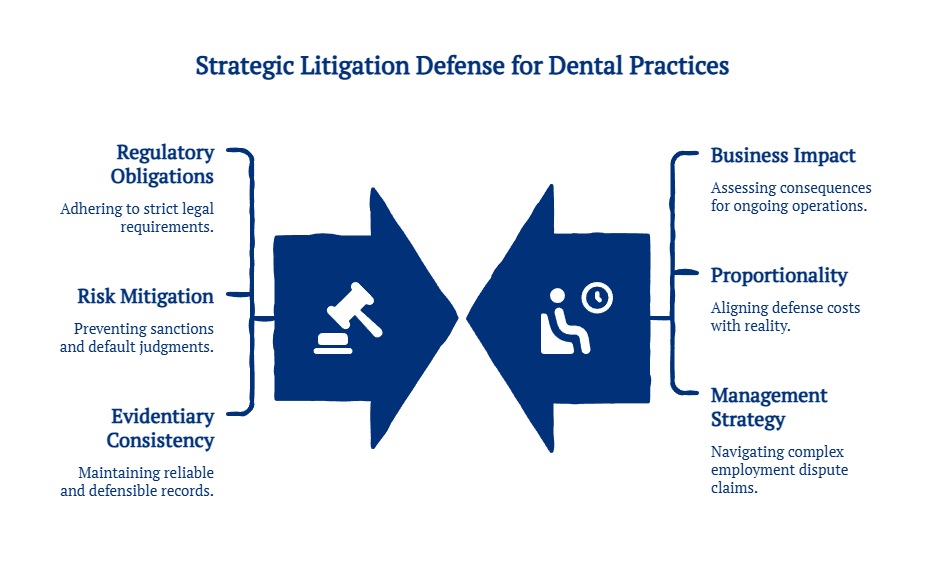
Active litigation or agency proceedings can involve strict obligations, and delayed or improper handling may create serious consequences, including default judgment, sanctions, expanded liability, or additional disputes. Experienced employment defense counsel can help a dental practice understand the nature of the allegations, the potential business impact, and the legal complexity of the dispute without losing sight of the practice’s ongoing operations.
Wrongful termination litigation may involve overlapping claims, disputed motivations, management communications, and credibility issues. For a small dental practice, proportionality also matters because litigation activity should remain aligned with the size and realities of the dispute. Early involvement of employment defense counsel may help ensure that the practice’s response to litigation is evaluated through the lens of defensible decision-making, evidentiary consistency, and proportionality.
Related Wrongful Termination Issues for Southern California Dental Practices
Wrongful termination disputes in dental practices may overlap with unlawful workplace retaliation, whistleblower retaliation, disability discrimination, reasonable accommodation, family and medical leave, wage-and-hour defense, and hostile work environment claims. These overlapping issues can affect how the dispute is framed, what evidence becomes significant, and how much pressure the claim places on the practice.
Employment Defense Representation for Small Dental Practices Facing Wrongful Termination Claims
Small dental practices facing an employee lawsuit, demand letter, agency complaint, or regulatory notice need litigation-focused employment defense counsel who understands closely held businesses. Wrongful termination claims can affect patient scheduling, staff stability, management credibility, and the owner’s ability to keep the practice operating while the dispute proceeds.
Akopyan Law Firm, A.P.C. represents employers in employment disputes involving small businesses, closely held companies, and owner-operated workplaces. Dental practice owners facing a wrongful termination lawsuit, demand letter, agency complaint, or regulatory notice can contact Akopyan Law Firm, A.P.C. to discuss employment defense representation with attorneys experienced in California employment disputes.
Disclaimer:
This content is for informational purposes only. Laws, definitions, and deadlines change. Verify current requirements through official California sources. This content is not legal advice. No attorney-client relationship is formed through this content. Please consult a qualified attorney in your jurisdiction for legal advice specific to your situation.
Protect Your Business | The Akopyan Law Firm, A.P.C. | Top Gun Employment Lawyers
Have you been sued by an employee? Are you overwhelmed by the complexities of employment law? If so, give us a call. The Akopyan Law Firm, A.P.C. assists small business owners throughout Southern California. Our seasoned employment defense lawyers stand ready to help employers quickly and efficiently resolve employment disputes. We are ready to aggressively and skillfully defend against any employment case, but understand that in most situations avoiding the expense of litigation is in the client’s best interest.
Take the First Step Protecting Your Future: Call us today to speak with one of our experienced employment lawyers.
Contact Us Today:
- Phone: (818) 509-9975
- Office Locations in California: Los Angeles, Bakersfield, Costa Mesa, Temecula, Rancho Cucamonga, Oxnard, Culver City, and San Diego.