
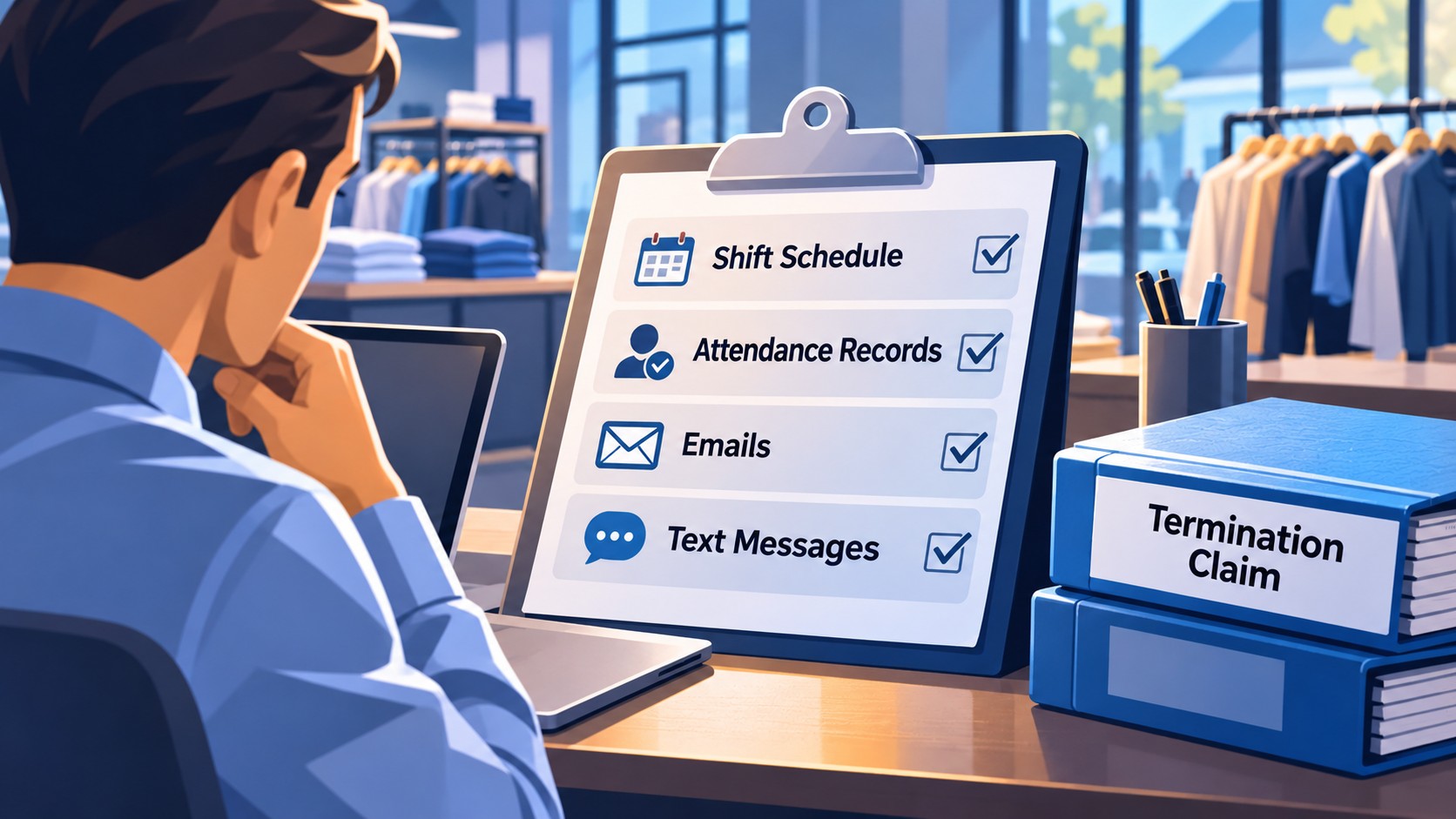
Attendance-related terminations may become complex wrongful termination disputes when the employer and former employee contest the reason for separation.
- Attendance Alone Is Inconclusive: An attendance or scheduling disagreement does not independently establish wrongful termination; the allegations, stated reason, and surrounding facts shape the dispute.
- Records Provide Factual Context: Schedules, attendance records, emails, and text messages may clarify events without independently resolving competing interpretations or determining liability.
- Credibility Increases Complexity: Different accounts from owners, managers, supervisors, and former employees may create credibility disputes when compared with existing records and surrounding circumstances.
- Litigation Reaches Operations: A wrongful termination claim may demand management attention and financial resources while the retailer continues meeting payroll and operating its storefront.
- Claim Paths May Differ: A dispute may involve a demand letter, administrative complaint, or civil lawsuit, but not every matter follows the same sequence.
For Culver City retail owners and authorized decisionmakers facing an active claim, these points frame the factual, operational, and representation issues that may follow.
Contested attendance decisions can place records, credibility, management attention, and business resources at the center of wrongful termination litigation.
~ ~ ~ ~ ~ ~ ~ ~ ~ ~ ~ ~ ~ ~ ~ ~ ~ ~
An attendance or scheduling disagreement does not, by itself, establish wrongful termination. When a former employee challenges the resulting discharge, however, the circumstances surrounding the employment separation may become central to a lawsuit, demand letter, or administrative complaint.
Culver City retailers rely on adequate staffing to serve customers and maintain storefront operations. An employer may attribute a termination to missed shifts, availability conflicts, or disagreements over assigned hours. A former employee may contest that explanation or allege that the decision implicated rights or conduct protected under applicable California employment law. The resulting dispute can place scheduling records, management communications, and differing accounts under scrutiny while the retailer continues operating its business.
Attendance and Scheduling Disputes in Wrongful Termination Litigation
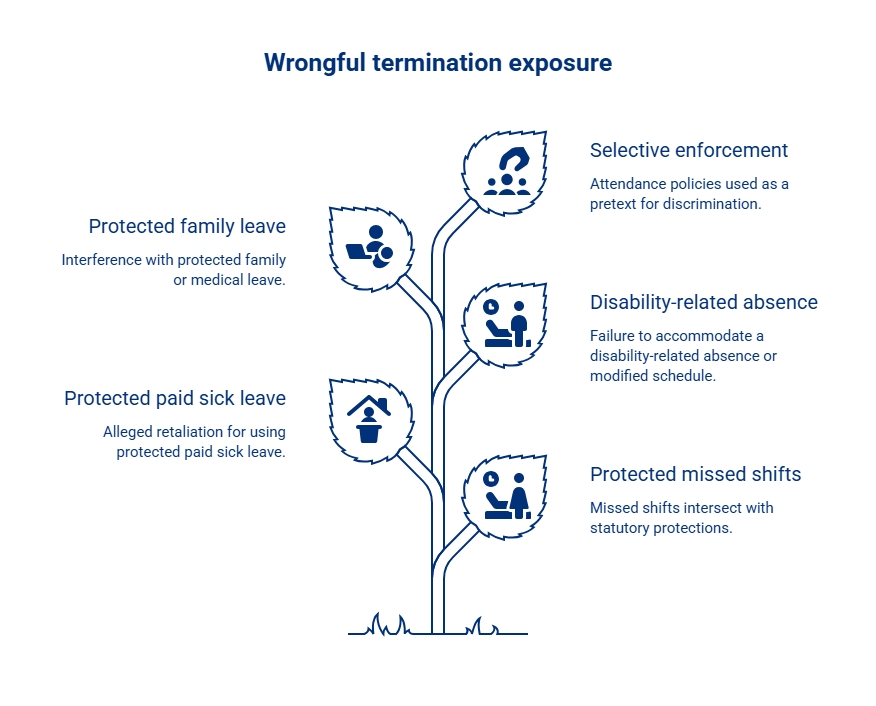
An attendance-related termination can produce distinct factual and legal questions. The employer may identify repeated absences, missed shifts, or an inability to work assigned hours as the operational reason for the separation. The former employee may dispute those circumstances, challenge the stated reason, or allege that rights or conduct protected under applicable California employment law influenced the decision.
Although California is an at-will employment state under Labor Code section 2922, an attendance-based discharge can trigger wrongful termination exposure when the missed shifts intersect with statutory protections. Common California claims arising from retail scheduling and attendance disputes include alleged retaliation for using protected paid sick leave under the Healthy Workplaces, Healthy Families Act, failure to accommodate a disability-related absence or modified schedule under the Fair Employment and Housing Act (FEHA), interference with protected family or medical leave under the California Family Rights Act (CFRA), or selective enforcement of attendance policies used as a pretext for discrimination.
The existence of a scheduling disagreement does not determine whether the termination was lawful or unlawful. The allegations, the employer’s explanation, and the facts surrounding the separation may affect the scope and complexity of the litigation.
That distinction can become significant in wrongful termination defense. A retailer’s staffing concerns may form part of the factual record, while rights or conduct protected under applicable California employment law may be relevant to the former employee’s allegations. Neither position establishes the outcome without consideration of the particular claims and circumstances.
Existing Scheduling Records and Communications May Provide Factual Context
Existing business records may provide context when the parties disagree about the events preceding a termination. Relevant materials may include, without limitation, shift schedules, attendance records, scheduling-system entries, emails, and text messages exchanged by employees and management.
These materials can carry particular significance in an independently operated store where owners or managers communicate directly with employees. A schedule may reflect assigned hours or later changes. An attendance record may document missed work. A message may show what an employee reported and what information management received at a particular time.
Beyond documenting the former employee’s own absences, defense evaluation often examines comparator records—how the store applied its attendance and tardiness rules to other retail staff in similar roles. Consistent enforcement across shifts and supervisors helps demonstrate that the termination rested on legitimate operational standards rather than pretext, whereas informal, uneven exceptions can complicate the defense record.
No single record necessarily resolves a contested event. Its significance depends on the allegations, the circumstances in which the record was created, and its relationship to the rest of the factual record. Existing documents may clarify the sequence of events even when they do not capture every related conversation or circumstance.
Differing Accounts Can Increase the Complexity of the Claim
A small retailer may have few management layers. The owner or store manager may have assigned shifts, discussed attendance concerns, received an explanation for an absence, and participated in the termination decision.
The former employee may recall those events differently. A supervisor may interpret a scheduling exchange in another way. An informal message may not capture all the circumstances surrounding the communication. Owners, managers, supervisors, and former employees may therefore present competing accounts of the same employment history.
These differences can create credibility disputes concerning what occurred, what information each participant possessed, and why the employment relationship ended. A credibility dispute does not independently prove wrongful termination or validate the employer’s position. Instead, the dispute may require different accounts to be considered alongside the existing records and surrounding circumstances.
Litigation Can Affect a Retailer Beyond Its Legal Expenses
A wrongful termination claim may require attention from people who ordinarily manage staffing, inventory, sales, customer service, and other storefront responsibilities. Business leaders may need to address the dispute while maintaining the retailer’s ordinary operations.
For a retailer without in-house counsel, the proceeding may also place pressure on available financial resources. The business may fund its defense while continuing to meet payroll, occupancy costs, vendor obligations, and other operating expenses. The amount and duration of that burden depend on the nature and development of the matter.
Litigation-related demands may affect management availability, workplace relationships, customer-facing functions, and business reputation. The extent of those effects varies, but the potential impact shows why employment-law representation for employers concerns both the legal allegations and the demands placed on the business.
How an Attendance-Related Dispute May Become a Formal Claim
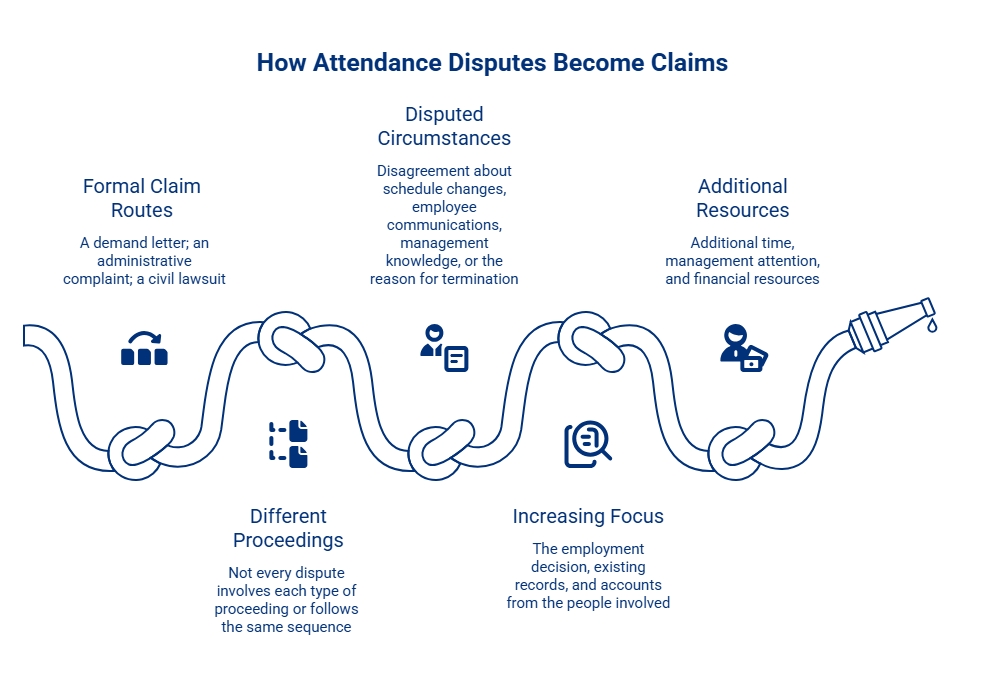
A demand letter may communicate a former employee’s allegations and requested resolution. An administrative complaint may place allegations before an employment agency. A civil lawsuit may present legal claims against the retailer in court. Not every dispute involves each type of proceeding or follows the same sequence.
In California, an administrative complaint typically involves a charge filed with the California Civil Rights Department (CRD), where a former employee may request an immediate Right-to-Sue notice or an agency investigation, or a retaliation complaint before the California Labor Commissioner’s Office (DLSE), while civil lawsuits against Culver City retailers are generally litigated in the Los Angeles County Superior Court.
The allegations determine which laws may apply and which disputed circumstances become relevant. A matter focused initially on missed shifts may also involve disagreement about schedule changes, employee communications, management knowledge, or the reason for termination. The scope depends on the claims asserted and the underlying facts.
As the matter develops, the parties may focus more closely on the employment decision, existing records, and accounts from the people involved. That increased focus can demand additional time, management attention, and financial resources without determining the ultimate merits of either party’s position.
Employment Litigation Representation for Culver City Retail Businesses
A wrongful termination claim can feel personal when an owner or manager participated directly in the disputed events. Experienced Culver City employment defense counsel can assess the allegations, the employer’s position, the factual record, and applicable law while the retailer’s leadership continues managing the business.
Disclaimer:
This content is for informational purposes only. Laws, definitions, and deadlines change. Verify current requirements through official California sources. This content is not legal advice. No attorney-client relationship is formed through this content. Please consult a qualified attorney in your jurisdiction for legal advice specific to your situation.
Protect Your Business | The Akopyan Law Firm, A.P.C. | Top Gun Employment Defense Lawyers
Have you been sued by an employee? Are you overwhelmed by the complexities of employment law? If so, give us a call. The Akopyan Law Firm, A.P.C. assists small business owners throughout Southern California. Our seasoned employment defense lawyers stand ready to help employers quickly and efficiently resolve employment disputes. We are ready to aggressively and skillfully defend against any employment case, but understand that in most situations avoiding the expense of litigation is in the client’s best interest.
Take the First Step Protecting Your Future: Call us today to speak with one of our experienced employment lawyers.
Contact Us Today:
- Phone: (818) 509-9975
- Office Locations in California: Los Angeles, Bakersfield, Costa Mesa, Temecula, Rancho Cucamonga, Oxnard, Culver City, and San Diego.