

Leave-related wrongful discharge allegations may involve competing explanations, employment records, procedural developments, and operational burdens without independently establishing unlawful conduct.
For Culver City retail employers facing active claims, these points identify where factual complexity, and business pressure may arise.
- Allegations Broaden Scrutiny: A leave-related allegation may expand scrutiny beyond the termination decision to the employee’s leave, the employer’s explanation, and related employment records.
- Timing Does Not Decide: Temporal proximity may form part of an alleged causal connection, but timing alone does not determine whether an employer is liable.
- Records May Conflict: Schedules, attendance information, management communications, and individual recollections may present different accounts of the circumstances surrounding the termination.
- Claims Follow Different Paths: Demand letters, administrative complaints, lawsuits, and discovery may arise in different combinations depending on the asserted claims and procedural requirements.
- Litigation Disrupts Operations: Legal expense, management involvement, scheduling strain, and uncertainty may affect a small retailer while owners and managers continue operating the store.
A leave-related allegation can widen both the factual inquiry and operational burden without establishing liability.
~ ~ ~ ~ ~ ~ ~ ~ ~ ~ ~ ~ ~ ~ ~ ~ ~ ~
A wrongful discharge allegation following family or medical leave can place a small Culver City retailer’s termination decision under close scrutiny. The dispute may reach beyond the termination to encompass the employee’s request for or use of family or medical leave, the employer’s stated reason, and related employment records. A former employee may claim that potentially protected leave influenced the decision, while the employer may identify an unrelated business reason. Neither the allegation nor the timing alone determines whether the termination was unlawful. For an owner-operated retailer, the claim may also consume management attention while the storefront continues serving customers.
Understanding the Central Wrongful Discharge Allegation
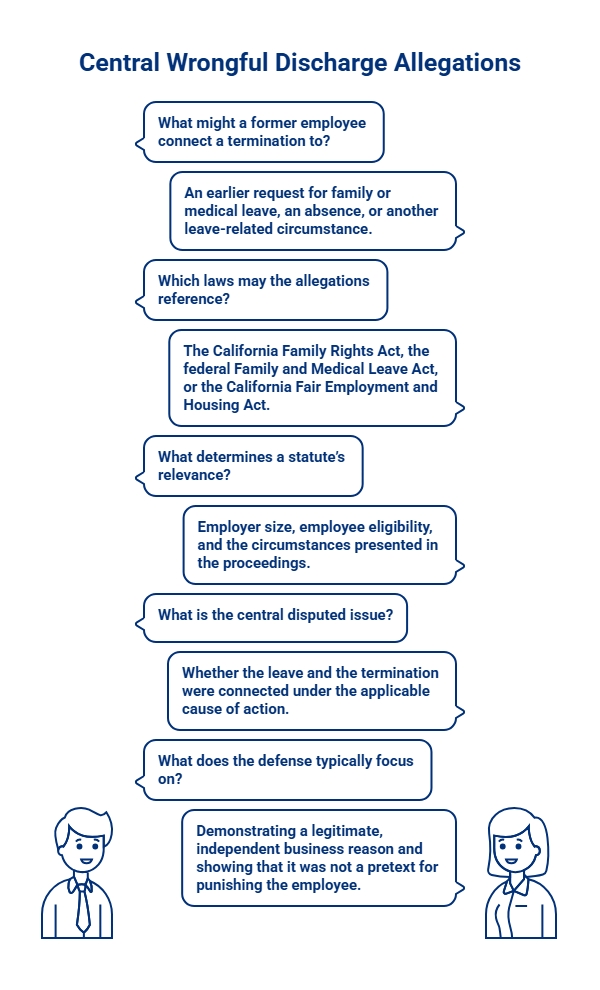
A former employee may connect a termination to an earlier request for family or medical leave, an absence, or another leave-related circumstance. Depending on the employment relationship and the asserted claim, the allegations may reference the California Family Rights Act, the federal Family and Medical Leave Act, or the California Fair Employment and Housing Act. Each law imposes distinct coverage and eligibility requirements, for example, the California Family Rights Act and the Fair Employment and Housing Act generally cover employers with five or more employees, whereas the federal Family and Medical Leave Act generally applies only to private employers with 50 or more employees within a 75-mile radius. A statute’s relevance depends on employer size, employee eligibility, and the circumstances presented in the proceedings.
The employer may state that attendance, scheduling, or another stated business reason caused the termination. The former employee may challenge that explanation or claim that it does not account for the decision. This disagreement creates a central disputed issue in wrongful termination defense: whether the leave and the termination were connected under the applicable cause of action. The existence of competing accounts does not establish which account will prevail.
In California leave disputes, the legal analysis often turns on whether the claim alleges interference with protected leave rights (under Cal. Gov. Code § 12945.2(q)) or retaliation and disability discrimination (under Cal. Gov. Code § 12940). Once a former employee points to protected leave and an adverse termination decision, the defense typically focuses on demonstrating a legitimate, independent business reason, such as documented pre-leave attendance violations, store-wide staffing reductions, or misconduct, and showing that this reason was not a pretext for punishing the employee. Additionally, when an employee’s 12-week CFRA leave expires and they still cannot return to work, FEHA generally requires employers with five or more employees to engage in a timely, good-faith interactive process (§ 12940(n)) to evaluate whether a brief extension of leave or workplace adjustment is a reasonable accommodation before proceeding with termination.
Timing Provides Context but Does Not Decide the Dispute
The sequence of events may shape the factual record. A proceeding may examine when the employee requested or took potentially protected family or medical leave, what managers communicated, when other relevant circumstances arose, and when the employer made the termination decision. Each event can provide context for the parties’ explanations.
Timing, however, does not operate in isolation. The closeness in time between leave and termination—often called temporal proximity—may form part of the alleged causal connection, but it does not determine whether the employer is liable. Its significance depends on the asserted legal theory, the surrounding employment circumstances, and the factual record. Conflicting accounts may complicate the evaluation without making either account conclusive.
Retail Records May Expand the Factual Inquiry
Retail operations generate employment records and management communications that may become relevant when a former employee challenges a termination. Shift schedules may show assigned hours and workplace coverage. Attendance information may reflect absences during the disputed period. Emails or text messages involving owners, store managers, supervisors, or shift leads may describe the circumstances at the time.
In evaluating these records, agencies and courts closely examine chronology, specifically whether written documentation of performance, attendance, or scheduling issues existed before the employee requested leave, or whether criticism first appeared in texts and schedules after the leave request was made.
Employment records and management communications may not present one uniform account. A schedule may supply operational context, while a manager’s recollection may address the reason for a decision. Another person may remember the same events differently. The factual inquiry may therefore extend beyond the final termination decision.
This scrutiny can be especially significant when a small management team handles staffing, customer service, inventory, and employment decisions. The same individuals may become involved in family and medical leave litigation involving employers because of their roles in the disputed circumstances. Their involvement can connect communications concerning the employee’s absence, scheduling, or termination of the claim without establishing unlawful conduct.
A Claim May Develop Through Different Proceedings
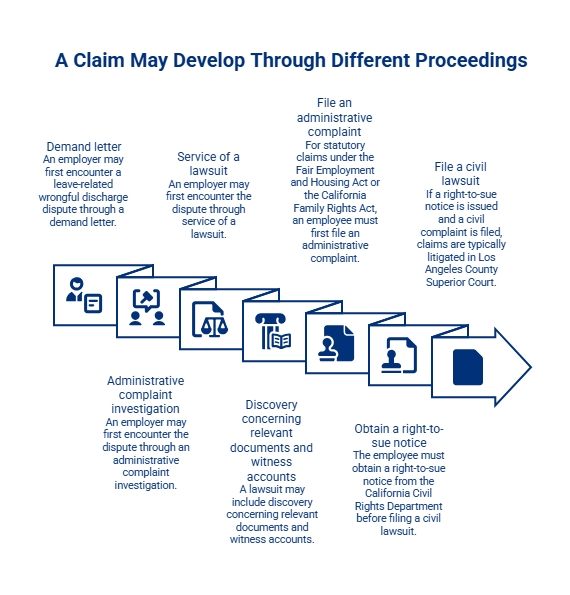
An employer may first encounter a leave-related wrongful discharge dispute through a demand letter, an administrative complaint investigation, or service of a lawsuit. Some claims involve more than one proceeding, and a lawsuit may include discovery concerning relevant documents and witness accounts. The availability, relationship, and sequence of these proceedings depend on the claims asserted and the governing procedural requirements. For statutory claims under the Fair Employment and Housing Act or the California Family Rights Act, an employee must first file an administrative complaint and obtain a right-to-sue notice from the California Civil Rights Department before filing a civil lawsuit, even if the employee requests an immediate right-to-sue notice without an agency investigation. Under California Government Code § 12960, a former employee generally has up to three years from the date of termination to file an administrative complaint with the CRD, meaning a Culver City retailer may face a claim long after seasonal staff or shift supervisors have moved on. If a right-to-sue notice is issued and a civil complaint is filed, claims arising out of Culver City retail operations are typically litigated in the Los Angeles County Superior Court.
No single sequence applies to every case. A demand letter does not always precede an administrative filing, an administrative investigation does not always occur before litigation, and every lawsuit does not develop in the same manner. Even a dispute involving relatively few procedural stages may require owners and managers to address the claim while continuing their ordinary work.
Litigation Can Disrupt a Small Retail Operation
A closely held retailer may rely on a few people to supervise employees, open and close the store, maintain sales-floor coverage, oversee stock, and respond to customers. When those same people become involved in an employment proceeding, the claim may divert attention from daily operations.
The business impact may include legal expense, management time, scheduling strain, and uncertainty. Store managers, supervisors, or employees may also become involved because they participated in communications or witnessed relevant events. The employer may separately face concerns about employee relations or business reputation. These consequences vary by dispute, and their presence does not predict liability, duration, or outcome.
Employment Defense Representation for Culver City Retail Employers
Leave-related wrongful discharge allegations may combine disputed reasons, overlapping records, potentially applicable employee protections, and different procedural settings. The significance of each issue depends on the claims asserted, the applicable law, and the circumstances of the employment relationship. Experienced employment litigation representation for employers can evaluate the claims, employment records, management communications, and surrounding circumstances in the context of the particular proceeding.
Disclaimer:
This content is for informational purposes only. Laws, definitions, and deadlines change. Verify current requirements through official California sources. This content is not legal advice. No attorney-client relationship is formed through this content. Please consult a qualified attorney in your jurisdiction for legal advice specific to your situation.
Protect Your Business | The Akopyan Law Firm, A.P.C. | Top Gun Employment Defense Lawyers
Have you been sued by an employee? Are you overwhelmed by the complexities of employment law? If so, give us a call. The Akopyan Law Firm, A.P.C. assists small business owners throughout Southern California. Our seasoned employment defense lawyers stand ready to help employers quickly and efficiently resolve employment disputes. We are ready to aggressively and skillfully defend against any employment case, but understand that in most situations avoiding the expense of litigation is in the client’s best interest.
Take the First Step Protecting Your Future: Call us today to speak with one of our experienced employment lawyers.
Contact Us Today:
- Phone: (818) 509-9975
- Office Locations in California: Los Angeles, Bakersfield, Costa Mesa, Temecula, Rancho Cucamonga, Oxnard, Culver City, and San Diego.