
📌 Key Takeaways
Working conditions are typically considered “intolerable” for constructive discharge purposes only when they become so severe or pervasive, and so sustained, that a reasonable employee in the same position would feel compelled to resign.
- Objective and subjective lens: The analysis commonly asks both whether a reasonable person would feel forced to quit (objective) and whether the employee actually resigned because of the conditions (subjective).
- High threshold: Ordinary workplace friction—unfair criticism, inconvenient schedules, or personality conflicts—often does not meet the legal standard by itself.
- Patterns matter: Duration, escalation, and whether management knew (or should have known) about the problem—and how management responded—often matter more than a single incident.
- Concrete examples help show severity: Repeatedly assigning work that conflicts with documented medical restrictions, mocking an employee’s injury, or escalating dangerous assignments after a safety complaint may support an argument that conditions became intolerable, depending on the full context.
- Overlap is common: The same facts may also implicate disability discrimination, failure to reasonably accommodate, failures in the interactive process, harassment, or retaliation.
Constructive discharge analysis generally focuses on extreme workplace conditions, not ordinary dissatisfaction.
~ ~ ~ ~ ~ ~ ~ ~ ~ ~ ~ ~ ~ ~ ~ ~ ~ ~
Many employees resign because work feels unbearable. Under California employment law, a resignation may be treated like a termination in certain circumstances if the employee can show constructive discharge—meaning the employer created, allowed, or failed to correct working conditions that became intolerable under the legal standard.
In plain terms, “intolerable working conditions” generally means conditions that are so serious and sustained that a reasonable employee in the same situation would conclude resignation is the only realistic option.
Constructive Discharge: A Plain-Language Overview of the Legal Concept
constructive discharge or constructive termination is considered to have happened when:
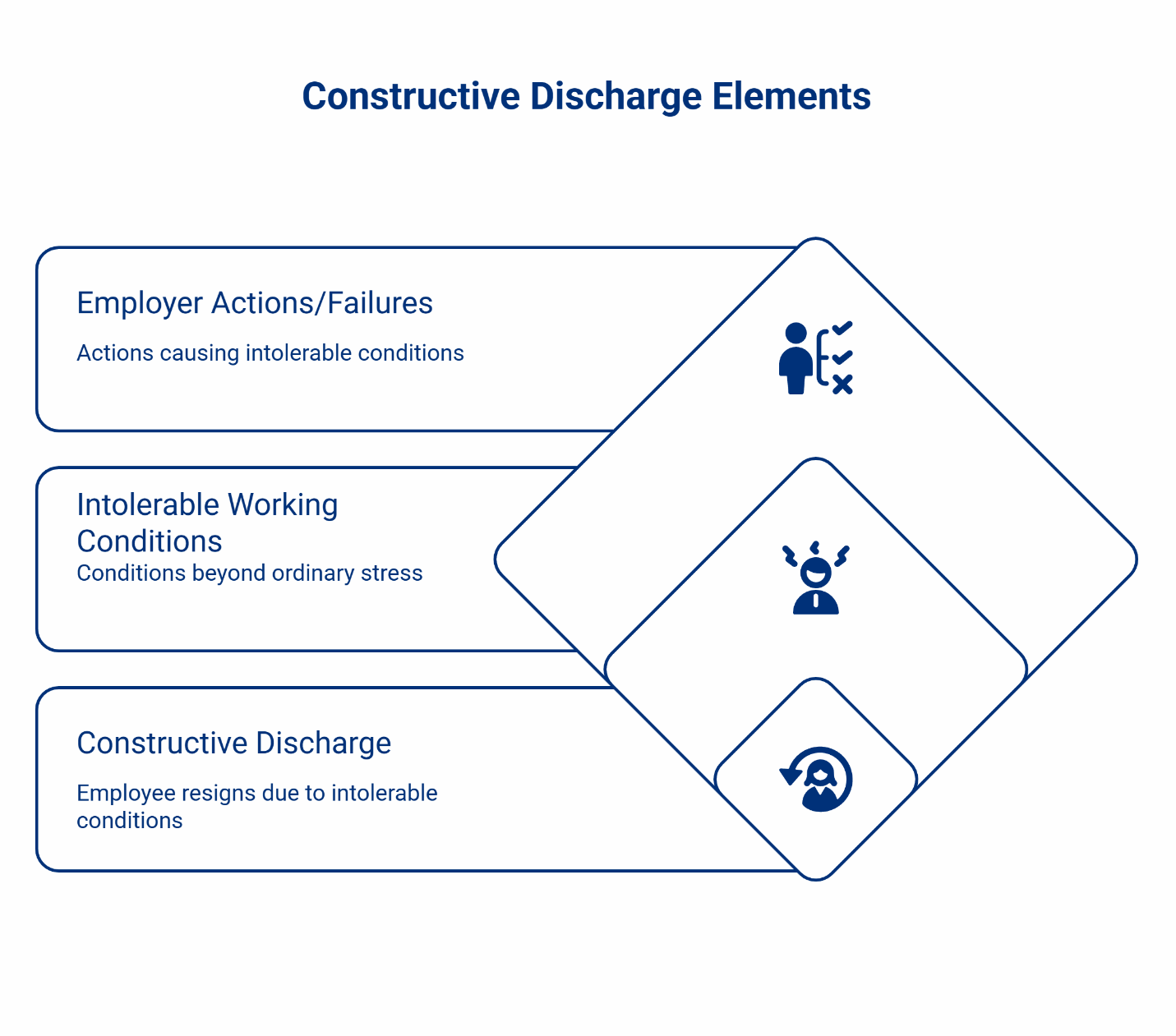
- Working conditions became intolerable under an objective “reasonable employee” standard,
- The employee resigned because of those conditions,
- The intolerable conditions are tied to what the employer did, allowed, or failed to address (for example, management actions, supervisor conduct, or management’s failure to correct known problems).
A key takeaway for readers is that the doctrine is not meant to convert every difficult workplace into a termination claim. It is typically reserved for situations where the working conditions are beyond ordinary workplace stress and instead reflect sustained, serious harm.
Examples That May Contribute to an Intolerable Environment
The following hypotheticals illustrate the type of facts that may support a constructive discharge analysis, depending on severity, duration, documentation, and the employer’s response:
- Ignoring documented medical restrictions and escalating pressure:
An employee provides medical documentation limiting heavy lifting. A supervisor repeatedly assigns heavy-lifting tasks anyway, threatens discipline if the employee refuses, and mocks the injury in front of coworkers. If management knows this is happening and does not intervene, the employee may argue the employer allowed the workplace to become intolerable. - Punishing a safety complaint with dangerous work and harassment:
An employee reports serious workplace safety hazard. After the report, the supervisor assigns the employee to the most dangerous tasks, excludes the employee from necessary meetings, and dismisses follow-up safety concerns while coworkers engage in ongoing harassment. The employee may argue that the sequence—protected safety activity followed by escalating adverse treatment—contributed to intolerable working conditions.
What Often Does Not Rise to “Intolerable” by Itself
Some situations may feel deeply discouraging but often fall short of the constructive discharge threshold when they occur in isolation:
- A single rude comment that does not repeat or escalate.
- A stressful workload or hectic schedule that affects most employees similarly.
- Personality conflicts where there is no indication of discrimination, retaliation, or other unlawful conduct.
While any of these issues can be serious, constructive discharge analysis usually requires more than everyday unfairness. Multiple issues can combine over time, but the details and employer involvement matter.
Patterns That Often Matter: Severity, Duration, and Employer Awareness
Constructive discharge is frequently analyzed as a pattern-based issue. Decision-makers often focus on:
- Severity: Was the conduct threatening, humiliating, dangerous, or seriously harmful?
- Duration: Did the conditions persist long enough to show an ongoing environment rather than a brief episode?
- Notice and response: Did the employee report the problem (or was it otherwise obvious), and did the employer respond promptly and effectively?
How “Intolerable Working Conditions” Can Overlap with Other Employment Law Problems
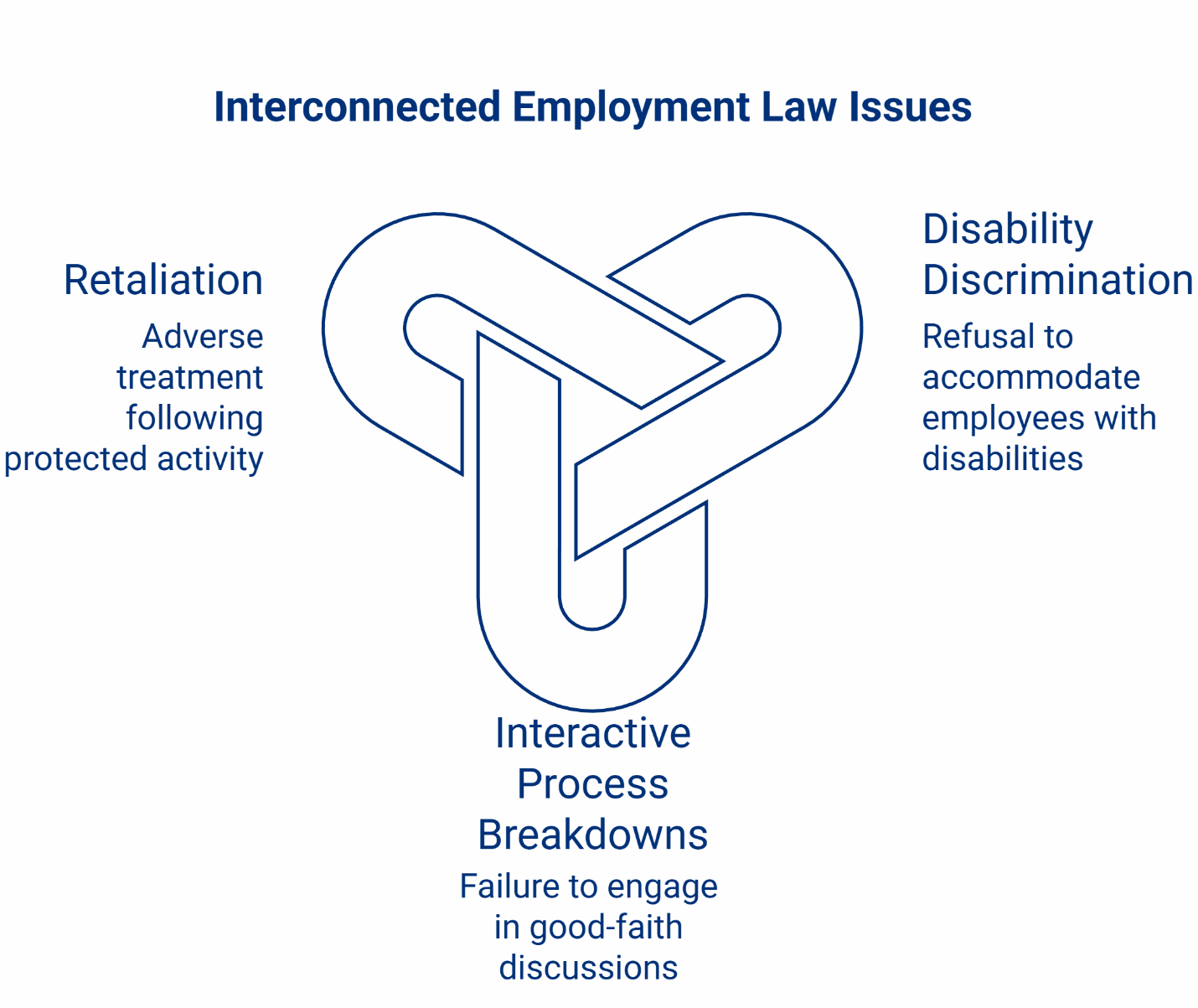
Conditions described as “intolerable” often overlap with other employment law doctrines, such as:
- Disability discrimination or failure to provide reasonable accommodation when an employer refuses to consider modifications for an employee with a disability.
- Breakdowns in the interactive process when an employer fails to engage in good-faith discussions about accommodation options after an employee raises medical needs.
- Retaliation when adverse treatment follows protected activity such as reporting safety concerns, discrimination, wage issues, or harassment.
Overlap can change how a situation is evaluated, what evidence matters most, and which legal duties may be implicated.
When to Speak with a California Employment Lawyer
Constructive discharge is fact-intensive. A qualified California employment lawyer typically evaluates the intensity of the conditions, how long they lasted, whether management was on notice, and whether the facts suggest related issues (like failure to accommodate or retaliation).
Strict deadlines can apply to employment claims, and the deadlines vary by claim type and facts. If you are considering whether a resignation might be treated as a constructive discharge, it may be prudent to speak with counsel promptly about any time limits that may apply.
Disclaimer:
This content is for informational purposes only. Laws, definitions, and deadlines change. Verify current requirements through official California sources. This content is not legal advice. No attorney-client relationship is formed through this content. Please consult a qualified attorney in your jurisdiction for legal advice specific to your situation.
Protect Your Rights | The Akopyan Law Firm, A.P.C. | Top Gun Employment Lawyers
Have you been wrongfully terminated from your job? Have you suffered discrimination, harassment, or retaliation in the workplace? Has your employer violated wage and hour laws? If so, we can help. The Akopyan Law Firm, A.P.C. is dedicated to protecting and enforcing employees’ rights throughout Southern California. With a 97% success rate and millions recovered for our clients, our team of experienced and talented employment lawyers can fight to secure the justice you deserve.
Take the First Step Towards Securing Justice: Call us today to speak with one of our experienced employment lawyers. The firm offers case evaluations free of charge.
Contact Us Today:
- Phone: (818) 509-9975
- Office Locations: Los Angeles, Bakersfield, Costa Mesa, Temecula, Rancho Cucamonga, Oxnard, Culver City, and San Diego in California.
Important: Contacting the Akopyan Law Firm, A.P.C. does not create an attorney-client relationship, but all communications will remain private and confidential. Each case is unique. The Akopyan Law Firm, A.P.C., does not guarantee any outcome.