
📌 Key Takeaways
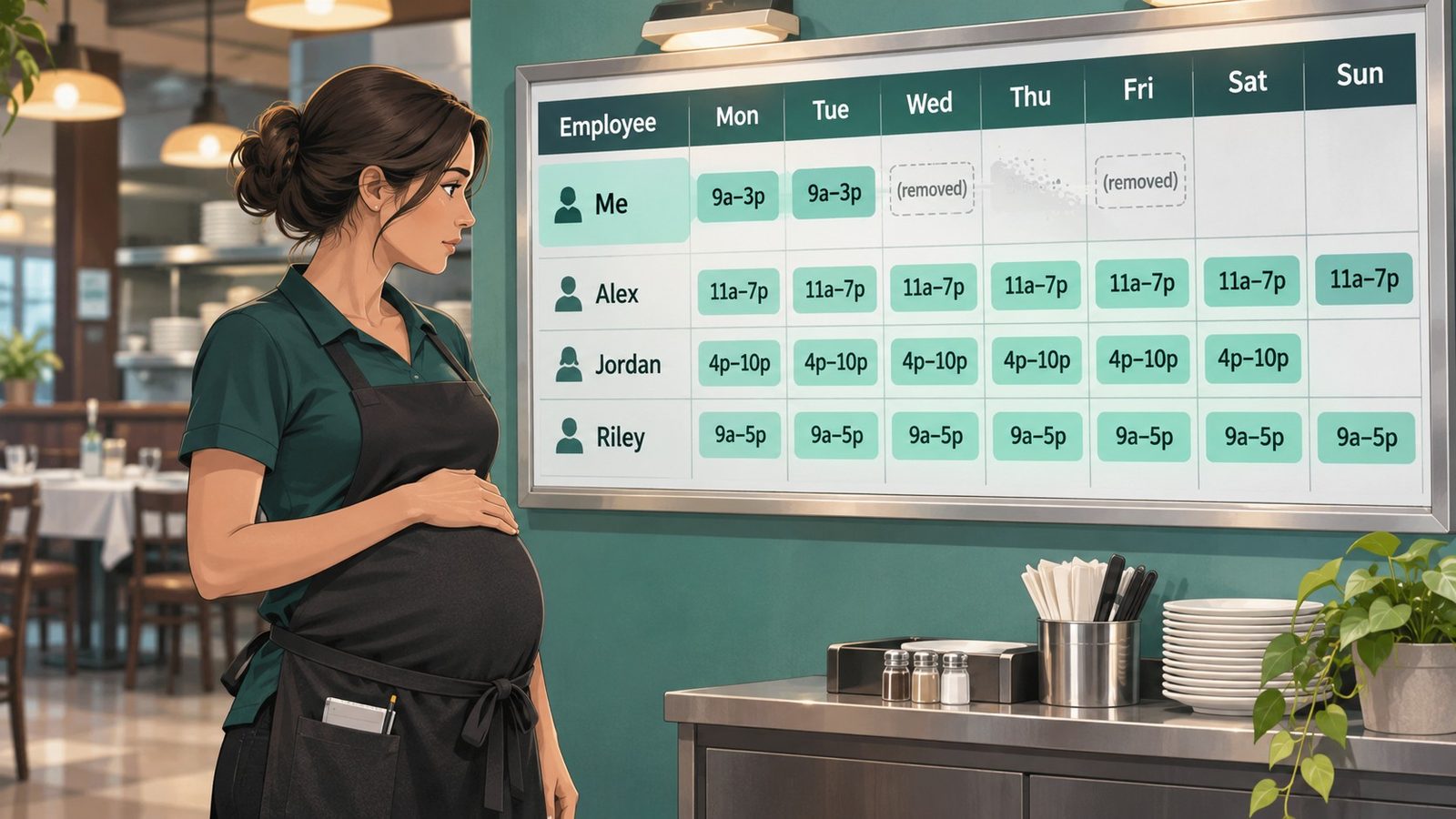
Restaurant workers in Encino may experience pregnancy discrimination under California’s Fair Employment and Housing Act (FEHA) when employers reduce shifts or restrict work opportunities because of pregnancy.
- Shift Cuts May Signal Discrimination: Sudden reductions in customary working hours after pregnancy disclosure may indicate discriminatory treatment when comparable employees retain their established schedules.
- Desirable Shifts Affect Earnings: Losing established evening or weekend assignments may reduce restaurant employees’ earning opportunities, even when their total scheduled hours remain unchanged.
- Pregnancy Stereotypes May Influence Scheduling: Supervisors who reduce shifts based on unsupported assumptions about a pregnant employee’s physical ability or reliability may engage in discriminatory treatment.
- Accommodation Differs from Discrimination: Pregnancy-related adjustments to particular duties differ from an employer’s decision to remove working hours based on generalized assumptions about pregnancy.
- Retaliation May Involve Reduced Shifts: An employer’s decision to cut customary hours because an employee raised a protected pregnancy-discrimination concern may constitute unlawful retaliation.
For restaurant employees working in Encino, the employer’s reasons for unfavorable scheduling decisions and the surrounding circumstances may be important considerations in an individualized employment-law assessment.
Keeping a restaurant job does not necessarily mean retaining working hours and opportunities protected against pregnancy-based discrimination under California law.
A restaurant employee in Encino may experience pregnancy discrimination when an employer reduces her scheduled hours, removes desirable shifts, or limits regular work opportunities because of her pregnancy. These changes can result in loss of earnings and thus arise to an adverse employment action, without ending the employment relationship.
California’s Fair Employment and Housing Act (FEHA) prohibits pregnancy-based employment discrimination by covered employers, generally those regularly employing five or more workers. Although restaurants may adjust schedules to accommodate customer demand and staffing needs, an employer’s reasons for changing an employee’s assignments can carry legal significance.
How Pregnancy Bias May Affect Restaurant Employees’ Work Schedules
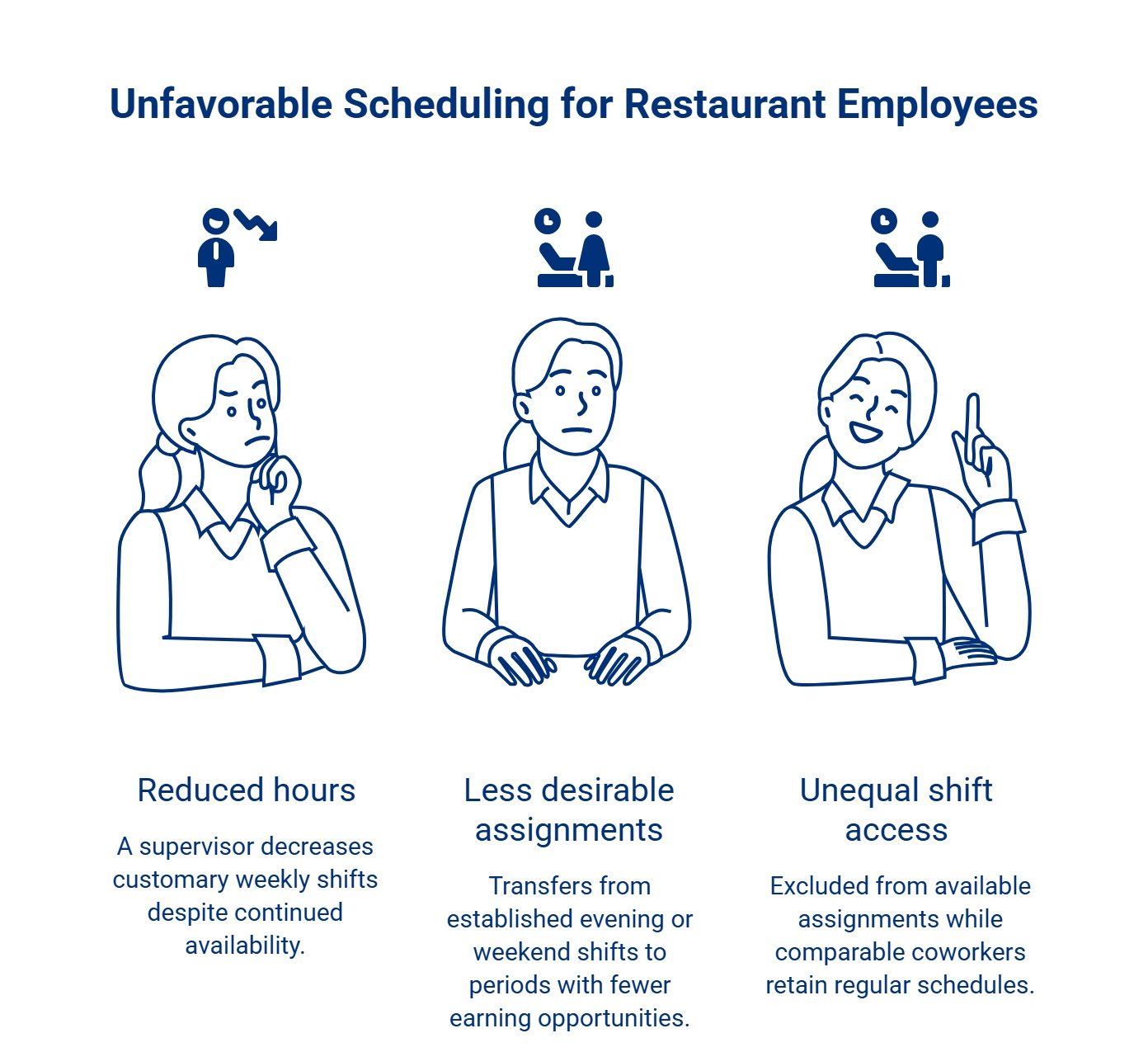
Restaurant employees, including servers, hosts, bartenders, cooks, food runners, and dishwashers, often depend on recurring shifts for consistent working hours. Unfavorable scheduling may take several forms:
- Reduced hours: A supervisor decreases an employee’s customary weekly shifts despite her continued availability.
- Less desirable assignments: A manager transfers an employee from established evening or weekend shifts to periods with fewer earning opportunities.
- Unequal access to shifts: An employer excludes an employee from available assignments while coworkers with comparable responsibilities retain their regular schedules.
These examples illustrate different ways scheduling decisions may adversely affect restaurant employees. Their significance depends on the reasons for the changes and the surrounding circumstances.
Why Sudden Shift Reductions After Pregnancy Disclosure May Raise Discrimination Concerns
The timing of a substantial scheduling reduction may be relevant when an employee previously received consistent hours.
Consider a hypothetical restaurant cashier who regularly works five shifts each week. Shortly after learning she is pregnant, her supervisor reduces her schedule to two shifts despite her continued availability. Other cashiers performing comparable duties retain their established schedules.
The employee’s previous assignments and the treatment of similarly situated coworkers provide context for evaluating the change.
Timing alone does not establish discrimination. Declining customer demand or operational adjustments may explain staffing reductions. However, inconsistent explanations or pregnancy-related supervisory remarks accompanying selective cuts for only the pregnant employee may raise questions about the employer’s motivation.
How Losing Desirable Shifts or Regular Scheduling Opportunities May Affect Restaurant Workers
Different restaurant shifts can provide different earning opportunities, even when employees work similar numbers of hours.
For example, a server who regularly works busy Friday and Saturday evenings may receive more opportunities to earn gratuities than during quieter weekday periods. If management removes those established high-earning assignments while maintaining her total weekly hours, the employee may still experience an adverse employment action.
Bartenders may encounter similar differences between service periods, while kitchen employees and dishwashers may experience lost wages when recurring shifts disappear entirely.
The relevant concern is whether an employer changed established working opportunities because of pregnancy, rather than whether an employee simply preferred a different schedule.
How Pregnancy-Related Assumptions May Influence Restaurant Scheduling Decisions
Supervisors may make unsupported assumptions about a pregnant employee’s ability to perform customary duties, remain reliable, or work particular shifts.
Consider a hypothetical food runner whose manager assumes pregnancy prevents her from handling regular assignments. Although she remains available to perform her customary responsibilities, the manager reduces her hours based on that belief.
A supervisor’s comments may clarify the circumstances. For instance, questioning whether a pregnant bartender can reliably work evening service before removing her from those shifts may suggest that pregnancy-related stereotypes influenced the decision.
The distinction involves the employee’s actual working circumstances rather than generalized beliefs about pregnancy.
When Pregnancy-Related Accommodation Issues May Overlap with Shift Reductions
Reasonable accommodation for pregnancy may intersect with scheduling when an employee requests adjustments to particular restaurant duties based on the advice of her health care provider. An accommodation-related adjustment differs from an employer’s unilateral reduction of working hours based on assumptions about the employee’s pregnancy.
For example, an employee may need a medically advised modification to certain physically demanding responsibilities while remaining available for other established duties. If her employer instead removes unrelated shifts because it assumes she cannot continue working, that reduction may violate California’s accommodation rules.
Under California Government Code section 12945, when a pregnant restaurant worker requests a medical adjustment—such as temporary relief from lifting heavy bus tubs, a stool at a host stand, or brief restroom breaks—a covered employer must engage in a timely, good-faith “interactive process” to explore workable accommodations. An employer generally cannot bypass that conversation by unilaterally cutting the worker’s shifts or forcing her onto unpaid leave when she remains able to perform her core duties with a reasonable adjustment.
Pregnancy Disability Leave may also affect an employee’s schedule when a health care provider determines that a pregnancy-related disability requires time off or a reduced work schedule. Such a medically supported absence is distinct from an employer’s decision to exclude the employee from otherwise available assignments
When Pregnancy-Related Retaliation May Involve Unfavorable Scheduling
Unfavorable scheduling may raise retaliation concerns when an employer takes adverse action because an employee engaged in legally protected pregnancy-related workplace activity.
For example, a restaurant employee who raises concern about pregnancy discrimination may experience unlawful retaliation if her supervisor responds negatively to the complaint and subsequently removes several established shifts.
The supervisor’s response may suggest a connection between the protected activity and the reduction in hours. Whether retaliation occurred depends on the circumstances, including the employer’s motivation for the scheduling decision.
Why Pregnancy-Related Shift Reductions May Matter Even When an Employee Remains Employed
FEHA addresses discrimination involving the terms, conditions, and privileges of employment, not merely termination.
Under California Government Code section 12940(a), an unlawful “adverse employment action” includes any scheduling change that materially affects a worker’s pay, working conditions, or opportunities for advancement. While a minor, one-time shift swap ordinarily does not cross that threshold, California courts recognize that a sustained cut in weekly hours or a permanent transfer off lucrative, high-tip dinner and weekend shifts can constitute a material change in the terms and conditions of employment.
An employee who remains on the restaurant’s payroll may nevertheless experience reduced earnings from substantial cuts to customary hours. Another employee may retain regular hours but lose established assignments offering different working opportunities.
The extent of these changes and their connection to pregnancy may affect whether they constitute potentially discriminatory employment decisions.
Why Employment Counsel May Be Important in Pregnancy-Related Scheduling Disputes
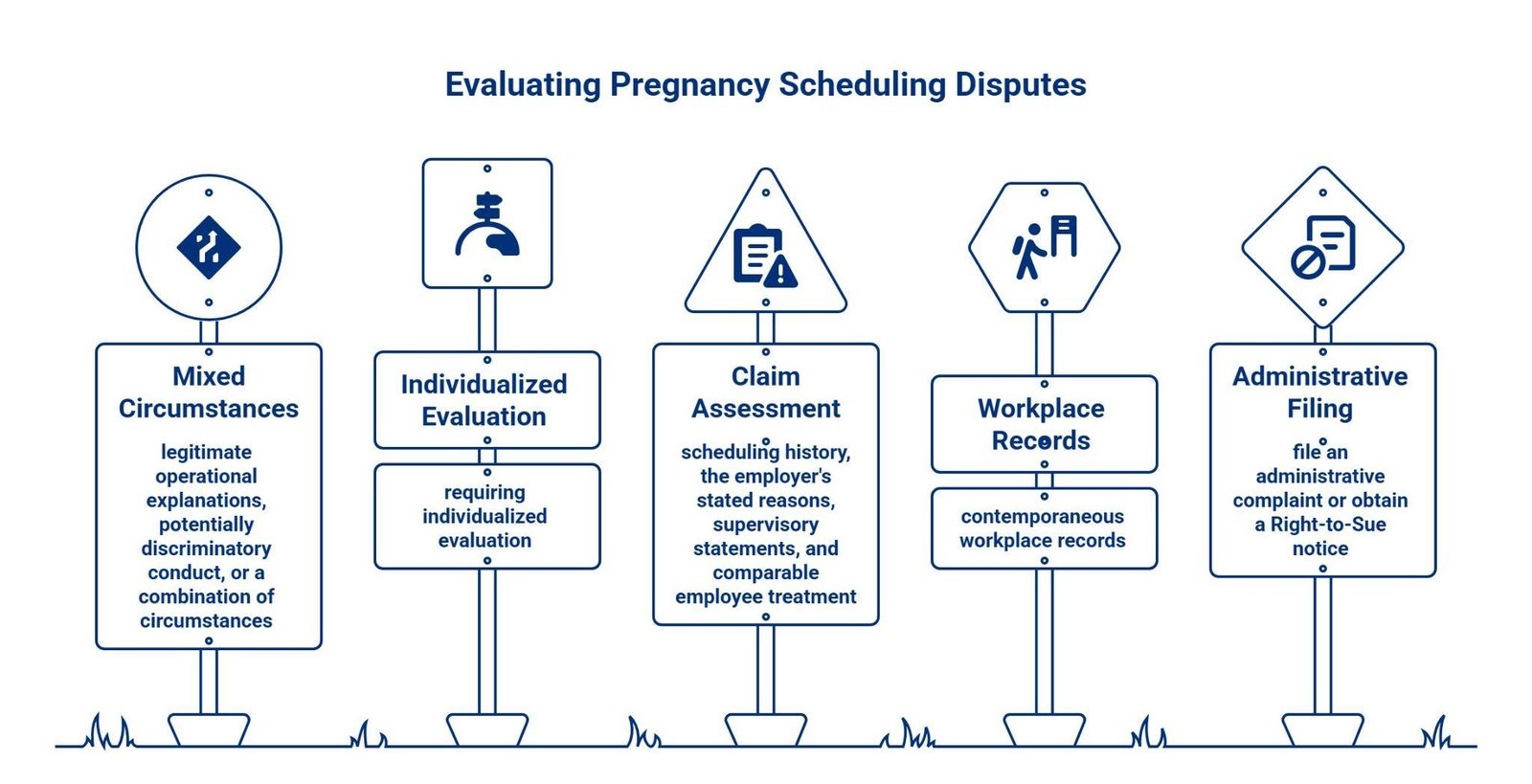
Restaurant scheduling disputes may involve legitimate operational explanations, potentially discriminatory conduct, or a combination of circumstances requiring individualized evaluation.
An employment attorney can assess how an employee’s scheduling history, the employer’s stated reasons, supervisory statements, and comparable employee treatment relate to California pregnancy-discrimination protections.
In scheduling disputes at Encino restaurants, which operate within the City of Los Angeles jurisdiction along corridors like Ventura Boulevard, evaluating a potential claim often turns on contemporaneous workplace records. Relevant documentation typically includes digital scheduling logs (such as 7shifts or HotSchedules) from before and after the pregnancy disclosure, point-of-sale tip and sales reports comparing evening versus daytime earnings, written shift-pickup requests, and text messages or emails with managers regarding availability. Before pursuing a civil lawsuit under FEHA, an employee generally must file an administrative complaint or obtain a Right-to-Sue notice through the California Civil Rights Department (CRD).
Disclaimer:
This content is for informational purposes only. Laws, definitions, and deadlines change. Verify current requirements through official California sources. This content is not legal advice. No attorney-client relationship is formed through this content. Please consult a qualified attorney in your jurisdiction for legal advice specific to your situation.
Protect Your Business | The Akopyan Law Firm, A.P.C. | Top Gun Employment Lawyers
Have you been wrongfully terminated from your job? Have you suffered discrimination, harassment, or retaliation in the workplace? Has your employer violated wage and hour laws? If so, we can help. The Akopyan Law Firm, A.P.C. is dedicated to protecting and enforcing employees’ rights throughout Southern California. With a 97% success rate and millions recovered for our clients, our team of experienced and talented employment lawyers can fight to secure the justice you deserve.
Take the First Step Towards Securing Justice: Call us today to speak with one of our experienced employment lawyers. We offer case evaluations free of charge.
Contact Us Today:
- Phone: (818) 509-9975
- Office Locations in California: Los Angeles, Culver City, Costa Mesa, Rancho Cucamonga, San Diego, Oxnard, Temecula, and Bakersfield.