
📌 Key Takeaways
Escalating discipline after a disability-related event or a request for reasonable accommodation can become important evidence in a constructive discharge evaluation for California workers.
- Discipline patterns can matter. If an employer begins issuing repeated write-ups, imposing performance improvement plans (PIPs), or changing schedules after an employee discloses a disability or requests a reasonable accommodation, those actions may become relevant to later legal claims.
- Timing can support an inference. When an employer starts serious discipline soon after an employee requests to engage in the interactive process, the employee may later allege the timing supports disability discrimination or retaliation.
- Unequal enforcement can be evidence. If an employer disciplines an employee with a disability for minor conduct that similarly situated co-workers without disabilities do not get disciplined for, that inconsistency may support an argument of selective enforcement.
- Medical restrictions should be addressed. If an employer receives documented medical restrictions but keeps quotas or performance standards unchanged—and then disciplines the employee for failing to meet those unchanged standards—the employee may allege a failure to accommodate or a failure to engage in the interactive process.
- Workplace statements can increase pressure. Comments by a supervisor suggesting the employee should “move on” or find “something less physical,” when paired with escalating discipline, may be alleged as pressure to resign rather than a good-faith effort to solve the problem.
When disability-related disclosures, escalating discipline, and suggestions to leave begin to align, the paper trail—write-ups, PIPs, schedules, evaluations, emails, and texts—may matter as much as the resignation itself.
~ ~ ~ ~ ~ ~ ~ ~ ~ ~ ~ ~ ~ ~ ~ ~ ~ ~
Not every job ends with a direct termination. In some cases, an employee resigns and later alleges the employer effectively forced the resignation by creating or allowing intolerable working conditions. That allegation is commonly described as constructive discharge.
In plain terms, constructive discharge generally refers to working conditions that are alleged to be so intolerable that a reasonable person would feel compelled to resign—and the employee does resign because of those conditions. The analysis is usually fact-specific. It often turns on what the employer did, when it happened, what the employer knew, and whether the employer addressed the problem when it had the opportunity to do so.
In disability-related situations, constructive discharge allegations often involve patterns that develop over time, such as escalating discipline, shifting expectations, and communications implying the employee is no longer a fit after the employee discloses a disability or requests a reasonable accommodation.
How Performance Management Typically Works in Hourly and Physically Demanding Jobs
In workplaces such as construction, warehousing, manufacturing, retail, food service, landscaping, and delivery, performance management often involves multiple tools rather than a single annual review. For example:
- A supervisor may hold a verbal warning or “coaching” meeting about speed, accuracy, safety, attitude, or attendance.
- An employer may issue written warnings for safety violations, timekeeping mistakes, or policy violations.
- An employer may use attendance point systems or strict call-in rules that trigger write-ups.
- Management may place an employee on a formal performance improvement plan (PIP) with defined expectations and short timelines.
- An employer may change schedules, reassign shifts, reduce hours, or move an employee into a lower-paying role.
When an employer uses these tools consistently and in good faith, they may document legitimate performance concerns. The issue often arises when an employer begins using these tools more aggressively after the employer learns about an employee’s disability, medical condition, medical restrictions, or accommodation request.
Disability Law Concepts That Commonly Intersect with Discipline
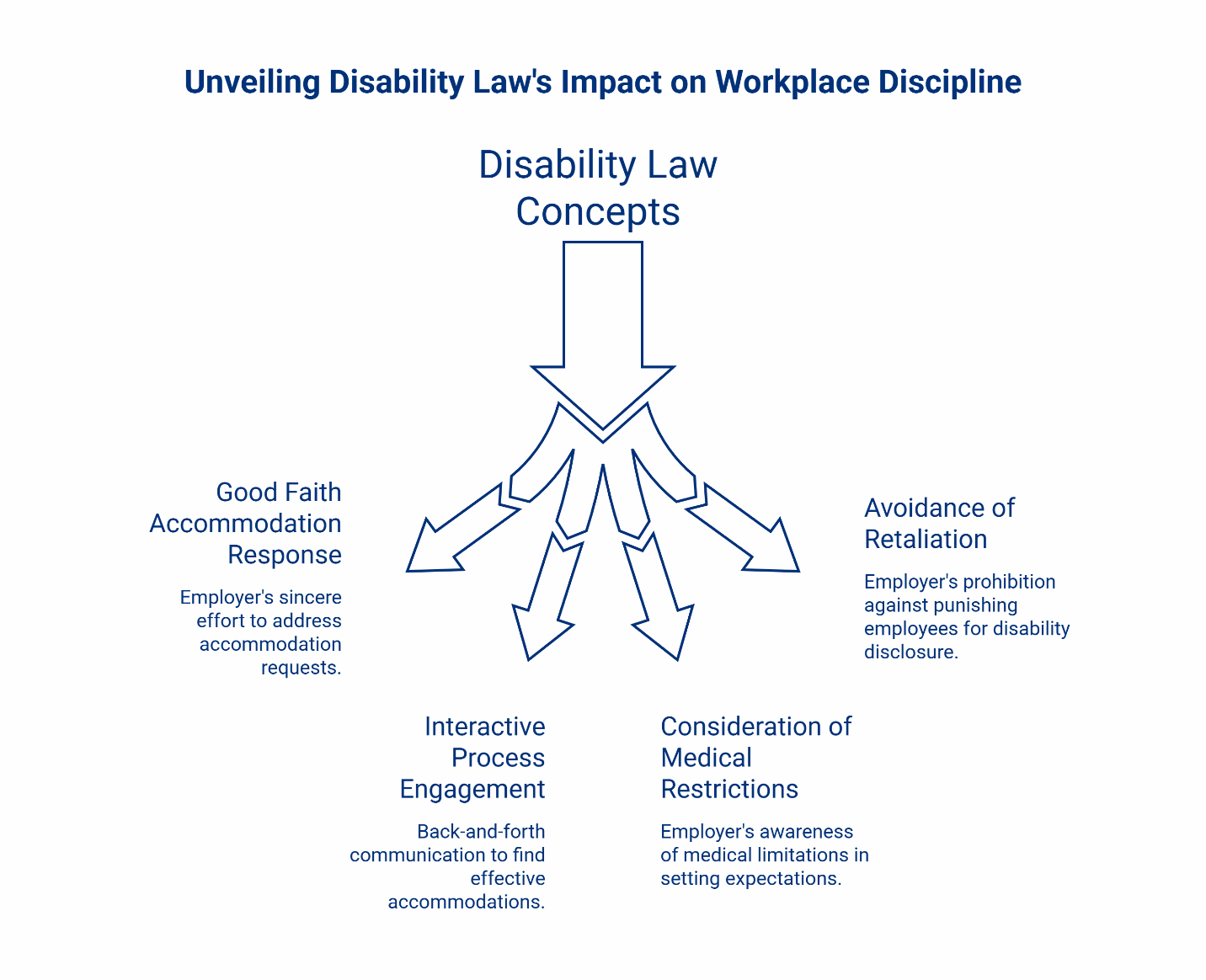
Disability-related workplace disputes in California commonly involve the Fair Employment and Housing Act (FEHA) and, in some situations, the Americans with Disabilities Act (ADA). These laws generally prohibit disability discrimination. They may also require an employer to consider a reasonable accommodation and to engage in the interactive process, which is the back-and-forth communication intended to identify an effective accommodation when one is available.
In practice, disability-related discipline disputes often focus on whether the employer:
- responded to an accommodation request in good faith,
- engaged in the interactive process,
- accounted for documented medical restrictions when setting expectations, and
- avoided retaliating against an employee for requesting accommodation or disclosing a disability.
When Escalating Discipline May Raise Concerns for an Employee with a Disability
Escalating discipline may raise concerns when the discipline intensifies after a disability-related event or protected activity. Common patterns include situations where an employer’s discipline:
- begins or accelerates shortly after the employer learns of an injury, diagnosis, flare-up, or other disability-related condition;
- follows closely after the employee requests a reasonable accommodation (for example, light duty, a modified schedule, assistive equipment, a reassignment request, or additional breaks) or asks to engage in the interactive process; or
- targets issues the employer previously handled informally or did not treat as discipline-worthy until after the disability-related disclosure or accommodation request.
These sequences do not automatically prove unlawful intent. However, they may become relevant when an employee later alleges disability discrimination, retaliation, failure to accommodate, failure to engage in the interactive process, or constructive discharge.
Signs an Employer’s Performance Management May Be Alleged as Constructive Discharge Pressure
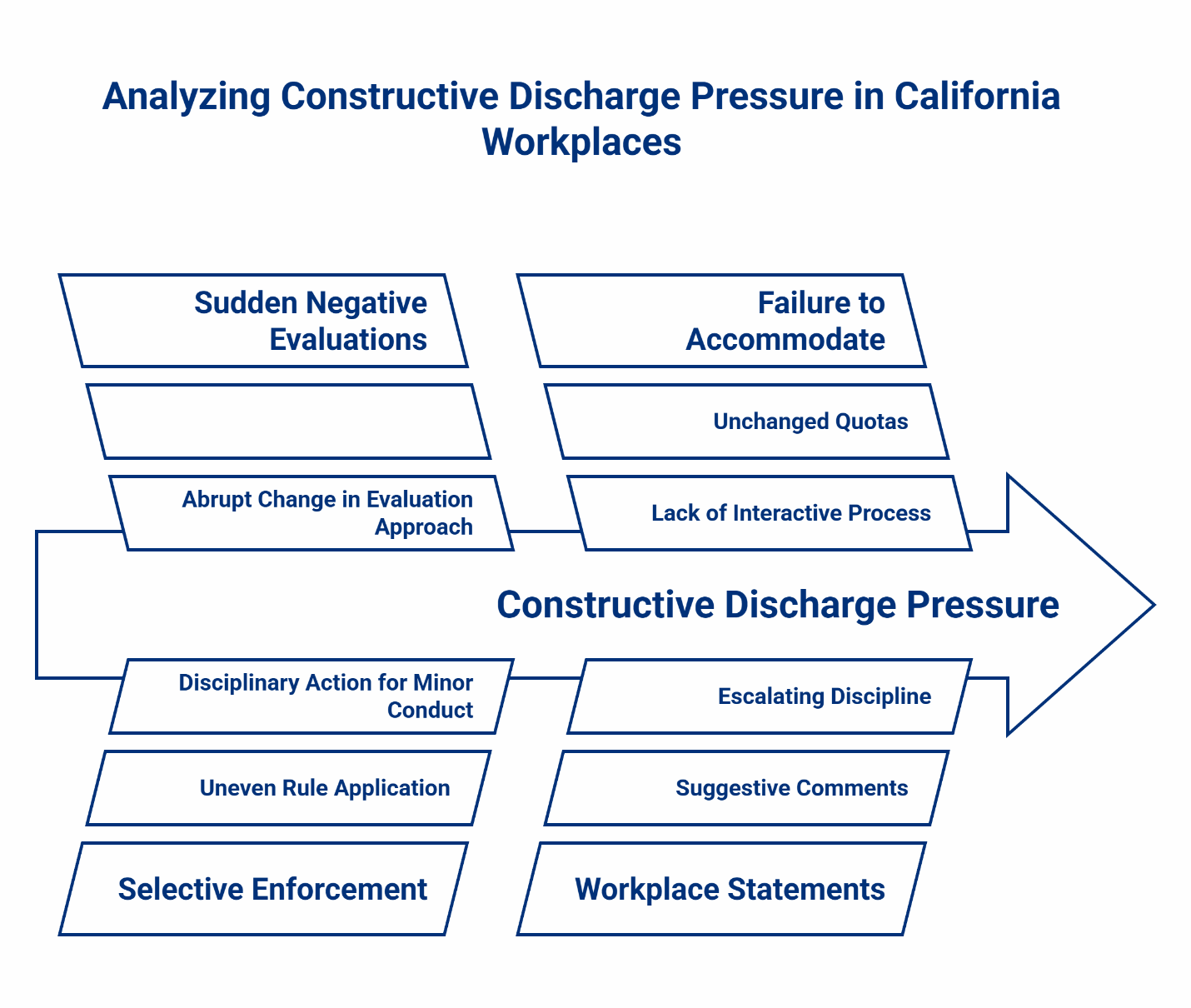
Sudden negative evaluations after a disability-related disclosure or accommodation request
An employee may have years of adequate performance and stable assignments. After the employee reports a back injury and provides a doctor’s note limiting heavy lifting, the employer may begin issuing sharply negative evaluations focused on minor issues or subjective criticisms. If the employer’s evaluation approach changes abruptly after the disability-related disclosure or accommodation request, the employee may later allege the shift reflects disability-related motivation rather than an actual change in work quality.
Selective enforcement of minor rules against an employee with a disability
Many workplaces have rules about tardiness, cell phone use, brief breaks, or minor inspection issues. Concerns may arise when a supervisor writes up an employee with a disability for minor conduct while similarly situated co-workers without disabilities engage in similar conduct without discipline—especially when the write-ups begin after the employee shares medical information or requests accommodation.
For example, an employer might write up the employee who requested accommodation for being two minutes late, while overlooking comparable tardiness by other employees. The employee may later argue that uneven enforcement is part of a disability discrimination or retaliation pattern.
Failure to account for documented medical restrictions in quotas or performance standards
An employee may provide documented restrictions limiting heavy lifting, repetitive bending, prolonged standing, or extended shifts. If the employer receives those restrictions but keeps quotas and performance standards unchanged—and then disciplines the employee for not meeting those unchanged expectations—the employee may allege the employer effectively set the employee up to fail. Depending on the facts, the employee may also allege the employer failed to provide a reasonable accommodation or failed to engage in the interactive process.
Workplace statements suggesting the employee should leave rather than be accommodated
Statements by a supervisor such as “maybe this job isn’t right for you,” “you should find something less physical,” or “you might be happier somewhere else” can take on legal significance when paired with escalating discipline. If the employer makes these comments after learning about the disability and then increases write-ups or imposes a PIP, an employee may later allege the employer was steering the employee toward resignation rather than exploring accommodations in good faith.
Why These Patterns Can Matter in a Constructive Discharge Evaluation
A California employment attorney often evaluates the events leading up to the resignation to determine whether the facts could support a constructive discharge theory. In disability-related matters, that evaluation commonly focuses on:
- Timing and sequence: Did the employer begin issuing write-ups, imposing a PIP, reducing hours, or changing schedules soon after the employee disclosed a disability or requested accommodation?
- Employer response to restrictions: Did the employer receive medical restrictions, and did the employer adjust expectations or consider reasonable accommodations through the interactive process?
- Treatment of similarly situated co-workers: Did the employer discipline the employee with a disability more harshly than employees without disabilities under comparable circumstances?
- Severity and persistence of conditions: Were the alleged conditions serious and ongoing enough that a reasonable person could feel compelled to resign?
These questions are highly fact-specific. A PIP, a write-up, or a schedule change can be interpreted differently depending on the employee’s prior performance history, the employer’s normal practices, the timing relative to protected activity, and what the employer communicated about accommodation efforts.
For additional background on wrongful termination concepts that may overlap with constructive discharge allegations, see the resources:
- Employment Law: https://www.akopyanlaw.com/practice-areas/employment-law/
- Wrongful Termination: https://www.akopyanlaw.com/practice-areas/employment-law/wrongful-termination/
- Wrongful Termination due to Medical Conditions: https://www.akopyanlaw.com/wrongful-termination-due-to-medical-conditions-california-employee-rights-guide/
Practical Next Steps: Preparing to Speak with a California Employment Law Attorney
Workers who recognize similar patterns often choose to consult a California employment law attorney. A consultation is usually more productive when the worker organizes a timeline and gathers key documents, including but not limited:
- performance evaluations (before and after the disability-related event),
- disciplinary write-ups, attendance records, and any point-system documents,
- PIPs and any stated metrics, quotas, or performance goals,
- doctor’s notes and documented medical restrictions,
- emails, texts, or HR communications about a reasonable accommodation or the interactive process,
- schedules showing reduced hours, shift changes, or reassignments, and
- a written summary of who said what, when, and in what context.
Constructive discharge, disability discrimination, failure to accommodate, and retaliation claims often depend on specific details—especially dates, sequence, employer knowledge, and documentation.
Disclaimer:
This content is for informational purposes only. Laws, definitions, and deadlines change. Verify current requirements through official California sources. This content is not legal advice. No attorney-client relationship is formed through this content. Please consult a qualified attorney in your jurisdiction for legal advice specific to your situation.
Protect Your Rights | The Akopyan Law Firm, A.P.C. | Top Gun Employment Lawyers
Have you been wrongfully terminated from your job? Have you suffered discrimination, harassment, or retaliation in the workplace? Has your employer violated wage and hour laws? If so, we can help. The Akopyan Law Firm, A.P.C. is dedicated to protecting and enforcing employees’ rights throughout Southern California. With a 97% success rate and millions recovered for our clients, our team of experienced and talented employment lawyers can fight to secure the justice you deserve.
Take the First Step Towards Securing Justice: Call us today to speak with one of our experienced employment lawyers. The firm offers case evaluations free of charge.
Contact Us Today:
- Phone: (818) 509-9975
- Office Locations: Los Angeles, Bakersfield, Costa Mesa, Temecula, Rancho Cucamonga, Oxnard, Culver City, and San Diego in California.
Important: Contacting the Akopyan Law Firm, A.P.C. does not create an attorney-client relationship, but all communications will remain private and confidential. Each case is unique. The Akopyan Law Firm, A.P.C., does not guarantee any outcome.