
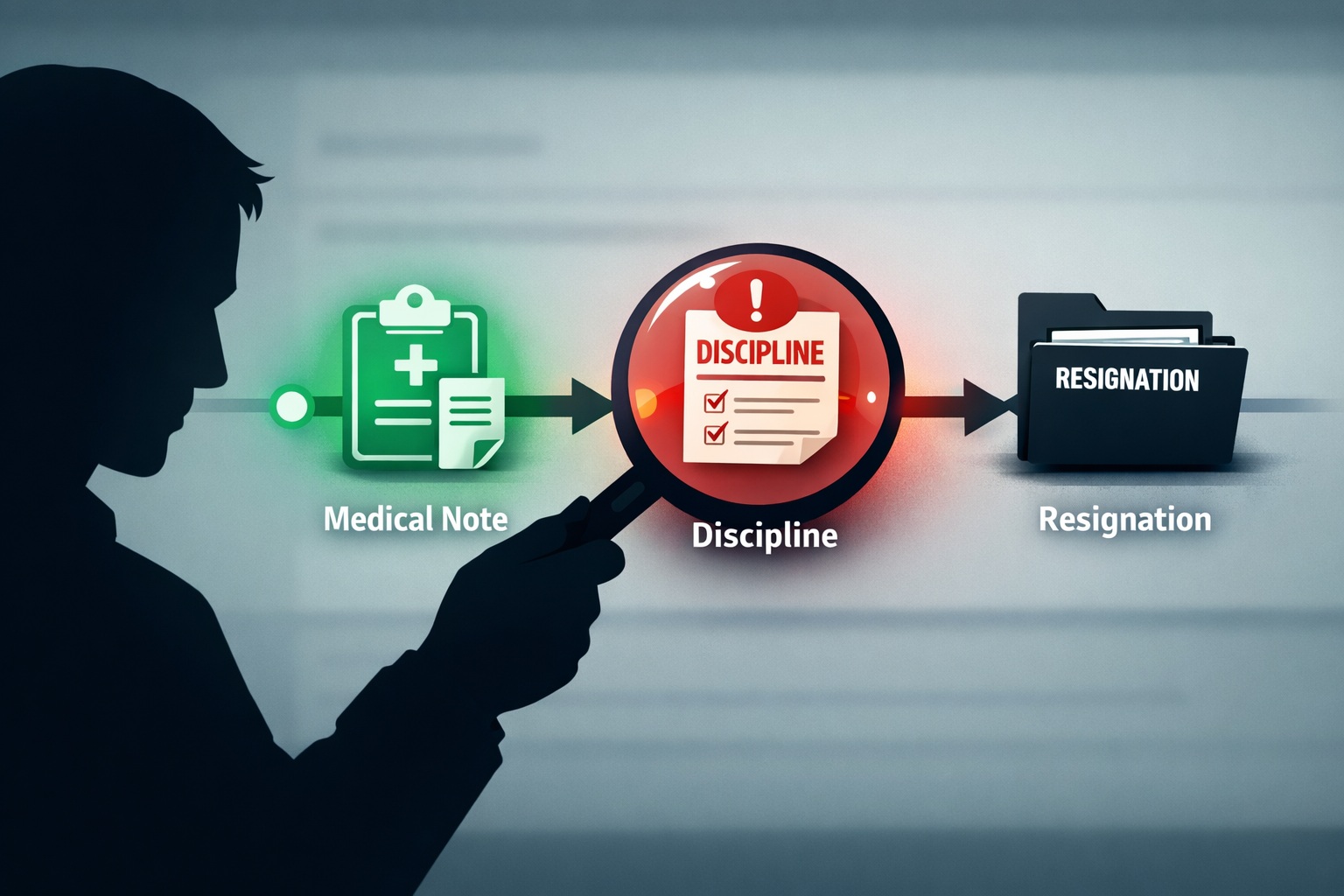
📌 Key Takeaways
A resignation may be treated as a termination if working conditions became so intolerable that a reasonable person would feel compelled to quit.
- Medical Restrictions Ignored: Employers who repeatedly assign tasks that conflict with documented medical limitations may create legally intolerable conditions.
- Timing Suggests Retaliation: Sudden schedule changes, reduced hours, or increased discipline shortly after disability disclosure or protected leave may indicate discriminatory intent.
- Interactive Process Failures: Employers who refuse to consider available light-duty tasks or alternative assignments may violate disability accommodation obligations.
- Pressure Tactics Undermine Voluntariness: Pre-drafted resignation documents presented under threat of termination may not constitute truly voluntary departures.
- Documentation Shifts Signal Problems: Neutral performance reviews that suddenly turn negative after accommodation requests may suggest the employer is building a termination record.
Coerced resignations under disability-related pressure may carry legal weight beyond the paperwork.
Southern California workers who resigned after repeated medical restriction violations, post-leave scheduling changes, or disability-related discipline will recognize actionable patterns here, preparing them for the detailed legal framework that follows.
~ ~ ~ ~ ~ ~ ~ ~ ~ ~ ~ ~ ~ ~ ~ ~ ~ ~
If you are a worker in Southern California who resigned after an injury, disability, or serious medical condition, you may question whether the resignation was truly voluntary. In some cases, a resignation may be treated as a termination if the worker can prove constructive discharge based on intolerable working conditions.
In California, constructive discharge generally refers to a resignation that may be treated as a termination when working conditions become so intolerable that a reasonable person would feel compelled to resign, and the worker actually resigns because of those conditions.
Patterns Involving Workers with Disabilities Who Are Assigned Tasks That Conflict with Medical Restrictions
The examples below are hypothetical and illustrative and are not intended to predict the outcome of any case.
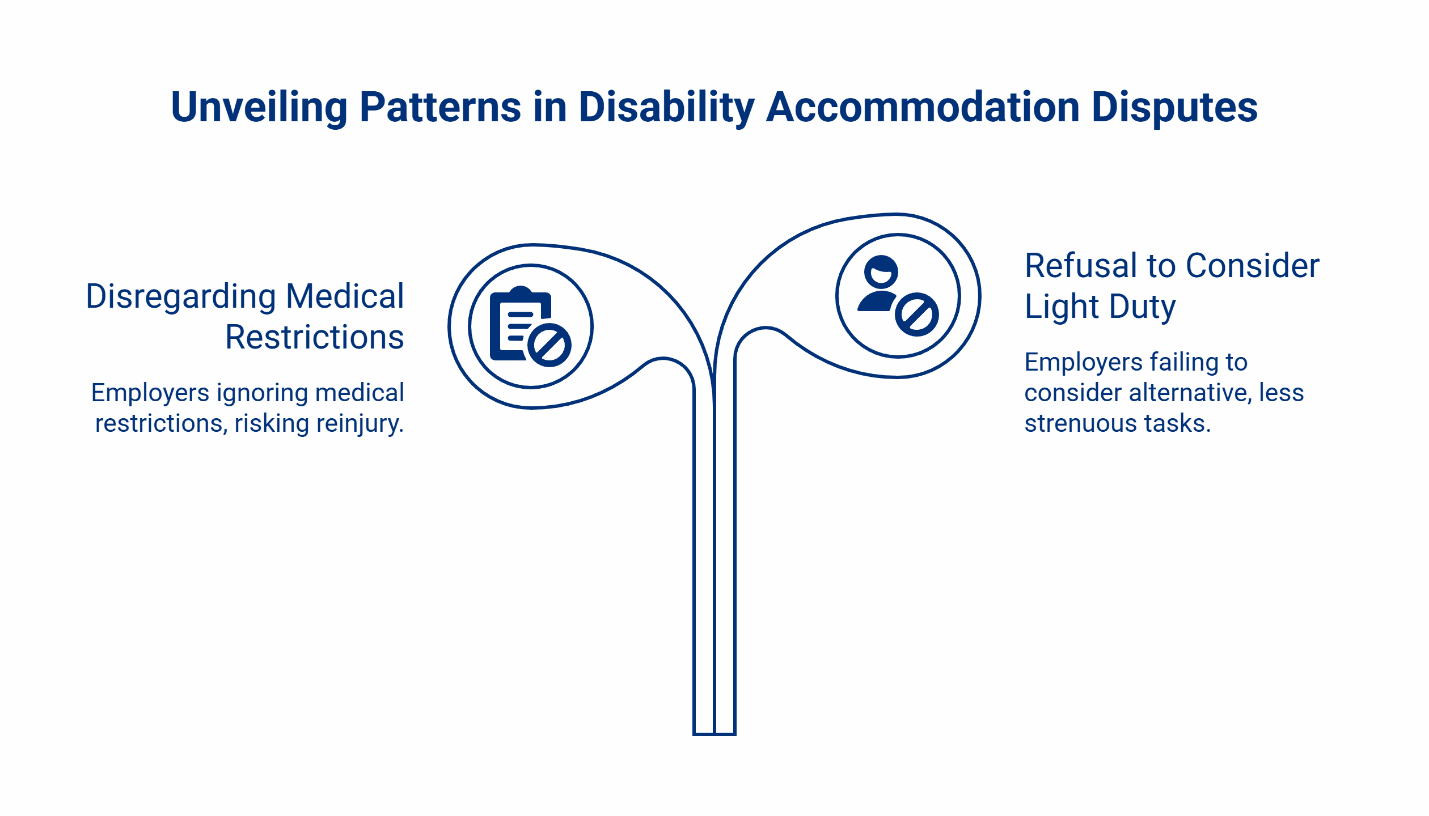
Disregarding Medical Restrictions After an Injury or Diagnosis
A common allegation arises when an employer acknowledges medical restrictions (for example, limits on heavy lifting, climbing, prolonged standing, or overhead work) but supervisors continue assigning tasks that conflict with those restrictions. If the worker is repeatedly placed in assignments that risk reinjury or discipline for following restrictions, the worker may argue the employer created intolerable conditions.
Refusal to Consider Light Duty or Alternative Tasks
Another pattern appears when alternative tasks exist, but the employer does not meaningfully consider them as potential reasonable accommodations. For example, a worker may be capable of scanning, packing, inventory tasks, dispatch support, or other less strenuous duties, yet the employer keeps the worker on the most physically demanding line. A failure to engage in a timely, good-faith interactive process or a refusal to consider reasonable accommodations may have legal significance.
California law, including the Fair Employment and Housing Act (FEHA), and federal law, including the Americans with Disabilities Act (ADA), may protect workers with disabilities from discrimination and retaliation and may require employers to engage in a timely, good-faith interactive process to explore reasonable accommodations.
Patterns Involving Shift or Hours Changes After Disability Disclosure, Accommodation Requests, or Job-Protected Medical Leave
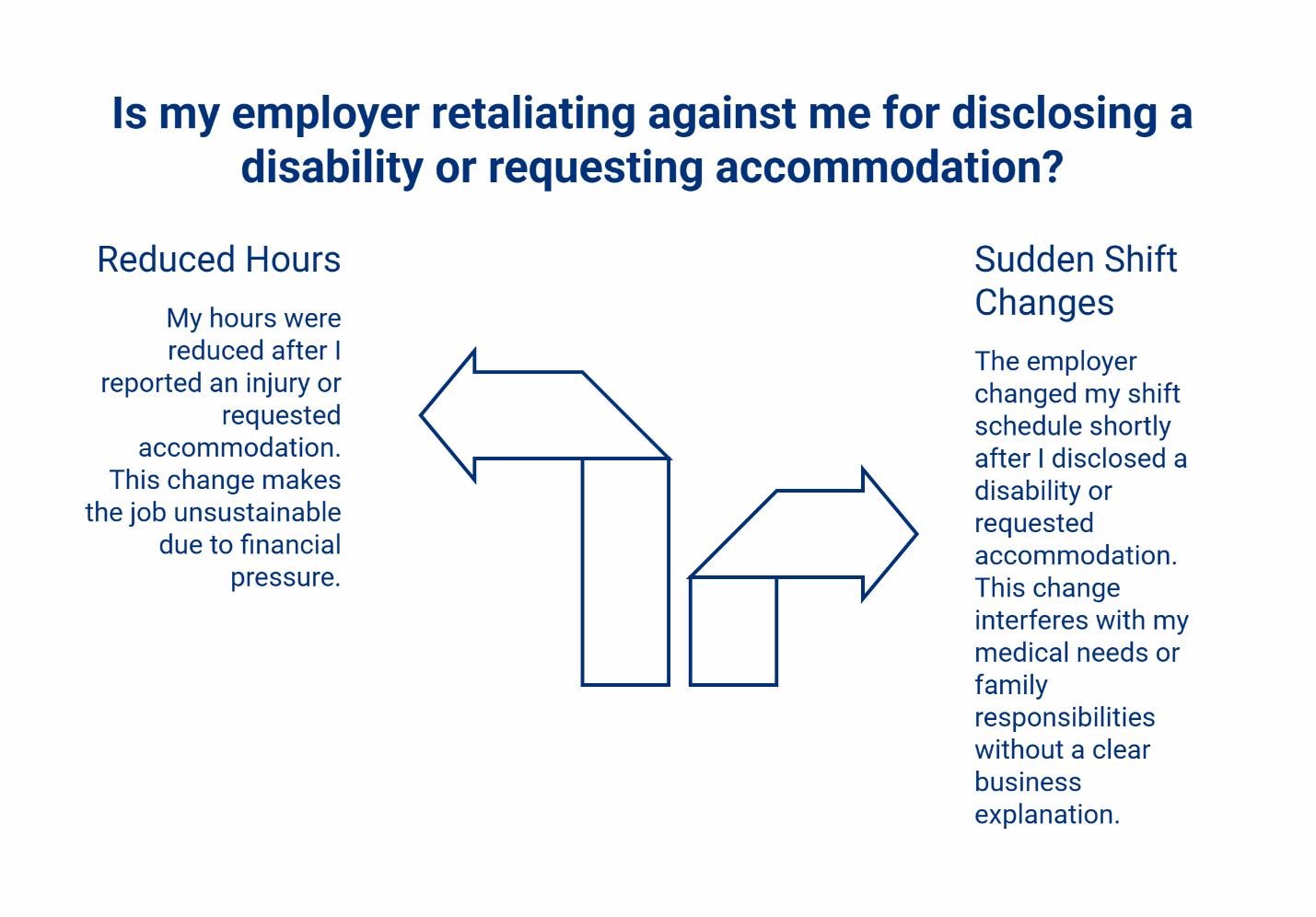
Sudden Shift Changes That Conflict with Medical Needs or Family Responsibilities
A worker may report that an employer changed a long-standing day shift to nights or a rotating schedule shortly after the worker disclosed a disability, requested an accommodation, or returned from job-protected medical leave. If the new schedule predictably interferes with treatment, pain management, or caregiving—and the employer offers no documented business explanation—the timing may be cited as evidence of retaliation or discriminatory motive, depending on the facts.
Reduced Hours or Unpredictable Scheduling That Makes the Job Unsustainable
In other situations, an employer may reduce a worker’s hours shortly after an injury report, disability disclosure, accommodation request, or return from job-protected medical leave. A shift from steady full-time work to scattered or last-minute shifts may create financial pressure and may be cited as evidence of retaliation or discrimination, depending on the documentation and surrounding circumstances.
Patterns Involving Disability-Related Hostility or Retaliation After Accommodation Requests
Hostile Comments About Disabilities or Medical Conditions
Some workers notice a change in workplace tone once an injury or medical condition becomes known. Coworkers or supervisors may make disability-related remarks, complain about covering appointments, or suggest the worker is no longer capable of keeping up. Repeated disability-related remarks may contribute to a hostile work environment theory when the conduct is severe or pervasive and tied to disability or medical condition.
Escalating Discipline or Write-Ups After Protected Activity
Another pattern involves increased scrutiny or discipline after protected activity, such as requesting a reasonable accommodation, providing medical documentation, or returning from job-protected medical leave. If minor issues that were previously addressed informally become written warnings, performance plans, or termination threats soon after protected activity, that timing may be cited as evidence of retaliation, depending on the record.
Patterns Involving Pressure to Work Outside Medical Restrictions
Threats of Termination or Replacement for Following Doctor’s Orders
Some workers report that supervisors explicitly state that the worker must perform all tasks without restriction or risk replacement. Statements suggesting the employer needs workers who are “100%” may be cited as evidence of disability bias, particularly when the worker has requested accommodations or is working under medical restrictions.
Pressure to Sign “Voluntary” Resignation or Separation Documents
A worker may be called into a meeting and presented with pre-drafted resignation or separation documents. A supervisor may suggest that signing will “make things easier” or avoid termination. If the worker signs under pressure, the paperwork may later be used to characterize the departure as voluntary, even if the worker contends the resignation was coerced.
Employer Documentation Patterns in Constructive Discharge Disputes
In constructive discharge disputes, the worker may notice a shift in employer documentation. For example, neutral or positive reviews may be followed by written warnings, negative evaluations, or performance plans soon after a disability disclosure, an accommodation request, or job-protected medical leave. A sudden documentation change may be cited as evidence that the employer was building a record to justify discipline or termination, depending on the surrounding facts.
Why These Patterns May Matter for Wrongful Termination and Disability Discrimination Issues
Under California employment law, including FEHA, and federal disability laws such as ADA, a worker with a disability or qualifying medical condition may be protected against disability discrimination, retaliation, and failures to engage in an interactive process. Patterns such as repeated assignments that conflict with medical restrictions, failure to engage in a good-faith interactive process, adverse schedule changes after job-protected medical leave, disability-related hostility, or discipline that closely follows protected activity may have legal significance under the law.
When Southern California Workers May Want to Consult an Employment Law Attorney
Many Southern California workers speak with an employment law attorney when they recognize these patterns in their own experience. Consider consulting an attorney if you resigned after months of assignments that conflicted with medical restrictions, after an employer failed to engage in the interactive process regarding reasonable accommodations, or after write-ups and threats began soon after you disclosed a disability or returned from job-protected medical leave. An attorney may evaluate whether the facts may support claims related to constructive discharge, disability discrimination, retaliation, or related violations.
Disclaimer:
This content is for informational purposes only. Laws, definitions, and deadlines change. Verify current requirements through official California sources. This content is not legal advice. No attorney-client relationship is formed through this content. Please consult a qualified attorney in your jurisdiction for legal advice specific to your situation
Protect Your Rights | The Akopyan Law Firm, A.P.C. | Top Gun Employment Lawyers
Have you been wrongfully terminated from your job? Have you suffered discrimination, harassment, or retaliation in the workplace? Has your employer violated wage and hour laws? If so, we can help. The Akopyan Law Firm, A.P.C. is dedicated to protecting and enforcing employees’ rights throughout Southern California. With a 97% success rate and millions recovered for our clients, our team of experienced and talented employment lawyers can fight to secure the justice you deserve.
Take the First Step Towards Securing Justice: Call us today to speak with one of our experienced employment lawyers. The firm offers case evaluations free of charge.
Contact Us Today:
- Phone: (818) 509-9975
- Office Locations: Los Angeles, Bakersfield, Costa Mesa, Temecula, Rancho Cucamonga, Oxnard, Culver City, and San Diego in California.
Important: Contacting the Akopyan Law Firm, A.P.C. does not create an attorney-client relationship, but all communications will remain private and confidential. Each case is unique. The Akopyan Law Firm, A.P.C., does not guarantee any outcome.