
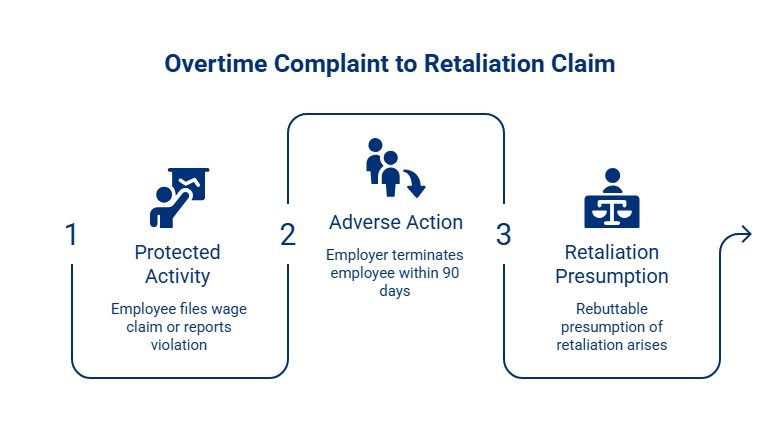
An overtime complaint may connect a payroll dispute and later termination within one alleged course of conduct, expanding scrutiny without automatically establishing liability.
For family-owned Southern California employers, the following considerations show how pay-related complaints may reshape termination litigation and the evidentiary record.
- Timing Can Raise Questions: Adverse action within 90 days of protected activity may trigger a rebuttable presumption of retaliation under specified California statutes.
- Documentation Supports Motive: Contemporaneous evaluations, warnings, attendance records, and communications may support or undermine the employer’s stated reason for ending employment.
- Decision-Maker Knowledge Matters: Scrutiny may increase when the person who learned of an overtime complaint also participated in the employee’s separation decision.
- Consistency Strengthens Credibility: An employer’s explanation may face closer examination when similarly situated employees with comparable performance or attendance histories were retained.
- Evidence Often Converges: Time entries, schedules, payroll data, messages, discipline records, and witness testimony may collectively shape disputes over motive, causation, and credibility.
A close sequence between a wage complaint and termination may expand the dispute, but the complete evidentiary record determines how each allegation is evaluated.
An overtime complaint does not make a later termination automatically unlawful. It may, however, connect a pay dispute and an employment separation within one alleged course of conduct. A former employee may claim that management ended the relationship because the employee questioned overtime compensation. The employer may attribute the decision to performance, attendance, misconduct, reduced work, or another legitimate business reason.
For a family-owned Southern California business, that conflict can transform a narrow payroll disagreement into broader litigation concerning motive, causation, credibility, and consistency. The number of allegations does not establish liability. The overlap instead expands the documents, witnesses, and events that may receive scrutiny.
Complaint and Separation May Form One Alleged Sequence
California overtime law generally requires covered, nonexempt employees to receive overtime compensation when work exceeds applicable daily or weekly thresholds. Exemptions, exceptions, alternative workweeks, and industry-specific rules may affect that general principle. A dispute often concerns recorded time, work outside scheduled hours, the regular rate of pay, classification, or the employer’s knowledge of additional work.
Several California statutes protect employee activity involving wage rights. Labor Code section 98.6 prohibits retaliation against an employee who files or threatens to file a wage claim. Labor Code section 1102.5 extends protection to employees who report conduct they reasonably believe violates state or federal law. Under SB 497, a rebuttable presumption of retaliation arises when an employer takes adverse action within 90 days of protected activity under either statute. An employer can rebut this presumption by presenting clear, legitimate, non-retaliatory reasons for the termination, such as a documented history of policy violations or performance failures that predate the protected activity. Furthermore, an employer who fails to rebut this presumption faces a civil penalty of up to $10,000 per violation, which is awarded directly to the employee. Depending on the facts, an oral or written overtime complaint may support a retaliation allegation under one or more of these provisions. A former employee will often portray the complaint as the event that changed the employment relationship, while the employer identifies a reason that developed independently.
Chronology can create a factual question, but chronology alone does not resolve causation. The parties often dispute who knew about the complaint, when the separation decision took shape, and what information influenced it.
Related Legal Theories May Expand the Dispute
One separation may produce overtime, retaliation, and wrongful termination allegations. The overtime theory may concern hours worked and compensation paid. The retaliation theory may concern protected activity and an alleged adverse employment action. A wrongful termination claim may characterize the discharge as contrary to a public policy reflected in California wage protections.
These theories often rely on the same history without becoming legally identical. The broader pattern resembles other disputes in which one termination may lead to several employment claims. Each claim retains distinct requirements, and pleading several claims does not prove any of them.
Payroll and Termination Evidence May Converge
Time entries may show clock activity. Schedules may show assigned shifts. Payroll data and wage statements may show reported hours and compensation. Messages may indicate when an owner, supervisor, scheduler, or payroll administrator learned of the concern. Evaluations, attendance records, warnings, and separation documents may reflect the history connected to the employer’s stated reason.
No single document necessarily decides the matter. A schedule records planned hours, not necessarily every hour worked. A termination notice identifies a reason, but it may not reveal when that reason arose. Witness testimony supplies context, although different participants may remember informal conversations differently.
Litigation typically compares the stated rationale with contemporaneous evidence. A performance explanation may be examined alongside evaluations. An attendance explanation may be compared with schedules and prior discipline. An operational explanation may be considered against staffing changes and communications. These comparisons define disputed facts; they do not dictate an outcome.
Illustrative Example: Overtime Concern Followed by a Performance-Based Separation
An hourly employee at a family-owned distribution company tells a shift supervisor that several closing shifts included unrecorded work. Two weeks later, the owner ends the employee’s employment and cites recurring performance problems. The employee alleges retaliation, while the employer maintains that the decision arose from documented issues that predated the pay concern.
The scenario could place time records, payroll entries, earlier evaluations, supervisor messages, and the owner’s knowledge into the same evidentiary record. Depending on the facts, the timing may support an inference that requires examination, but it would not independently establish retaliatory motive or defeat the employer’s explanation.
Family-Owned Operations May Create a Dense Witness Record
Small family businesses often assign overlapping duties. An owner may supervise staff, approve schedules, review payroll, and authorize terminations. A relative may keep the books, while a lead employee communicates day-to-day concerns without a formal management title.
That structure may distribute relevant knowledge among several people. One person may receive the complaint, another may review the hours, and a third may recommend separation. Informal texts and workplace conversations become significant when the parties dispute management knowledge or decision-making authority. Unlike a class-action lawsuit over a standard meal break policy—which often turns on written handbooks—an individual retaliation claim turns heavily on who exactly in the family management structure knew about the complaint, and when. This operational reality also distinguishes an overtime-specific dispute from broader wage-and-hour complaints involving family-owned businesses.
Why the Sequence Between a Wage Complaint and a Separation Decision Receives Close Attention
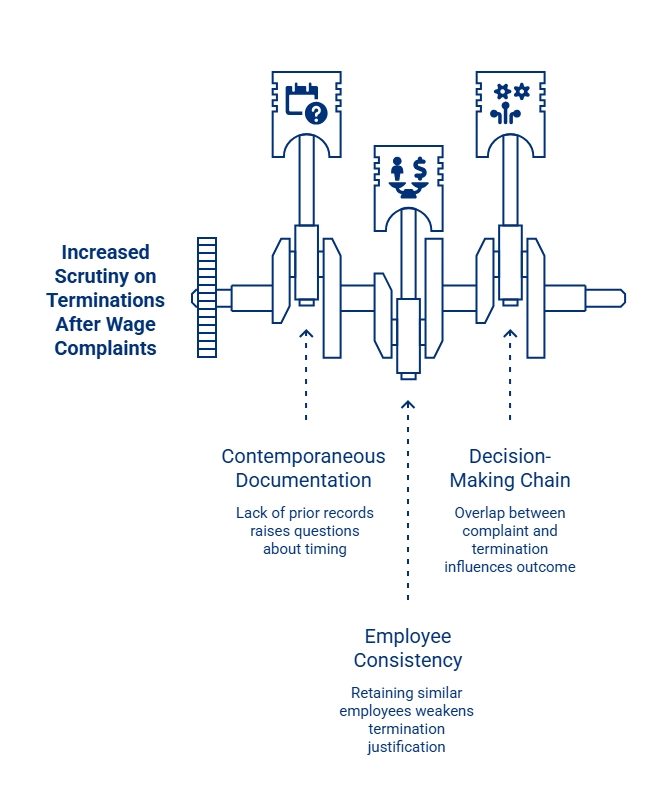
The evidentiary overlap described above is not merely theoretical. It reflects a pattern that surfaces frequently in employer-side litigation. Several factors tend to increase scrutiny when a wage complaint precedes a termination.
Contemporaneous documentation often becomes central. When the employer’s stated reason for separation rests on performance, attendance, or misconduct, a factfinder may examine whether written evaluations, warnings, or counseling records support that explanation and whether those records existed before the wage complaint arose. A reason that appears for the first time in a termination notice, without earlier documentation, can create a factual question about when the concern actually developed.
Consistency across similarly situated employees also receives attention. If other employees with comparable performance or attendance histories were retained, the employer’s explanation for one employee’s separation may face closer examination.
The decision-making chain matters as well. When the person who received or learned of the overtime complaint also participated in the separation decision, the proximity between those roles can support an inference that the complaint influenced the outcome. Separation of those functions within the organization — even in a small business — can affect how the record is evaluated. For example, if a shift supervisor receives an informal complaint about unpaid overtime, isolating that supervisor from a subsequent decision by the owner to terminate the employee for performance can help clarify the evidentiary record and potentially break the causal link.
None of these factors establishes liability. Each represents an area where the evidentiary record may either support or undermine the employer’s position, depending on the particular facts.
Litigation Can Affect Southern California Family-Owned Businesses Beyond Pay Allegation
The dispute may appear through a demand, an administrative proceeding, or a civil complaint. It may then involve document exchange, witness testimony, motion practice, resolution discussions, or trial preparation. The forum and claims shape that path.
Owners and employees who possess relevant knowledge also run daily operations. Their participation may consume management time, interrupt staffing, affect morale, and intensify concern about cash flow or reputation. Those pressures can be significant for a self-funded business, but they reveal nothing about whether the allegations are true.
The legal significance of any overlap between payroll records and separation evidence depends on the governing claims and the particular facts. Employers facing this combination of allegations benefit from understanding how the connection between a wage dispute and a termination decision shapes the scope of litigation.
Disclaimer:
This content is for informational purposes only. Laws, definitions, and deadlines change. Verify current requirements through official California sources. This content is not legal advice. No attorney-client relationship is formed through this content. Please consult a qualified attorney in your jurisdiction for legal advice specific to your situation.
Protect Your Business | The Akopyan Law Firm, A.P.C. | Top Gun Employment Defense Lawyers
Have you been sued by an employee? Are you overwhelmed by the complexities of employment law? If so, give us a call. The Akopyan Law Firm, A.P.C. assists small business owners throughout Southern California. Our seasoned employment defense lawyers stand ready to help employers quickly and efficiently resolve employment disputes. We are ready to aggressively and skillfully defend against any employment case but understand that in most situations avoiding the expense of litigation is in the client’s best interest.
Take the First Step Protecting Your Future: Call us today to speak with one of our experienced employment lawyers.
Contact Us Today:
- Phone: (818) 509-9975
- Office Locations in Southern California: Los Angeles, Bakersfield, Costa Mesa, Temecula, Rancho Cucamonga, Oxnard, Culver City, and San Diego.