

For small California retail employers, a customer complaint can become one disputed fact within a broader wrongful termination claim involving records, credibility, and competing explanations.
- Complaints Do Not Decide Claims: A customer complaint may support the employer’s stated reason for termination, but its existence alone does not establish either party’s position.
- Records Shape the Dispute: Contemporaneous communications, performance records, operational records, and witness accounts may become significant when the employer’s stated reason for termination is contested.
- Consistency Can Affect Credibility: Differences among management communications, existing records, and later recollections may influence credibility without automatically establishing pretext, unlawful motive, liability, or a defense.
- Protected Issues Add Complexity: Allegations involving discrimination, retaliation, protected leave, disability, reasonable accommodation, or whistleblower activity may broaden scrutiny of why the termination occurred.
- Litigation Affects Operations: Wrongful termination disputes may consume management attention, affect employee relations and staffing, and create additional financial and operational demands for small retailers.
A customer complaint may start the factual story, but a disputed termination can place the surrounding employment record under much broader scrutiny.
A customer complaint can become significant in wrongful termination litigation when a retail employee later disputes why the employment relationship ended. What initially appeared to be a customer-service incident may become one factual component of a larger dispute involving management communications, existing employment records, witness recollections, and the employer’s stated reason for the termination.
For a small Southern California retailer, that dispute can unfold while owners and managers continue handling staffing, inventory, sales-floor coverage, customer relationships, and employee relations. The former employee may dispute the accuracy or significance of the complaint or allege that a protected characteristic, protected activity, or another unlawful consideration influenced the termination. The existence of a customer complaint does not, by itself, establish the merits of either party’s position.
Why Customer Complaints May Receive Greater Scrutiny After Termination
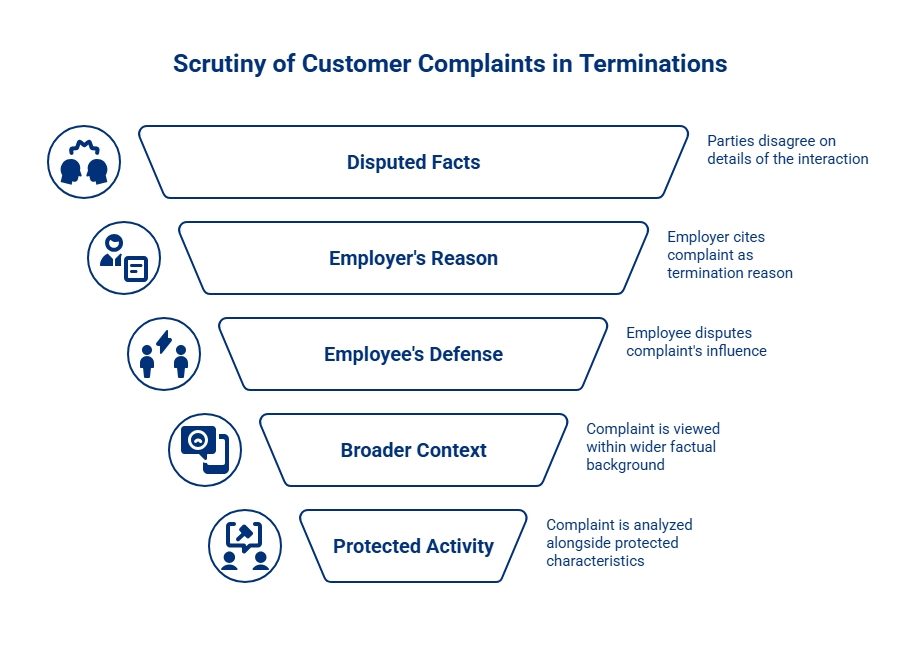
A complaint involving a cashier, sales associate, shift lead, store manager, or another customer-facing employee may form part of the factual background surrounding a termination. Once the termination is challenged, the parties may disagree about what the customer reported, what occurred during the interaction, how management understood the incident, and how much significance the complaint actually carried.
The employer may identify the complaint as one reason for the termination. Because California is an ‘at-will’ employment state, employers can generally terminate an employee for a customer complaint, provided the complaint is not being used as a pretext for unlawful discrimination or retaliation. The former employee may characterize the complaint differently or dispute whether it actually influenced the decision. The resulting controversy can place the employer’s stated reason for the termination within a broader factual context rather than treating the customer complaint as a standalone event.
The complaint also does not automatically resolve allegations involving discrimination, retaliation, protected leave, disability discrimination, reasonable accommodation, or whistleblower activity. In those circumstances, the relevant dispute may concern whether a protected characteristic or protected activity allegedly influenced the termination independently of, or together with, the customer complaint.
Existing Records May Become Important to the Factual Account
A disputed retail termination may involve information that existed before the claim arose. To protect the business, managers should ask complaining customers to provide a written statement or send an email detailing the incident, which creates a contemporaneous record outside of the employee’s control.
Depending on the allegations, potentially relevant material may include:
- Records reflecting the customer complaint or the underlying customer interaction.
- Communications among managers or supervisors concerning the employee or the termination.
- Emails or text messages relating to events surrounding employment decisions.
- Existing disciplinary or performance records bearing on the employer’s stated reason for the termination.
- Operational records or witness recollections directly connected to the events in dispute.
These categories are illustrative rather than universal. Their significance depends on the particular facts and allegations.
Contemporaneous records that consistently reflect the factual basis for an employment decision may assume greater significance when the employer’s stated reason for the termination is later contested. Existing workplace policies or practices may also become part of the factual record when the parties dispute whether the employment decision was handled consistently with other comparable circumstances.
Differences Among Records and Recollections Can Affect Credibility
Retail workplaces often involve several people with different perspectives. A shift lead may have observed part of a customer interaction. A store manager may have received the complaint. An owner may have participated in the termination decision. Each person may possess different information about the same sequence of events.
Contemporaneous communications and later recollections do not always describe those events in identical terms. One manager may remember the customer complaint as central to the termination, while another may remember it as one consideration among several.
Such differences may become relevant to witness credibility and to whether the employer’s stated reason for the termination is supported by a coherent contemporaneous factual record. An inconsistency does not automatically establish pretext, unlawful motive, dishonesty, liability, or a defense. Its significance depends on the surrounding facts and evidence.
Illustrative Example: A Customer Complaint Becomes Part of a Broader Termination Dispute
A small Southern California retailer terminates a customer-facing employee after customer complaints form part of the employment decision. The former employee later disputes whether those complaints actually motivated the termination and alleges that a legally protected circumstance also influenced the decision.
The dispute may then extend beyond whether the complaints occurred. Management communications, existing employment records, witness accounts, and the employer’s stated reason for the termination may all become relevant to competing explanations of why the employment relationship ended. Those circumstances do not establish which account is accurate or whether either party would ultimately prevail.
Overlapping Employment Allegations Can Add Factual Complexity
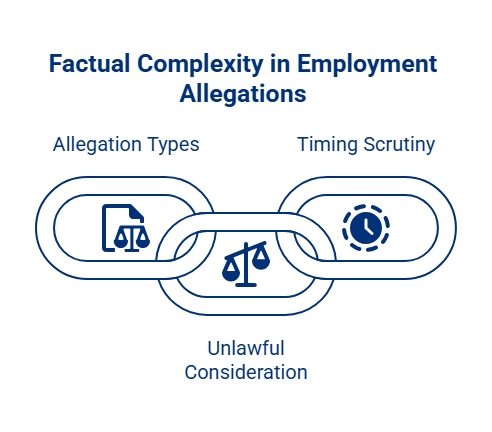
A former employee may allege that discrimination, retaliation, protected leave, disability discrimination, reasonable accommodation issues, or whistleblower activity affected the termination. Such allegations do not establish unlawful conduct merely because the employee engaged in protected activity or had a protected characteristic. Instead, the dispute may concern whether unlawful consideration allegedly influenced the employment decision.
Timing can become one part of that factual inquiry in retaliation-related disputes. When protected activity and a later termination occur within a sequence that the parties characterize differently, the timing may receive scrutiny together with the employer’s stated reason, contemporaneous communications, and other surrounding facts. Timing alone does not determine the outcome.
Wrongful Termination Litigation Can Affect Daily Retail Operations
Small retailers often operate with limited management depth. An employment dispute can therefore draw time and attention from people who also supervise employees, oversee inventory, manage schedules, address customer-facing responsibilities, and maintain ordinary store operations.
The dispute may also affect staff stability, employee relations, management bandwidth, customer trust, cash flow, and legal expenditure. The degree of disruption varies considerably from one business and one matter to another.
These operational pressures can make a contested termination consequential even when the original employment decision involved what appeared to be an ordinary customer complaint.
Employer-Side Representation in a Disputed Termination
Experienced wrongful termination lawyers for employers may provide individualized legal analysis when an active dispute involves customer complaints, the employer’s stated reason for the termination, contemporaneous communications, witness credibility, overlapping employment allegations, and operational concerns.
Disclaimer:
This content is for informational purposes only. Laws, definitions, and deadlines change. Verify current requirements through official California sources. This content is not legal advice. No attorney-client relationship is formed through this content. Please consult a qualified attorney in your jurisdiction for legal advice specific to your situation.
Protect Your Business | The Akopyan Law Firm, A.P.C. | Top Gun Employment Lawyers
Have you been sued by an employee? Are you overwhelmed by the complexities of employment law? If so, give us a call. The Akopyan Law Firm, A.P.C. assists small business owners throughout Southern California. Our seasoned employment defense lawyers stand ready to help employers quickly and efficiently resolve employment disputes. We are ready to aggressively and skillfully defend against any employment case, but understand that in most situations avoiding the expense of litigation is in the client’s best interest.
Take the First Step Protecting Your Future: Call us today to speak with one of our experienced employment defense lawyers.
Contact Us Today:
- Phone: (818) 509-9975
- Office Locations in California: Los Angeles, Bakersfield, Costa Mesa, Temecula, Rancho Cucamonga, Oxnard, Culver City, and San Diego.