
An attendance-based termination may become a broader wrongful termination dispute when a former employee connects the decision to protected activity, protected status, or another employment protection.
For Southern California retail owners facing these claims, the issues below show why the full employment record may matter beyond the final absence or missed shift.
- Attendance Reasons Face Scrutiny: A retailer’s stated attendance rationale may be compared with contemporaneous records, manager communications, policy consistency, and treatment of similarly situated employees.
- Timing May Matter: Temporal proximity between protected activity and termination may become part of a retaliation or pretext allegation, depending on the surrounding facts.
- Protected Issues Can Overlap: Disability accommodation, protected leave, wage complaints, discrimination concerns, or whistleblower activity may broaden the legal theories connected to a termination.
- Decision-Maker Knowledge Matters: What an owner or manager knew about protected activity, disability, leave, or another protected circumstance may become significant when motive is disputed.
- Claims Can Disrupt Operations: An active wrongful termination claim may divert management attention, involve current employees, increase defense expense, and affect day-to-day retail operations.
A scheduling dispute may begin with one missed shift, but the broader employment record may determine how the termination is evaluated.
A California employer may terminate an employee as the result of repeated absences, lateness, missed shifts, limited availability, or scheduling conflicts. A former employee may characterize the same termination as connected to protected activity, protected status, disability, pregnancy, protected leave, wage complaints, discrimination, or whistleblower activity.
When those accounts conflict, a seemingly narrow attendance dispute can develop into a broader wrongful termination claim. The dispute may place the retailer’s stated reason, chronology, decision-maker knowledge, communications, policy consistency, and treatment of similarly situated employees under scrutiny.
For a small Southern California retailer, that scrutiny can arise while the business continues managing sales-floor coverage, opening and closing shifts, inventory deliveries, payroll, customer service, and weekend or holiday staffing.
Retail Scheduling Can Create a Detailed Factual Record
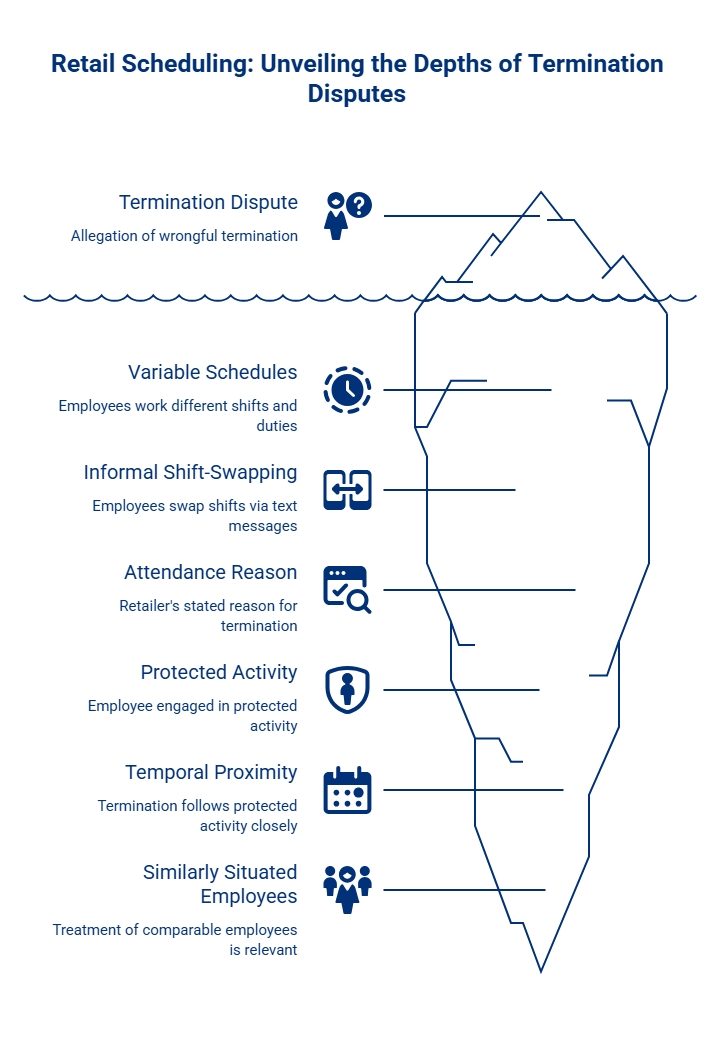
Retail operations often depend on variable schedules. Employees may work different opening and closing shifts, exchange shifts, change their availability, call out unexpectedly, or move between customer-facing and stockroom duties. Informal shift-swapping among employees via text message or group chats can complicate this record, as official timekeeping systems might not reflect the agreed-upon schedule changes that preceded a missed shift.
Those operational circumstances may provide context for a termination, but they do not resolve a later allegation concerning motive. The dispute may focus on whether the retailer’s stated attendance reason was the actual reason for the termination or whether the former employee alleges a causal connection to protected activity or protected status.
Temporal proximity refers to the closeness in time between protected activity and an adverse employment action. When a termination follows protected activity closely, a former employee often relies on that timing as part of a retaliation or pretext allegation. Temporal proximity does not determine the outcome by itself, but it may become one part of the factual analysis.
The treatment of similarly situated employees is also highly relevant. Material differences in how comparable attendance or availability issues were handled can draw scrutiny when discrimination or retaliation is alleged.
Attendance Issues May Intersect with Different Employment Protections
An attendance dispute can overlap with several distinct areas of employment law. The applicable legal theory depends on the conduct or status involved.
For example:
- A disability-related request for reasonable accommodation may implicate the interactive process under California’s Fair Employment and Housing Act, which applies to employers with five or more employees.
- An employee may allege that missed work involved leaves protected by the California Family Rights Act (which applies to employers with five or more employees) or the Family and Medical Leave Act (which applies to employers with 50 or more employees).
- An employee may claim that termination followed a complaint about wages, timekeeping, meal periods, rest periods, or off-the-clock work.
- An employee may allege that termination followed opposition to illegal discrimination or harassment.
- An employee may assert that the termination followed a disclosure of suspected unlawful conduct.
Retaliation for legally protected activity is unlawful. Whether an attendance-related termination was causally connected to protected activity, however, depends on the facts and applicable law. A former employee may therefore assert retaliation even when the retailer identifies attendance as the legitimate reason for the termination.
The Retailer’s Stated Reason May Be Compared with the Broader Employment Record
The factual evaluation of a wrongful termination claim compares contemporaneous employment records with later explanations for the termination. Attendance histories, schedules, timekeeping information, disciplinary records, manager communications, and the sequence of events may each provide part of that record.
Decision-maker knowledge can be especially significant. A dispute may concern what an owner, store manager, or other decision-maker knew about protected activity, disability, leave, pregnancy, or another protected circumstance when the termination occurred.
A former employee may also allege pretext, meaning that the stated reason was not the actual reason for the termination. A material inconsistency between the contemporaneous explanation and a later explanation may support that allegation. A departure from an established attendance policy or materially different treatment of similarly situated employees may also become relevant. For example, a personnel file containing only a manager’s vague note that an employee was ‘unreliable’ is difficult to defend. Conversely, a file containing specific dates of missed shifts, copies of written warnings signed by the employee, and the exact handbook policy violated provides a much stronger foundation for the stated reason.
Contemporaneous and consistent records may therefore affect how defensible the retailer’s explanation appears if challenged. None of these circumstances automatically establishes liability or a defense.
Illustrative Example: Attendance Problems Follow a Request for Disability-Related Schedule Accommodation
A sales associate at an independent retailer has documented attendance problems. The employee later tells a store manager about a disability and requests schedule-related reasonable accommodation. Additional attendance issues follow, and the retailer subsequently terminates the employee, citing repeated attendance problems.
The former employee may allege that the termination was connected to the disability or accommodation request. The dispute could then involve the timing of the request and termination, the manager’s knowledge, the attendance chronology, the retailer’s contemporaneous explanation, the interactive process, and the treatment of similarly situated employees. Those facts illustrate potential areas of dispute without establishing whether the termination was lawful or unlawful.
How a Wrongful Termination Claim Can Affect Day-to-Day Retail Operations
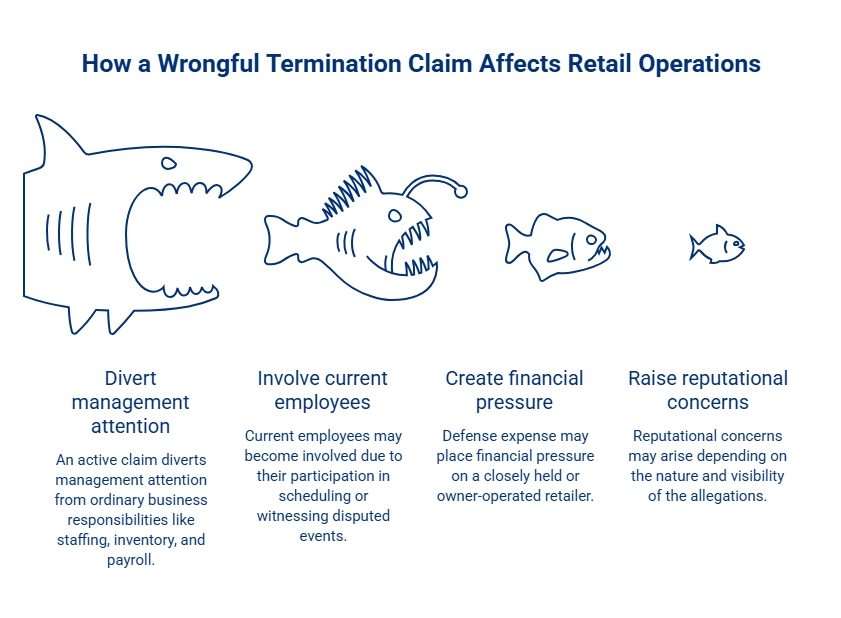
An active claim can divert management attention from ordinary business responsibilities. Owners and managers may have to balance the dispute with staffing, inventory, vendor coordination, payroll administration, customer relationships, and employee relations.
Current employees may also become involved because they participated in scheduling decisions or witnessed disputed events. Defense expense may place financial pressure on a closely held or owner-operated retailer. Reputational concerns may arise depending on the nature and visibility of the allegations.
The degree of disruption varies with the allegations and business circumstances.
Why the Full Employment Record Matters When Attendance-Based Termination Is Challenged
Attendance-related terminations can become more complex when they intersect with protected activity, protected status, disability, pregnancy, leave, wage complaints, discrimination, or whistleblower allegations. Early involvement of HR and employment defense counsel in legally sensitive employment decisions can affect how the underlying process and record appear if the decision is later challenged.
For employers already facing a demand letter or claim, experienced California employment defense counsel can evaluate the stated reason for termination, the chronology, the applicable employment protections, and the broader factual record.
Disclaimer:
This content is for informational purposes only. Laws, definitions, and deadlines change. Verify current requirements through official California sources. This content is not legal advice. No attorney-client relationship is formed through this content. Please consult a qualified attorney in your jurisdiction for legal advice specific to your situation.
Protect Your Business | The Akopyan Law Firm, A.P.C. | Top Gun Employment Lawyers
Have you been sued by an employee? Are you overwhelmed by the complexities of employment law? If so, give us a call. The Akopyan Law Firm, A.P.C. assists small business owners throughout Southern California. Our seasoned employment defense lawyers stand ready to help employers quickly and efficiently resolve employment disputes. We are ready to aggressively and skillfully defend against any employment case, but understand that in most situations avoiding the expense of litigation is in the client’s best interest.
Take the First Step Protecting Your Future: Call us today to speak with one of our experienced employment defense lawyers.
Contact Us Today:
- Phone: (818) 509-9975
- Office Locations in California: Los Angeles, Bakersfield, Costa Mesa, Temecula, Rancho Cucamonga, Oxnard, Culver City, and San Diego.