

📌 Key Takeaways
- Close timing can matter. When an employer disciplines, reduces hours, changes schedules, or terminates an employee shortly after a request for job-protected family-care leave, the sequence of events may be relevant in a retaliation or interference analysis.
- Compare “before” and “after.” A shift from stable performance feedback to sudden criticism, write-ups, or schedule changes after a leave request can be an important pattern to document.
- Employer reasons should be evaluated against the record. “Restructuring,” “performance issues,” or “minor mistakes” may be legitimate in some situations, but a lawyer will often assess whether those explanations are consistent, documented, and applied evenly.
- More than one law can apply. Depending on eligibility and the facts, job-protected family and medical leave protections and anti-retaliation rules may overlap.
- Details and documents help. In an initial consultation, an employment lawyer will typically focus on the timeline, written communications, schedule records, and supervisor statements to assess potential claims.
~ ~ ~ ~ ~ ~ ~ ~ ~ ~ ~ ~ ~ ~ ~ ~ ~ ~
When an employee in California loses a job soon after requesting time off to care for a seriously ill family member, that timing may raise questions about whether the employer acted unlawfully. In many cases, the key issues are what was requested, whether the request involved job-protected leave, what changed afterward, and how the employer explains the termination or other adverse actions.
When A Request for Family-Care Leave is Followed by Job Loss
Consider two examples:
- Example 1: An employee in a warehouse role requests several days off to help a spouse through serious surgery. After the request, the employee’s schedule changes, disciplinary write-ups begin, and the employer terminates the employee.
- Example 2: A grocery employee requests time off to care for a seriously ill parent. Soon afterward, a supervisor starts focusing on minor issues that previously drew no attention, and the employee is told the position is no longer available.
These examples do not prove wrongdoing by themselves. But when termination (or other significant employment actions) closely follows a request for job-protected family medical leave, the timing and pattern can become relevant facts in evaluating possible retaliation, interference with protected leave, or other unlawful conduct.
Employees In Hourly and Schedule-Dependent Jobs May Feel the Impact Most Immediately
A sudden termination can be especially disruptive for employees in hourly, schedule-dependent, or frontline roles (for example, warehouse, retail, delivery, restaurant, manufacturing, and similar jobs). Job loss in these circumstances often creates:
- Immediate loss of income needed for housing, food, transportation, and basic expenses.
- Added strain when the same paycheck supports a seriously ill family member’s care.
- Limited ability to absorb missed paychecks, particularly for employees living paycheck to paycheck.
It is also common for employees to feel unsure how to describe what happened or to assume the situation is “just unfair.” A clearer approach is to focus on the sequence of events, the employer’s actions, and what was said or documented.
Red Flags to Document Before and After the Leave Request
One practical way to evaluate what happened is to compare workplace conditions before and after the employee requested time off to care for a seriously ill family member. The question is not whether any single incident proves a claim, but whether the overall pattern suggests the leave request triggered negative action.
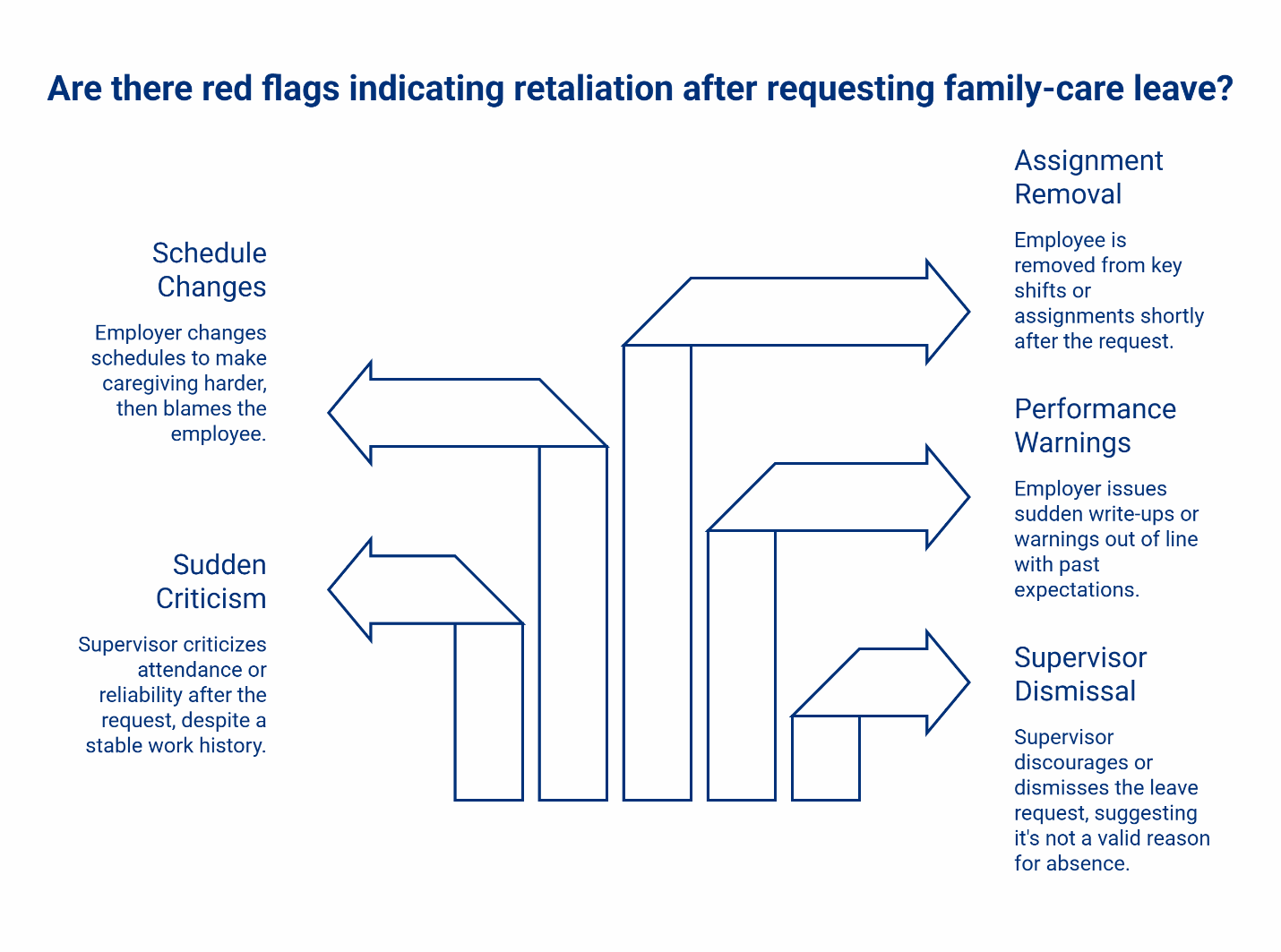
Commonly reported warning signs include:
- A supervisor dismisses the request or discourages it (for example, saying the employee must handle it “on personal time,” or that the business “needs someone fully committed”).
- A supervisor begins criticizing “attendance” or “reliability” only after the leave request, despite a previously stable work history.
- The employer issues a sudden series of write-ups or performance warnings that appear out of line with past expectations.
- The employer changes schedules in a way that makes caregiving significantly harder, then blames the employee for struggling with the new hours.
- The employer removes the employee from key shifts or assignments shortly after the request or replaces the employee on the schedule.
A short gap between the leave request and the negative treatment does not automatically prove retaliation or interference. Still, timing plus a treatment shift is often the type of fact pattern an employment lawyer in California will want to examine closely.
Common Employer Explanations after a Family Medical Leave Request
After an employee requests time off for family care, employers often offer explanations that sound neutral on their face. Employees commonly hear:
- “Restructuring,” “budget cuts,” or “reduced hours,” even though similar roles remain staffed or new hires appear.
- “Performance issues” that were not documented or communicated before the leave request.
- A sudden focus on minor mistakes that previously did not matter, is now used as justification for discipline or termination.
These explanations do not, by themselves, establish unlawful conduct. In many cases, the legal analysis turns on whether the employer’s stated reason is supported by contemporaneous documentation, applied consistently to comparable employees, and consistent with how the employer treated the employee before the protected leave request.
How Job-Protected Family Medical Leave and Anti-Retaliation Protections May Apply
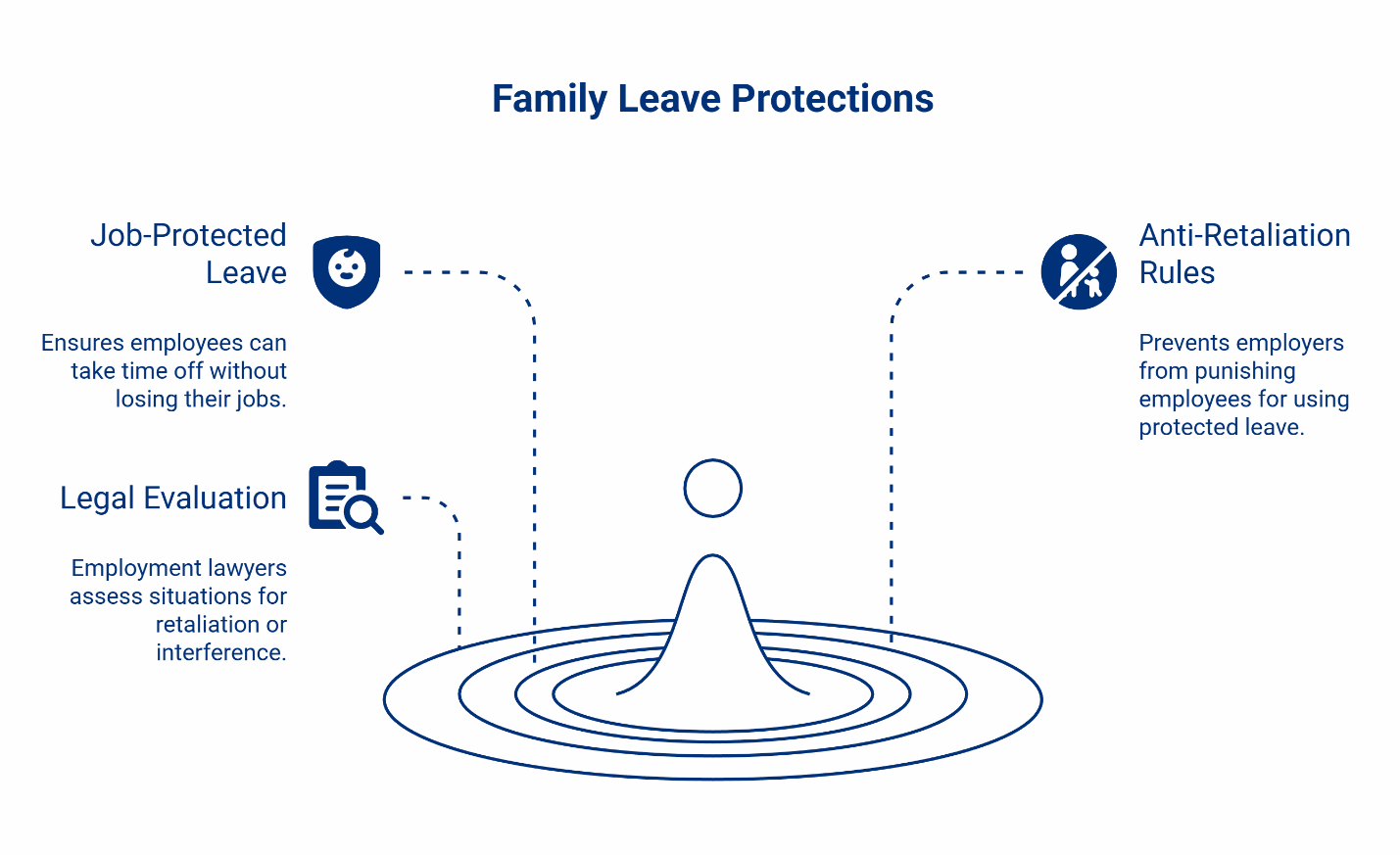
Employees sometimes need time away from work to address serious health conditions affecting a close family member. Depending on eligibility and the facts, an employee’s situation may involve:
- Job-protected family and medical leave protections (for example, under the California Family Rights Act (CFRA) and/or the federal Family and Medical Leave Act (FMLA), among other possible protections).
- Anti-retaliation rules that may prohibit an employer from punishing an employee for requesting or using protected leave.
In practical terms, an employer’s termination, demotion, significant reduction in hours, or hostile schedule changes shortly after a request for job-protected family-care leave may be facts an employment lawyer evaluates for retaliation or interference. Eligibility rules and deadlines can be highly fact-specific, so it is usually important to review the details quickly.
When It May Be Worth Speaking with a California Employment Lawyer
Some fact patterns are commonly serious enough to justify confidential case evaluation, including:
- The employer terminates the employee soon after the employee requests time off to care for a seriously ill spouse, child, parent, or other qualifying family member.
- The employee has a stable work history, then negative treatment begins only after the leave request.
- The employer targets the employee for discipline or termination while similarly situated coworkers who did not request family-care leave keep their jobs under similar conditions.
- The employee resigns because working conditions become intolerable after the leave request (sometimes called constructive discharge, which generally involves conditions a reasonable person would find intolerable, and that the employee in fact found intolerable).
No general overview can determine whether any particular employee has a viable claim. However, these patterns often provide enough detail for a lawyer to assess protected activity, adverse action, and whether the facts support a causal link.
What A Lawyer May Focus on in an Initial Consultation
In an initial conversation, an employee-side wrongful termination lawyer typically focuses on the facts and documents including but not limited to:
- Timeline: When the family member’s serious condition arose, when the employee requested time off, and when discipline, scheduling changes, or termination occurred.
- Documents and records: Schedules, leave requests, text messages, emails, performance reviews, written warnings, and any notices about restructuring or termination.
- Supervisor statements: Comments about commitment, reliability, inconvenience, attendance, or the need for someone “who can be here without interruptions.”
- Comparisons: Whether employees who did not request leave were treated differently in similar circumstances.
The lawyer’s role is to analyze the facts under applicable California and federal employment laws and evaluate potential claims. The employee’s role is to provide an accurate narrative and share any records that help establish what changed after the leave request.
Next Steps for Unlawfully-Terminated Employees in Southern California
Employees in Los Angeles, Bakersfield, Costa Mesa, Temecula, Rancho Cucamonga, Oxnard, Culver City, San Diego, and surrounding areas who lose a job after requesting time off to care for a seriously ill family member often benefit from getting advice promptly. A case evaluation can help clarify how timing, documentation, and the employer’s stated reasons may fit into a retaliation or wrongful termination under California law.
Disclaimer:
This content is for informational purposes only. Laws, definitions, and deadlines change. Verify current requirements through official California sources. This content is not legal advice. No attorney-client relationship is formed through this content. Please consult a qualified attorney in your jurisdiction for legal advice specific to your situation.
Protect Your Rights | The Akopyan Law Firm, A.P.C. | Top Gun Employment Lawyers
Have you been wrongfully terminated from your job? Have you suffered discrimination, harassment, or retaliation in the workplace? Has your employer violated wage and hour laws? If so, we can help. The Akopyan Law Firm, A.P.C. is dedicated to protecting and enforcing employees’ rights throughout Southern California. With a 97% success rate and millions recovered for our clients, our team of experienced and talented employment lawyers can fight to secure the justice you deserve.
Take the First Step Towards Securing Justice: Call us today to speak with one of our experienced employment lawyers. The firm offers case evaluations free of charge.
Contact Us Today:
- Phone: (818) 509-9975
- Office Locations: Los Angeles, Bakersfield, Costa Mesa, Temecula, Rancho Cucamonga, Oxnard, Culver City, and San Diego in California.
Important: Contacting the Akopyan Law Firm, A.P.C. does not create an attorney-client relationship, but all communications will remain private and confidential. Each case is unique. The Akopyan Law Firm, A.P.C., does not guarantee any outcome.