
📌 Key Takeaways
Find out whether a post-injury firing crossed the line by focusing on motive, process, and what the law actually protects.
- FEHA Sets the Guardrails: California law forbids disability discrimination in private-sector employment (Gov. Code §12940(a)) and often provides broader protection than the ADA.
- Process Is Evidence: Employers have duties to consider reasonable accommodation and engage in a good-faith interactive process (§§12940(m), (n)), and skipping these steps is a red flag.
- Timing Alone Is Not Conclusive: Temporal proximity between injury disclosure and termination can be important, but outcomes turn on the totality of circumstances—not a single date on the calendar.
- Lawful Reasons Are Narrow: A discharge can be lawful when it stems from bona fide business reasons, a genuine undue hardship, or the inability to perform essential functions even with accommodation.
- Think Before You Quit: Constructive-discharge claims carry a high threshold, and resigning can negatively affect income and legal posture.
Clarity comes from understanding the protections, recognizing warning signs, and distinguishing legitimate business decisions from disability-based motives.
This guide is for Southern California blue-collar employees in ongoing private-sector roles who were let go after an injury and want a clear, non-jargon framework to spot potential FEHA problems.
A termination that follows a bodily injury may be wrongful under California’s Fair Employment and Housing Act (FEHA) when the decision involves disability discrimination (Gov. Code § 12940(a)), failure to provide reasonable accommodation (§ 12940(m)), failure to engage in the interactive process (§ 12940(n)), or retaliation for protected activity (§ 12940(h)). A discharge may be lawful when the reason is genuinely unrelated to disability, when the employee cannot perform the essential functions of the job even with reasonable accommodation, or when a requested accommodation would create an undue hardship. Determining where a particular termination falls along this spectrum requires professional legal analysis.
California defines physical disability broadly, including injuries that limit major life activities (Gov. Code § 12926.1(c)). FEHA prohibits disability discrimination in private-sector employment (§ 12940(a)) and imposes an affirmative duty on employers to consider reasonable accommodation (§ 12940(m)) through a good-faith, interactive process (§ 12940(n)). Retaliation for requesting accommodation or communicating disability-related work restrictions is prohibited (§ 12940(h)). California’s at-will presumption (Lab. Code § 2922) does not permit termination for reasons that conflict with these protections. Federal ADA provisions (42 U.S.C. § 12101 et seq.) run in parallel, while FEHA often provides broader coverage
Key Ideas to Keep in Mind

When a worker is fired after a bodily injury, the analysis usually focuses on the employer’s motivation, the steps the employer did or did not take, and how disability-related issues were handled.
First, FEHA sets important guardrails for employers. California law forbids disability discrimination in private-sector employment and often provides broader protection than federal law.
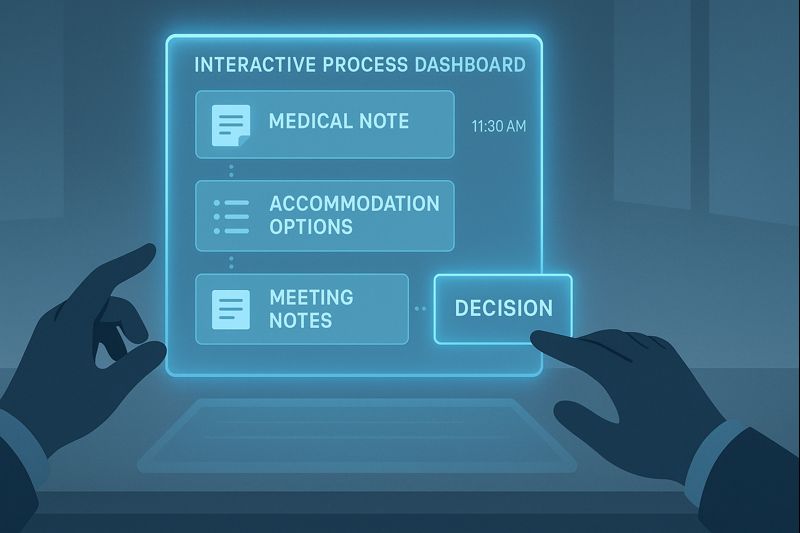
Second, the way an employer handles reasonable accommodation is often powerful evidence. Employers are expected to consider reasonable accommodations and to engage in a good-faith interactive process with the employee. When an employer skips this process altogether, that choice can be a red flag.
Third, the timing of the termination is only one piece of the picture. A firing that occurs soon after an injury, a diagnosis, or an accommodation request may be suspicious, but the outcome in any given case usually turns on the totality of the circumstances rather than on a single date.
Fourth, there are situations in which a discharge may be lawful. These include circumstances where the decision is based on bona fide business reasons, where a requested accommodation would cause an undue hardship, or where the employee is unable to perform the essential functions of the job even with reasonable accommodation.
Finally, resigning instead of waiting to be fired can create its own set of legal and financial complications. Constructive-discharge claims carry a high threshold, and an impulsive resignation can negatively affect both income and legal posture.
Situations That Often Align with Wrongful Termination (Illustrative Only)
The following examples are meant to illustrate patterns that may be consistent with FEHA concerns in typical private-sector jobs. They do not replace individualized legal advice.
One common pattern arises when an employee is terminated shortly after disclosing an injury, explaining disability-related work restrictions, or requesting reasonable accommodation, and managers make comments suggesting the worker is now a “risk” or “liability.” In such a scenario, a decision that appears tied to the employee’s disability or disability-related restrictions may raise questions under FEHA’s prohibition on disability discrimination.
Another situation occurs when an employer refuses to discuss modified duties, adjusted schedules, or other potential accommodations, and instead immediately insists that “no accommodations are available” without exploring options. When an employer refuses to meaningfully explore reasonable accommodations or to participate in an interactive process, that conduct may implicate FEHA’s accommodation and interactive-process requirements.
A further pattern can emerge when performance critiques appear only after the injury or after the employee discloses a disability. For example, an employee who previously had satisfactory reviews may suddenly receive write-ups and escalating discipline only after returning from an injury or after requesting accommodation. That abrupt shift can sometimes suggest that the stated performance concerns are a pretext rather than the real reason for the termination.
Retaliation concerns also arise when adverse action closely follows protected activity. For instance, discipline or discharge that occurs soon after an employee reports disability-related harassment, asks for accommodation for a disability, or otherwise engages in protected activity may support a retaliation theory, depending on the other surrounding facts.
To illustrate, consider a full-time warehouse employee who reports a serious back injury and provides medical documentation reflecting disability-related restrictions on heavy lifting. An employer who fails to consider placing that disabled warehouse worker in a light-duty position—such as scanning, packing, quality control, inventory management, or dispatch—and instead summarily responds “all jobs require heavy lifting” and proceeds to terminate employment, may be failing to meet its obligations under FEHA’s disability-discrimination, reasonable-accommodation, and interactive-process provisions. This hypothetical is only an example and is not meant as a prediction of how any actual case will come out.
When a Discharge May Be Lawful

Balanced context is important and can help workers avoid incorrect assumptions or self-help measures that backfire.
In some cases, an employer can lawfully terminate an employee when the decision is based on bona fide, non-disability business reasons. For example, a company-wide restructuring or position elimination that affects multiple employees and is not motivated by disability or protected activity may be lawful even if it occurs after an injury.
A discharge can also be lawful when a requested accommodation would impose an undue hardship. Undue hardship is a relatively narrow concept that may apply when an accommodation would impose significant operational difficulty or expense on the employer.
Finally, a termination may be lawful when the employee cannot perform the essential functions of the job even with reasonable accommodation. In these situations, a good-faith interactive process should ordinarily occur before an employer concludes that no reasonable accommodations are available.
Distinctions That Often Shape Outcomes
Several recurring distinctions tend to influence how courts and fact finders view wrongful-termination and disability-discrimination claims.
One distinction is between an employer’s stated explanation and its actual motivation. Simply re-labeling a disability-based decision as “performance-related” or “business-related” does not change the underlying motivation. In contested cases, the focus is often on whether disability status or disability-related protected activity actually drove the decision.
Another distinction involves process. Evidence that an employer genuinely engaged in the interactive process, considered different accommodation options, and documented its efforts can affect how a termination is evaluated. By contrast, a complete absence of process can be a sign that disability-related concerns were not handled appropriately.
Timing is also best understood as a data point rather than a verdict. Temporal proximity between disability-related events and termination can matter, but it is typically assessed together with other facts, such as the employer’s explanations, documentation, and prior treatment of the employee.
Topics That Call for Extra Caution
Some issues that injured and disabled workers face are particularly complex and can have long-term consequences.
Resigning because the workplace feels intolerable, for example, may seem emotionally appealing in the moment, but constructive-discharge claims involve a high legal bar. A resignation can make it more difficult to secure income and can complicate potential legal claims.
Retaliation questions are also nuanced. Demonstrating a connection between protected activity and adverse action often requires careful attention to chronology, documentation, and causation. Complaints that are poorly framed or made without forethought can sometimes escalate tensions and affect how events are perceived.
Communications about accommodations and disability-related work restrictions can be delicate as well. The interactive process can involve detailed exchanges between the employee, employer, and medical providers. Both over-sharing and under-sharing information may have unintended consequences, which is why individualized legal advice is important.
Reality Checks for Injured Workers in Southern California
Not every termination that follows a bodily injury or the onset of a disability violates FEHA. Outcomes commonly depend on disability-related motivation, the presence or absence of a good-faith interactive process, whether reasonable accommodations were truly considered, and how the sequence of events unfolded.
Because these assessments are both fact-intensive and time-sensitive, it is important for workers to understand that legal deadlines exist and that they may affect their rights. Those deadlines can vary and can change over time, which is one reason it is prudent to seek professional guidance promptly rather than relying on general information.
A qualified California employment attorney can help evaluate whether a particular termination or resignation aligns more closely with FEHA’s prohibitions on disability discrimination, failure to accommodate, and retaliation, or instead reflects lawful business justifications.
Disclaimer:
This content is for informational purposes only. Laws, definitions, and deadlines change. Verify current requirements through official California sources. This content is not legal advice. No attorney-client relationship is formed through this content. Please consult a qualified attorney in your jurisdiction for legal advice specific to your situation.
Protect Your Rights | The Akopyan Law Firm, A.P.C. | Top Gun Employment Lawyers
Have you been wrongfully terminated from your job? Have you suffered discrimination, harassment, or retaliation in the workplace? Has your employer violated wage and hour laws? If so, we can help. The Akopyan Law Firm, A.P.C. is dedicated to protecting and enforcing employees’ rights throughout Southern California. With a 97% success rate and millions recovered for our clients, our team of experienced and talented employment lawyers can fight to secure the justice you deserve.
Take the First Step Towards Securing Justice: Call us today to speak with one of our experienced employment lawyers. The firm offers case evaluations free of charge.
Contact Us Today:
- Phone: (818) 509-9975
- Office Locations: Los Angeles, Bakersfield, Costa Mesa, Temecula, Rancho Cucamonga, Oxnard, Culver City, and San Diego in California.
Important: Contacting the Akopyan Law Firm, A.P.C. does not create an attorney-client relationship, but all communications will remain private and confidential. Each case is unique. The Akopyan Law Firm, A.P.C., does not guarantee any outcome.