
A wrongful termination claim can become more complex for a California restaurant employer when the former employee previously complained about meal breaks, rest breaks, timekeeping, unpaid wages, scheduling practices, or related wage-and-hour issues. In that setting, the dispute may not focus only on the termination decision. The factual record will be scrutinized for protected activity and the restaurant’s stated reason for termination. Under California’s SB 497 (the Equal Pay and Anti-Retaliation Protection Act), a rebuttable presumption of retaliation is now triggered if an employer takes adverse action—including termination or discipline—within 90 days of an employee engaging in protected activity, such as complaining about meal or rest breaks. This shifts the initial burden to the employer to provide a legitimate, non-retaliatory reason for the action.
For a small restaurant, that kind of claim can create immediate pressure. Owners may be managing services, staffing, vendors, labor costs, and customer expectations while also responding to a demand letter, agency complaint, or lawsuit. The dispute can feel especially disruptive in an owner-operated business where the people making employment decisions are often the same people responsible for keeping the restaurant open each day.
Why Meal and Rest Break Complaints Can Change the Termination Dispute
Meal and rest break allegations often appear in California wage-and-hour disputes because restaurants operate in fast-moving environments. Shift coverage, customer volume, callouts, kitchen timing, and front-of-house demands all may affect how workdays unfold. When an employee later alleges wrongful termination, prior complaints about breaks may become part of the factual background.
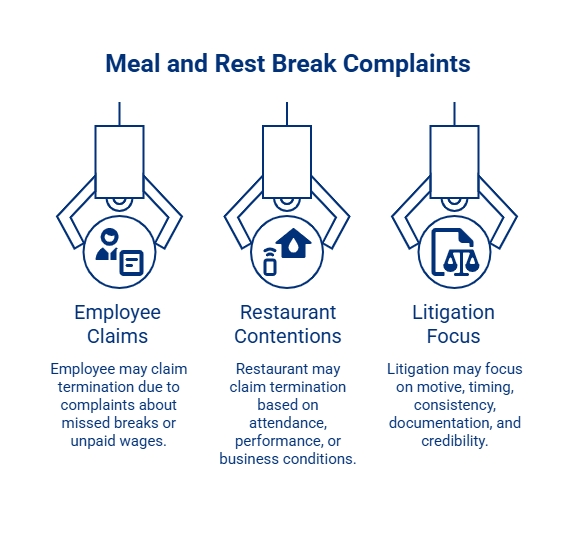
A former employee may claim that the restaurant terminated employment because the employee complained about missed meal periods, interrupted breaks, late breaks, rest break issues, off-the-clock work, unpaid wages, or inaccurate time records. The restaurant may contend that the termination was based on a legitimate business reason, such as attendance, performance, misconduct, customer complaints, scheduling needs, or business conditions.
Once litigation begins, the dispute may turn on motive, timing, consistency, documentation, and credibility. That overlap is one reason a claim involving meal and rest break disputes may connect wage-and-hour allegations with retaliation theories and wrongful termination claims.
How Wage-and-Hour Allegations May Shape the Litigation Narrative
In California employment litigation, the factual record often matters as much as the legal label attached to the claim. A former employee may assert that complaints about wages or breaks were followed by discipline, reduced hours, schedule changes, negative comments, or termination. The restaurant may dispute that account, but the allegation can still expand the scope of the case.
Depending on the claims asserted, the factual record may include materials such as the following, among others:
- Time records that show when employees clocked in, clocked out, and recorded meal periods.
- Posted schedules, shift changes, payroll records, and manager edits to timekeeping entries.
- Text messages, emails, group chats, POS data, and internal communications involving scheduling, breaks, discipline, or performance.
- Witness testimony from owners, managers, supervisors, co-workers, and former employees.
- Prior complaints, disciplinary records, attendance records, write-ups, and performance-related communications.
These materials may affect how the parties evaluate the employee’s allegations and the restaurant’s stated reason for termination. A single message, inconsistent record, or unclear explanation may receive close attention during litigation or agency proceedings.
Why Retaliation Allegations Often Appear Alongside Wrongful Termination Claims
California retaliation claims may arise when an employee alleges that an employer made an adverse employment decision because the employee engaged in legally protected activity. In the wage-and-hour context, protected activity may include complaints about unpaid wages, meal periods, rest periods, or rights under the Labor Code or applicable wage orders.
For restaurant employers, the issue is not limited to whether the underlying break complaint was accurate. A retaliation theory may focus on the employer’s response after the complaint was made. That means timing, communication, and the sequence of events may become central to the dispute.
The restaurant owner may believe the termination was based on a legitimate business reason. A former employee may argue that the stated reason was pretextual. Litigation may then examine whether the explanation is consistent with prior records, whether similarly situated employees were treated differently, and whether manager communications support or undermine the restaurant’s account.
This is why unlawful workplace retaliation claims can be difficult for small employers. The dispute may involve not only what happened, but why it happened.
Why Restaurant-Specific Facts Matter
Restaurant employment disputes often involve facts that do not always appear in office-based workplaces. Employees may trade shifts. Managers may cover stations during rush periods. Break timing may be affected by customer flow, staffing levels, kitchen demands, and front-of-house coordination.
Those operational realities may matter in litigation, but they do not automatically determine the outcome. The evaluation of restaurant-specific facts often depends on how events are documented, how witnesses describe the workplace, and how the restaurant’s explanation fits the broader record.
For small restaurants, the challenge can be intensified by lean management structures. The same person may own the business, approve schedules, respond to employee concerns, supervise performance, and participate in termination decisions. That structure can make litigation more disruptive because the people with the most knowledge are often the same people needed to manage daily operations.
A Single Employee Claim Can Create Business Pressure
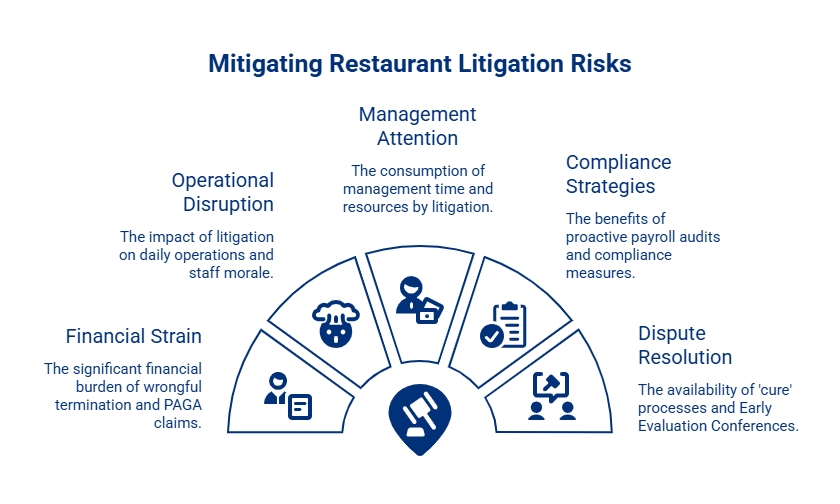
A wrongful termination lawsuit tied to wage-and-hour complaints often involves a parallel claim under the Private Attorneys General Act (PAGA), creating significant financial strain. However, under the 2024 PAGA Reform Act (SB 92/AB 2288), restaurants that proactively audit their payroll or take ‘all reasonable steps’ to comply can now slash potential penalties by up to 85% to 100%. Small businesses with fewer than 100 employees also have access to a new confidential ‘cure’ process and Early Evaluation Conferences to resolve these disputes before they escalate into high-stakes litigation.
For an owner-operated restaurant, the cost is not only monetary. Litigation may consume management attention, affect staff morale, interrupt daily operations, and create uncertainty for a business that depends on consistency. A claim that begins with one former employee may feel much larger when owners and managers must revisit workplace records, communications, and employment decisions.
This is one reason wage and hour defense often benefits from careful evaluation by employment counsel experienced in employer-side litigation.
Why Experienced Employer-Side Representation Matters
Wrongful termination litigation after meal and rest break complaints can involve overlapping legal theories, disputed motive, documentary evidence, witness credibility, and business disruption. The restaurant’s position may depend on the factual record, the applicable California employment laws, the claims asserted, and the forum in which the dispute is pending.
Akopyan Law Firm, A.P.C. represents Southern California employers in employment disputes and focuses on helping small businesses efficiently and effectively resolve employee claims. For restaurant owners facing a lawsuit, demand letter, or agency complaint, experienced employment defense representation may provide the legal judgment needed to evaluate the allegations, the factual record, and the potential business impact.
Disclaimer:
This content is for informational purposes only. Laws, definitions, and deadlines change. Verify current requirements through official California sources. This content is not legal advice. No attorney-client relationship is formed through this content. Please consult a qualified attorney in your jurisdiction for legal advice specific to your situation.
Protect Your Business | The Akopyan Law Firm, A.P.C. | Top Gun Employment Lawyers
Have you been sued by an employee? Are you overwhelmed by the complexities of employment law? If so, give us a call. The Akopyan Law Firm, A.P.C. assists small business owners throughout Southern California. Our seasoned employment defense lawyers stand ready to help employers quickly and efficiently resolve employment disputes. We are ready to aggressively and skillfully defend against any employment case, but understand that in most situations avoiding the expense of litigation is in the client’s best interest.
Take the First Step Protecting Your Future: Call us today to speak with one of our experienced employment lawyers.
Contact Us Today:
- Phone: (818) 509-9975
- Office Locations in California: Los Angeles, Bakersfield, Costa Mesa, Temecula, Rancho Cucamonga, Oxnard, Culver City, and San Diego.