
California employers may face significant litigation exposure when a former employee alleges that a termination violated fundamental public policy. Under California law, generally, this form of wrongful termination claim may arise when an employee asserts that the discharge was tied to protected activity, the exercise of statutory rights, refusal to engage in unlawful conduct, or other conduct the law protects. For small, owner-operated medical practices in Southern California, that allegation may broaden the dispute from a single termination decision into a closer examination of motive, timing, records, and management communications.
When a California Public-Policy Wrongful Termination Claim May Arise
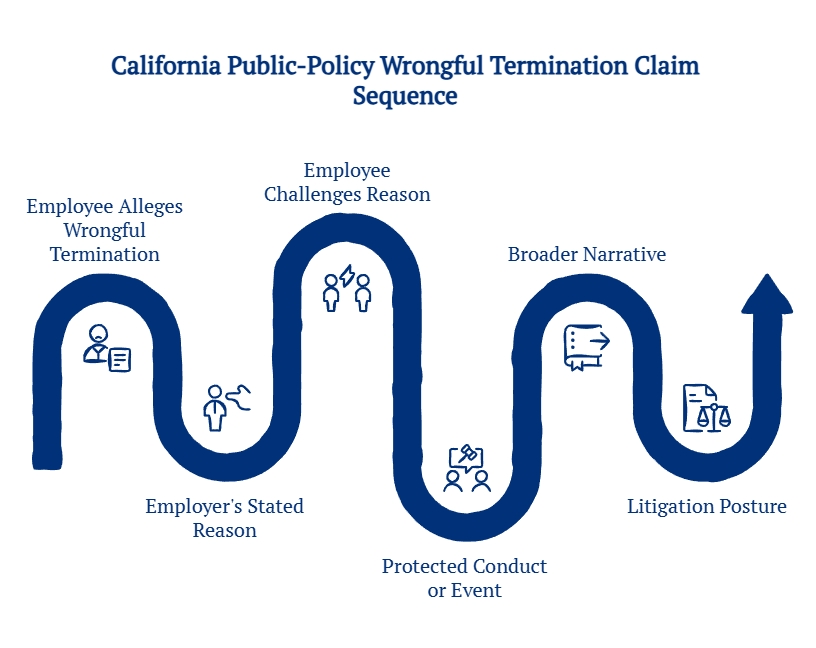
California law generally recognizes a wrongful termination claim where an employee alleges that an employer ended the employment relationship for a reason that contravened an established public policy reflected in law. In many cases, the dispute does not turn only on the fact of termination. The dispute may also turn on why the employer made the decision, what protected conduct or workplace event preceded it, and whether the employer’s stated reason is later challenged as pretext.
That distinction may materially affect the employer’s litigation posture. A complaint may present a termination that management viewed as a discrete personnel action as part of a broader narrative involving protected activity, protected leave, disability-related issues, workplace complaints, or compliance-related objections.
Why Public-Policy Violation Claim Often Broadens the Case
A California public-policy wrongful termination claim often appears alongside other employment allegations arising from the same facts. An employee may allege that protected activity was followed by termination, and the same sequence of events may also be used to support claims involving retaliation, discrimination, whistleblower activity, job-protected medical leave, or reasonable accommodation.
For example, an employee may allege that protected complaints or protected disclosures were followed by discharge, and the case may then focus on whether the timing supports an inference of retaliatory motive. An employee may allege that job-protected medical leave or disability-related requests were followed by discipline or termination, and the dispute may then extend to the employer’s communications, records, and stated rationale.
In that setting, the employer may face a wider factual inquiry than the termination decision alone would suggest. The case may expand into a review of who made the decision, what information those decision-makers considered, how the employer documented events, and whether the employer acted consistently over time.
California employers already facing wrongful termination claims may also confront overlap with unlawful retaliation, whistleblower retaliation, family and medical leave, or reasonable accommodation allegations, depending on the pleadings and facts.
What Facts Often Receive Closer Scrutiny
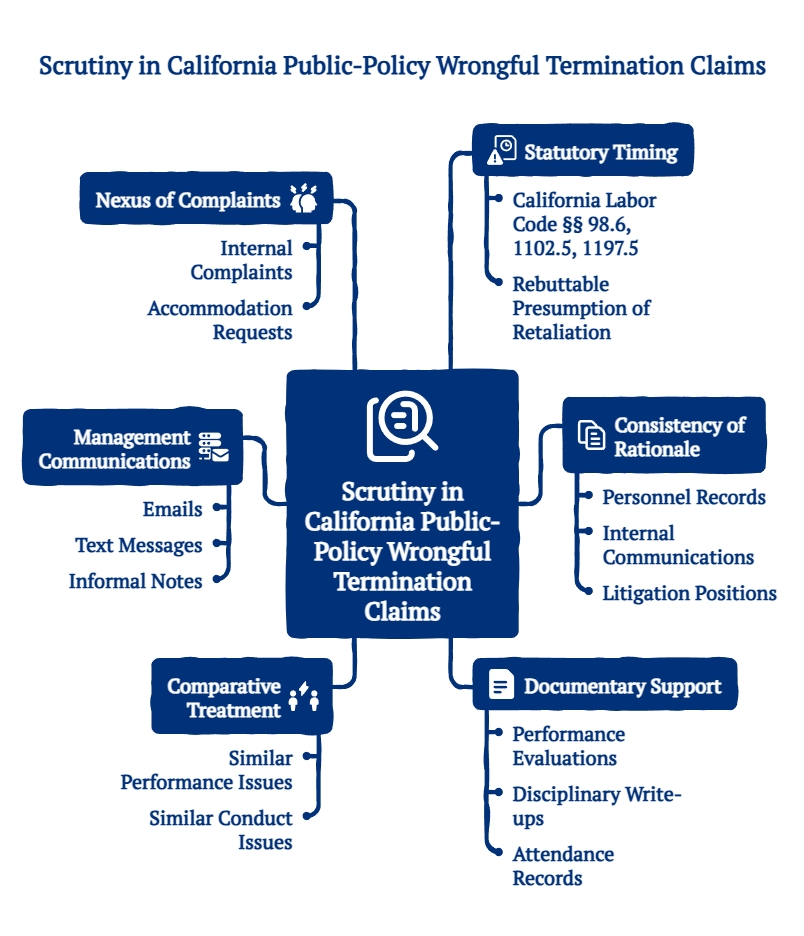
These disputes are often highly fact-specific. A judge may evaluate the legal sufficiency of the pleadings at one stage, and the trier of fact may later assess motive, causation, and credibility through a detailed review of the record. Common areas of scrutiny include:
- Statutory Timing (The 90-Day Window): Under California Labor Code §§ 98.6, 1102.5, and 1197.5 (amended by SB 497), an adverse action taken within 90 days of a protected activity triggers a rebuttable presumption of retaliation. This effectively shifts the burden of proof to the employer to provide “clear and convincing” evidence of a legitimate, non-retaliatory reason.
- Consistency of Rationale: Whether the employer’s stated reason remained consistent across personnel records, internal communications, and later litigation positions.
- Documentary Support: Whether performance evaluations, disciplinary write-ups, and attendance records created prior to the protected activity support the employer’s explanation.
- Comparative Treatment: Whether supervisors treated “similarly situated” employees—those with similar performance or conduct issues who did not engage in protected activity—differently.
- Management Communications: Whether emails, text messages, or informal notes complicate the stated rationale or suggest a retaliatory motive.
- Nexus of Complaints: Whether internal complaints or accommodation requests appear logically connected to the timing or nature of the discharge.
Those facts matter because they are the primary tools used to either support or rebut the legal presumption of retaliation. Even where an employer disputes liability, these recordkeeping practices will face substantial scrutiny.
Why Small Medical Practices May Face Distinct Pressure
Small businesses in Southern California—particularly medical practices and healthcare facilities—face heightened exposure under Health & Safety Code § 1278.5. For these employers, the law provides a broader 120-day rebuttable presumption of retaliation if an adverse action is taken after a healthcare worker reports unsafe patient care or conditions. Unlike general public policy claims, § 1278.5 specifically shields whistleblowers in clinical settings, often carrying mandatory civil penalties of up to $25,000 per violation. Furthermore, under Health & Safety Code § 1278.5(f), a willful violation is a misdemeanor punishable by a criminal fine of up to $75,000, in addition to the civil penalties. For a small practice, these tiered financial sanctions—combined with the possibility of criminal prosecution—represent a critical risk to both the business’s solvency and the owner’s professional licensure.
This operational pressure is compounded by the Strengthening Corporate Practice of Medicine Act (SB 351), effective January 1, 2026. This law—specifically targeting Private Equity groups and Hedge Funds involved in medical or dental practices—explicitly voids any contract provision in Management Services Agreements (MSAs) that attempts to restrict a clinician’s ability to report quality-of-care concerns. For medical practices utilizing these investment structures, any attempt to influence clinical staffing or discipline now invites direct intervention from the California Attorney General. For practices managed by outside investors or private equity, any attempt to influence clinical staffing or discipline in response to a safety report now invites direct intervention from the California Attorney General, creating a secondary front of litigation alongside the wrongful termination claim.
Owners must also manage new proactive compliance mandates, such as the Workplace Know Your Rights Act (SB 294). As of February 1, 2026, all California employers are required to provide a standalone written notice to employees outlining these specific retaliation protections. Failure to maintain proof of this annual distribution may result in direct penalties of up to $500 per employee. More importantly, in the context of a healthcare whistleblower claim, such a compliance gap can be used as evidence of ‘willful’ misconduct. This evidence can help a plaintiff bridge the gap toward the $75,000 criminal fine authorized under Health & Safety Code § 1278.5(f) for willful retaliation, as it suggests a systemic disregard for mandated employee protections.
Why Active Disputes Often Require Serious Legal Attention
A California public-policy wrongful termination claim often involves more than a disagreement about whether an employee should have remained employed. Depending on the allegations and evidence, the claim may become a broader dispute involving retaliation theories, protected activity, disputed motives, credibility issues, and extensive factual review. For that reason, employers facing a complaint, lawsuit, demand letter, or agency notice often need prompt legal evaluation by qualified employment defense lawyers with employer-side experience.
This material provides general information about California employment law issues. It does not constitute legal advice, does not create an attorney-client relationship, and should not be relied upon as a substitute for case-specific legal analysis. Laws are subject to change, and current legal requirements should be confirmed through official sources and qualified defense attorney.
For many Southern California small medical or healthcare-adjacent practices, the central concern is not only the termination itself. The larger concern is that a California public-policy wrongful termination claim may broaden the matter into a more searching review of motive, timing, records, communications, and related statutory allegations.
Disclaimer:
This content is for informational purposes only. Laws, definitions, and deadlines change. Verify current requirements through official California sources. This content is not legal advice. No attorney-client relationship is formed through this content. Please consult a qualified attorney in your jurisdiction for legal advice specific to your situation.
Protect Your Business | The Akopyan Law Firm, A.P.C. | Top Gun Employment Lawyers
Have you been sued by an employee? Are you overwhelmed by the complexities of employment law? If so, give us a call. The Akopyan Law Firm, A.P.C. assists small business owners throughout Southern California. Our seasoned employment defense lawyers stand ready to help employers quickly and efficiently resolve employment disputes. We are ready to aggressively and skillfully defend against any employment case, but understand that in most situations avoiding the expense of litigation is in the client’s best interest.
Take the First Step Protecting Your Future: Call us today to speak with one of our experienced employment lawyers.
Contact Us Today:
- Phone: (818) 509-9975
- Office Locations in California: Los Angeles, Bakersfield, Costa Mesa, Temecula, Rancho Cucamonga, Oxnard, Culver City, and San Diego.