

📌 Key Takeaways
In California restaurant disputes, a termination following discipline or restructuring may draw wrongful termination scrutiny when timing, documentation, consistency, and stated business reasons do not align cleanly.
- Business Reasons Face Testing: A legitimate business reason may still receive close scrutiny when a plaintiff challenges timing, consistency, or the employer’s stated rationale.
- Timing Creates a Legal Presumption: Termination within 90 days of a protected activity—such as a wage claim or a report of harassment—creates a rebuttable presumption of retaliation under California Senate Bill 497 (the Equal Pay and Anti-Retaliation Protection Act). This shift means that rather than the plaintiff merely using timing to ‘shape’ motive, the law now assumes retaliation occurred, effectively shifting the burden to the employer to prove a non-retaliatory business reason. In the fast-paced restaurant environment, this 90-day window transforms ‘unfortunate timing’ into a significant legal hurdle that mandates immediate, contemporaneous documentation of the underlying performance or restructuring issues.
- Records Shape Credibility: Informal texts, abbreviated write-ups, and shifting explanations may create credibility disputes when managers and supervisors describe the decision differently.
- One Decision Can Expand: A single separation may develop into overlapping wrongful termination, retaliation, discrimination, or whistleblower allegations arising from the same facts.
- Early Review Supports Defensibility: Employment decisions often become easier to defend when documentation is consistent and experienced employer-side attorney is involved early.
Defensibility often turns on whether the employer’s explanation remains consistent from the workplace record to the litigation record.
California restaurant employers facing active disputes will gain immediate clarity here, guiding them into the wrongful-termination-specific details that follow.
~ ~ ~ ~ ~ ~ ~ ~ ~ ~ ~ ~ ~ ~ ~ ~ ~ ~
A discipline-related termination or restructuring-related separation may begin as an ordinary business decision. While California is an at-will employment state under Labor Code § 2922—meaning either party may generally terminate the relationship at any time—this ‘at-will’ status does not shield an employer from statutory retaliation or Wrongful Termination in Violation of Public Policy (Tameny claims). In restaurant disputes, a separation may be examined under the McDonnell Douglas burden-shifting framework to determine if the employer’s stated rationale—such as restructuring—is a ‘pretext’ for an unlawful motive. Therefore, a single termination can trigger multiple overlapping theories of liability, including statutory violations of the Fair Employment and Housing Act (FEHA) or the California Labor Code. In many restaurant disputes, the central question is not simply whether management identified a business reason for the decision, but whether the employer’s stated rationale, timing, documentation, and consistency can withstand litigation scrutiny.
This article provides general information only, focuses on California employer-side employment disputes, does not create an attorney-client relationship, and does not constitute legal advice. Laws are subject to change. A restaurant business facing a lawsuit, demand letter, or agency complaint may be subject to strict deadlines and serious consequences, which is why prompt involvement of experienced employment defense attorneys often matters.
Why Discipline-Related Terminations May Receive Closer Litigation Scrutiny
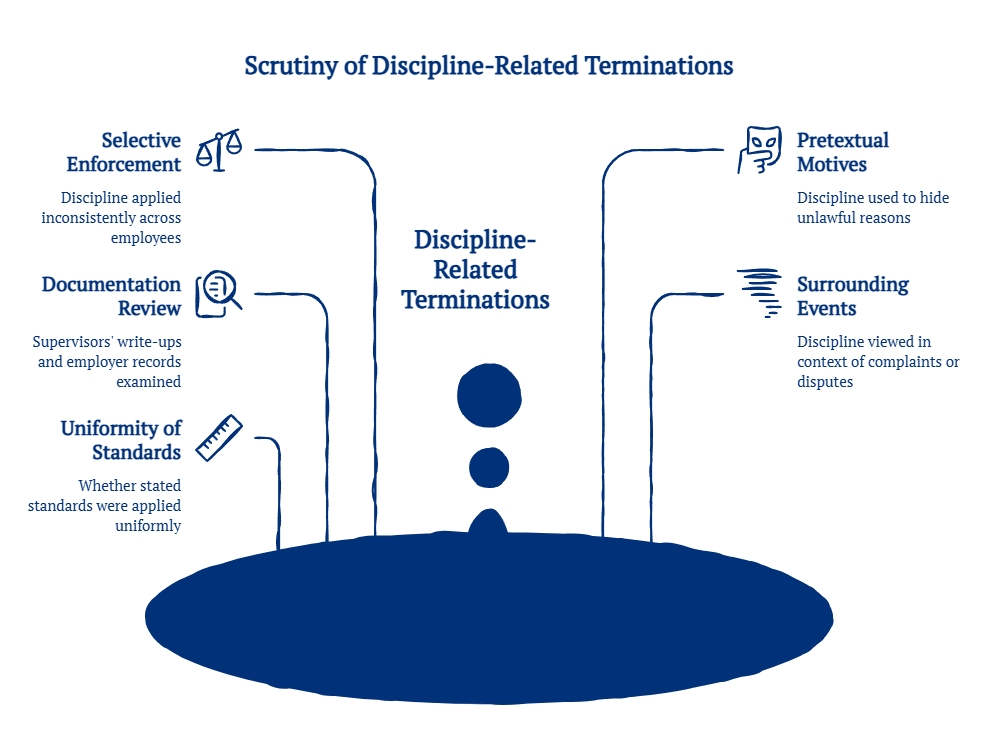
Under California law, generally, a wrongful termination claim may extend beyond the final discharge decision. A plaintiff may allege that discipline was selective, inconsistently enforced, or used as a pretext for an unlawful motive. In that setting, supervisors’ write-ups, managers’ explanations, and the employer’s broader treatment of comparable employees may become part of the contested record.
In many employment disputes, discipline becomes a focal point because it appears objective on paper but may look less settled when viewed alongside surrounding events. A termination that follows a complaint, a leave-related issue, a wage dispute, or an internal report may be framed as more than a performance decision. The dispute may center on whether the employer applied its stated standards uniformly or whether the asserted reason changed as the conflict escalated.
Why Restructuring Decisions May Be Challenged as Pretextual
Restaurant employers often make staffing changes for legitimate operational reasons. Restructuring, reduced headcount, revised scheduling models, and changing supervisory structures may all reflect business pressures rather than unlawful motive. Even so, a plaintiff may argue that a restructuring explanation was inconsistent, selectively applied, or asserted only after the employer faced criticism or a protected complaint.
From a defense perspective, restructuring cases often become fact-intensive because the employer’s business rationale may be examined alongside who was selected, who remained, what explanations managers gave at the time, and whether contemporaneous records reflect the same reason later advanced in litigation. Common legal principles suggest that when timing appears close or explanations appear to shift, the plaintiff may try to characterize the restructuring decision as pretext rather than business judgment.
Why Motive, Causation, and Timing Often Shape the Case
Wrongful termination litigation frequently turns on motive and causation. A plaintiff may argue that the stated reason for discharge was not the actual reason, and that the real motivation was retaliation, discrimination, or another unlawful purpose. A judge or jury may be asked to decide whether the employer’s explanation remained consistent across disciplinary records, internal communications, witness testimony, and later litigation positions.
Timing often becomes significant in that analysis. If discipline or termination follows protected activity, the plaintiff may rely on temporal proximity to support an inference of retaliation. Protected activity may include internal complaints, reports to management, participation in an investigation, opposition to allegedly unlawful conduct, or complaints involving wages, breaks, safety, harassment, discrimination, or leave. In that context, protected activity creates documentation and process issues for the employer because later litigation may focus heavily on sequence, consistency, and comparative treatment.
Why Restaurant Operations Often Produce Credibility and Documentation Disputes
California restaurant workplaces often operate through fast decisions, multiple supervisors, lean management structures, and frequent staffing adjustments. Those business conditions may produce abbreviated write-ups, informal text messages, verbal instructions, shifting schedules, and overlapping management authority. In litigation, that environment may create credibility disputes about who made the decision, when the decision was made, and what reasons were actually communicated.
Supervisors, managers, and owners may each become relevant actors in that record. One manager’s informal message may be compared to another manager’s formal write-up. A supervisor’s description of misconduct may be measured against payroll records, schedules, prior evaluations, or the treatment of other employees. As a result, wrongful termination claims in restaurant settings often become disputes about narrative coherence as much as disputes about the final termination itself.
How One Termination Decision May Expand into Multiple Claims
A wrongful termination claim may not remain limited to one legal theory. Depending on the alleged facts, the same separation may also be pleaded as a wrongful termination claim alongside unlawful retaliation allegations, discrimination theories, harassment-related theories, leave-related allegations, or whistleblower retaliation allegations.
That overlap matters because one employment decision may expose the defendant employer to multiple standards, multiple alleged motives, and broader factual disputes. A complaint that began as a challenge to one discharge decision may expand into a wider examination of internal communications, disciplinary history, treatment of similarly situated employees, and the employer’s handling of prior complaints or compliance concerns.
Why Small Restaurant Employers Often Feel Immediate Business Pressure
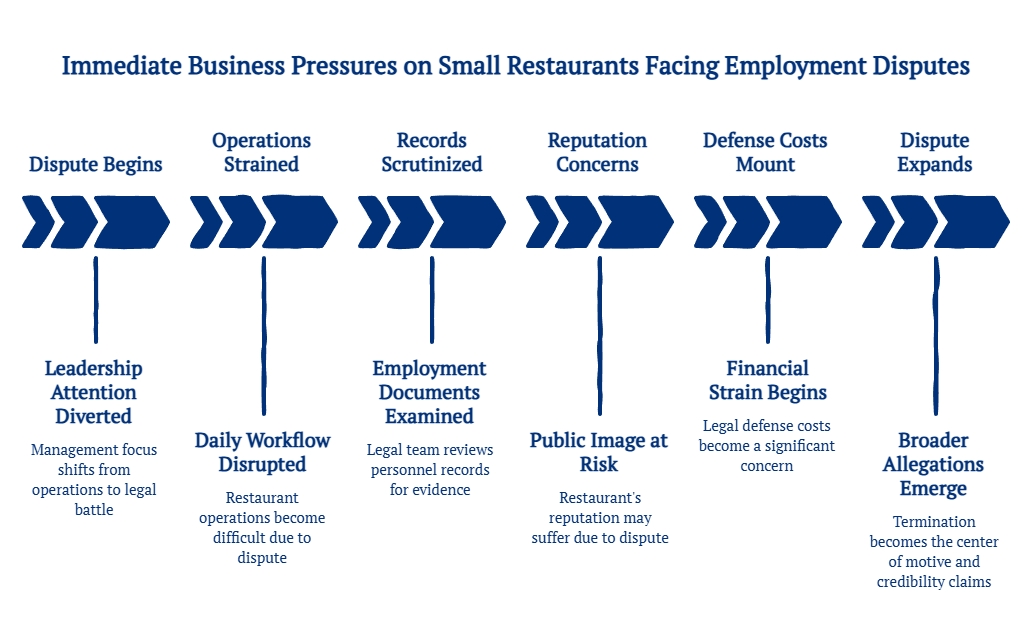
For small and closely held restaurant businesses, an active employment dispute may create pressure well beyond the pleading itself. Leadership attention may be diverted. Operations may become strained. Employment records may receive close scrutiny. Reputational concerns may intensify. Defense costs may begin to matter early, especially when the plaintiff pleads multiple causes of action arising from the same termination.
That pressure is one reason these disputes often feel larger than the underlying personnel event. A termination that management viewed as a contained business decision may later become the center of a broader allegation about motive, consistency, and organizational credibility.
Why Early Defense Attorney Involvement Often Matters
At a high level, discipline-related and restructuring-related termination disputes are often judged through the lens of defensibility rather than through the employer’s business rationale alone. In many cases, the litigation record will test whether documentation was contemporaneous and consistent, whether established standards were applied uniformly, whether protected activity preceded the adverse action, and whether supervisors, managers, HR, and company leadership presented one coherent explanation.
For California restaurant employers already facing an active claim, those issues often become more complex than when they first appear. That is why early evaluation by employment defense attorneys experienced in employer-side disputes often matter when a termination following discipline or restructuring is being challenged as wrongful.
Disclaimer:
This content is for informational purposes only. Laws, definitions, and deadlines change. Verify current requirements through official California sources. This content is not legal advice. No attorney-client relationship is formed through this content. Please consult a qualified attorney in your jurisdiction for legal advice specific to your situation.
Protect Your Business | The Akopyan Law Firm, A.P.C. | Top Gun Employment Lawyers
Have you been sued by an employee? Are you overwhelmed by the complexities of employment law? If so, give us a call. The Akopyan Law Firm, A.P.C. assists small business owners throughout Southern California. Our seasoned employment defense lawyers stand ready to help employers quickly and efficiently resolve employment disputes. We are ready to aggressively and skillfully defend against any employment case, but understand that in most situations avoiding the expense of litigation is in the client’s best interest.
Take the First Step Protecting Your Future: Call us today to speak with one of our experienced employment lawyers.
Contact Us Today:
- Phone: (818) 509-9975
Office Locations in California: Los Angeles, Bakersfield, Costa Mesa, Temecula, Rancho Cucamonga, Oxnard, Culver City, and San Diego.