
An initial wrongful termination claim against a Southern California medical practice often begins with the exhaustion of administrative remedies before a civil complaint is filed in court. For claims involving discrimination, harassment, or retaliation under the Fair Employment and Housing Act (FEHA), a plaintiff must typically first obtain a “Right-to-Sue” notice from the California Civil Rights Department (CRD) [formerly DFEH].
Only after this administrative process is complete—or if the claim is based on common law “Tameny” theories (wrongful termination in violation of public policy)—does the matter proceed to an initial civil complaint. The complaint usually identifies the parties; states alleged facts, legal theories, and lists requested relief. It is ordinarily an organized set of allegations rather than proof, and a single pleading can assert multiple theories.
Overview of What an Initial Wrongful Termination Filing Against a Medical Practice Typically Alleges
A complaint commonly frames the termination as unlawful by alleging a motive or course of conduct that the plaintiff contends violates the law. The pleading typically uses neutral attribution language such as “the plaintiff alleges” and “the complaint claims,” and it often characterizes the decision as discriminatory, retaliatory, harassing, or disability-related depending on the theories asserted.
Strict deadlines apply to legal claims, and these deadlines vary. You should speak with an attorney as soon as possible about any time limits that may apply to your situation.
A practical takeaway is that an initial complaint usually reads as a map of the plaintiff’s theory of liability, not a factual finding.
How Plaintiffs Commonly Identify Employers, Related Entities, and Individual Defendants
The complaint typically identifies the plaintiff and the employer entity the plaintiff contends employed them. The pleading may name related entities where the plaintiff alleges shared control over employment decisions or pay practices. The complaint may also name individuals—such as owners, practice administrators, managers, or supervisors—when the plaintiff alleges personal participation in the challenged conduct.
The practical implication for a smaller practice is that party naming can pull multiple leaders into the narrative even while those assertions remain allegations.
How Complaints Often Describe the Employment Relationship and the Separation
Many complaints present a chronology. The complaint often describes the role, reporting relationships, performance communications, and workplace events the plaintiff contends led to the separation. The narrative frequently emphasizes sequence because the plaintiff commonly seeks to allege a causal connection between earlier events and later discipline or termination.
A plaintiff may quote or summarize workplace communications such as written warnings, policy acknowledgments, performance evaluations, complaint reports, emails, or texts. A plaintiff may also describe who communicated what to whom and how management responded, because those details can be used to support allegations about motivation, notice, or employer knowledge.
A practical implication is that early pleadings often use documentation and communications to give the allegations structure, even when the employer disputes that framing.
Allegation Categories Frequently Pleaded Alongside Wrongful Termination Claims
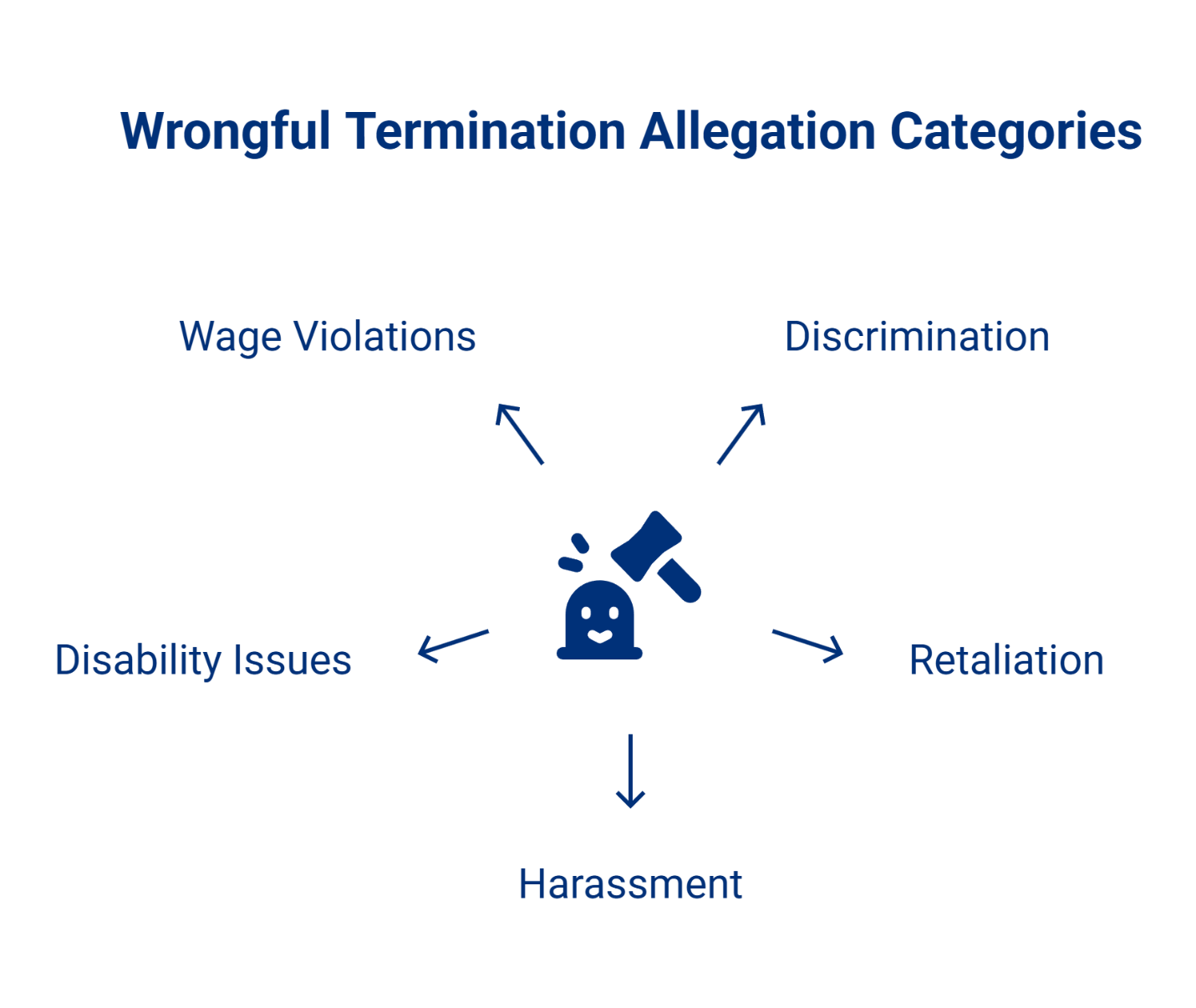
A “wrongful termination” label often appears with multiple causes of action. The complaint may plead overlapping theories as alternative bases for liability and may rely on the same core events to support several counts.
Allegation categories may include, depending on what the plaintiff asserts:
- The plaintiff alleges discrimination based on a protected characteristic and ties that allegation to an adverse employment action.
- The plaintiff alleges retaliation based on protected activity and claims protected activity was followed by discipline, reduced hours, termination, or other adverse action.
- The plaintiff alleges harassment or a hostile work environment and contends the employer failed to prevent or correct the conduct.
- The plaintiff alleges disability-related issues, including a failure to provide reasonable accommodation or a failure to engage in a good-faith interactive process.
- The plaintiff alleges wage-and-hour violations and may also allege retaliation connected to wage-related complaints.
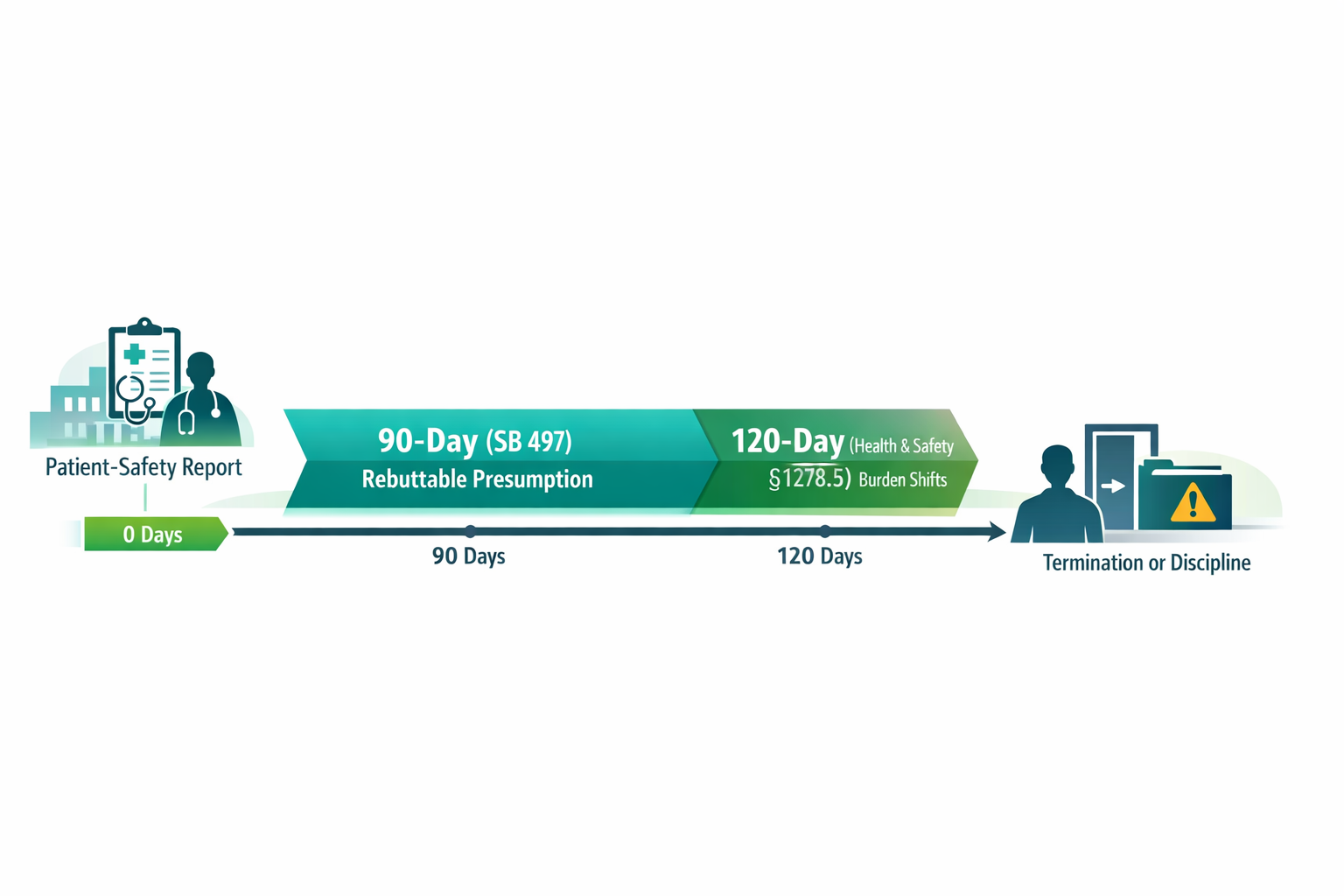
Under California law, a statute may provide a basis for a claim depending on the facts alleged. For example, California Government Code § 12940 may appear in complaints asserting certain discrimination, harassment, retaliation, or disability-related theories. California Labor Code § 1102.5 (the general whistleblower protection statute) frequently appears in retaliation allegations, as does California Labor Code § 98.6, which protects employees who exercise rights under the Labor Code, such as filing a wage claim. Furthermore, Health and Safety Code § 1278.5 provides specific, robust protections for healthcare workers (including those in medical practices) who report concerns regarding patient safety or care quality, creating a rebuttable presumption of retaliation if adverse action occurs within 90 to 120 days of the report, depending on the specific statute cited. While Health and Safety Code § 1278.5 creates a rebuttable presumption of retaliation if adverse action occurs within 120 days of a protected report for healthcare workers, recent amendments to California Labor Code § 1102.5 and § 98.6 (via SB 497) have codified a 90-day rebuttable presumption window for general whistleblower and wage-related retaliation claims. Consequently, a medical practice may face an automatic shift in the burden of proof if a termination occurs within these strict 90-day or 120-day statutory windows.
The practical implication is that a single complaint can combine several legal theories, which can broaden the scope of issues the practice must track as the dispute unfolds.
What Complaints Typically Request as Relief
Most complaints include a prayer for relief, which lists the remedies the plaintiff asks the court to award if liability is found. The prayer for relief typically states categories rather than precise numbers and may include a request for attorney’s fees where a statute allows.
The practical implication is that the relief section often signals how broadly the plaintiff frames the dispute, even when the employer contests the underlying allegations.
Administrative References and Materials That May Be Mentioned Early
A complaint may refer to administrative activity or attach selected materials the plaintiff contends support the allegations. Attachments vary, and many complaints rely on narrative allegations without underlying records.
The practical implication is that even limited references can place internal communications and management decisions under scrutiny.
Why These Matters Can Escalate Quickly for Small Medical Practices
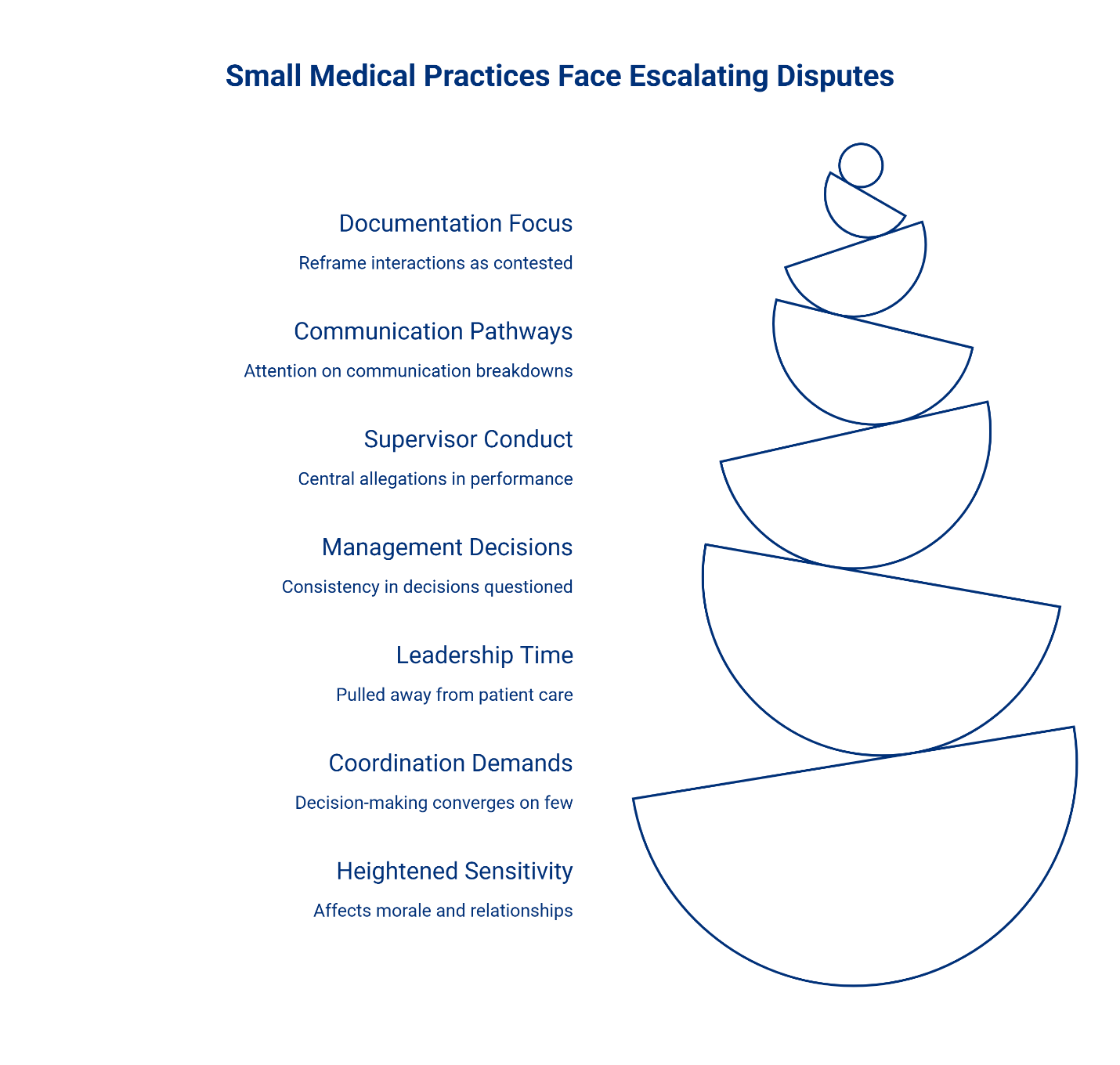
A wrongful termination complaint can strain medical practices because the dispute can reframe ordinary workplace interactions as contested events. The complaint may focus attention on documentation, communication pathways, supervisor conduct, and consistency in management decisions. The process can also pull leadership time away from patient care, staffing stability, and day-to-day operations.
Operational pressure often concentrates on a small leadership group:
- Practice owners and administrators may face increased coordination demands because decision-making and record review converge on a limited number of people.
- Supervisors may experience disruption because performance management and separation communications can become central allegations.
- The organization may experience heightened sensitivity because allegations involving discrimination, harassment, disability, or retaliation can affect morale and working relationships even when the practice disputes the allegations.
The practical implication is that the first complaint often signals where leadership attention may be pulled, even before the employer has a complete factual record.
Disclaimer:
This content is for informational purposes only. Laws, definitions, and deadlines change. Verify current requirements through official California sources. This content is not legal advice. No attorney-client relationship is formed through this content. Please consult a qualified attorney in your jurisdiction for legal advice specific to your situation.
Protect Your Business | The Akopyan Law Firm, A.P.C. | Top Gun Employment Lawyers
Have you been sued by an employee? Are you overwhelmed by the complexities of employment law? If so, give us a call. The Akopyan Law Firm, A.P.C. assists small business owners throughout Southern California. Our seasoned employment lawyers stand ready to help employers quickly and efficiently resolve employment disputes. We are ready to aggressively and skillfully defend against any employment case, but understand that in most situations avoiding the expense of litigation is in the client’s best interest.
Take the First Step Protecting Your Future: Call us today to speak with one of our experienced employment lawyers.
Contact Us Today:
- Phone: (818) 509-9975
Office Locations in California: Los Angeles, Bakersfield, Costa Mesa, Temecula, Rancho Cucamonga, Oxnard, Culver City, and San Diego.