
📌 Key Takeaways
In California wrongful termination disputes involving small restaurants, damages, attorney’s fees, and defense costs may make the case economically significant even when the employer disputes liability.
- Exposure Often Expands: A termination dispute may widen into claims about protected activity, causation, motive, pretext, and whether management’s explanation remained consistent.
- Overlap Increases Pressure: Retaliation, whistleblower, discrimination, and public-policy allegations may arise from the same events, increasing legal complexity and broadening potential exposure.
- Fees Change the Math: Back pay, front pay, emotional-distress damages, statutory penalties, and attorney’s fees may shift the dispute from personnel issue to serious business risk.
- Operations Also Suffer: Owners, supervisors, and managers may be pulled into discovery, testimony, and document review while still running staffing, service, and day-to-day operations.
- Narratives Drive Litigation: Plaintiffs and employers may present competing explanations, and a court or trier of fact may closely examine timing, consistency, documentation, and credibility.
When damages exposure grows, the cost of defending the case may become part of the case itself.
California restaurant employers facing wrongful termination disputes will gain a clear view of why these claims may become financially disruptive, guiding them into the employer-side litigation details that follow.
~ ~ ~ ~ ~ ~ ~ ~ ~ ~ ~ ~ ~ ~ ~ ~ ~ ~
For small restaurant employers in California, a wrongful termination dispute may become economically serious even where management maintains that the discharge was justified. The case may expand beyond the termination decision itself and turn into a broader contest over protected activity, causation, motive, pretext, and whether the employer’s explanation appears consistent across managers, records, and workplace events. That shift often changes the economics of the dispute because the employer is no longer dealing only with a separation decision. The employer may also be defending the narrative surrounding it.
Why Exposure Often Extends Beyond the Termination Decision
In many disputes, the plaintiff alleges that the discharge followed some form of protected activity, such as a complaint about discrimination, harassment, wages, breaks, request/taking a disability leave, or raising a safety concern. Under California law, generally, the legal framework may reach not only discrimination-based discharge but also retaliation for opposing forbidden practices or participating in related proceedings. That means a termination may be examined considering what happened before it, who knew what, what concerns were raised, and whether the stated rationale remained the same over time.
For restaurant employers, that scrutiny can be especially fact-intensive. Restaurant operations often involve multiple supervisors, rapid staffing decisions, informal communications, and close owner involvement. A plaintiff may use those conditions to argue that the employer’s explanation shifted, that decision-makers acted with inconsistent motives, or whether the timing of the discharge triggers a rebuttable presumption of retaliation. Under California Senate Bill 497 (the Equal Pay and Anti-Retaliation Protection Act), if an employer takes adverse action against an employee within 90 days of certain protected activities—such as a complaint about unpaid tips or health and safety—a legal presumption of retaliation is established. This shifts the initial burden to the restaurant to prove a legitimate, non-retaliatory reason for the termination, making the case significantly harder to dismiss at the early stages of litigation. The dispute may therefore become less about a simple narrative and more about overcoming a statutory hurdle that favors the employee’s timeline.
How Overlapping Allegations Can Increase Exposure
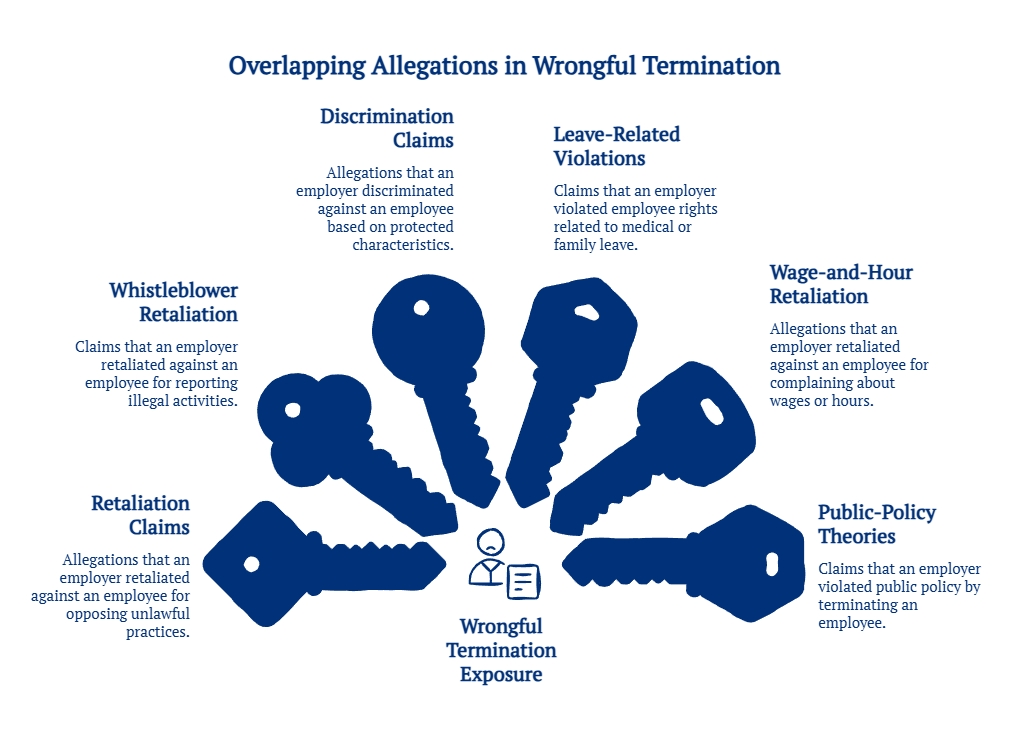
Wrongful termination claims often do not stand alone. In practice, the same complaint may also assert retaliation, whistleblower retaliation, discrimination, leave-related violations, wage-and-hour retaliation, or public-policy theories arising from the same course of events. California’s statutory framework generally prohibits retaliation for opposing unlawful practices, protects certain whistleblower disclosures and refusals to participate in unlawful conduct, and provides remedies for retaliation tied to protected labor-related complaints or proceedings. When those theories overlap, legal complexity and exposure may increase together.
That overlap matters because plaintiffs often frame the case around more than one theory of harm. A wrongful termination allegation may be paired with a retaliation claim that focuses on timing, a whistleblower claim that focuses on protected reporting, or a wage-related retaliation claim that focuses on prior complaints. In that setting, restaurant employers may face a broader evidentiary dispute involving managers, shift supervisors, company leadership, HR participants if any were involved, internal communications, and the consistency of the employer’s explanations across the life of the dispute.
A reader looking for tightly related context may also find it useful to review the firm’s employer-side pages on wrongful termination, unlawful retaliation, and whistleblower retaliation, because those themes frequently overlap in active California employment disputes.
Why Damages, Fees, and Defense Costs Change Economics
The economics of the case often change because the employer may be facing more than a claim for past wages. Depending on the allegations, the plaintiff may seek back pay, front pay, emotional-distress damages, statutory penalties, including those under the Private Attorneys General Act (PAGA). Following the 2024 PAGA Reform (SB 92 and AB 2288), the economics of these penalties have shifted for small restaurants. If an employer can demonstrate they took ‘all reasonable steps’ to be in compliance prior to a dispute—such as conducting regular audits and distributing clear written policies—potential penalties can be capped at 15% or 30% of the maximum. Furthermore, small employers (fewer than 100 employees) now have expanded ‘cure’ rights to fix specific violations and avoid litigation entirely. The legal expenses and operational drag remain high, but proactive compliance now provides a concrete mechanism to limit the ‘stacked’ penalty exposure that historically bankrupted smaller venues.
Even where liability is sharply disputed, defense costs may become a major part of the pressure. Discovery may draw in personnel records, performance history, emails, text messages, scheduling decisions, and testimony from owners, supervisors, and other witnesses. For a small restaurant, those burdens may fall on the same individuals already responsible for staffing, service, inventory, vendor relationships, and customer-facing operations. The legal expenses matter, but so does the operational drag created by a live employment dispute.
Why Small Restaurants Often Feel These Pressures More Acutely
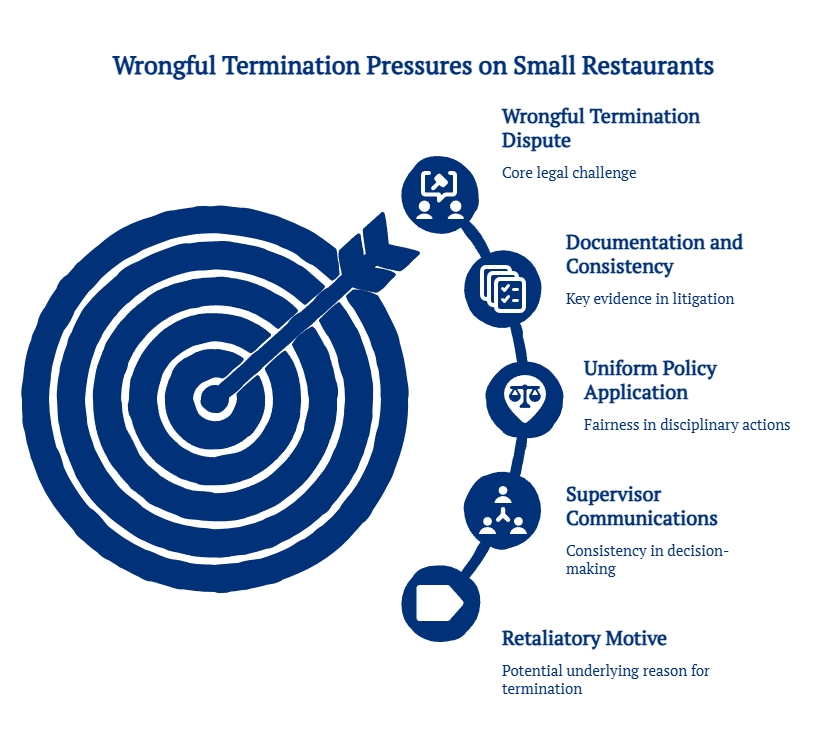
Small restaurant employers may face disproportionate strain because they usually do not have the staffing depth, in-house legal infrastructure, or administrative redundancy of larger employers. A single wrongful termination dispute may absorb leadership attention quickly. It may also create reputational pressure, internal disruption, and stress around how prior decisions, manager communications, and disciplinary history will be characterized by the plaintiff in litigation. That is one reason these cases may feel larger than the termination decision that triggered them.
In many disputes, plaintiffs focus heavily on whether documentation appears contemporaneous and consistent, whether company policies seem to have been applied uniformly, whether different supervisors described the decision the same way, and whether the timing of the discharge may support an inference of retaliatory motive. Those issues do not automatically determine the outcome, but they often shape how the claim is framed and why the case becomes more expensive to defend.
Why These Cases Often Become Narrative Contests
Wrongful termination disputes often become contests over competing narratives rather than a simple review of one employment decision. The plaintiff may allege retaliatory motive, discriminatory intent, or pretext. The employer may assert a legitimate business reason. A court, jury, or other trier of fact may then evaluate timing, comparative treatment, witness credibility, internal consistency, and the broader workplace context. For restaurant employers, that reality helps explain why damages exposure, attorney’s fees, and defense costs can change the economics of the case quickly.
Disclaimer:
This content is for informational purposes only. Laws, definitions, and deadlines change. Verify current requirements through official California sources. This content is not legal advice. No attorney-client relationship is formed through this content. Please consult a qualified attorney in your jurisdiction for legal advice specific to your situation.
Protect Your Business | The Akopyan Law Firm, A.P.C. | Top Gun Employment Lawyers
Have you been sued by an employee? Are you overwhelmed by the complexities of employment law? If so, give us a call. The Akopyan Law Firm, A.P.C. assists small business owners throughout Southern California. Our seasoned employment defense lawyers stand ready to help employers quickly and efficiently resolve employment disputes. We are ready to aggressively and skillfully defend against any employment case, but understand that in most situations avoiding the expense of litigation is in the client’s best interest.
Take the First Step Protecting Your Future: Call us today to speak with one of our experienced employment lawyers.
Contact Us Today:
- Phone: (818) 509-9975
Office Locations in California: Los Angeles, Bakersfield, Costa Mesa, Temecula, Rancho Cucamonga, Oxnard, Culver City, and San Diego.