
Southern California family-owned businesses defending whistleblower retaliation claims need consistent records, credible witnesses, and a documented rationale that withstands a demanding evidentiary standard.
- Documentation Drives the Defense: Contemporaneous performance evaluations, warnings, disciplinary records, and attendance logs may support legitimate, independent reasons for a termination.
- Employers Carry a High Burden: After protected activity becomes a contributing factor, the employer must prove its action by clear and convincing evidence.
- The Timeline Matters: Adverse action within 90 days of protected activity creates a rebuttable presumption of retaliation, making documented decision-making critically important.
- Consistency Strengthens Credibility: Records, communications, and witness accounts that consistently support the stated business reason strengthen the employer’s position against allegations of pretext.
- Each Claim Requires Attention: Statutory retaliation and wrongful termination claims have different standards, defenses, and potential remedies, requiring separate analysis of each theory.
For Southern California family-owned businesses, early review by employment litigation counsel may clarify deadlines, evidence, litigation risk, and potential business consequences.
Consistent records turn a stated business reason into a defensible evidentiary position.
When a former employee alleges that a family-owned business terminated employment because of a protected complaint or a refusal to participate in allegedly unlawful conduct, the resulting dispute often combines wrongful termination and whistleblower retaliation claims. For a Southern California family-owned business, these overlapping allegations can draw owners, managers, and employees into an extensive factual record — and the employer’s burden of proof under California law is demanding.
For an owner-operated company facing a demand letter, administrative complaint, or lawsuit, owners may become witnesses and employees may possess relevant information while normal operations continue.
What California Whistleblower Protections Address
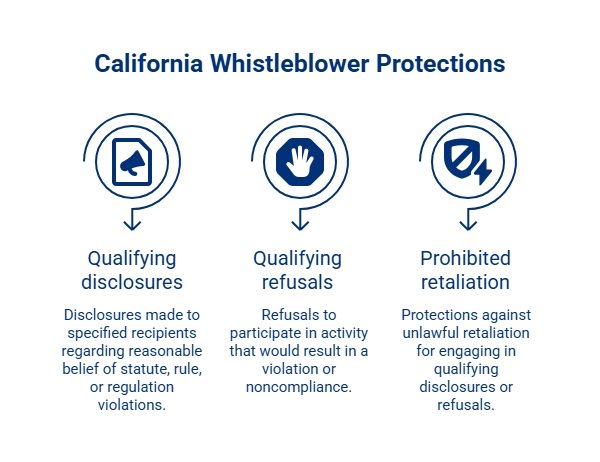
California Labor Code section 1102.5 protects qualifying disclosures made to specified recipients when an employee has reasonable cause to believe the information reveals a violation of a state or federal statute, or a violation of or noncompliance with a local, state, or federal rule or regulation. The statute also protects qualifying refusals to participate in activity that would result in such a violation or noncompliance. Whether a particular communication or refusal qualifies depends on the governing law and complete factual record.
These protections prohibit unlawful retaliation. They do not establish that every workplace complaint constitutes protected activity, every later termination is retaliatory, or an employer’s stated reason lacks merit.
Why Wrongful Termination and Retaliation Allegations May Overlap
A single termination can support both a statutory claim under Labor Code section 1102.5 and a common-law tort claim for wrongful termination in violation of fundamental public policy. The statutory claim carries the burden-shifting framework discussed below, while the tort claim requires the employee to establish that the termination violated a public policy grounded in a constitutional or statutory provision. Their standards, available defenses, and potential remedies differ, which means an employer’s defense strategy often must address each theory on its own terms. Related allegations involving wages, leave, discrimination, accommodation, or workplace safety frequently accompany these claims when those issues form part of the alleged disclosure or the events surrounding the termination, further expanding the scope of discovery and the number of witnesses involved.
How the Burden-Shifting Framework Under Labor Code Section 1102.6 Affects Employer Defense
Under Labor Code section 1102.6, once an employee demonstrates that protected activity was a contributing factor in an adverse employment action, the burden shifts to the employer. The employer must then prove, with clear and convincing evidence, that the same action would have been taken for legitimate, independent reasons. This is a demanding evidentiary standard that exceeds the preponderance-of-the-evidence standard applicable in many other employment disputes.
In Lawson v. PPG Architectural Finishes, Inc., the California Supreme Court confirmed that Labor Code section 1102.6 exclusively governs whistleblower retaliation claims under section 1102.5, meaning employers must always meet this rigorous standard rather than the easier frameworks used in other employment disputes.
Violations carry steep financial consequences. Beyond potential damages for lost wages and emotional distress, employers face a civil penalty of up to $10,000 per violation, which is awarded directly to the retaliated employee, plus the employee’s reasonable attorney’s fees. Crucially for family-owned operations, liability under Section 1102.5 is not limited to the corporate entity; individual supervisors and owners acting on behalf of the employer can also be held personally liable for these civil penalties.
For a family-owned business, this framework means that the employer’s stated business reason for the termination is not simply accepted at face value. The reason must be supported by contemporaneous documentation, consistent application, and credible witness testimony. Informal explanations, after-the-fact rationales, or records that do not align with the stated reason can undermine the defense.
Because the statute places this burden on the employer rather than the employee, the quality of the employer’s own records often becomes the most consequential factor once litigation begins.
Why the Disclosure and the Business Reason Become Central
The factual record may place several issues under close scrutiny:
- The parties may dispute the content of the alleged disclosure, its recipient, and whether the employee had reasonable cause to believe that the information disclosed a violation covered by Labor Code section 1102.5.
- The parties may contest what each decision-maker knew and how that knowledge relates to the termination.
- The employer’s stated business reason may be compared with contemporaneous communications, employment records, and witness testimony.
A family-owned business may identify performance concerns, misconduct, attendance problems, restructuring, or another lawful reason. Where the employer’s records, communications, and witness accounts consistently support the stated business reason, the defense position is stronger. Where those records conflict with one another or with the employer’s stated rationale, the employee’s retaliation theory gains traction.
Chronology, Knowledge, and Informal Management Structures
The sequence of the alleged disclosure, management awareness, intervening employment developments, and the termination decision receives close scrutiny. Under SB 497, which amended Labor Code section 1102.5, a rebuttable presumption of retaliation arises when an employer takes adverse action within 90 days of an employee’s protected activity. This presumption does not establish liability, but it shifts the initial burden and makes the employer’s documented timeline and decision-making process critically important. Even outside the 90-day window, temporal proximity between a disclosure and a termination raises questions about motive that the employer’s records must address.
Owners may supervise employees directly, managers may use informal texts or emails, and few people may participate in employment decisions. These characteristics concentrate relevant knowledge among a small number of individuals who also run daily operations, which can complicate privilege considerations and increase the operational disruption of litigation.
Why Documentation Practices Are Central to Employer’s Defense
In whistleblower retaliation litigation, the employer’s own records frequently determine whether the stated business reason for a termination can withstand the clear-and-convincing-evidence standard. For family-owned businesses, where management structures tend to be informal and decisions are often made verbally, the absence of contemporaneous documentation can create significant vulnerabilities.
Performance evaluations, written warnings, disciplinary records, and attendance logs that predate any protected disclosure tend to support the employer’s position that the termination was based on legitimate business considerations. Records created or formalized only after a complaint or disclosure, by contrast, are often characterized as pretextual.
The consistency of the documented record also matters. A unified documentary trail anchors the employer’s defense, whereas inconsistencies open the door for a judge or jury to infer pretext.
For closely held businesses where owners and managers communicate through informal channels such as texts and verbal conversations, the content of those communications can become part of the evidentiary record. Awareness of how informal communications are preserved and what they convey is an important consideration for employers managing personnel issues.
Communications, Witnesses, and Related Claims
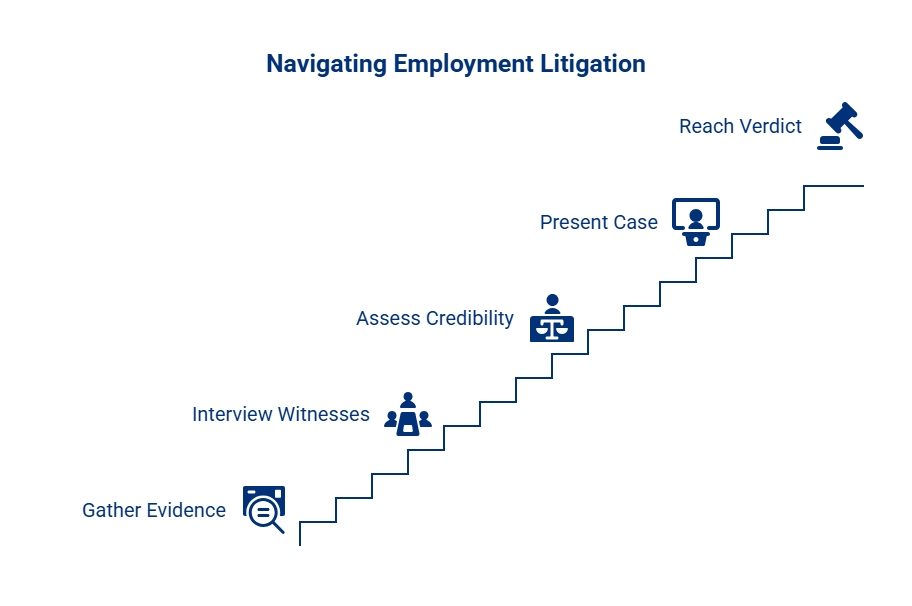
Employment litigation may involve emails, texts, testimony, and records concerning the employee’s report, performance, conduct, attendance, or termination. Owners, managers, supervisors, and current or former employees may provide differing accounts. A judge or jury may consider the credibility and consistency of those accounts when assessing conflicting evidence.
A Performance-Based Termination After Workplace Report
A family-owned service business terminates a nonexecutive employee for stated performance-related reasons. Before the termination, the employee raised concerns to a supervisor about workplace practices that the employee believed violated California law. The termination occurs within 90 days of the disclosure. The employee later alleges that the stated performance reasons were not the true basis for the termination and asserts both whistleblower retaliation under Labor Code section 1102.5 and wrongful termination in violation of public policy. Under the burden-shifting framework, the employer would need to demonstrate through clear and convincing evidence that the termination would have occurred regardless of the disclosure. The quality of the employer’s contemporaneous performance documentation, the consistency of its stated rationale, and the credibility of its witnesses become central to the defense.
What Litigation May Mean for Business
A dispute that begins with a demand letter or administrative complaint can progress into a civil action involving pleadings, discovery, depositions, mediation, motions, and potentially trial. In a family-owned business, the owners who made or approved the termination decision are often the same individuals who must be deposed, produce documents, and testify — demanding substantial time and focus away from the core business.
In a closely held company, family members may serve as decision-makers and witnesses, employee relationships may become strained, and legal expenditures may compete with operating priorities. Reputational concerns may add pressure while the merits remain unresolved.
The Role of Employer-Side Employment Litigation Counsel
Experienced counsel can assess the complete record, asserted causes of action, procedural posture, and business consequences. Trial-ready employment litigation representation for employers can account for witness-intensive and discovery-intensive issues while balancing readiness, proportionality, and cost control.
Disclaimer:
This content is for informational purposes only. Laws, definitions, and deadlines change. Verify current requirements through official California sources. This content is not legal advice. No attorney-client relationship is formed through this content. Please consult a qualified attorney in your jurisdiction for legal advice specific to your situation.
Protect Your Business | The Akopyan Law Firm, A.P.C. | Top Gun Employment Defense Lawyers
Have you been sued by an employee? Are you overwhelmed by the complexities of employment law? If so, give us a call. The Akopyan Law Firm, A.P.C. assists small business owners throughout Southern California. Our seasoned employment defense lawyers stand ready to help employers quickly and efficiently resolve employment disputes. We are ready to aggressively and skillfully defend against any employment case but understand that in most situations avoiding the expense of litigation is in the client’s best interest.
Take the First Step Protecting Your Future: Call us today to speak with one of our experienced employment lawyers.
Contact Us Today:
- Phone: (818) 509-9975
- Office Locations in Southern California: Los Angeles, Bakersfield, Costa Mesa, Temecula, Rancho Cucamonga, Oxnard, Culver City, and San Diego.