
📌 Key Takeaways
California restaurant employers facing wrongful termination claims tied to tips, service charges, or pay disputes may confront overlapping wage-and-hour, retaliation, and whistleblower allegations.
- Pay Disputes Expand Claims: A termination dispute may broaden when an employee links the employment decision to complaints about tips, wages, breaks, or payroll practices.
- Retaliation Theories Add Pressure: Protected activity allegations may shift attention toward timing, decision-maker knowledge, management communications, causation, and pretext.
- Service Charges Invite Scrutiny: Service charges may become disputed when menus, receipts, payroll entries, or employee communications describe the same money differently.
- Restaurant Facts Matter: Shift-based staffing, supervisor comments, text messages, scheduling changes, and front-of-house or back-of-house roles may shape the litigation narrative.
- Defensible Decisions Require Context: Contemporaneous records, consistent policies, and legitimate business reasons may affect how a termination decision is evaluated.
Restaurant pay disputes rarely stay confined to payroll when termination, timing, and protected activity enter the case.
Southern California restaurant owners and operators facing active employment disputes will gain a clearer view of the risks, guiding them into the restaurant-specific details that follow.
~ ~ ~ ~ ~ ~ ~ ~ ~ ~ ~ ~ ~ ~ ~ ~ ~ ~
A wrongful termination claim involving tips, service charges, or pay disputes may create significant potential exposure for a California restaurant because the dispute often extends beyond the termination decision itself. A former server, bartender, cook, cashier, host, or shift lead may allege that the restaurant ended employment after the employee raised concerns about wages, tip distribution, service charges, overtime, meal periods, rest periods, scheduling, timekeeping, or payroll practices.
The restaurant may dispute that allegation and assert that the employment decision rested on legitimate business reasons, including performance, attendance, conduct, restructuring, or operational considerations. In many cases, the dispute concerns not only what decision was made, but why the restaurant made it and how the surrounding facts may be interpreted.
This content provides general information about California employer-side employment disputes. It does not constitute legal advice, does not create an attorney-client relationship, and is not a substitute for individualized legal counsel. Laws may change, and active disputes may involve time-sensitive legal issues that require prompt review by employment counsel.
Why Tip Practices and Pay Disputes Can Complicate Wrongful Termination Claims
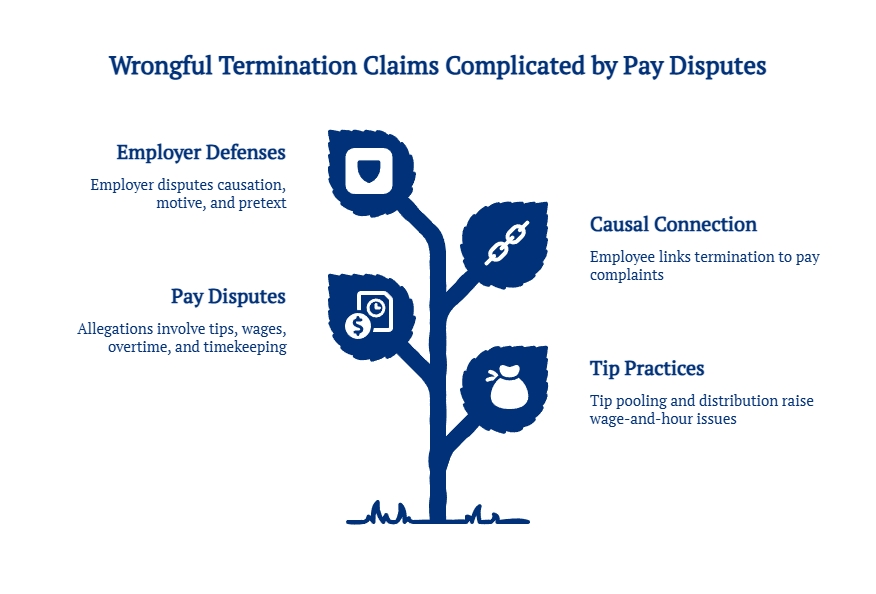
In restaurant litigation, a termination claim may become more complex when the employee connects the termination to compensation-related complaints. Pay disputes may include allegations involving tips, service charges, wages, overtime, meal periods, rest periods, off-the-clock work, timekeeping, or payroll practices.
Under California law, generally, tips and gratuities may raise wage-and-hour issues in restaurant employment disputes. Because restaurants frequently employ tipped workers, allegations concerning tip pooling, tip distribution, or management involvement in tip practices may become part of the factual narrative in a wrongful termination claim.
A termination dispute may therefore involve more than one issue. While one issue may concern why the employment relationship ended, another may concern whether the employee’s pay-related complaint had any causal connection to the termination decision. The employer may dispute causation, motive, and pretext, but those issues are often fact-specific.
How Allegations About Restaurant Pay Practices May Overlap With Retaliation Theories
A pay dispute may become a retaliation claim when the employee characterizes a complaint about wages, tips, service charges, payroll practices, schedules, or breaks as protected activity. The plaintiff may assert that restaurant management knew about the complaint and later made an adverse employment decision because of it.
The restaurant may present a different account. The employer may assert that the decision resulted from legitimate business reasons unrelated to the employee’s complaint. In litigation, the trier of fact may examine timing, decision-maker knowledge, management communications, consistency with stated practices, and whether the employer’s explanation is challenged as pretext.
For restaurant owners and operators, unlawful workplace retaliation allegations may increase pressure on the business. The claim may no longer concern only whether the termination occurred. The dispute may also concern whether the employee engaged in protected activity, whether the restaurant knew about it, and whether the alleged protected activity and termination decision are causally connected.
Why Service Charges and Tip Practices May Draw Close Scrutiny in Litigation
Service charges and tip practices often draw intense scrutiny because California law distinguishes strictly between the two. Under Labor Code Section 351, tips are the sole property of the employee, whereas service charges are generally considered gross receipts of the employer that may be used to pay wages—unless local ordinances in cities like Los Angeles, Santa Monica, or Berkeley mandate otherwise. Mislabeling a service charge as a ‘gratuity’ on a menu or receipt can inadvertently trigger Labor Code violations if those funds are not distributed in accordance with tip-pooling rules. A complaint may allege confusion about whether a charge shown on menus, receipts, or guest checks was a gratuity, whether employees received consistent explanations, or whether management treated the charge consistently.
Disputes may involve several categories of restaurant-specific facts, including but not limited to the language used on guest checks, menus, receipts, point-of-sale records, payroll entries, employee communications, and management explanations. Those facts may be interpreted differently by the plaintiff and the employer.
This does not mean that every dispute involving a service charge creates liability. It means that labels, practices, communications, and payroll treatment may become disputed issues when a former employee links a termination claim to compensation allegations.
Why Restaurant Operations Can Create Fact-Intensive Termination and Pay Disputes
Restaurant operations often move quickly. A general manager may address staffing shortages during service. A shift lead may communicate with employees by text message. A supervisor may adjust schedules after a busy weekend. An owner-operator may make employment decisions while also managing food costs, vendors, payroll, customer concerns, and daily staffing pressure.
Those circumstances may become legally significant because wrongful termination litigation often turns on motive, credibility, consistency, and the surrounding factual record. A plaintiff may characterize informal scheduling changes, supervisor comments, or payroll discussions as evidence of retaliation. The restaurant may contend that the same facts reflect ordinary operational decisions.
Front-of-house and back-of-house roles may also affect the dispute. Servers, bartenders, bussers, hosts, cooks, dishwashers, cashiers, shift leads, supervisors, and managers may each have different information about the termination decision and the underlying pay allegations. Their accounts may influence how the claim is framed.
How Wage-and-Hour Allegations Can Expand the Scope of a Termination Case
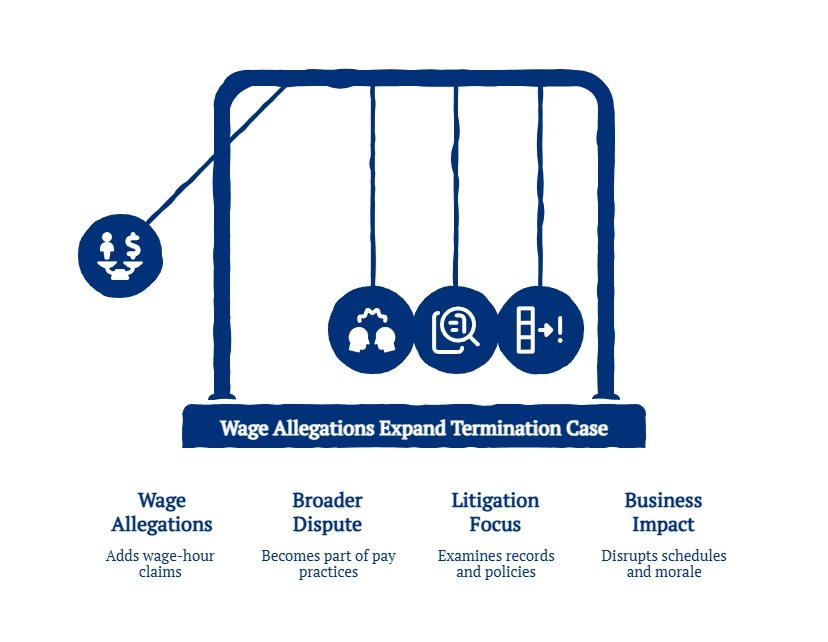
A termination claim may expand when the complaint adds wage-and-hour allegations. A former employee may assert claims involving minimum wage, overtime compensation, meal periods, rest periods, timekeeping, off-the-clock work, or classification issues.
In that setting, the termination claim may become part of a broader dispute about restaurant pay practices. The plaintiff may allege that the termination followed complaints about unpaid wages or break violations. The employer may dispute both the wage allegations and the alleged connection between those allegations and the termination decision.
Active litigation may examine contemporaneous records, consistency with established policies, deviations from stated practices, decision-maker knowledge, and the proximity between alleged protected activity and the termination decision. These issues may affect whether an employment decision appears consistent, supported, and defensible in the context of the dispute.
For a small restaurant, the business impact may be substantial. A single former-employee dispute may draw attention to schedules, payroll records, shift practices, supervisor communications, and staff morale. Owner-operated and closely held restaurants may feel that disruption immediately because the same people responsible for daily operations are often the people involved in managing the dispute.
Why Experienced Employer-Side Litigation Attorney Matters in Restaurant Employment Disputes
Wrongful termination claims involving tip practices, service charges, and pay disputes are often legally complex and fact-intensive. The plaintiff may allege retaliation, wage violations, meal and rest break violations, whistleblower activity, or public-policy wrongful termination. The restaurant may dispute those allegations and maintain that the employment decision was based on legitimate business reasons.
When an employee alleges that a restaurant terminated employment after reports of unlawful or regulatory conduct, whistleblower retaliation theories may also become part of the dispute. That possibility may increase complexity because the case may involve overlapping statutory protections, disputed communications, and competing explanations for the employer’s decision.
Restaurant owners in Los Angeles, Bakersfield, Costa Mesa, Temecula, Rancho Cucamonga, Oxnard, Culver City, San Diego, and other Southern California communities often face these disputes while continuing to manage daily operations. Akopyan Law Firm, A.P.C. represents employers in active employment disputes involving termination allegations, wage-and-hour claims, retaliation theories, and related restaurant employment issues. A restaurant employer facing a lawsuit, demand letter, agency complaint, or regulatory notice involving tips, service charges, or pay practices may contact the firm to discuss the matter with employer-side employment defense attorney.
Disclaimer:
This content is for informational purposes only. Laws, definitions, and deadlines change. Verify current requirements through official California sources. This content is not legal advice. No attorney-client relationship is formed through this content. Please consult a qualified attorney in your jurisdiction for legal advice specific to your situation.
Protect Your Business | The Akopyan Law Firm, A.P.C. | Top Gun Employment Lawyers
Have you been sued by an employee? Are you overwhelmed by the complexities of employment law? If so, give us a call. The Akopyan Law Firm, A.P.C. assists small business owners throughout Southern California. Our seasoned employment defense lawyers stand ready to help employers quickly and efficiently resolve employment disputes. We are ready to aggressively and skillfully defend against any employment case, but understand that in most situations avoiding the expense of litigation is in the client’s best interest.
Take the First Step Protecting Your Future: Call us today to speak with one of our experienced employment lawyers.
Contact Us Today:
- Phone: (818) 509-9975
- Office Locations in California: Los Angeles, Bakersfield, Costa Mesa, Temecula, Rancho Cucamonga, Oxnard, Culver City, and San Diego.