
📌 Key Takeaways
Wrongful termination claims against California restaurant employers often expand into broader, fact-intensive disputes that reach far beyond the discharge itself.
- Claims Rarely Stay Narrow: A termination dispute may quickly widen into retaliation, discrimination, harassment, whistleblower, leave-related, disability-related, or wage-and-hour allegations.
- Timing Shapes Exposure: Protected activity, workplace complaints, medical leave, and later discipline or termination may become the chronology that drives the dispute.
- Informal Practices Carry Weight: Text messages, verbal decisions, uneven discipline, and fast-moving scheduling changes may later become central evidence in litigation.
- Small Restaurants Feel Pressure Faster: Owner-operated businesses may face legal expenses, management distraction, staffing strain, and operational disruption sooner than larger employers.
- Business Risk Extends Beyond Fees: Alleged lost wages, emotional distress damages, statutory remedies, attorney’s fees, and fee-shifting exposure may change the economics quickly.
One discharge may trigger a much larger review of motive, management practices, and business exposure.
California restaurant owners facing active employment disputes will gain immediate clarity here, guiding them into the wrongful-termination-specific details that follow.
~ ~ ~ ~ ~ ~ ~ ~ ~ ~ ~ ~ ~ ~ ~ ~ ~ ~
A wrongful termination claim against a California restaurant employer often becomes broader than the termination decision itself. In many active employment disputes, the complaint does not remain limited to one discharge. A plaintiff may also allege retaliation, discrimination, harassment, whistleblower retaliation, leave-related violations, disability-related violations, or wage-and-hour overlap. For small restaurant owners in Southern California, that expansion may create litigation exposure, fee-shifting exposure, and business disruption at the same time.
Restaurant workplaces often generate the kinds of facts that later become central in litigation. Scheduling changes, layered supervision, informal communications, complaint history, performance concerns, and fast operational decisions may all become part of the dispute record. From an employer-side litigation perspective, that is why wrongful termination claims often require a broader analysis than the stated reason for separation alone.
Why Wrongful Termination Claims Against Restaurant Employers Often Expand Beyond the Termination Decision
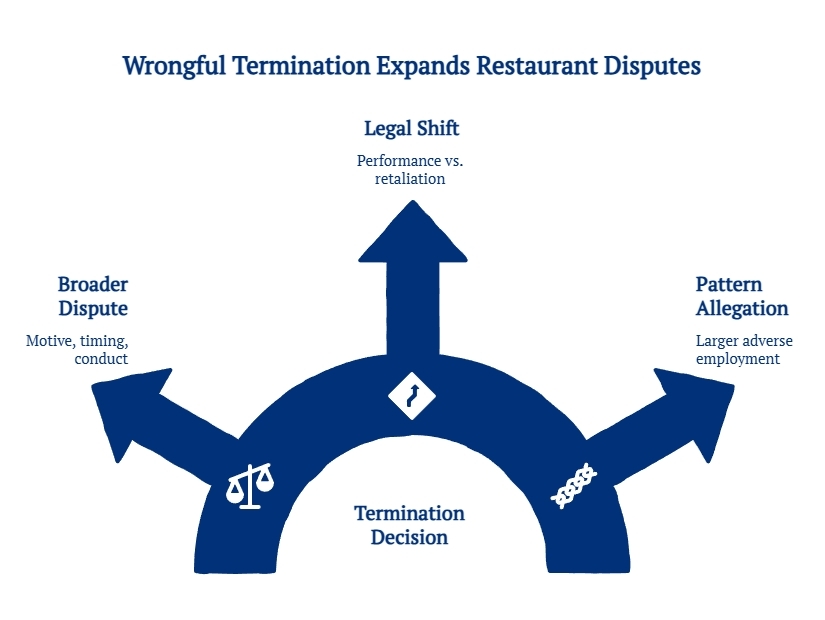
Under California law, generally, wrongful termination allegations may overlap with statutory and common-law theories arising from the same set of facts. A plaintiff may allege that the termination followed protected activity, a workplace complaint, a disability-related issue, an employee’s request for job-protected medical leave, or a report of suspected misconduct. A wrongful termination dispute may therefore become a broader dispute about motive, timing, consistency, and surrounding conduct.
That broader framing matters because the legal issue often shifts quickly. A restaurant owner may view the dispute as a performance or attendance matter, while the complaint may characterize the same chronology as retaliation, discrimination, or interference with protected rights. In practice, these disputes may expand when the plaintiff alleges that the discharge was not an isolated business decision, but part of a larger pattern of adverse employment action.
Why Small California Restaurant Employers Face Distinct Litigation Pressure
Small restaurant businesses often operate without in-house counsel, dedicated human resources personnel, or multiple management layers. The owner may also function as operator, scheduler, and decision-maker. Supervisors may handle discipline while also managing service demands, staffing shortages, and customer-facing pressures. That structure can create a dispute record that is more informal and more operationally compressed than the record maintained by a larger employer.
In many active employment disputes, that structure may increase both legal pressure and business pressure. Legal expenses may compete directly with payroll, vendor obligations, and staffing needs. Management time may be diverted into pleadings, document review, witness preparation, and agency responses. For a restaurant with one or two locations, the burden of defending a single employment case may become a material business issue well before any final resolution.
How Retaliation Allegations May Become Part of a Wrongful Termination Dispute
A related exposure issue may arise when a plaintiff alleges that the termination followed protected activity. Under California law, generally, retaliation allegations may arise when an employee engages in protected activity and later experiences an adverse employment action. That is one reason wrongful termination disputes often overlap with retaliation disputes.
Protected activity is not always dramatic or formal. A plaintiff may allege that the employee complained about workplace harassment, discrimination, raised wage concerns, objected to suspected legal violations, or sought legally protected leave. If discipline, reduced hours, or termination followed, the complaint may rely on timing and sequence as part of the alleged retaliatory motive. At a general level, that chronology may shape how the termination decision is characterized in litigation.
How Workplace Complaints May Shape Employer Exposure
Workplace complaints may affect employer exposure even when the complaint did not appear significant at the time. An employee may complain about harassment, discrimination, scheduling practices, pay practices, favoritism, or supervisor conduct. The employer may view the issue as a routine workplace disagreement. The complaint may later frame the same events as protected activity followed by adverse treatment.
In restaurant settings, that risk may be heightened because complaints are often raised informally and communicated quickly. A server may speak to a shift lead. A line employee may text a manager. A supervisor may escalate concerns verbally rather than through a formal process. In litigation, those facts may matter because they may be used to support allegations that management knew about the complaint before the termination decision was made.
How Leave-Related and Disability-Related Issues May Affect Wrongful Termination Allegations
Wrongful termination allegations may also broaden when the facts involve disability, an employee with a qualifying medical condition, reasonable accommodation, or job-protected medical leave. Under California law, generally, those facts may create overlapping exposure under disability-discrimination laws, leave laws, and retaliation protections. A complaint may also allege that the employer failed to engage in the interactive process or failed to consider reasonable accommodation.
Timing often becomes central in these disputes. A plaintiff may allege that job-protected medical leave was followed by write-ups, reduced hours, discipline, or termination. A complaint may also allege that an employee’s medical leave status or disability affected how management viewed attendance, scheduling, or reliability. At a general level, that sequence may increase scrutiny of the employer’s duty to engage in the interactive process and its handling of family medical leave issues.
How Whistleblower and Public-Policy Issues May Expand Restaurant Employment Disputes
California wrongful termination disputes may also expand when the plaintiff alleges whistleblower activity or a discharge that violates public policy. A plaintiff may assert that termination followed a report of suspected legal violations, a refusal to participate in conduct believed to be unlawful, or the exercise of statutory rights.
These allegations often bridge common-law ‘Tameny’ claims with statutory protections under Labor Code § 1102.5. This expansion increases complexity because the evidentiary standards differ; for a § 1102.5 claim, a plaintiff needs only show that protected activity was a ‘contributing factor’ in the termination, shifting a heavy burden to the restaurant to prove by clear and convincing evidence that the same decision would have been made regardless. In 2026, this exposure is further heightened by the Workplace Know Your Rights Act, which requires restaurants to have provided annual written notices of these specific whistleblower protections by February 1, 2026
Why Timing, Communications, and Disciplinary History Often Become Central in Litigation
In many active employment disputes, the surrounding chronology becomes one of the most contested parts of the case. A plaintiff may rely on temporal proximity between protected activity and termination, alleged inconsistencies in stated reasons, disciplinary write-ups, text messages, emails, or differences in treatment among employees. From an employer-side litigation perspective, those surrounding facts may shape how the trier of fact evaluates motivation and credibility.
Restaurant operations often create recurring fact patterns that invite close review. Scheduling changes may occur quickly. Performance concerns may be communicated verbally before they are documented. Disciplinary history may develop unevenly across shifts or supervisors. Those realities do not establish liability, but they may affect how the complaint is pleaded and how the evidence is later understood.
How Wrongful Termination Allegations May Trigger Broader Review of Restaurant Management Practices
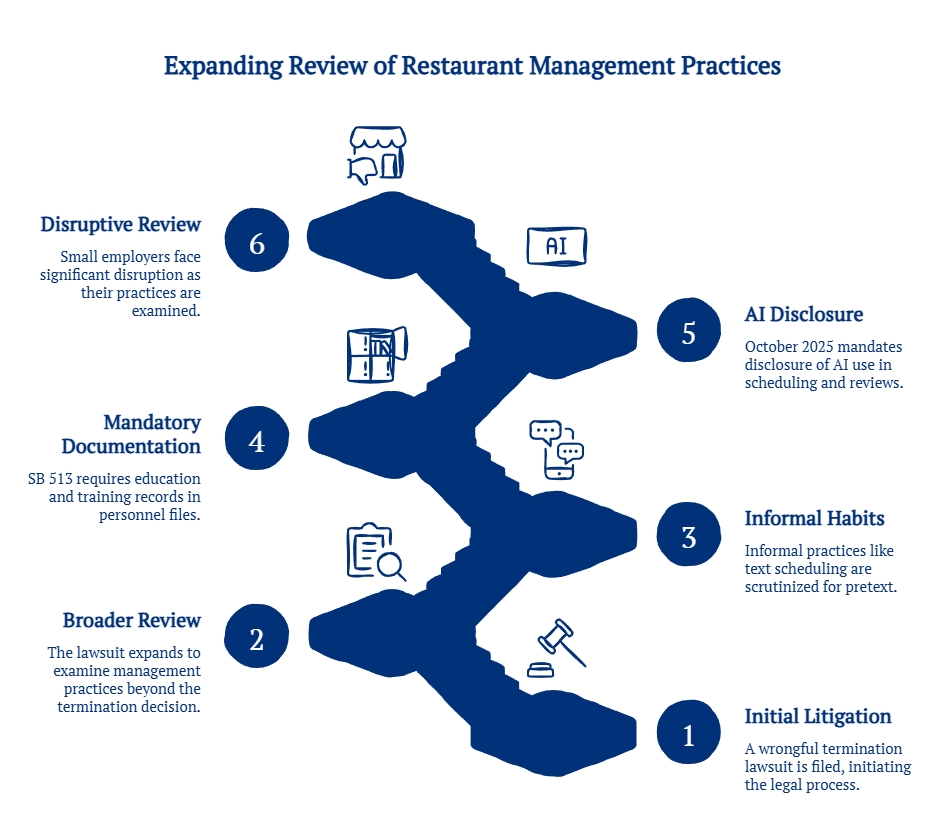
Once wrongful termination litigation begins, the dispute may expand beyond one personnel decision and into a broader review of management practices. The plaintiff may examine whether discipline was consistent, whether supervisors communicated appropriately, whether stated policies were followed, and whether comparable employees were treated differently.
A complaint may leverage informal habits, such as text-based scheduling or verbal-only warnings, to suggest a narrative of pretext. In 2026, this review extends to mandatory documentation; for instance, SB 513 now requires that any education or training records (including food safety or bias mitigation) be included in the personnel file and made available for inspection, creating a new focal point for ‘consistency’ audits during discovery. Furthermore, as of October 2025, any use of AI or ‘automated decision systems’ for scheduling or performance reviews must be disclosed, or it may be framed as a ‘black box’ for discriminatory bias.
For small restaurant employers, that broader review may be especially disruptive. Management practices that developed around operational speed and practical necessity may later be examined in a litigation setting that emphasizes consistency, chronology, and documented reasoning. That is one reason these cases often become larger than the employer initially expected.
Why the Business Cost of Defending Wrongful Termination Litigation Matters
Wrongful termination litigation may involve more than defense fees. Depending on the claims asserted, the case may involve alleged lost wages, emotional distress damages, statutory remedies, and attorney’s fees. When multiple causes of action are pleaded together, the economics of the dispute may change quickly, especially where fee-shifting exposure is alleged.
For a small restaurant business, the practical burden may be as serious as the legal burden. Ownership attention may be pulled away from operations. Staffing stability may be affected by prolonged uncertainty. Reputation concerns may influence morale and retention. The cost of defending the matter may therefore become a business problem as well as a litigation problem.
Why Experienced Employer-Side defense Attorney Matters in Active Restaurant Employment Disputes
When a California restaurant owner faces a lawsuit, demand letter, or agency complaint, the legal issue is often broader than a single discharge decision. The dispute may involve overlapping wrongful termination, retaliation, disability-related, leave-related, whistleblower, and public-policy allegations, along with serious business consequences if the matter expands. In many active employment disputes, experienced employer-side employment defense lawyers play an important role because case-specific exposure depends on verified facts, applicable law, and the way the pleadings frame the dispute.
Disclaimer:
This content is for informational purposes only. Laws, definitions, and deadlines change. Verify current requirements through official California sources. This content is not legal advice. No attorney-client relationship is formed through this content. Please consult a qualified attorney in your jurisdiction for legal advice specific to your situation.
Protect Your Business | The Akopyan Law Firm, A.P.C. | Top Gun Employment Lawyers
Have you been sued by an employee? Are you overwhelmed by the complexities of employment law? If so, give us a call. The Akopyan Law Firm, A.P.C. assists small business owners throughout Southern California. Our seasoned employment defense lawyers stand ready to help employers quickly and efficiently resolve employment disputes. We are ready to aggressively and skillfully defend against any employment case, but understand that in most situations avoiding the expense of litigation is in the client’s best interest.
Take the First Step Protecting Your Future: Call us today to speak with one of our experienced employment lawyers.
Contact Us Today:
- Phone: (818) 509-9975
Office Locations in California: Los Angeles, Bakersfield, Costa Mesa, Temecula, Rancho Cucamonga, Oxnard, Culver City, and San Diego.