📌 Key Takeaways
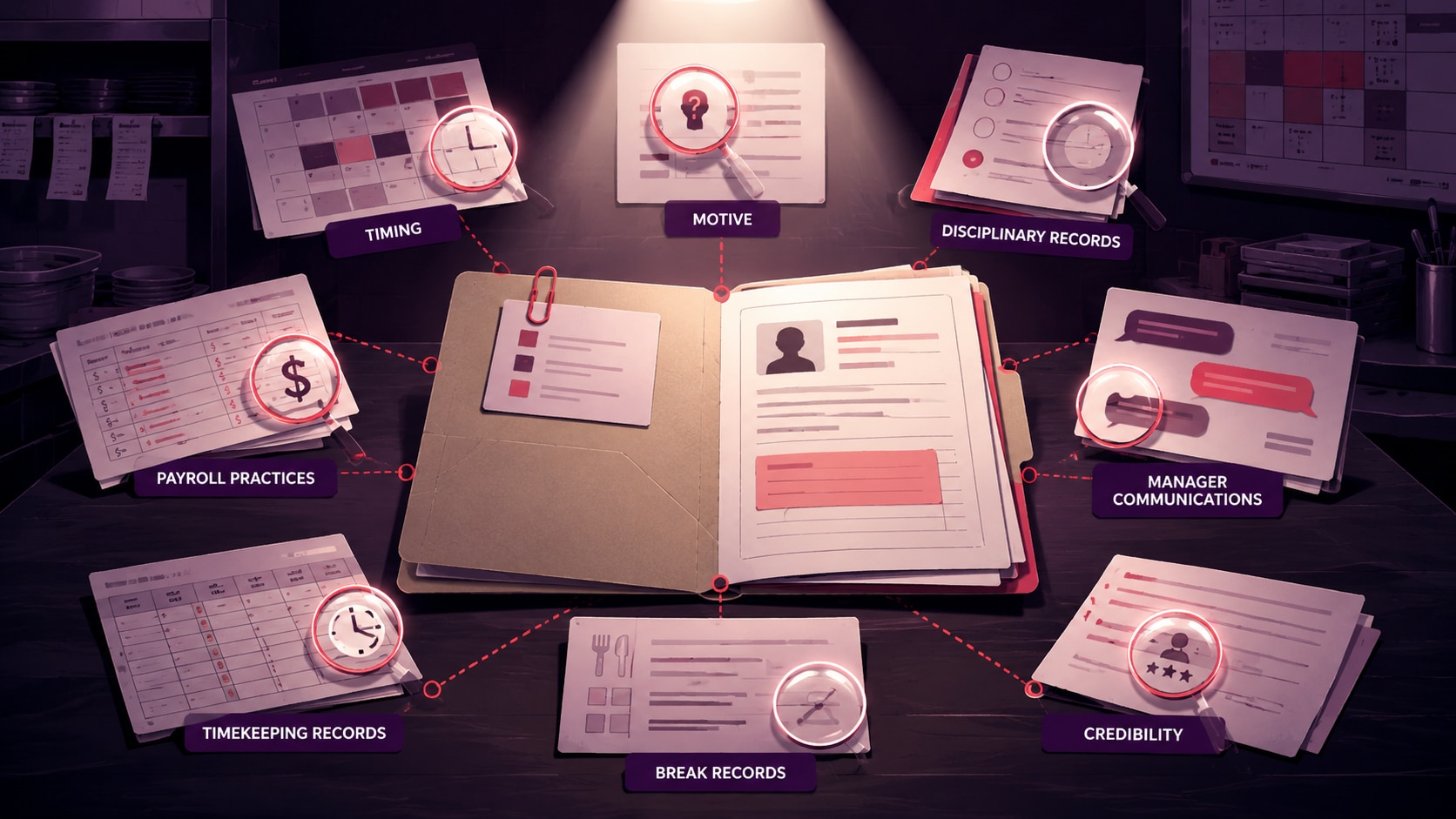
Wrongful termination claims can turn a California restaurant’s employee separation into a broad review of motive, records, timing, and credibility.
- Separation Creates Scrutiny: A termination, resignation, layoff, or end-of-employment dispute may draw attention to the restaurant’s stated business reason.
- Timing Shapes Exposure: Proximity between protected activity and termination is a critical legal threshold. Under California Labor Code updates (specifically following SB 497), if an employer disciplines or terminates an employee within 90 days of certain protected activities—such as complaining about unpaid wages or meal breaks—a rebuttable presumption of retaliation is created. This shifts the initial burden to the restaurant to provide clear evidence of a legitimate, non-retaliatory reason for the separation.
- Records Matter Early: Contemporaneous documentation remains the baseline. However, as of the March 30, 2026 deadline established by the Workplace Know Your Rights Act (SB 294), restaurants must also produce records showing that employees were given the opportunity to designate emergency contacts and provided with the mandatory stand-alone notice regarding law enforcement interactions. Failure to maintain these specific 2026 records can impair an employer’s credibility when defending the ‘reasonableness’ of their overall personnel management.
- Managers Become Witnesses: Text messages, disciplinary notes, shift comments, and inconsistent explanations may affect credibility in restaurant employment litigation.
- Claims Often Overlap: Wrongful termination allegations may expand into wage-and-hour, harassment, discrimination, leave, accommodation, or whistleblower retaliation claims.
Defensible employment decisions depend on consistent reasons, careful records, and facts that withstand scrutiny.
California restaurant owners facing employee separation disputes will gain immediate clarity here, preparing them for the detailed overview that follows.
~ ~ ~ ~ ~ ~ ~ ~ ~ ~ ~ ~ ~ ~ ~ ~ ~ ~
A wrongful termination claim can place a California restaurant’s separation decision under serious scrutiny. In this context, an employee separation may include a termination, resignation, layoff, or other end-of-employment dispute that a former employee later characterizes as unlawful.
The dispute may begin with one former employee, but it can quickly expand into questions about timing, contemporaneous documentation, payroll records, scheduling practices, manager communications, prior complaints, and the restaurant’s stated reason for ending employment. For small independent restaurants, these issues are disruptive due to close working relationships. However, for those operating within the fast-food sector, the regulatory environment is even more stringent. Under the standards established by the Fast Food Council (AB 1228), termination decisions are evaluated against strict, industry-specific regulations regarding wages and working conditions. While the Council does not directly adjudicate individual separations, any deviation from Council-mandated standards can be leveraged by a former employee to demonstrate pretext. In 2026, for a ‘legitimate business reason’ to withstand scrutiny in this sector, it must be documented alongside proof of compliance with the most recent Council wage adjustments and health and safety protocols.
Why Employee Separations Can Lead to Wrongful Termination Claims Against Restaurants
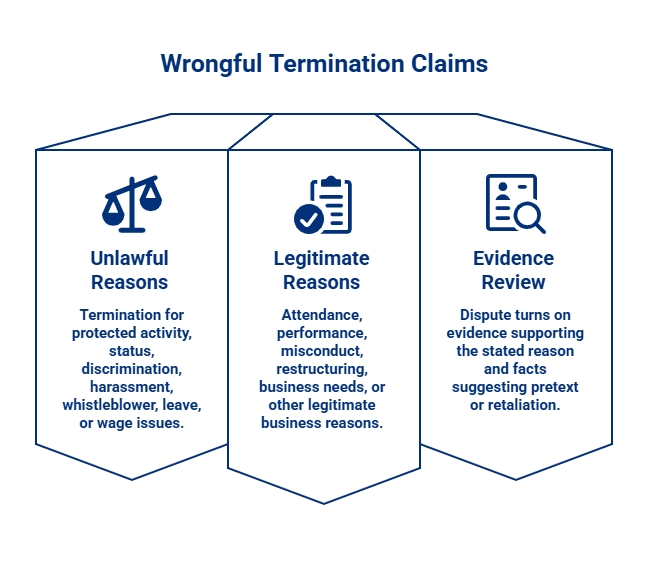
Under California law, generally, employment may be at will, but at-will employment does not eliminate potential exposure when a former employee alleges termination for an unlawful reason. A plaintiff may claim that the restaurant terminated employment because of protected activity, protected status, discrimination, harassment complaints, whistleblower activity, leave-related issues, or wage-and-hour concerns.
The restaurant may contend that the separation resulted from attendance issues, performance concerns, misconduct, restructuring, business needs, or another legitimate business reason. In many cases, the dispute turns on whether the evidence supports that stated reason and whether the former employee can point to facts suggesting pretext, causal connection, or retaliatory motivation.
That is why wrongful termination claims against employers often involve review of the full employment history, not just the final decision.
Why Restaurant Employment Disputes Often Become Fact-Intensive
Restaurant workplaces create factual complexity because operations depend on schedules, shifts, supervisors, customer volume, staffing levels, and timekeeping systems. A claim may involve more than one manager, more than one version of events, and more than one category of records.
Several issues may become relevant in a wrongful termination dispute:
- The restaurant’s stated reason for separation may be evaluated for consistency over time.
- Contemporaneous documentation may affect how the parties explain performance concerns, attendance issues, discipline, or workplace complaints.
- A deviation from established policies may become relevant if the former employee claims the restaurant treated similarly situated employees differently.
- The former employee may claim that a complaint about wages, harassment, discrimination, safety, scheduling, or workplace treatment preceded the termination.
- Payroll records, schedules, break records, and time entries may support or complicate the restaurant’s position.
- Witness testimony from owners, managers, shift leads, and employees may affect credibility assessments.
These issues can be especially disruptive for a closely held restaurant because the people operating the business may also become witnesses in the dispute.
How a Former Employee May Reframe the Separation Decision
A restaurant may view separation as a business decision, but plaintiffs in 2026 increasingly target ‘Stay-or-Pay’ provisions. Under AB 692, most agreements requiring employees to repay training costs or signing bonuses upon separation are now unlawful for contracts entered into on or after January 1, 2026. Attempting to enforce such a debt during an employee’s separation can be reframed as an unlawful retaliatory act or a violation of public policy, complicating the restaurant’s defense of the termination.
For example, a restaurant may describe the termination as the result of repeated attendance problems. The former employee may assert that the decision followed a complaint about unpaid wages, missed meal periods, harassment, or a request for job-protected medical leave. When termination follows alleged protected activity closely in time, proximity may become part of a retaliation or pretext theory, depending on the facts.
The allegation does not establish liability. It does, however, show why wrongful termination litigation often becomes a dispute over motive, causation, documentation, and credibility.
Overlapping Claims That May Accompany Wrongful Termination Allegations
Wrongful termination claims against restaurants frequently appear with related employment claims. A former employee may allege retaliation, discrimination, harassment, whistleblower retaliation, failure to accommodate, leave interference, or wage-and-hour violations.
Wage-related allegations can expand the dispute beyond the separation decision. Claims involving missed meal periods, unpaid overtime, minimum wage issues, off-the-clock work, or inaccurate timekeeping may increase the scope of the case. Restaurants facing those allegations may also encounter issues associated with wage and hour defense, meal and rest break disputes, or overtime compensation claims.
Retaliation allegations may arise when a former employee claims that the restaurant acted against them after they complained internally, participated in an investigation, reported suspected unlawful conduct, or asserted workplace rights. Depending on the facts alleged, the dispute may implicate workplace retaliation or whistleblower retaliation theories.
Why Payroll, Scheduling, and Timekeeping Issues Can Complicate the Case
Restaurant wrongful termination litigation may become more complex when the former employee connects the separation to pay practices. Payroll records, scheduling records, time entries, break records, tip-related records, and manager communications may become relevant to the parties’ competing claims.
A single-employee claim may also create broader exposure through the Private Attorneys General Act (PAGA). Following the 2024 PAGA reform measures (SB 92 and AB 2288), restaurants that have taken proactive ‘reasonable steps’ toward compliance—such as regular audits and updated handbook distributions—may significantly cap their penalty exposure if a separation leads to a representative action. Without such documentation, allegations involving off-the-clock work or missed breaks can quickly escalate into costly, multi-employee litigation. If the dispute involves whether workers were properly classified, employee misclassification claims may become part of the broader risk analysis.
For small restaurants, consistent application of payroll, scheduling, and timekeeping practices may affect whether the employment decision appears supported by a legitimate business reason or vulnerable to challenge.
Why Manager Conduct and Communications May Become Central Issues
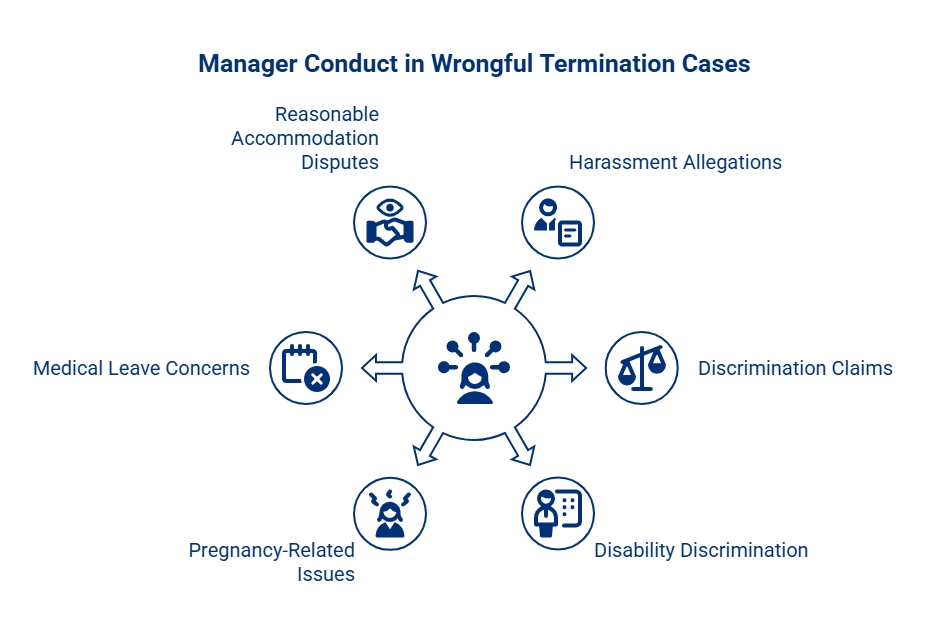
Wrongful termination cases often turn on what managers said, wrote, knew, and did. A casual text message, shift-change comment, disciplinary note, or inconsistent explanation may take on new significance after litigation begins.
Manager conduct may also matter when the former employee alleges harassment, discrimination, disability discrimination, pregnancy-related issues, medical leave concerns, or a request for reasonable accommodation. In accommodation-related disputes, the interactive process may become a central issue if the employee claims the restaurant failed to evaluate a disability-related request in good faith.
These allegations may overlap with claims involving hostile work environment, family and medical leave, reasonable accommodation, or disability discrimination.
The central question is often not whether the restaurant had authority to make an employment decision. The dispute may focus instead on whether the evidence supports a legitimate business reason or suggests unlawful motivation.
Business Pressure Created by Wrongful Termination Litigation
Wrongful termination litigation can place substantial pressure on a restaurant’s ownership and management team. A lawsuit, demand letter, agency complaint, or regulatory notice may involve strict obligations and serious consequences if mishandled. Business may also face disruption from witness issues, document disputes, employee concerns, and reputational stress.
For owner-operated restaurants and closely held restaurant businesses, the legal dispute can feel deeply personal because the decision-makers are often directly involved in hiring, discipline, scheduling, and termination decisions. Experienced employer-side employment counsel can help evaluate the claims, the factual record, the consistency of the restaurant’s documentation, and the potential exposure considering the restaurant’s specific circumstances.
Disclaimer:
This content is for informational purposes only. Laws, definitions, and deadlines change. Verify current requirements through official California sources. This content is not legal advice. No attorney-client relationship is formed through this content. Please consult a qualified attorney in your jurisdiction for legal advice specific to your situation.
Protect Your Business | The Akopyan Law Firm, A.P.C. | Top Gun Employment Lawyers
Have you been sued by an employee? Are you overwhelmed by the complexities of employment law? If so, give us a call. The Akopyan Law Firm, A.P.C. assists small business owners throughout Southern California. Our seasoned employment defense lawyers stand ready to help employers quickly and efficiently resolve employment disputes. We are ready to aggressively and skillfully defend against any employment case, but understand that in most situations avoiding the expense of litigation is in the client’s best interest.
Take the First Step Protecting Your Future: Call us today to speak with one of our experienced employment lawyers.
Contact Us Today:
- Phone: (818) 509-9975
- Office Locations in California: Los Angeles, Bakersfield, Costa Mesa, Temecula, Rancho Cucamonga, Oxnard, Culver City, and San Diego.