
📌 Key Takeaways
California dental practices can face wrongful termination claims when staffing changes are later challenged as pretext for an unlawful motive.
- Pretext Drives Exposure: A stated restructuring reason may be challenged when timing, explanations, or staffing patterns appear inconsistent with the employment decision.
- Timing Shapes Disputes: Termination after protected activity, protected leave, accommodation discussions, wage complaints, or whistleblower concerns may support a causation theory.
- Consistency Matters: Similar treatment of similarly situated employees, stable explanations, and contemporaneous records may become important factual issues in litigation.
- Related Claims Expand Risk: Retaliation, whistleblower retaliation, disability, pregnancy, leave, and wage-and-hour allegations may broaden a termination-centered dispute.
- Small Practices Feel Pressure: A single employee claim may affect patient scheduling, staff morale, leadership attention, and the daily operations of a dental practice.
Restructuring may be operational, but litigation often tests motive, timing, consistency, and context.
California dental practice owners facing employee claims after staffing changes will gain focused issue-spotting, preparing them for the detailed overview that follows.
~ ~ ~ ~ ~ ~ ~ ~ ~ ~ ~ ~ ~ ~ ~ ~ ~ ~
Wrongful termination claims can arise when a Southern California dental practice restructures staff, eliminates a position, reduces hours, changes schedules, modifies job duties, transfers an employee, or demotes a staff member. The legal dispute often begins when a former employee alleges that the stated restructuring reason was a pretext for an unlawful motive.
A staffing change may reflect legitimate operational needs. A later claim may still focus on whether the practice acted for a legitimate, nondiscriminatory reason or whether protected status, activity, protected leave, disability, pregnancy, wage complaints, or whistleblower activity influenced the employment decision.
Why Staffing Changes Can Lead to Wrongful Termination Claims
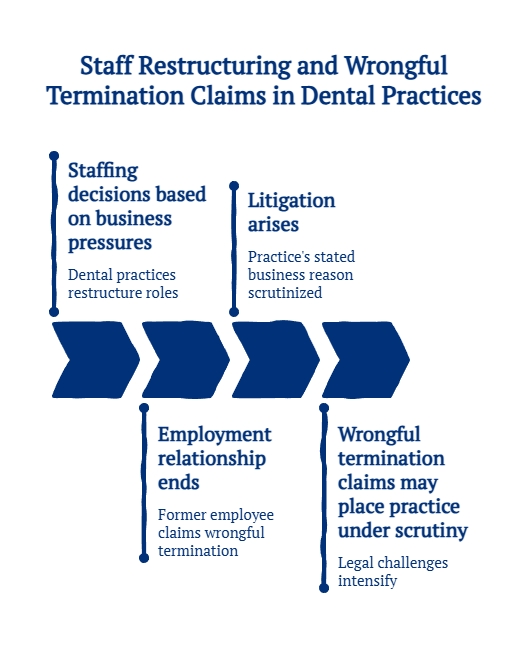
California dental practices often make staffing decisions because patient scheduling patterns change, production needs shift, insurance and billing workflows evolve, coverage gaps develop, or the practice’s operational model changes. Those business pressures may lead a dentist-owner, managing dentist, office manager, or practice administrator to restructure roles, reduce hours, combine duties, or eliminate a position.
The litigation issue usually arises after the employment relationship ends. A former dental assistant, hygienist, treatment coordinator, billing employee, front-office employee, office manager, associate dentist, or other employee may claim that the stated restructuring reason does not match the surrounding facts. The former employee may allege that the practice used a position change, demotion, reassignment, or reduction in hours as a cover for retaliation, discrimination, leave interference, disability-related bias, pregnancy discrimination, whistleblower retaliation, or another legally significant motive.
A workplace disagreement is not the same as a wrongful termination claim. A claim becomes more serious when the former employee connects the termination or position change to a protected characteristic, protected activity, statutory right, or public policy theory. In that setting, wrongful termination claims may place the practice’s stated business reason under close scrutiny.
How Former Employees May Challenge the Stated Business Reason
In restructuring-related litigation, the former employee may challenge the stated business reason as pretext. Pretext generally refers to an argument that the employer’s stated reason was not the actual motivating reason for the employment decision. Pretext allegations often rely on timing, inconsistent explanations, differential treatment, or continued need for the duties that the practice allegedly eliminated.
Timing may become significant. A termination that follows soon after a workplace complaint, protected leave request, reasonable accommodation discussion, pregnancy-related issue, wage complaint, or internal compliance concern may become part of the plaintiff’s causation theory.
Consistency may also become significant. A complaint may allege that similarly situated employees were treated differently, that the eliminated duties continued after the termination, or that the practice gave different explanations at different times. In litigation, contemporaneous records, consistency with established practices, and the timing of decision-making may become factual issues. Those concepts matter because a trier of fact may evaluate whether the stated restructuring reason fits the broader employment history.
Common allegations may include the following:
- The former employee alleges that the practice eliminated a position but reassigned the same core duties to another employee.
- The complaint claims that reduced hours followed a wage-and-hour complaint or protected workplace complaint.
- The administrative charge alleges that a schedule change, transfer, or demotion occurred after protected leave or an accommodation discussion.
- The plaintiff contends that the practice treated similarly situated employees more favorably.
These examples are illustrative, not exhaustive. The central dispute often concerns whether the stated business reason and the surrounding facts support a defensible employment decision.
Related Claims That Can Expand the Dispute
Wrongful termination litigation often grows beyond the termination decision itself. A former employee may attach additional causes of action that increase the complexity, cost, and disruption of the dispute.
A retaliation claim may arise when the employee alleges that the staffing change followed protected activity. Protected activity may include certain workplace complaints, participation in employment-related proceedings, or opposition to conduct the employee believes is unlawful. Retaliation claims often focus on timing, motive, and causal connection.
A whistleblower retaliation claim may arise under California Labor Code Section 1102.5 if an employee alleges the practice altered their employment status after they raised concerns about suspected regulatory, billing, OSHA, or patient-safety issues. Defending against these allegations during a staff reorganization is uniquely demanding; pursuant to the California Supreme Court’s landmark ruling in Lawson v. PPG Architectural Finishes, Inc. (2022), California rejects the traditional employer-friendly burden-shifting framework for whistleblower claims. Once an employee demonstrates by a preponderance of the evidence that their internal disclosure was merely a ‘contributing factor’ to the scheduling change or termination, the burden shifts entirely to the practice. The dental practice must then prove by clear and convincing evidence—an exceptionally high evidentiary hurdle—that the restructuring decision would have occurred anyway for purely independent, legitimate operational reasons.
Disability-related allegations may also emerge if a staffing change closely follows a disability disclosure, medical restriction, or accommodation request. In California, statutory obligations under the Fair Employment and Housing Act (FEHA)—including the mandatory duty to provide reasonable accommodation and engage in a timely, good-faith interactive process—apply strictly to employers with five or more employees (Cal. Gov. Code § 12926(d)). For practices meeting this headcount threshold, an administrative or civil failure to navigate these duties can easily become intertwined with a wrongful termination theory if an employee’s duties, schedules, or hours are subsequently modified.
Leave-related and pregnancy-related allegations can also expand the legal scope of a dispute if a former employee claims that a staffing change followed a request for family and medical leave, or pregnancy-related time off. However, these protections carry strict headcount triggers: the California Family Rights Act (CFRA) and California’s Pregnancy Disability Leave (PDL) law apply only to employers with five or more employees (Cal. Gov. Code § 12945.2; § 12945), while the federal Family and Medical Leave Act (FMLA) applies exclusively to employers with 50 or more employees (29 U.S.C. § 2611(4)). Micro-practices operating below these employee counts are generally exempt from these specific statutory leave mandates, though growing practices must monitor their exact headcounts to understand when these complex compliance obligations attach.
Wage-and-hour and misclassification allegations frequently expand a restructuring dispute into a severe, multi-layered wage theft claim. Under California’s strict independent contractor framework—where non-dentist clinical staff like hygienists and assistants are evaluated under the rigid ‘ABC test’ (Cal. Labor Code § 2775) and associate dentists are governed by the multi-factor Borello balancing standard—any worker historically paid via a Form 1099 can challenge their classification when their hours are altered or their position is eliminated. Rather than remaining secondary to the wrongful termination topic, misclassification exposure can completely eclipse it. A worker who establishes they were an employee by law can pursue immense retroactive damages for unpaid overtime, missed meal and rest break premiums, un-reimbursed business expenses (Cal. Labor Code § 2802), and statutory penalties under the Private Attorneys General Act (PAGA).
Why Small Dental Practices May Feel Litigation Pressure Quickly
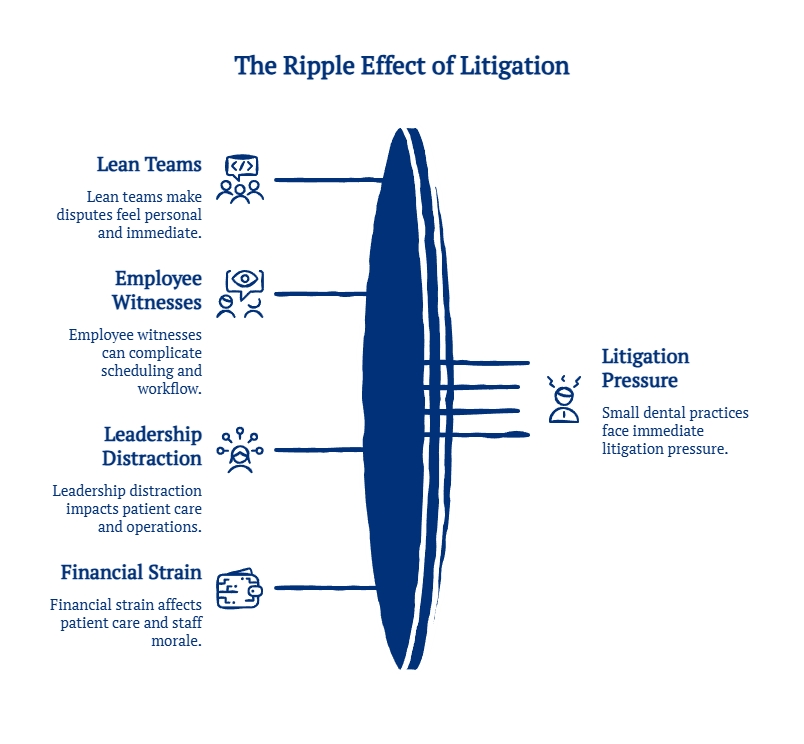
Small and mid-sized dental practices often operate with lean teams. Owners, managing dentists, office managers, and practice administrators may work directly with the employee who later brings the claim. That structure can make the dispute feel immediate, stressful, and personal, even when the employment decision involved business operations.
A single employee lawsuit may affect patient scheduling, leadership attention, staff morale, and the practice’s ordinary workflow. Employees who witnessed scheduling changes, duty changes, workplace complaints, performance concerns, or management communications may become relevant witnesses.
For a closely held dental practice, the disruption is not limited to potential legal exposure. The same dentist-owner or office manager involved in the staffing decision may also be responsible for patient care, billing oversight, staff supervision, and daily operations. Employment litigation can place pressure on each of those responsibilities at once.
What Litigation May Examine After a Position Change
In a wrongful termination case, a judge, jury, agency, or trier of fact may evaluate the employment decision in context. The focus may include communications, schedules, payroll records, job duties, replacement decisions, prior complaints, treatment of similarly situated employees, and testimony from decision-makers.
The dispute may not turn on a single document or conversation. It may turn on whether the practice’s stated business reason remains consistent when measured against the full employment history. A restructuring decision that appears straightforward from a business perspective may be challenged through circumstantial evidence, timing, competing narratives, and alleged inconsistencies.
Active disputes may also involve sensitive legal obligations and protected legal communications. Those issues generally require fact-specific evaluation by employment defense counsel.
Employment Defense Representation for Dental Practices Facing Wrongful Termination Claims
A wrongful termination defense lawyer for dental practices in Southern California can evaluate the allegations, the stated restructuring reason, the related employment history, and the potential exposure created by overlapping claims. Experienced employment defense representation matters because these cases often involve motive, credibility, timing, protected activity, and the relationship between the stated restructuring reason and the surrounding facts.
Akopyan Law Firm, A.P.C. represents employers in employment disputes involving wrongful termination, retaliation, whistleblower retaliation, disability discrimination, reasonable accommodation, leave-related claims, pregnancy-related disputes, and wage-and-hour allegations. Southern California Dental practices facing a demand letter, administrative charge, regulatory notice, lawsuit, or serious litigation threat after restructuring or position changes may contact Akopyan Law Firm, A.P.C. to speak with an employment defense attorney about representation.
Disclaimer:
This content is for informational purposes only. Laws, definitions, and deadlines change. Verify current requirements through official California sources. This content is not legal advice. No attorney-client relationship is formed through this content. Please consult a qualified attorney in your jurisdiction for legal advice specific to your situation.
Protect Your Business | The Akopyan Law Firm, A.P.C. | Top Gun Employment Lawyers
Have you been sued by an employee? Are you overwhelmed by the complexities of employment law? If so, give us a call. The Akopyan Law Firm, A.P.C. assists small business owners throughout Southern California. Our seasoned employment defense lawyers stand ready to help employers quickly and efficiently resolve employment disputes. We are ready to aggressively and skillfully defend against any employment case, but understand that in most situations avoiding the expense of litigation is in the client’s best interest.
Take the First Step Protecting Your Future: Call us today to speak with one of our experienced employment defense lawyers.
Contact Us Today:
- Phone: (818) 509-9975
- Office Locations in California: Los Angeles, Bakersfield, Costa Mesa, Temecula, Rancho Cucamonga, Oxnard, Culver City, and San Diego.