

📌 Key Takeaways
For California restaurant employers, wrongful termination and whistleblower allegations often increase exposure because one termination may be framed as retaliation for protected activity.
- One Termination, Multiple Theories: A single discharge may be pleaded as wrongful termination, whistleblower retaliation, statutory retaliation, and a public-policy claim at the same time.
- Protected Activity Drives Scrutiny: Complaints about wages, breaks, safety, harassment, discrimination, leave, scheduling, or payroll may later be framed as protected activity.
- Timing Becomes Evidence: When discipline or termination follows protected activity, the plaintiff may argue that chronology supports a causal connection and an inference of pretext.
- Restaurant Facts Matter: Multiple supervisors, shifting schedules, informal texts, and fast operational decisions may create a fragmented record that draws heavier scrutiny.
- Exposure Often Expands Quickly: These disputes may broaden into wider document review, more witness attention, greater management distraction, and increased defense costs.
In restaurant employment disputes, motive, timing, consistency, and pretext often matter as much as the termination decision itself.
California restaurant owners facing demand letters, agency complaints, or civil actions will gain immediate clarity here, preparing them for the detailed overview that follows.
~ ~ ~ ~ ~ ~ ~ ~ ~ ~ ~ ~ ~ ~ ~ ~ ~ ~
For California restaurant employers, a termination decision may draw greater scrutiny when the plaintiff alleges that the discharge followed protected activity. In that setting, a wrongful termination claim may appear alongside a whistleblower retaliation allegation, a statutory retaliation claim, or a common-law public-policy theory. That overlap may increase employer exposure because the dispute often turns on causal connection, stated reasons for the decision, and whether the plaintiff can frame the employer’s explanation as pretext.
In restaurant operations, that pattern is often shaped by the realities of the workplace. Restaurants commonly rely on multiple supervisors, compressed decision-making, changing schedules, text-based communication, and immediate staffing demands. Those conditions may later become central to the plaintiff’s narrative. A supervisor may describe a separation as performance-based, while the plaintiff may allege that the real reason was earlier protected activity, such as reporting suspected legal violations, opposing allegedly unlawful conduct, or raising workplace complaints that California law may protect.
Why The Claims Often Overlap
Wrongful termination and whistleblower retaliation allegations often arise from the same sequence of events. An employee may complain about wage-and-hour practices, safety issues, manager conduct, harassment, discrimination, leave-related treatment, payroll concerns, or other conduct the employee characterizes as unlawful. If termination follows, the plaintiff may allege that the discharge was retaliatory and therefore wrongful.
For restaurant employers, the legal significance often lies in how the facts are connected. A plaintiff may try to show a causal connection between protected activity and the termination by focusing on timing, internal communications, inconsistent explanations, or differences in how management handled similar situations. The employer, by contrast, may assert a legitimate business reason for the decision. That is why these cases often become disputes about motive and pretext, complicated further by PAGA (Private Attorneys General Act) reforms.
Why Restaurant Employers May Face Heightened Factual Scrutiny
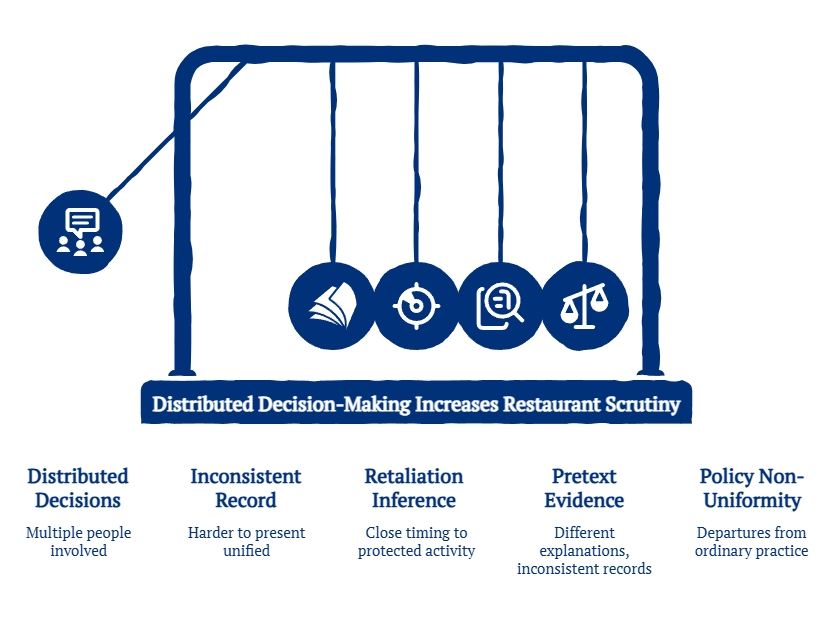
Restaurant cases often become fact-intensive because decision-making may be distributed across owners, general managers, shift supervisors, payroll personnel, and outside consultants. When several people participate in discipline or termination decisions, the factual record may become harder to present as consistent and unified. In litigation, decision-makers may later be asked to explain who made the final call, when the reason for termination was identified, whether earlier complaints were known, and whether the stated rationale remained the same over time.
That scrutiny may intensify when the chronology is close. If protected activity is followed by discipline, suspension, or discharge within a short period, the plaintiff may argue that timing supports an inference of retaliation. If management later offers a different explanation, or if internal records appear inconsistent with the explanation ultimately presented, the plaintiff may characterize those facts as evidence of pretext. In restaurant settings, where communications are often informal and operational pressure is constant, those issues may become especially prominent.
The same is true when the plaintiff alleges that established policies were not applied uniformly. A restaurant employer may view the decision as routine or justified, but the plaintiff may try to frame the matter differently by pointing to departures from ordinary practice, conflicting manager communications, or records that do not appear contemporaneous or consistent. In that sense, the dispute may expand beyond the separation itself and into the overall defensibility of the decision-making process.
The Kinds Of Complaints That Often Become Part Of The Claim Narrative
In many restaurant disputes, the underlying complaint is not unusual. Legal exposure often develops because an ordinary workplace conflict is later framed as protected activity followed by adverse action. Allegations commonly arise from concerns involving:
- meal periods, rest breaks, payroll practices, scheduling, or other wage-and-hour issues;
- harassment, discrimination, accommodation, pregnancy-related issues, or leave-related treatment;
- safety complaints, including those related to mandatory Workplace Violence Prevention Plans (SB 553), internal reports, or objections to conduct the employee claims violated local, state, or federal law.
Those background allegations do not automatically establish employer liability, and a complaint alone does not convert every later termination into a viable claim. Even so, those allegations may shape how the plaintiff frames motive, causal connection, and pretext. For restaurant employers already confronting an active dispute, the practical exposure often comes from how the complaint and the termination are linked within the larger factual record.
Why These Cases May Become Expensive And Disruptive
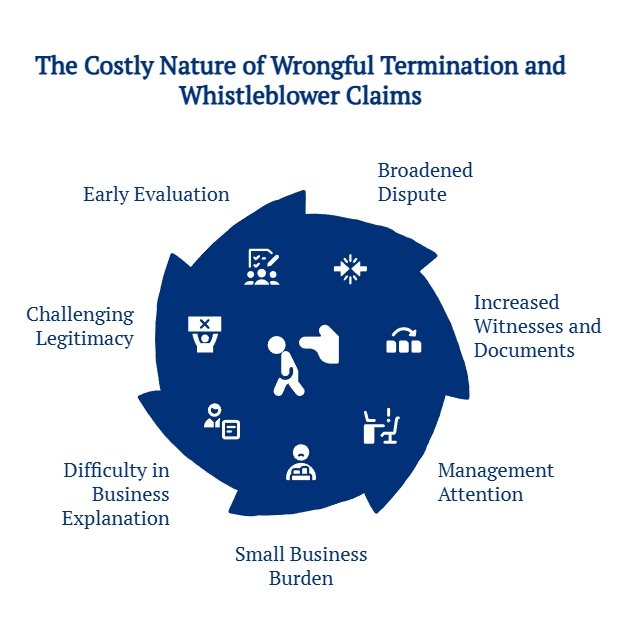
Once wrongful termination and whistleblower retaliation allegations are asserted together, the dispute may broaden quickly. The plaintiff may attempt to connect the discharge to a larger theory involving retaliation, public policy, or protected reporting. That broader framing may increase the number of witnesses, the scope of document review, and the amount of management attention the matter requires. For small restaurant operators, the burden may be especially pronounced because owners and managers are often closely involved in scheduling, discipline, payroll communication, and separation decisions.
These cases may also be difficult to reduce to a single business explanation. A restaurant employer may believe the decision was lawful and justified, yet the plaintiff may still argue that the stated reason was not the real reason. Where timing is close, documentation appears uneven, or supervisors communicated inconsistently, the plaintiff may try to use those facts to challenge the legitimacy and defensibility of the employer’s position.
A broader understanding of wrongful termination claims, unlawful retaliation disputes, and whistleblower retaliation allegations may help explain why complaint-related terminations can become significant sources of exposure for California restaurant businesses.
For employers already facing a demand letter, agency complaint, or civil action, these matters often require early evaluation because the dispute may center on protected activity, causal connection, pretext, timing, and the consistency of the employer’s stated rationale. In practice, that is one reason these cases are often disruptive, fact-sensitive, and costly.
Disclaimer:
This content is for informational purposes only. Laws, definitions, and deadlines change. Verify current requirements through official California sources. This content is not legal advice. No attorney-client relationship is formed through this content. Please consult a qualified attorney in your jurisdiction for legal advice specific to your situation.
Protect Your Business | The Akopyan Law Firm, A.P.C. | Top Gun Employment Lawyers
Have you been sued by an employee? Are you overwhelmed by the complexities of employment law? If so, give us a call. The Akopyan Law Firm, A.P.C. assists small business owners throughout Southern California. Our seasoned employment defense lawyers stand ready to help employers quickly and efficiently resolve employment disputes. We are ready to aggressively and skillfully defend against any employment case, but understand that in most situations avoiding the expense of litigation is in the client’s best interest.
Take the First Step Protecting Your Future: Call us today to speak with one of our experienced employment lawyers.
Contact Us Today:
- Phone: (818) 509-9975
Office Locations in California: Los Angeles, Bakersfield, Costa Mesa, Temecula, Rancho Cucamonga, Oxnard, Culver City, and San Diego.