

📌 Key Takeaways
Protected activity may turn an ordinary employment dispute into a broader retaliation and wrongful termination claim when a plaintiff links protected activity to a later adverse employment action.
- Protected Activity Broadens Claims: Protected complaints, reports, participation, refusals, and leave-related communications may qualify as protected activity under California law, depending on the facts alleged.
- Causation and Statutory Presumptions: In California, timing is more than just a circumstantial argument. Under statutes like Labor Code § 1102.5 (as amended by SB 497), a rebuttable presumption of retaliation is triggered if an adverse action occurs within 90 days of certain protected activities. This shift in the burden of proof means the employer must demonstrate a legitimate, non-retaliatory reason for the action once the timeline is established.
- Internal Communications Matter: Emails, texts, meeting discussions, performance write-ups, and leave-related communications may become central evidence once protected activity is alleged.
- Healthcare Whistleblower Presumptions: Medical practices face unique statutory risks under Health and Safety Code § 1278.5. This law creates a rebuttable presumption of retaliation if a healthcare worker is disciplined or terminated within 120 days of filing a grievance or report related to patient safety or quality of care. Unlike general employment disputes, this specific healthcare mandate places a heavy evidentiary burden on practice owners to justify personnel decisions following a complaint.
- Small Medical Practices Feel It Fast: In closely held workplaces, a single protected-activity dispute may expand beyond one personnel decision and disrupt operations, morale, scheduling, and reputation.
Protected activity may reshape both the legal theory and the practical stakes of an employment case.
Southern California medical practice owners confronting retaliation or wrongful termination exposure will gain immediate clarity here, guiding them into the protected-activity-specific details that follow.
~ ~ ~ ~ ~ ~ ~ ~ ~ ~ ~ ~ ~ ~ ~ ~ ~ ~
Protected activity may become the issue that transforms a disputed employment decision into a broader retaliation or wrongful termination claim. Under California law, generally, an employee’s complaint, report, opposition, participation, refusal, or leave-related communication may qualify as protected activity, depending on the statute and the facts alleged. Once protected activity is alleged, the dispute may no longer focus only on the termination or discipline itself. The dispute may also focus on causation, motive, chronology, and whether the employer’s stated reason for the adverse employment action will withstand scrutiny.
For small medical practices in Los Angeles, Bakersfield, Costa Mesa, Temecula, Rancho Cucamonga, Oxnard, Culver City, San Diego, and other cities in Southern California, that shift may materially expand risk. A medical practice, dental office, veterinary clinic, urgent care operator, or other closely held business may view a workplace event as informal or operational. A plaintiff may later allege that the same event was protected activity and may use that allegation to support claims involving wrongful termination, unlawful workplace retaliation, or overlapping whistleblower and leave-related claims. That is why protected activity often becomes central in employer-side employment litigation.
Protected Activity May Arise from Internal Complaints, Reports, Participation, or Job-Protected Leave
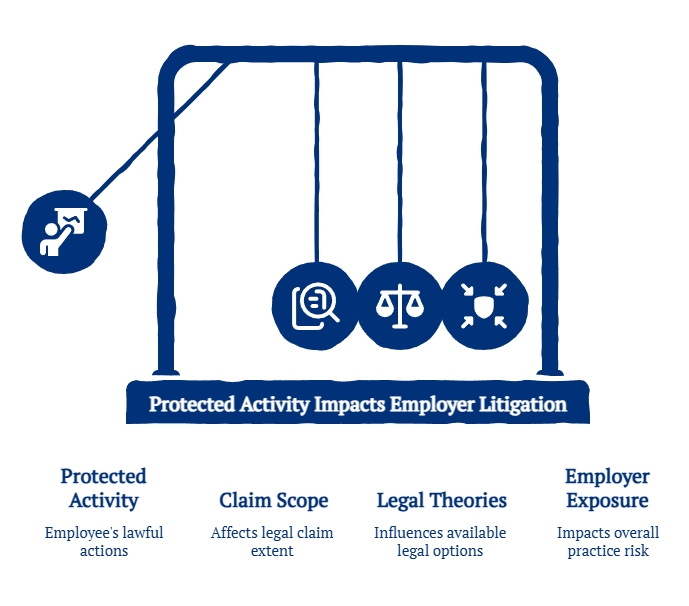
Protected activity is not limited to a filed lawsuit or an agency charge. California law may protect certain internal complaints of unlawful conduct, reports of suspected unlawful conduct, participation in an investigation, refusals tied to legal compliance, communications about job-protected medical leave, and requests involving disability rights, the interactive process, or reasonable accommodation. In some matters, an employee may allege protected activity even when management believed the concern was informal, unsubstantiated, or already resolved.
In employer-side litigation, a recurring legal issue is whether the employee engaged in protected activity and whether the employer later imposed an adverse employment action because of that activity. That issue matters because the answer may affect the scope of the claim, the available legal theories, and the overall exposure facing the practice.
Protected Activity May Supply the Causal Link in a Retaliation Claim
Protected activity may supply the causal connection that allows a plaintiff to link an earlier workplace event to a later termination, write-up, suspension, demotion, reduced hours, or other adverse employment action. A plaintiff may allege that protected activity occurred first, that management reacted adversely, and that the later employment decision was motivated by retaliation. In some circumstances, that same sequence may also be used to support a claim for wrongful termination in violation of public policy.
For employers, the practical consequence is significant. A dispute that began as a disagreement about performance, attendance, conduct, or fit may become a dispute about retaliatory motive. Once that occurs, the legal analysis may turn less on the employer’s internal view of the event and more on how the timing, communications, and decision-making process appear in litigation.
Several Workplace Events May Be Pleaded as Protected Activity
Protected activity allegations may arise from many workplace events, including:
- internal complaints about discrimination, harassment, or retaliation;
- reports that later become part of a whistleblower retaliation claim;
- communications about family medical leave or other job-protected medical leave;
- requests involving disability, the interactive process, or reasonable accommodation; and
- wage-and-hour complaints that later become part of a broader wage and hour defense dispute.
These examples are illustrative, not exhaustive. Under California law, their significance may depend on the legal theory pleaded, the content of the communication, the decision-maker’s knowledge, and the sequence of events that followed.
Internal Communications May Become Central Evidence in a Protected-Activity Dispute
Many employers expect legal significance to attach only to formal proceedings. Employment litigation often develops differently. An employee may allege that a complaint to a supervisor was protected activity. An employee may allege that participation in a workplace process was protected activity. An employee may allege that a report about compliance, safety, discrimination, or job-protected medical leave was protected activity.
When that occurs, the parties may dispute what the employee communicated, who received the communication, when management learned of it, and what happened next. Emails, texts, meeting discussions, performance write-ups, and leave-related communications may become part of the evidentiary record. For the employer, that shift may broaden the case from a single personnel decision into a larger dispute about chronology, knowledge, and motivation.
Medical Practices and Other Regulated Employers May Face Distinct Retaliation Risk
Medical practices and other regulated employers may face distinct risk because employee concerns may involve patient care, staffing, records, workplace safety, legal compliance, disability-related issues, or job-protected medical leave. A concern that management understood as operational may later be alleged as protected activity under a retaliation or whistleblower theory.
That risk may be especially pronounced in smaller medical practice with limited management layers and no in-house counsel. In a closely held healthcare setting, owners, administrators, and supervisors may become direct witnesses to the events at issue. As a result, a single complaint may affect not only legal exposure but also operations, morale, scheduling, and reputation. For those employers, protected activity is often not a side issue. It may become one of the central issues in the case.
⚖️ At-a-Glance: The “Presumption” Windows
As of 2026, California law creates an automatic “rebuttable presumption” of retaliation if an adverse action occurs within these specific windows:
| Feature | Labor Code § 1102.5 (SB 497) | Health & Safety Code § 1278.5 |
|---|---|---|
| Presumption Window | 90 Days | 120 Days |
| Applicable To | All California Employers | Medical Practices / Healthcare |
| Core Protection | General Whistleblowing | Patient Safety & Quality of Care |
| Legal Impact | Shifts burden of proof to Employer | Shifts burden of proof to Employer |
Timing, Consistency, and Stated Reasons May Shape the Outcome of the Dispute
Retaliation and wrongful termination claims often rely on circumstantial evidence. Timing may matter because protected activity followed closely by discipline, reduced hours, or termination may be offered as evidence of a causal connection. Consistency may matter because differing explanations, uneven treatment, or conflicting records may affect how a trier of fact evaluates the employer’s stated reason. Stated reasons may matter because a plaintiff may argue that the stated reason was not the actual motivation and was instead a pretext for retaliation.
For medical practice leaders in Southern California, the implication is straightforward. A dispute involving protected activity may expand beyond the original employment decision and become a broader contest over knowledge, motive, sequence, and credibility.
📋 90-Day Performance Compliance Checklist
For Southern California Medical Practice Owners & Administrators
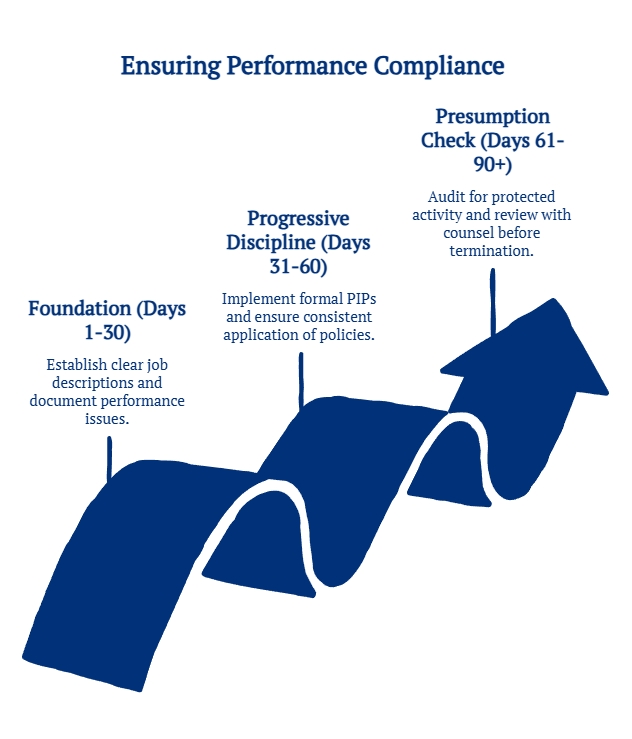
Phase 1: The Foundation (Days 1–30 of an Issue)
- [ ] Standardized Job Descriptions: Ensure the employee has a signed job description on file that clearly outlines the duties they are allegedly failing to perform.
- [ ] Contemporary Documentation: Record performance issues as they happen. Never back-date notes. Use a “memo to file” or an internal performance log.
- [ ] Verbal Warning Log: Note the date, time, and specific topic of any “informal” coaching sessions. Even “quick chats” about tardiness or charting errors should be logged.
Phase 2: Progressive Discipline (Days 31–60)
- [ ] The “But For” Test: Ask yourself: “Would I be taking this action but for their recent complaint?” If the answer is no, stop and consult an employment defense attorney.
- [ ] Performance Improvement Plan (PIP): Issue a formal PIP with specific, measurable goals (e.g., “Medical records must be completed within 24 hours of patient visit”).
- [ ] Consistent Application: Verify that other employees with similar performance issues were treated the same way. Inconsistency is the #1 indicator of “pretext” in a lawsuit.
- [ ] Employee Signature: Always ask the employee to sign the disciplinary notice. If they refuse, have a witness sign stating: “Employee was presented with this notice and refused to sign.”
Phase 3: The “Presumption Check” (Days 61–90+)
- [ ] Protected Activity Audit: Has the employee made any complaint regarding discrimination, harassment, safety, wages, patient care, or leave in the last 120 days?
- If Yes: The risk of a “rebuttable presumption” of retaliation is high.
- [ ] Review Against Policy: Ensure the proposed termination or discipline matches the penalties outlined in your Employee Handbook.
- [ ] The “Final Look” by Counsel: Before pulling the trigger on a termination for an employee who has recently complained, have an attorney review the “timeline of documentation” to ensure it outweighs the “timeline of the complaint.”
Why This Matters for 2026 Litigation
In Southern California courts, a “sudden” performance issue that appears only after an employee mentions a medical leave or a staffing concern is almost impossible to defend. This checklist ensures that your evidence of “poor performance” exists independently of their protected activity.
Disclaimer:
This content is for informational purposes only. Laws, definitions, and deadlines change. Verify current requirements through official California sources. This content is not legal advice. No attorney-client relationship is formed through this content. Please consult a qualified attorney in your jurisdiction for legal advice specific to your situation.
Protect Your Business | The Akopyan Law Firm, A.P.C. | Top Gun Employment Lawyers
Have you been sued by an employee? Are you overwhelmed by the complexities of employment law? If so, give us a call. The Akopyan Law Firm, A.P.C. assists small business owners throughout Southern California. Our seasoned employment defense lawyers stand ready to help employers quickly and efficiently resolve employment disputes. We are ready to aggressively and skillfully defend against any employment case, but understand that in most situations avoiding the expense of litigation is in the client’s best interest.
Take the First Step Protecting Your Future: Call us today to speak with one of our experienced employment lawyers.
Contact Us Today:
- Phone: (818) 509-9975
- Office Locations in California: Los Angeles, Bakersfield, Costa Mesa, Temecula, Rancho Cucamonga, Oxnard, Culver City, and San Diego.