

📌 Key Takeaways
Wrongful termination and retaliation allegations may be pleaded together because a complaint can link protected activity to termination as the alleged adverse employment action.
- Pairing Broadens Disputes: A complaint may expand the case beyond termination by emphasizing earlier communications, scheduling changes, discipline, and alleged motive.
- Causation Drives Theories: A complaint may tie protected activity, employer knowledge, and a claimed causal connection to an adverse employment action.
- Sequences Shape Allegations: A complaint may allege protected activity, management awareness, changed treatment such as write-ups or reduced hours, then termination.
- Protected Activity Varies: A complaint may invoke FEHA opposition, protected disability-related doctrines, job-protected leave, wage-and-hour concerns, or whistleblower-style allegations.
- Pretext Becomes Central: A complaint may allege pretext by pointing to shifting explanations, uneven enforcement, or disputed performance accounts as supposed support.
Paired allegations can turn a single termination event into a wider credibility dispute about what happened before and why.
California medical practice owners and practice leadership facing active employment disputes will gain clear context here, preparing them for the detailed overview that follows.
~ ~ ~ ~ ~ ~ ~ ~ ~ ~ ~ ~ ~ ~ ~ ~ ~ ~
In California employment disputes involving medical practices, a complaint may plead wrongful termination and retaliation together because both theories can be tied to the same alleged event: an employment separation, including termination. Under California law, generally, retaliation claims focus on whether an employee engaged in protected activity, whether the employer knew about that protected activity, and whether the employee then experienced an adverse employment action. A termination may be alleged as the adverse employment action. While a statutory retaliation claim is based on specific codes like the FEHA or Labor Code, a ‘wrongful termination in violation of public policy’ (a Tameny claim) is a common law tort. This theory contends that the discharge violated a policy ‘tethered to’ a constitutional or statutory provision, such as refusing to participate in illegal billing practices common in medical settings. (Tameny v. Atlantic Richfield Co. (1980) 27 Cal.3d 167; Green v. Ralee Engineering Co. (1998) 19 Cal.4th 66.)
This pairing may broaden the disputed issues beyond the termination decision alone. A complaint may place earlier communications, internal complaints, scheduling changes, and discipline into the foreground to support an inference about motivation and causation.
Why retaliation and wrongful termination allegations may be paired in one complaint
In many cases, a retaliation theory is pleaded to connect protected activity to an alleged adverse employment action through a claimed causal connection. A wrongful termination theory may then be pleaded as a separate legal basis for the claim that the termination was unlawful. When both are asserted, the complaint may use the retaliation theory to frame alleged motive and the wrongful termination theory to frame the asserted legal constraint on the termination decision.
In small medical practices, a complaint may emphasize that the decision chain is short and communications are frequent among owners, office managers, supervisors, and frontline staff. That context can matter because the pleading may argue that knowledge and intent can be inferred from proximity, repeated interactions, or who participated in discussions.
A sequence that a complaint may allege to link protected activity to termination
Many complaints use a straightforward sequence to connect protected activity and termination. A complaint may allege that:
- An employee engaged in protected activity, such as making a workplace complaint, requesting job-protected leave, raising concern about wages, or participating in an inquiry.
- Management knew about the protected activity, and the complaint identifies who received the complaint or who discussed it.
- The employee experienced a change in treatment, such as disciplinary write-ups, heightened scrutiny, altered scheduling, reduced hours, or other adverse changes.
- The termination followed, and the plaintiff argues that the sequence supports a causal connection.
Retaliation claims often rely on circumstantial allegations rather than direct admissions. A complaint may highlight a sudden escalation in discipline, disputed performance criticisms, or inconsistent explanations to support an inference that protected activity was a motivating factor in the termination. This strategy can shift attention to credibility and internal communications, not only to the stated reason for termination.
Protected-activity themes that may appear in medical practice disputes
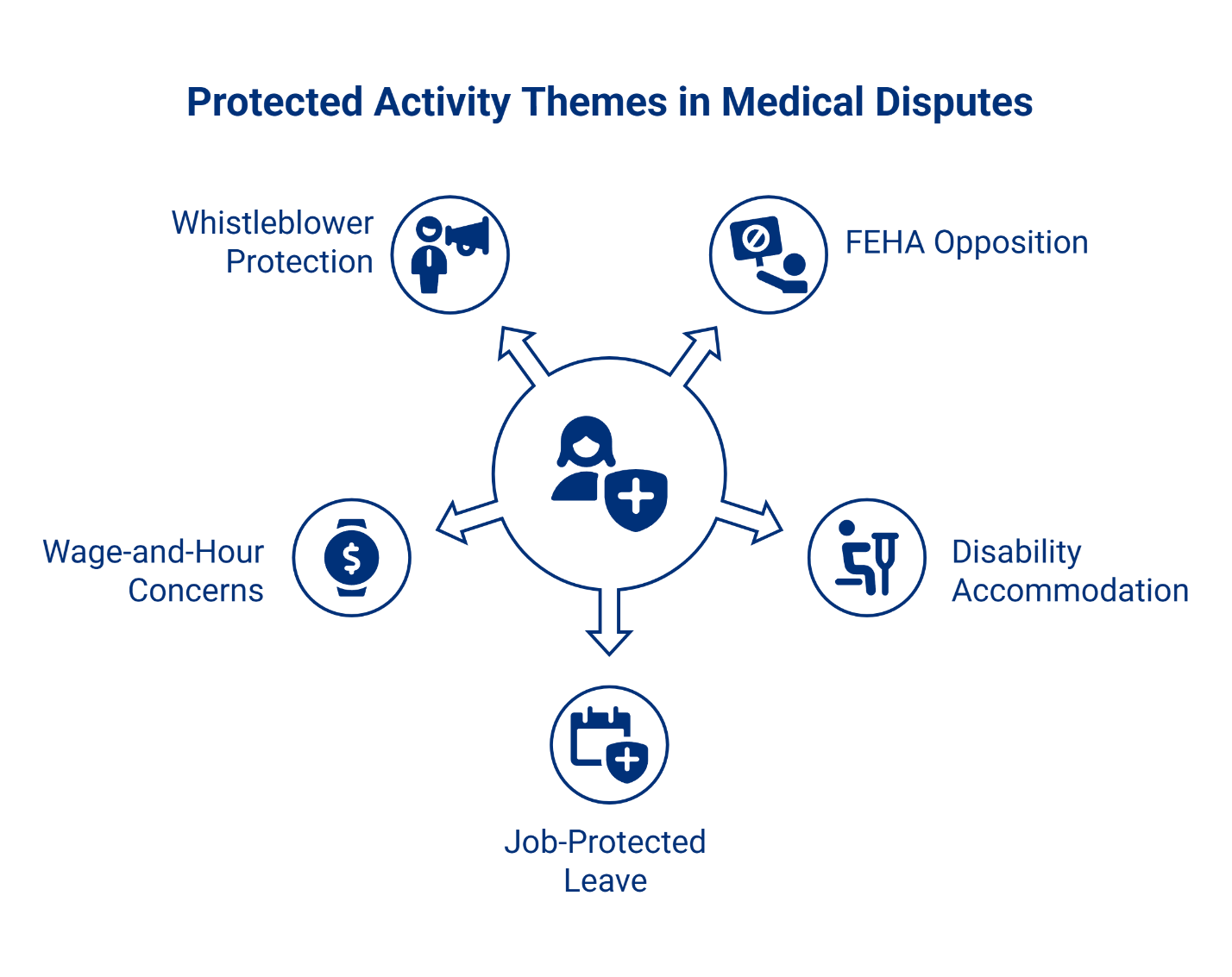
Protected activity depends on the statute invoked, and a complaint may reference more than one source of protection. The themes below describe how complaints may be framed, not what any employer did.
FEHA opposition and participation themes. A complaint may allege that an employee opposed discrimination, harassment, or retaliation in a manner protected by the Fair Employment and Housing Act (FEHA). A complaint may also invoke participation concepts, such as cooperating in an internal investigation or engaging in conduct the plaintiff characterizes as protected opposition.
Disability and medical-condition. A complaint may allege that adverse action followed events tied to a protected disability or medical condition. When disability issues are part of the allegations, a complaint may reference doctrines such as the interactive process or reasonable accommodation and contend that the termination was linked to those events. The practical impact in litigation is that the dispute may expand to cover what was communicated about restrictions, requests, and options, as alleged by each side.
Job-protected leave. A complaint may allege that the employee requested or used job-protected leave such as family and medical leave and then experienced discipline, reduced hours, or termination. Where leave laws are raised, the allegations often focus on what was requested, what was communicated, and what allegedly changed afterward. This kind of framing can move the dispute toward sequencing and knowledge, because the plaintiff may argue that the protected leave status came first and the adverse action came next.
Wage-and-hour concern. A complaint may allege that an employee raised wage-and-hour concerns and then faced adverse treatment. The theory may be framed as retaliation under California Labor Code protections, depending on the allegations, and wage-and-hour topics can include overtime, meal and rest periods, or wage statements. The implication is that the case may involve both the termination decision and the background dispute over pay practices, as alleged.
Whistleblower protection. A complaint may contend that an employee disclosed, or was perceived as having disclosed, information the employee believed reflected unlawful conduct or regulatory noncompliance. In California, a complaint may invoke Labor Code protections, most notably Section 1102.5, the ‘general’ whistleblower statute. Under Labor Code Section 1102.6, once a plaintiff establishes by a preponderance of evidence that retaliation was a ‘contributing factor’ in their termination, the burden shifts to the employer to prove by clear and convincing evidence that the action would have occurred for legitimate, independent reasons. This makes these allegations particularly potent in medical practice disputes involving patient safety reports. Allegations framed this way may expand the dispute to include what was reported and to whom. Critically, under People ex rel. Garcia-Brower v. Kolla’s, Inc. (2023), a ‘disclosure’ is protected even if the recipient already knew about the information. In medical practice, this means an employee is protected even if they ‘report’ a billing discrepancy that the office manager was already attempting to fix.
Practice features that complaints may cite to support knowledge and motive
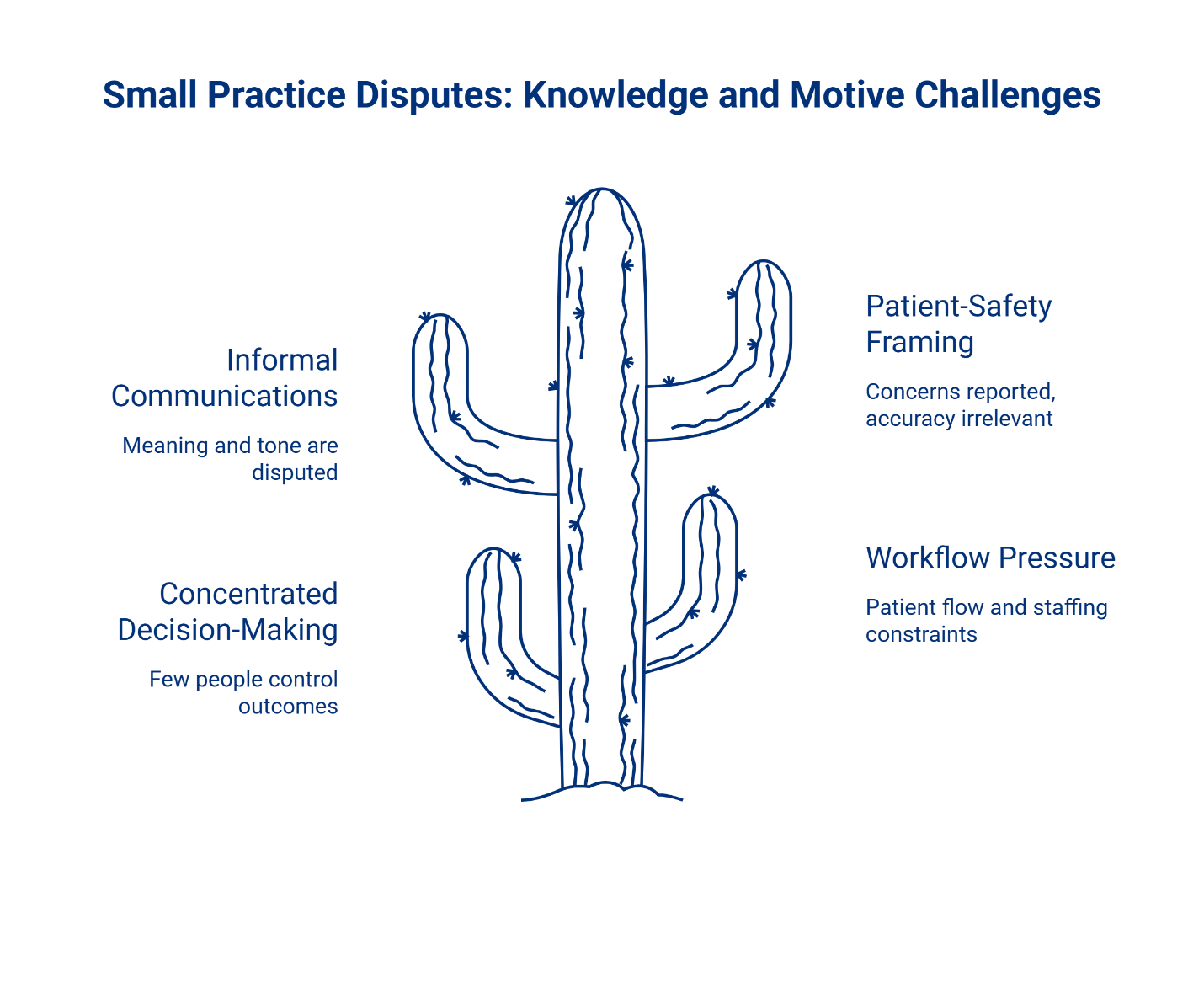
A complaint may place the allegations in the operational realities of a small medical practice to support claims about knowledge and motivation. Commonly alleged context can include the following:
- Concentrated decision-making. A complaint may emphasize that a small number of people controlled scheduling, discipline, and workflow, and therefore had influence over employment outcomes.
- Workflow pressure. A complaint may reference patient flow, staffing constraints, and productivity expectations as the environment in which conflict escalated.
- Informal communications. A complaint may point to texts, short emails, or quick verbal exchanges and argue that meaning or tone is disputed.
- Patient-safety framing. A complaint may mention patient-care concerns as the alleged catalyst for reporting or opposition, even when the case does not depend on whether the underlying concern was accurate.
This context can matter because it can shape how the pleading argues knowledge and intent, particularly when the alleged decision chain is short.
What a complaint may emphasize when both theories are asserted
When wrongful termination and retaliation are pleaded together, a complaint may emphasize a few recurring themes.
A “before-and-after” contrast. A complaint may allege that the employee received positive evaluations or stable scheduling before the protected activity, followed by write-ups, criticism, or reduced hours afterward. The plaintiff may argue that the contrast supports an inference of retaliatory motivation.
A sequencing narrative. A complaint may arrange events to show protected activity first, then escalating discipline, then termination. The plaintiff may argue that the sequence supports causation, particularly when the complaint alleges management awareness of the protected activity.
A pretext theory. A complaint may use the concept of pretext to allege that the stated reason for termination was a cover for a different motivation. In plain terms, pretext is often alleged as an explanation that masks another reason. A complaint may point to shifting explanations, uneven enforcement of expectations, or disputed performance accounts as alleged support for that theory.
The practical takeaway is that these themes tend to put internal consistency and credibility at the center of the dispute, not only the final termination decision.
Why paired allegations may expand the scope and complexity of a dispute
A termination-only claim may focus on the separation event. By contrast, retaliation allegations typically pull earlier events into dispute because protected activity, employer knowledge, and causation are central elements. As a result, communications, internal complaints, scheduling decisions, and discipline history may become heavily contested topics. In a small practice, the witness pool may be limited, which can intensify credibility disputes about what was said, what was meant, and who participated in decision-making.
The implication for practice leadership is that a paired claim may require a broader factual account of the employment relationship than a termination-only dispute, because the plaintiff may frame the case around a sequence rather than a single decision.
Disclaimer:
This content is for informational purposes only. Laws, definitions, and deadlines change. Verify current requirements through official California sources. This content is not legal advice. No attorney-client relationship is formed through this content. Please consult a qualified attorney in your jurisdiction for legal advice specific to your situation.
Protect Your Business | The Akopyan Law Firm, A.P.C. | Top Gun Employment Lawyers
Have you been sued by an employee? Are you overwhelmed by the complexities of employment law? If so, give us a call. The Akopyan Law Firm, A.P.C. assists small business owners throughout Southern California. Our seasoned employment defense lawyers stand ready to help employers quickly and efficiently resolve employment disputes. We are ready to aggressively and skillfully defend against any employment case, but understand that in most situations avoiding the expense of litigation is in the client’s best interest.
Take the First Step Protecting Your Future: Call us today to speak with one of our experienced employment lawyers.
Contact Us Today:
- Phone: (818) 509-9975
Office Locations in California: Los Angeles, Bakersfield, Costa Mesa, Temecula, Rancho Cucamonga, Oxnard, Culver City, and San Diego.