

Wrongful termination disputes in Southern California medical practices often follow a recognizable allegation pattern. This sequence typically unfolds as follows:
- The Alleged Protected Activity: An employee characterizes a patient-related concern or an internal report as a protected disclosure.
- The Alleged Hostility: A subsequent management response or performance review is characterized as “hostility” or “animus.”
- The Alleged Retaliation: A later termination or forced resignation (sometimes alleged as constructive discharge) is framed as the direct result of that reporting.
In this framing, routine workplace events can be cited as alleged evidence of retaliatory motive, even when the practice disputes both the facts and the legal characterization. This pattern often shapes the tone of a demand letter, the structure of a civil complaint, and the way an agency filing describes ordinary management decisions.
The Legal Framework: How Narratives Become Statutory Claims
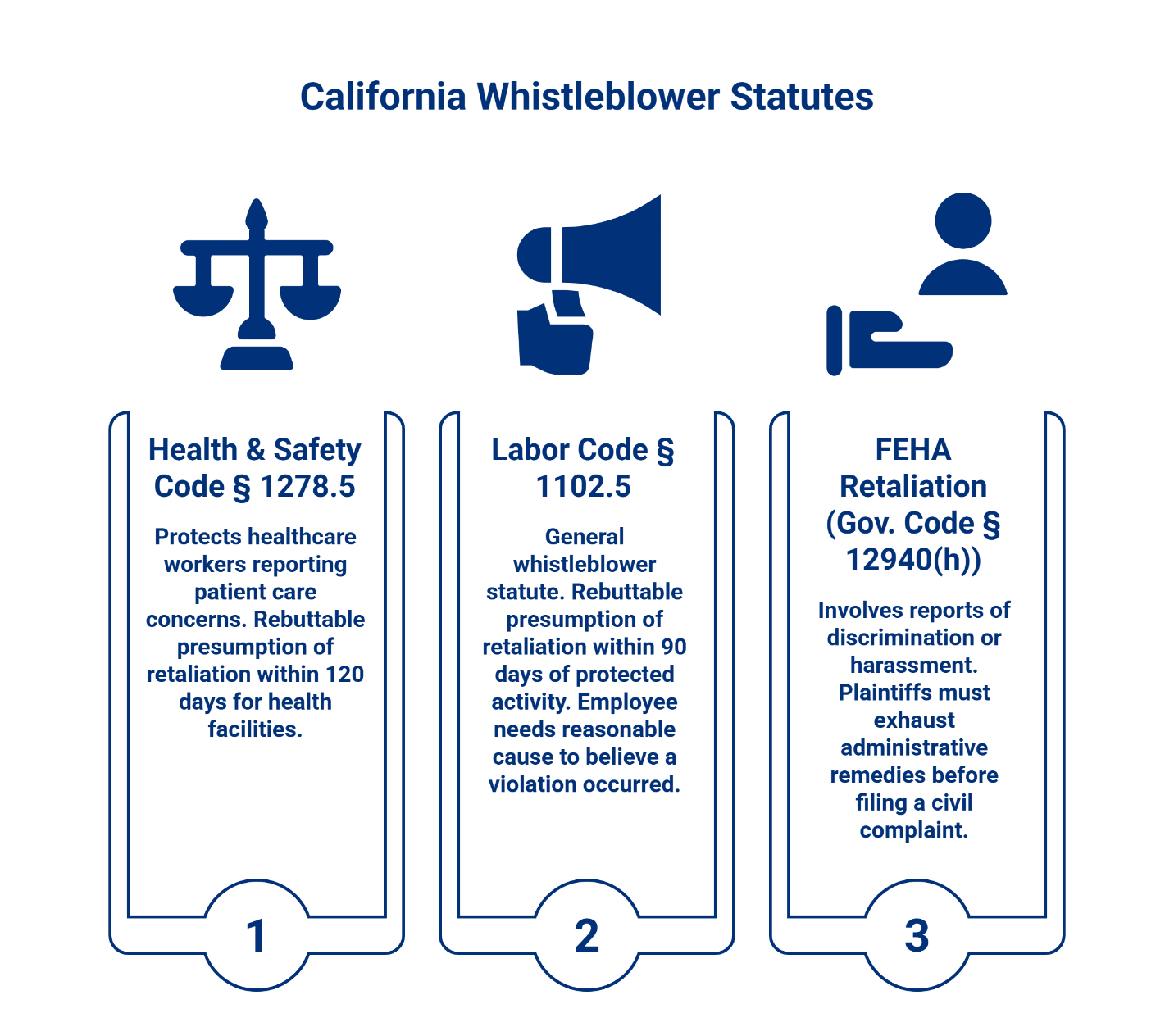
California laws provide several statutory bases that a plaintiff may use to label a report as “protected activity.” Practice owners should be aware of the specific “rebuttable presumption” windows that favor employees in these disputes:
- Health & Safety Code § 1278.5: This protects physicians, nurses, and healthcare workers who report concerns regarding patient care or safety. For practices classified as “health facilities,” a rebuttable presumption of retaliation exists if the adverse action occurs within 120 days of the employee’s report [Health & Saf. Code, § 1278.5(d)(1)].
- Labor Code § 1102.5: This is the general “whistleblower” statute. Under the SB 497 expansion (effective Jan 2024), there is a rebuttable presumption of retaliation if an employer takes an adverse action within 90 days of protected activity [Cal. Lab. Code, §§ 1102.5, 1102.6]. Furthermore, an employee only needs “reasonable cause to believe” a violation occurred—they do not need to prove an actual legal violation.
- FEHA Retaliation (Gov. Code § 12940(h)): This involves reports of discrimination or harassment. Plaintiffs must typically “exhaust administrative remedies” by obtaining a right-to-sue notice from the Civil Rights Department (CRD) before a civil complaint can be filed.
Internal Reporting: Where Disputes Are Won or Lost
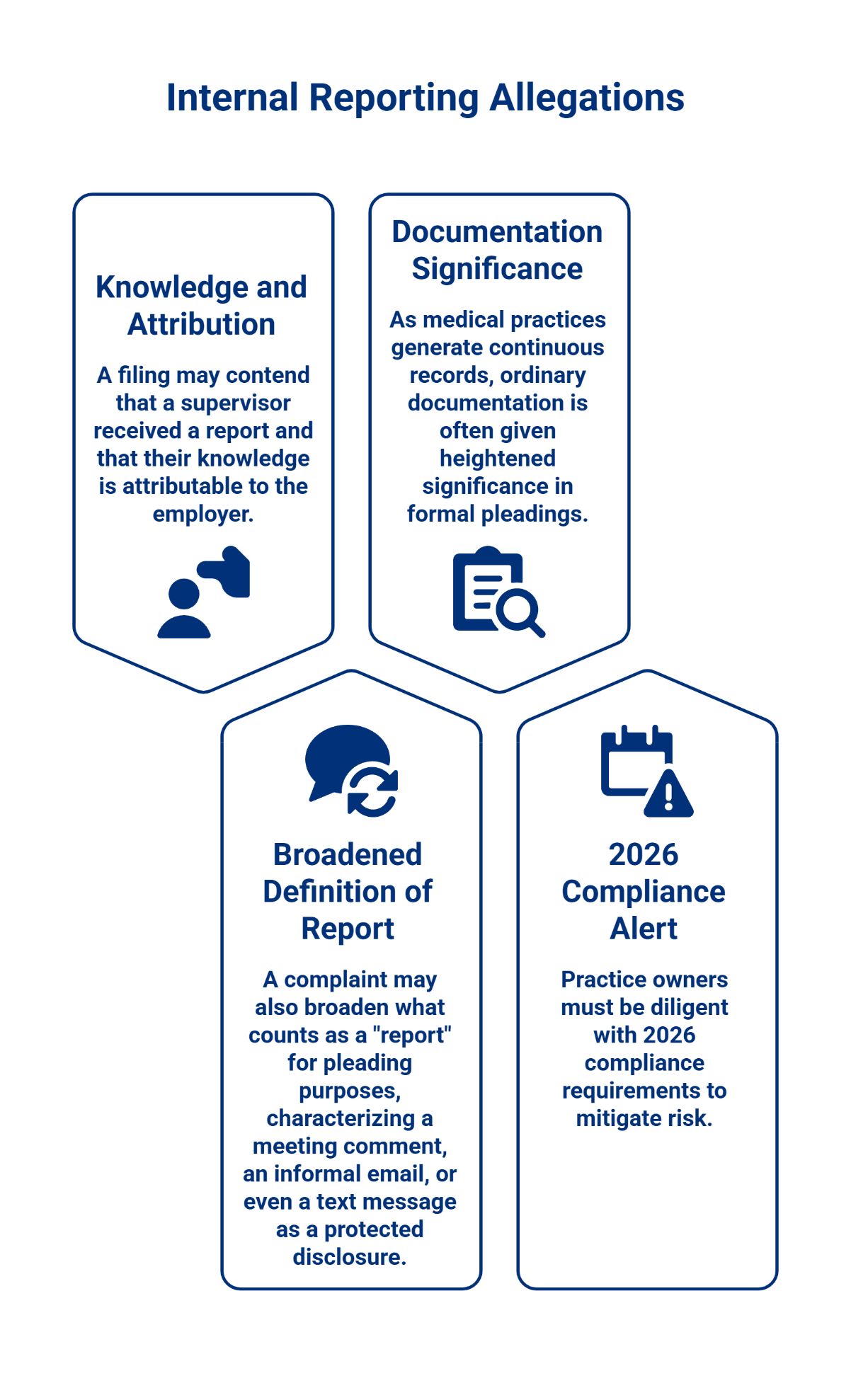
Internal reporting allegations often focus on knowledge and attribution. A filing may contend that a supervisor received a report and that their knowledge is attributable to the employer. A complaint may also broaden what counts as a “report” for pleading purposes, characterizing a meeting comment, an informal email, or even a text message as a protected disclosure.
As medical practices generate continuous records, ordinary documentation is often given heightened significance in formal pleadings. To mitigate this risk, practice owners must be diligent with 2026 compliance requirements:
2026 Compliance Alert: Under the Workplace Know Your Rights Act, practice owners must have provided a stand-alone annual written notice to employees by February 1, 2026. Additionally, by March 30, 2026, employers must allow employees to designate an emergency contact for notification in the event of a worksite arrest. Failure to maintain these records for three years can undermine a practice’s defense in a retaliation lawsuit [Cal. Lab. Code §§ 1553, 1555].
Dispute Themes and Business Impact
These cases often turn on recurring contested themes, including the “Knowledge Theme” (who knew about the report?) and the “Motive Theme” (was it routine supervision or animus?). For small or owner-operated practices, these disputes can be particularly taxing. They consume leadership bandwidth, strain staffing continuity, and create significant cost pressures through legal spending and operational distraction.
Disclaimer:
This content is for informational purposes only. Laws, definitions, and deadlines change. Verify current requirements through official California sources. This content is not legal advice. No attorney-client relationship is formed through this content. Please consult a qualified attorney in your jurisdiction for legal advice specific to your situation.
Protect Your Business | The Akopyan Law Firm, A.P.C. | Top Gun Employment Lawyers
Have you been sued by an employee? Are you overwhelmed by the complexities of employment law? If so, give us a call. The Akopyan Law Firm, A.P.C. assists small business owners throughout Southern California. Our seasoned employment lawyers stand ready to help employers quickly and efficiently resolve employment disputes. We are ready to aggressively and skillfully defend against any employment case, but understand that in most situations avoiding the expense of litigation is in the client’s best interest.
Take the First Step Protecting Your Future: Call us today to speak with one of our experienced employment lawyers.
Contact Us Today:
- Phone: (818) 509-9975
Office Locations in California: Los Angeles, Bakersfield, Costa Mesa, Temecula, Rancho Cucamonga, Oxnard, Culver City, and San Diego.