
📌 Key Takeaways
Wrongful termination claims often expand beyond a single discharge decision because a prior workplace complaint may increase scrutiny of timing, motive, documentation, and policy consistency.
- Complaints Broaden Exposure: A workplace complaint may turn a termination dispute into a wider review of causation, pretext, and overlapping retaliation allegations.
- Protected Activity Matters: Once an employee engages in protected activity, later adverse action may receive closer scrutiny under California employment law.
- Timing Drives Scrutiny: Termination that closely follows a complaint may support an inference of retaliatory motive and increase focus on causation.
- Documentation Must Align: Inconsistent records, shifting explanations, and uneven policy enforcement may undermine the employer’s stated reason for discharge.
- Restaurant Facts Escalate Quickly: Informal supervision, multiple managers, and fast operational decisions may create fragmented evidence that expands wrongful termination exposure.
Complaint plus termination often means broader scrutiny, not a narrow dispute.
Small restaurant employers facing complaint-related termination disputes will gain immediate clarity here, guiding them into the California employer-side details that follow.
~ ~ ~ ~ ~ ~ ~ ~ ~ ~ ~ ~ ~ ~ ~ ~ ~ ~
A wrongful termination claim often broadens the dispute beyond the discharge itself. Under California law, generally, a termination that follows a workplace complaint may lead the plaintiff to allege retaliation, pretext, or overlapping statutory violations. For small restaurant employers, that broader scrutiny can become especially significant because restaurant operations often rely on fast staffing decisions, shift-based supervision, informal communications, and multiple managers whose actions may later be examined together rather than in isolation.
This article provides general information only, focuses on California employer-side employment disputes, does not create an attorney-client relationship, should not be treated as legal advice, and laws are subject to change. Active disputes may involve strict deadlines and serious consequences, which is why prompt involvement of an experienced employment defense lawyer often matters.
Why Complaint-Related Terminations Often Create Greater Employer Exposure
At a high level, a workplace complaint may change the way a later termination is evaluated. A plaintiff may allege that the complaint was protected activity and that the discharge was an adverse employment action tied to that activity. In that setting, the dispute may center on causation, motive, and pretext rather than on the termination decision alone.
California law generally recognizes that retaliation claims may arise even when the underlying complaint is disputed. That point matters in employer-side litigation because if a plaintiff can establish making a protected complaint, then the employer’s response of a termination may be unlawful. As a result, once a protected complaint enters the factual record, management communications, stated reasons, and the sequence of events may all receive closer scrutiny.
The Complaints That Often Form the Background of These Claims
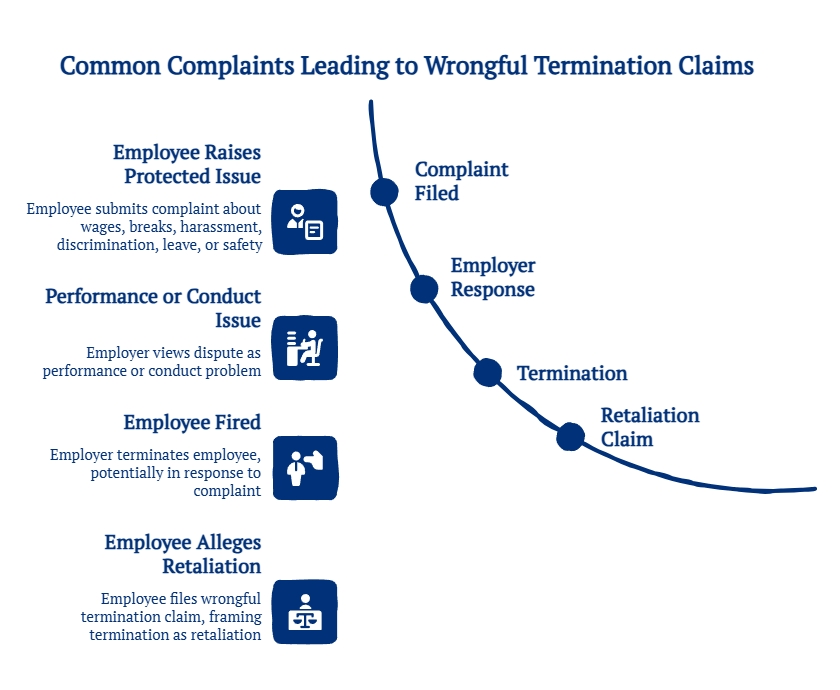
In many restaurant disputes, the protected complaints may involve unpaid wages, meal and rest breaks, harassment, discrimination, leaves of absence, or safety concerns. The article’s focus is not the merits of those underlying issues. The relevant point is that these complaints may be characterized as protected activity, and protected activity may create both documentation obligations and process-based scrutiny.
An employer may view the dispute as a performance or conduct issue. The plaintiff may frame the same events as a retaliation claim. That difference in framing often expands the scope of the case and increases liability exposure.
Why Timing, Causation, and Pretext Often Become Central
Timing is a critical legal threshold because, under the California Equal Pay and Anti-Retaliation Protection Act (SB 497), effective January 1, 2024, there is a rebuttable presumption of retaliation if an employer discharges or takes adverse action against an employee within 90 days of certain protected activities, including complaints about wages or equal pay [Cal. Lab. Code §§ 98.6, 1102.5, 1197.5]. This shifts the initial burden to the employer to provide a legitimate, non-retaliatory reason for the action, rather than requiring the plaintiff to first prove a retaliatory motive through mere inference.
In this context, defensible decision-making requires more than a lawful-sounding explanation. A court, agency, or trier of fact may examine whether management applied established policies uniformly, whether the employer’s explanation remained consistent, and whether contemporaneous records reflect the same rationale later advanced in the dispute. Documentation does not eliminate exposure, but inconsistent documentation may increase it.
Why Restaurant Workplaces Often Generate Fact-Intensive Disputes
Restaurant employers often face a particular kind of evidentiary problem. Owners, operators, supervisors, and shift managers may all participate in discipline, scheduling, and separation decisions. Text messages, hurried conversations during service, staffing shortages, and informal supervisory practices may later become part of the factual record.
That setting can make credibility disputes more difficult. A plaintiff may point to conflicting manager explanations, uneven enforcement, or casual comments as evidence of pretext. The employer may argue that the termination rested on a legitimate business reason. The dispute may then turn on whether the decision appears consistent, documented, and defensible when viewed against the full complaint-related timeline.
A generalized example shows how this may arise. An employee makes a workplace complaint, management later cites performance concerns, and different supervisors describe the reasons for termination differently. In that situation, the plaintiff may allege that the inconsistency supports a broader retaliation theory, even where the employer maintains that the discharge was justified.
The Management Practices That May Come Under Review
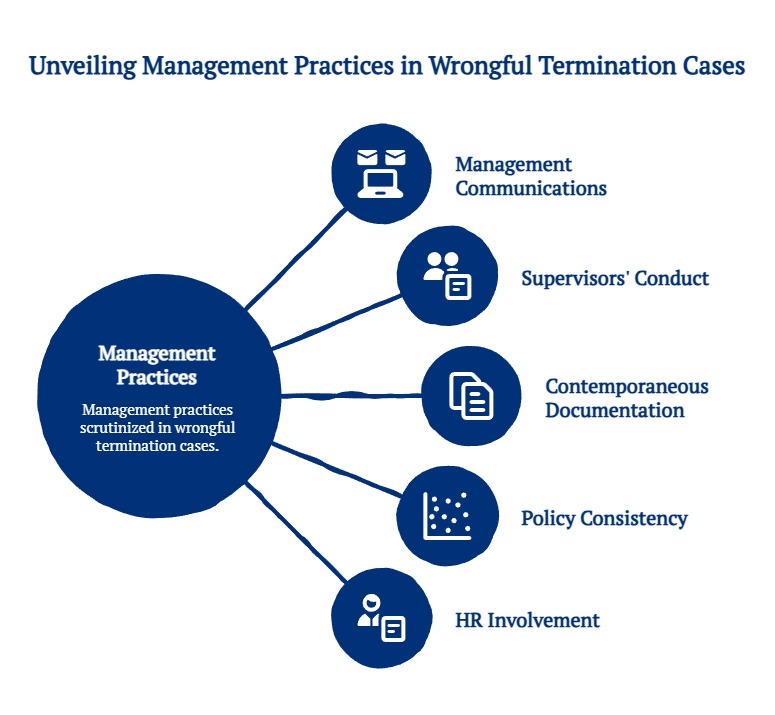
When a wrongful termination claim expands, the scrutiny often reaches beyond the separation itself. The dispute may place several issues at the center of the case:
- Management communications may become relevant if emails, texts, or internal discussions are alleged to reflect retaliatory motive or inconsistent reasoning.
- Supervisors’ conduct may receive closer review if different decision-makers applied expectations unevenly or communicated conflicting explanations.
- Contemporaneous documentation may become significant if later testimony does not align with disciplinary records, performance records, or other internal materials.
- Policy consistency may matter if the plaintiff alleges that management deviated from established practices in complaint-related situations.
- HR involvement may become important where a sensitive termination allegedly proceeded without adequate review of complaint history, protected activity, or litigation risk.
These points do not establish liability by themselves. They do, however, affect whether the employer’s decision appears defensible rather than merely asserted to be lawful.
How Wrongful Termination Claims May Expand into Other Allegations
More broadly, a wrongful termination claim may overlap with related allegations that increase legal complexity. A complaint-followed termination may be paired with unlawful retaliation allegations because California retaliation protections can apply across multiple employment laws. In many instances, the factual narrative triggers Labor Code Section 1102.5, California’s general whistleblower statute, which protects employees who report what they ‘reasonably believe’ to be a violation of a local, state, or federal rule or regulation. Because this statute provides for the recovery of reasonable attorney’s fees and a civil penalty of up to $10,000 per violation, the overlap with wrongful termination claims materially expands the employer’s financial exposure [Cal. Lab. Code § 1102.5(f), (j)]. The broader dispute may still remain anchored in wrongful termination, but the overlap can materially expand exposure, cost, and factual complexity.
Why These Claims Can Create Immediate Pressure for Small Restaurant Employers
For small restaurant employers, these disputes often create pressure well beyond the pleadings. Leadership attention may shift away from operations. Managers may become witnesses. Business records and communications may receive close review. Reputational concerns, cost pressure, and disruption to daily operations may follow quickly, particularly where the business is closely held and ownership remains directly involved in staffing decisions.
That practical pressure is one reason these cases often feel larger than a single personnel dispute. The claim may evolve into a broader challenge to management credibility, consistency, and judgment.
Why Early Defense Lawyer Involvement Often Matters
Depending on the facts, a complaint-related wrongful termination dispute may be difficult to evaluate in the abstract. The legal significance of timing, protected activity, causation, pretext, policy consistency, HR involvement, and contemporaneous documentation may depend on the allegations and the evidence developed in the matter. For California restaurant employers facing a lawsuit, attorney demand, or agency complaint, these disputes are often fact-specific, legally complex, and better assessed with experienced employer-side defense lawyer.
Disclaimer:
This content is for informational purposes only. Laws, definitions, and deadlines change. Verify current requirements through official California sources. This content is not legal advice. No attorney-client relationship is formed through this content. Please consult a qualified attorney in your jurisdiction for legal advice specific to your situation.
Protect Your Business | The Akopyan Law Firm, A.P.C. | Top Gun Employment Lawyers
Have you been sued by an employee? Are you overwhelmed by the complexities of employment law? If so, give us a call. The Akopyan Law Firm, A.P.C. assists small business owners throughout Southern California. Our seasoned employment defense lawyers stand ready to help employers quickly and efficiently resolve employment disputes. We are ready to aggressively and skillfully defend against any employment case, but understand that in most situations avoiding the expense of litigation is in the client’s best interest.
Take the First Step Protecting Your Future: Call us today to speak with one of our experienced employment lawyers.
Contact Us Today:
- Phone: (818) 509-9975
Office Locations in California: Los Angeles, Bakersfield, Costa Mesa, Temecula, Rancho Cucamonga, Oxnard, Culver City, and San Diego.