📌 Key Takeaways
In California small restaurant wrongful termination disputes, timing often becomes the framework through which motive, causation, pretext, and defensibility are judged.
- Sequence Shapes Exposure: A termination that follows a complaint, leave-related event, or accommodation-related discussion may invite closer scrutiny of retaliation and pretext allegations.
- Documentation Drives Credibility: Contemporaneous records, consistent explanations, and uniform policy application may strongly influence whether the employer’s rationale appears defensible in litigation.
- Informal Decisions Create Risk: Small restaurant operations often rely on verbal direction, overlapping supervisors, and rapid staffing changes that may later complicate the chronology.
- Protected Activity Matters: Once protected activity enters the timeline, employers may face increased scrutiny over process, documentation, and the stated reason for discharge.
- One Timeline Supports Many Claims: The same sequence of events may be cited across wrongful termination, retaliation, whistleblower, leave-related, and wage-and-hour allegations.
When timing looks inconsistent, the dispute often shifts from one termination decision to the credibility of the employer’s entire narrative.
California small restaurant employers confronting active wrongful termination disputes will gain immediate clarity here, guiding them into the detailed legal analysis that follows.
~ ~ ~ ~ ~ ~ ~ ~ ~ ~ ~ ~ ~ ~ ~ ~ ~ ~
Timing often becomes central in wrongful termination litigation because the sequence of events may shape how a plaintiff alleges motive, causation, and pretext. In California restaurant disputes, that sequence may draw heightened scrutiny when a termination follows a protected complaint, a leave-related event, an accommodation-related discussion, a wage-and-hour concern, or a management conflict. For small restaurant employers already facing a lawsuit, attorney demand letter, or a complaint filed with the California Civil Rights Department (CRD)—formerly the DFEH—or the Labor Commissioner’s Office, the dispute may turn less on any single event and more on how the chronology is framed, compared, and contested.
Why Timing Often Moves to the Center of a Wrongful Termination Dispute
Under California law, generally, wrongful termination claims often rely on circumstantial evidence rather than direct proof of unlawful motive. That is one reason temporal proximity may take on unusual importance. A plaintiff may rely on temporal proximity to establish a prima facie case of retaliation; however, California courts have clarified that while timing may suggest a causal link, it is often insufficient on its own to defeat an employer’s motion for summary judgment if a legitimate, non-discriminatory reason for termination is provided. The dispute may therefore center on whether the sequence of events makes the employer’s stated rationale appear consistent and defensible.
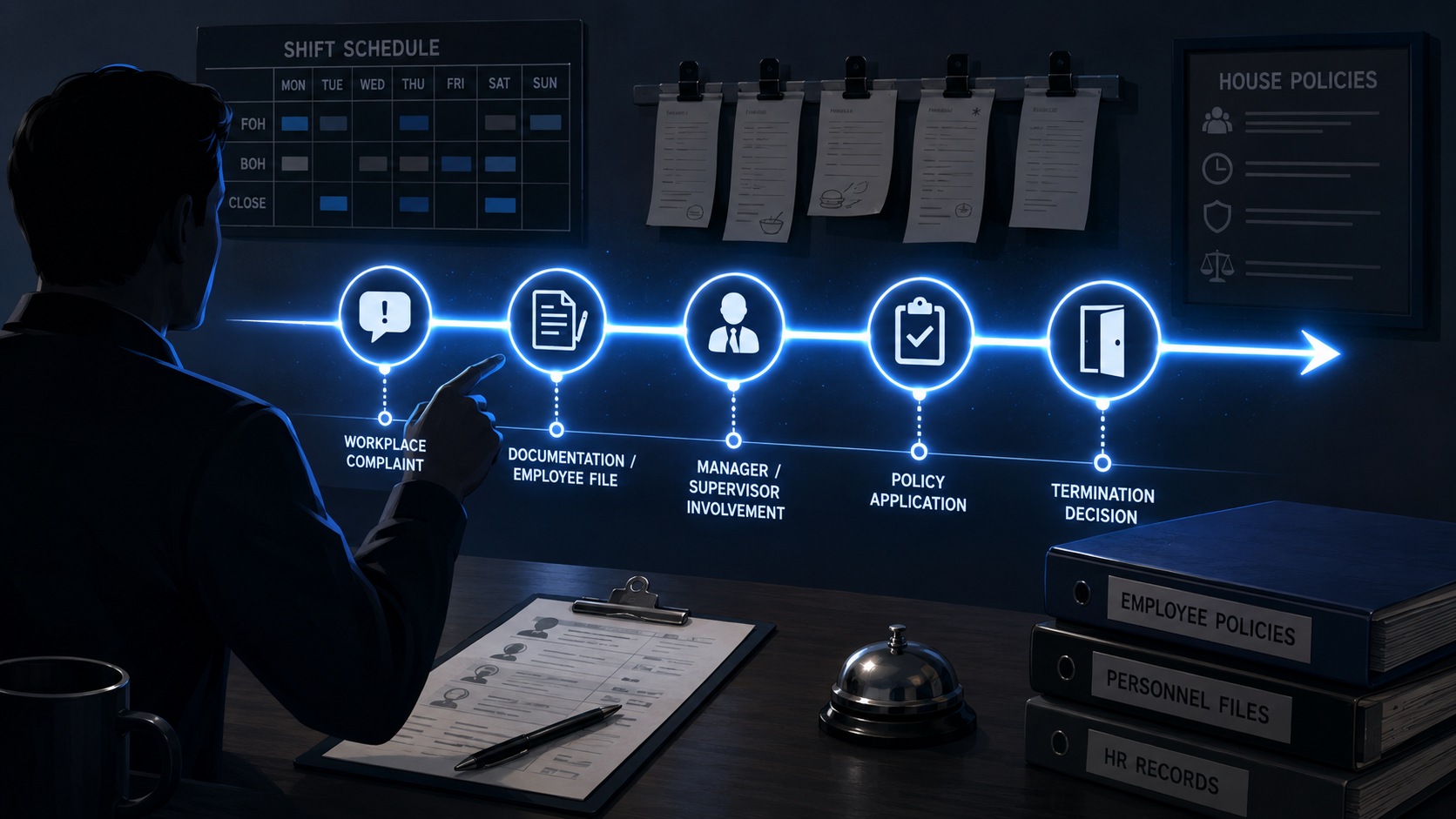
In this setting, timing does not mean a filing deadline or procedural timetable. Timing means when a complaint was raised, when performance concerns were documented, when supervisors became involved, when discipline changed, when policies were applied, and when the termination decision occurred. The brief requires that distinction because the article must treat timing as an evidentiary and narrative issue rather than as a procedural-deadline discussion.
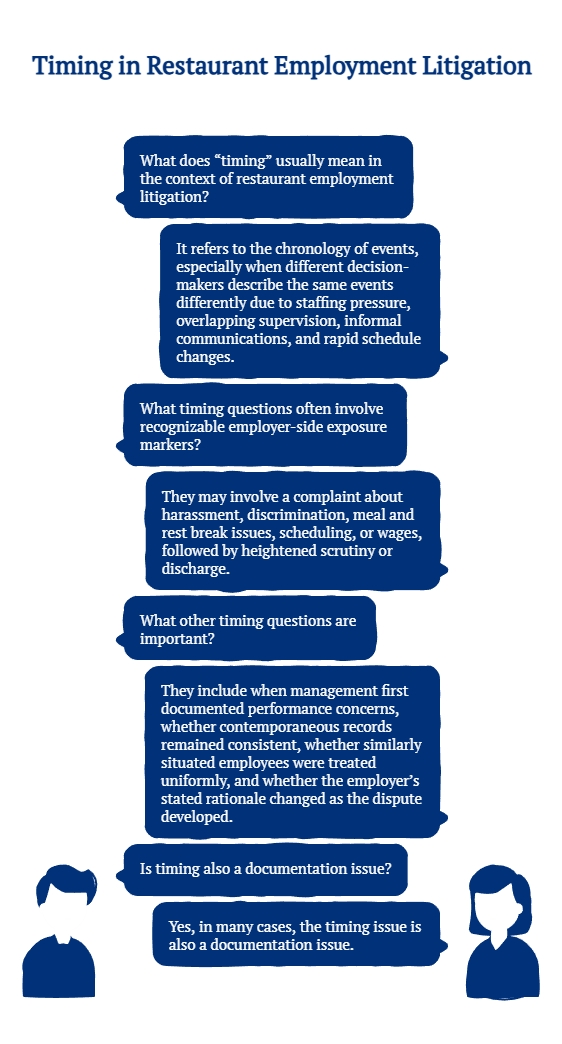
What “Timing” Usually Means in the Context of Restaurant Employment Litigation
In small restaurant operations, employment decisions may unfold in fast-moving environments shaped by staffing pressure, overlapping supervision, informal communications, and rapid schedule changes. Those conditions may make chronology more vulnerable to dispute once litigation begins. A restaurant owner may view a staffing adjustment as operationally necessary, a shift manager may describe it as routine discipline, and the plaintiff may later allege that the same sequence reflected retaliation or discrimination. In that kind of record, timing becomes important not simply because events occurred close together, but because different decision-makers may describe the same events differently.
Timing questions often involve recognizable employer-side exposure markers. The plaintiff may point to a complaint about harassment, discrimination, meal and rest break issues, scheduling, or wages, followed by heightened scrutiny or discharge. The complaint may also compare when management first documented performance concerns, whether contemporaneous records remained consistent, whether similarly situated employees were treated uniformly, and whether the employer’s stated rationale changed as the dispute developed. In many cases, the timing issue is also a documentation issue.
Why Complaint-to-Termination Timing Often Draws Heightened Scrutiny
A termination that follows workplace complaints may receive heightened scrutiny because the plaintiff may allege that the complaint was protected activity and that the discharge was retaliatory. Even when the employer asserts a legitimate business reason, close temporal proximity may still become one part of a broader causation argument. In employer-defense terms, that sequence may increase exposure to retaliation allegations and may place unusual pressure on whether management’s rationale appears contemporaneous, uniform, and supported by the record. That is one reason timing-related allegations often overlap with unlawful retaliation claims.
This issue may become more complicated when the alleged complaint was informal rather than formal. The plaintiff may rely on internal objections, workplace reports, or asserted protected activity that management did not initially treat as legally significant. Once protected activity enters the chronology, documentation and process obligations may receive greater scrutiny, especially if supervisors, owners, and managers did not frame or record events consistently.
Why Timing Questions Often Intersect with Motive, Causation, and Pretext
Timing matters because it may influence how a court, jury, or other trier of fact evaluates competing explanations. A plaintiff may argue that discipline intensified only after a complaint, that management explanations changed, or that established policy was not followed uniformly. The employer may argue that conduct, performance, attendance, or operational concerns predated the alleged protected activity. In that setting, timing becomes part of the dispute over motive, causation, and pretext rather than a standalone issue.
Pretext disputes often become sharper when the employer’s stated rationale appears inconsistent across supervisors, records, or policy application. Defensible decision-making is not measured only by whether a reason existed in the abstract. In litigation, the sequence of communications, the consistency of contemporaneous documentation, and the uniform application of established policies may all affect how the employer’s rationale is evaluated. Timing alone does not establish liability, but timing may shape how nearly every other fact is interpreted.
Why Timing Disputes Can Be Especially Complicated in Small Restaurant Operations
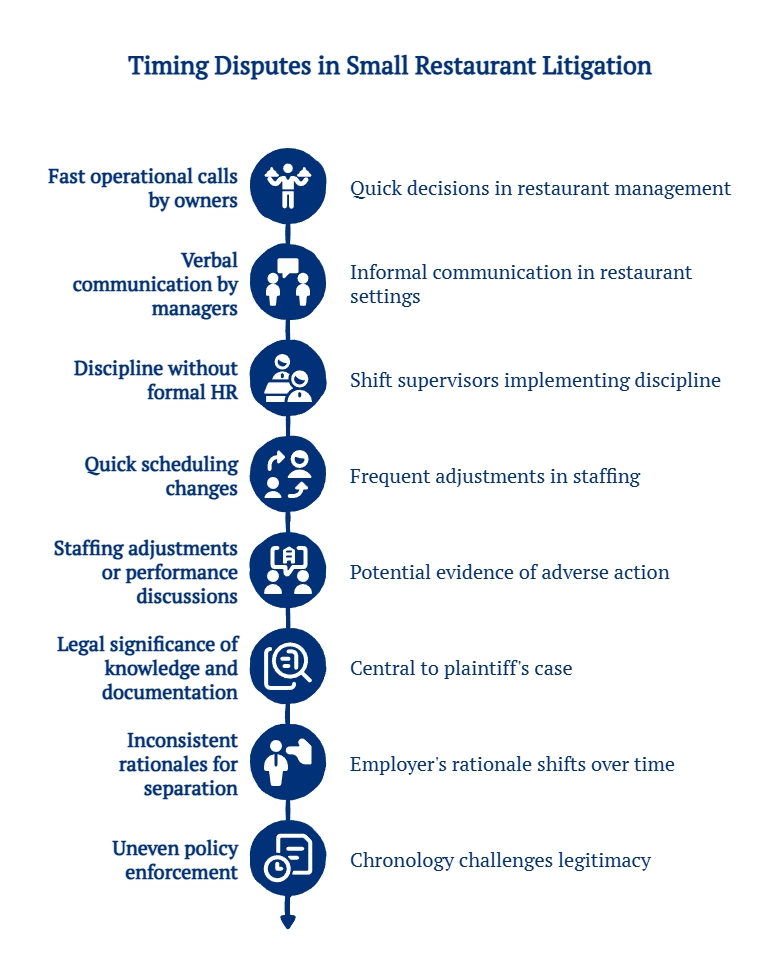
Restaurant workplaces often generate fact patterns that are especially vulnerable to timing-based credibility disputes. Owners may make fast operational calls, managers may communicate verbally, shift supervisors may implement discipline without formal HR layers, and scheduling decisions may change quickly. Ordinary staffing adjustments or performance discussions may later be cited as evidence that adverse action followed protected activity too closely. In that environment, the legal significance of who knew what, when they knew it, and how they documented it may become central to the plaintiff’s theory of the case.
That reality also explains why timing disputes in restaurant cases often become disputes about consistency. When one manager describes a separation as performance-based, another refers to attitude, and the written record points elsewhere, the plaintiff may argue that the employer’s rationale shifted over time. When policies appear to have been enforced unevenly, chronology may be used to challenge the legitimacy of the decision itself.
Why Timing Issues May Expand a Wrongful Termination Case into Overlapping Claims
Timing-related allegations rarely remain confined to one cause of action. A wrongful termination claim may be paired with retaliation, discrimination, harassment, leave-related, whistleblower, or wage-and-hour theories when the plaintiff alleges that the same chronology supports multiple claims. The same sequence may be cited to challenge motive, to argue causation, and to portray the employer’s rationale as pretextual. That is also why whistleblower retaliation issues or other overlapping theories may become part of the broader narrative in some disputes.
Why Timing-Centered Cases Create Immediate Pressure for Small Restaurant Employers
For small restaurant employers, timing-driven wrongful termination disputes may create serious business strain. Leadership attention may be diverted, operations may be disrupted, and reputational concerns may grow while the dispute expands beyond the termination decision itself. These cases are often fact-specific and expensive to defend because they may require close evaluation of when complaints were raised, how managers responded, whether documentation was contemporaneous and consistent, whether established policies were followed uniformly, and whether HR or counsel became involved early enough to frame the decision-making record clearly. Where the allegations are tied to wrongful termination, the pressure often comes from the combination of evidentiary scrutiny, overlapping claims, and leadership burden rather than from any single allegation alone.
Disclaimer:
This content is for informational purposes only. Laws, definitions, and deadlines change. Verify current requirements through official California sources. This content is not legal advice. No attorney-client relationship is formed through this content. Please consult a qualified attorney in your jurisdiction for legal advice specific to your situation.
Protect Your Business | The Akopyan Law Firm, A.P.C. | Top Gun Employment Lawyers
Have you been sued by an employee? Are you overwhelmed by the complexities of employment law? If so, give us a call. The Akopyan Law Firm, A.P.C. assists small business owners throughout Southern California. Our seasoned employment defense lawyers stand ready to help employers quickly and efficiently resolve employment disputes. We are ready to aggressively and skillfully defend against any employment case, but understand that in most situations avoiding the expense of litigation is in the client’s best interest.
Take the First Step Protecting Your Future: Call us today to speak with one of our experienced employment lawyers.
Contact Us Today:
- Phone: (818) 509-9975
Office Locations in California: Los Angeles, Bakersfield, Costa Mesa, Temecula, Rancho Cucamonga, Oxnard, Culver City, and San Diego.