

📌 Key Takeaways
Experienced employment defense counsel may matter early because wrongful termination disputes against small California medical practices often expand beyond one termination decision into overlapping, fact-intensive employment claims.
- Claims Rarely Stay Narrow: Wrongful termination allegations may overlap with retaliation, whistleblower, discrimination, leave, accommodation, or pregnancy-related theories tied to the same discharge.
- Timing And Consistency Matter: Plaintiffs often frame these disputes around causation, timing, comparative treatment, internal communications, and asserted pretext rather than one isolated event.
- Small Practices Face Unique Pressure: Leadership distraction, staffing disruption, discovery burden, and patient-facing operational strain may create outsized pressure even where liability is disputed.
- Credibility Can Drive Exposure: Performance history, disciplinary records, emails, texts, and policy application may become central when the trier of fact evaluates motive and consistency.
- Experience Shapes Early Judgment: Experienced employment defense counsel may better assess overlapping allegations, discovery risk, business disruption, and the true drivers of exposure.
One termination may open a much larger employer-side dispute when motive, timing, consistency, and overlapping statutory allegations all come into play.
Small medical practice employers facing active wrongful termination allegations will gain immediate clarity here, guiding them into the topic-specific details that follow.
~ ~ ~ ~ ~ ~ ~ ~ ~ ~ ~ ~ ~ ~ ~ ~ ~ ~
Experienced employment defense attorneys matter in wrongful termination cases against small medical practices in California because a single termination may trigger a dispute that is much broader than the separation itself. Under California law, generally, a wrongful termination claim may be pleaded together with retaliation, whistleblower retaliation, discrimination, job-protected leave, pregnancy discrimination, reasonable accommodation, or interactive process allegations when the employee claims that the same employment decision violated multiple legal protections. For a small medical practice, that overlap may increase potential exposure, widen the factual dispute, and place immediate pressure on operations, leadership time, and internal staff relationships.
Distinctive Form Of Employment Risk
Small medical practices often face a distinctive form of employment risk because owners, physicians, administrators, managers, and supervisors usually work in close proximity to employees and often make decisions without the layered structure found in larger organizations. In litigation, that reality may concentrate attention on a small number of decision-makers, a short sequence of events, and a limited set of emails, messages, evaluations, write-ups, or conversations. A plaintiff may argue that those materials show pretext, retaliatory motive, or inconsistent treatment. The employer may deny that characterization, but the dispute may still turn on whether the practice’s explanation remains consistent across witnesses, documents, and policy application.
Business Consequences Of A Wrongful Termination Claim
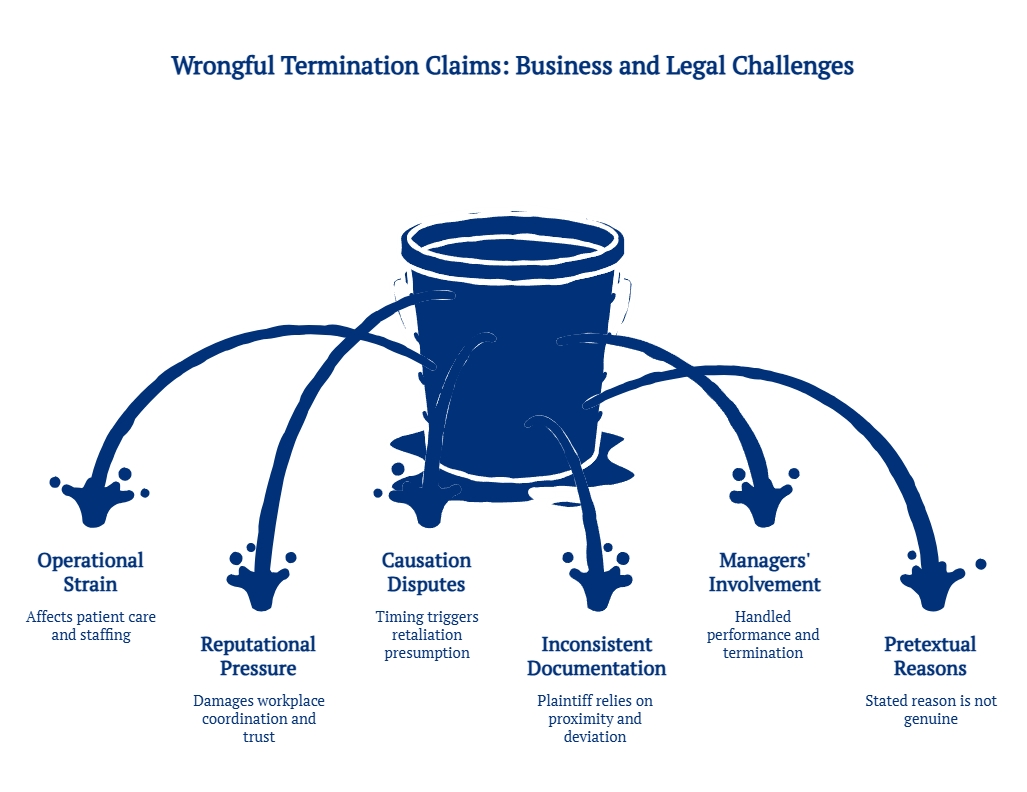
The medical-practice setting may also magnify the business consequences of a wrongful termination claim. Patient scheduling, call coverage, continuity of care, supervision, and day-to-day staffing may all be affected when practice leadership is pulled into a legal dispute. That is one reason these cases may involve more than legal expense alone. They may also create operational strain, reputational pressure, and internal employee-relations concerns inside a workplace that depends on coordination and trust.
Wrongful termination cases also tend to become causation disputes. The question is often not limited to whether employment ended. The question often centers on whether the stated business reason is consistent with the record and whether the timing of the employment decision triggers a rebuttable presumption of retaliation. Under California Labor Code sections 98.6, 1102.5, and 1197.5 (as amended by SB 497), if an employer takes adverse action against an employee within 90 days of certain protected activities, a move toward retaliation is or may be presumed, shifting the initial burden to the employer to articulate a legitimate, non-retaliatory reason. This statutory presumption makes timing a decisive legal hurdle rather than a mere point of inference.
For example, a plaintiff may rely on proximity between protected activity and termination, inconsistent documentation, deviation from stated policy, shifting explanations, or unequal treatment of similarly situated employees. In a medical practice, those issues may be especially significant where the same managers who handled performance concerns, leave-related discussions, accommodation issues, or internal complaints also participated in the termination decision.
That is why contemporaneous, consistent documentation may carry legal significance in employer-side disputes, even though documentation alone does not decide a case. A practice may believe it acted for a legitimate business reason, yet a plaintiff may still contend that the record does not support that explanation. If performance concerns appear only after protected activity, if evaluations conflict with the stated reason for discharge, or if the practice applied a policy unevenly, the trier of fact may scrutinize whether the stated reason is genuine or pretextual. From an employer-defense perspective, the dispute often turns on whether the employment decision appears defensible considering the full record, not merely whether the decision can be described as facially lawful.
Job-Protected Activities
The same is true when the case involves protected status or protected activity. Once an employee reports possible wrongdoing, requests job-protected leave, raises discrimination concerns, seeks reasonable accommodation, or triggers the interactive process, the legal context may change materially. A later termination may then be examined not as an isolated staffing decision, but as part of a chronology that the plaintiff says reflects retaliation, interference, disability-related conflict, or another statutory violation. That does not mean the plaintiff’s theory is correct. It does mean that timing, communication, policy consistency, and decision-making rationale may receive closer scrutiny.
Why Employment Defense Attorney May Matter
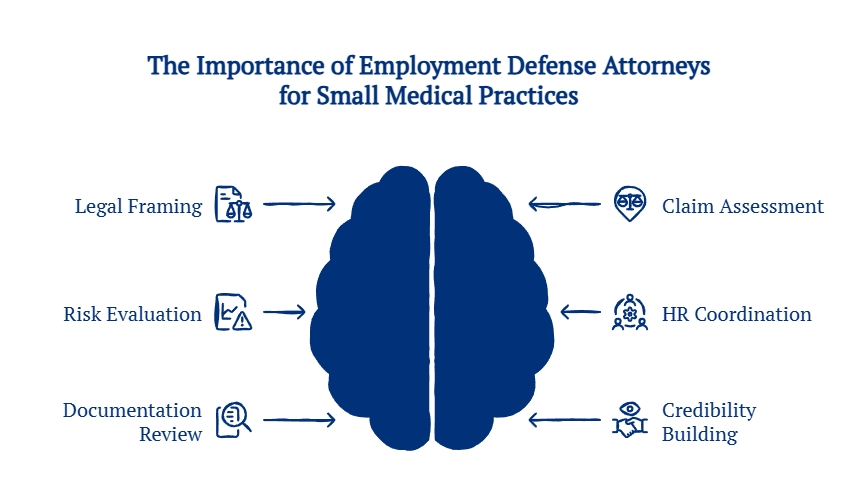
Experienced employment defense attorney may matter in that setting because California employer-side disputes often require disciplined legal framing, careful assessment of overlapping claims, and realistic evaluation of business risk. Attorney experienced in wrongful termination, retaliation, whistleblower, leave, and accommodation litigation may be better positioned to identify which legal theories are driving the dispute and which factual issues may receive the greatest scrutiny. That judgment may be especially important for self-funded small employers, because prolonged litigation, diffuse decision-making, and reactive case handling may increase cost and disruption even before the merits are resolved. The employer-side materials provided by the firm emphasize focused representation, direct attorney involvement, and efficient handling of serious employment disputes affecting smaller businesses.
Early involvement of HR, where available, and employment counsel may also matter because defensible decision-making in a sensitive employment matter often depends on consistency across the people who communicate, supervise, document, and make final decisions. In a small medical practice, that coordination may be harder to achieve because one administrator or physician may wear multiple roles. That practical reality is one reason wrongful termination disputes may expand quickly once filed.
For small medical practice employers, the larger point is straightforward. A wrongful termination case may challenge more than one separation decision. It may challenge the practice’s chronology, documentation, policy application, communication, and credibility. Experienced employment defense attorneys may therefore matter not only because California employment law is complex, but because a defensible employment decision often depends on how the full record appears when protected activity, protected status, or overlapping statutory claims are placed at issue.
Disclaimer:
This content is for informational purposes only. Laws, definitions, and deadlines change. Verify current requirements through official California sources. This content is not legal advice. No attorney-client relationship is formed through this content. Please consult a qualified attorney in your jurisdiction for legal advice specific to your situation.
Protect Your Business | The Akopyan Law Firm, A.P.C. | Top Gun Employment Lawyers
Have you been sued by an employee? Are you overwhelmed by the complexities of employment law? If so, give us a call. The Akopyan Law Firm, A.P.C. assists small business owners throughout Southern California. Our seasoned employment defense lawyers stand ready to help employers quickly and efficiently resolve employment disputes. We are ready to aggressively and skillfully defend against any employment case, but understand that in most situations avoiding the expense of litigation is in the client’s best interest.
Take the First Step Protecting Your Future: Call us today to speak with one of our experienced employment lawyers.
Contact Us Today:
- Phone: (818) 509-9975
Office Locations in California: Los Angeles, Bakersfield, Costa Mesa, Temecula, Rancho Cucamonga, Oxnard, Culver City, and San Diego.