

📌 Key Takeaways
For small restaurant employers in California, defending a wrongful termination lawsuit may cost far more than legal fees because the dispute may expand into motive, timing, records, and management scrutiny.
- Costs Go Beyond Fees: Defense costs may include leadership distraction, operational strain, reputational pressure, and business uncertainty, not just hourly billing and litigation expense.
- Timing Draws Scrutiny: When termination allegedly follows protected activity, timing may become part of the plaintiff’s causation narrative and increase the burden of defense.
- Records Shape Exposure: Emails, texts, disciplinary history, scheduling changes, and supervisor communications may become part of the factual record and pretext analysis.
- Multiple Theories Multiply Risk: A wrongful termination dispute may widen into retaliation, whistleblower, discrimination, or leave-related allegations, increasing complexity, cost, and exposure.
- Leadership Time Has Value: Owners, managers, and supervisors may become central witnesses, and that operational diversion may be one of the most expensive business consequences.
Defense cost = legal expenses plus operational disruption, document scrutiny, and pressure on leadership.
Small restaurant employers facing active California employment disputes will gain immediate clarity here, guiding them into the wrongful-termination-specific details that follow.
~ ~ ~ ~ ~ ~ ~ ~ ~ ~ ~ ~ ~ ~ ~ ~ ~ ~
For small restaurant employers in California, the cost of defending a wrongful termination lawsuit often includes far more than attorney billing. In many disputes, the plaintiff alleges that the employer’s stated reason for discharge was pretextual, retaliatory, discriminatory, or otherwise unlawful. Once that happens, the dispute may expand into a broader examination of motive, causation, timing, comparative treatment, supervisor communications, and management decision-making. For an owner-operated restaurant or closely held business, that level of scrutiny may create legal expense, operational disruption, leadership strain, and reputational pressure at the same time.
Why Wrongful Termination Litigation Can Be Especially Burdensome for Small Restaurant Employers
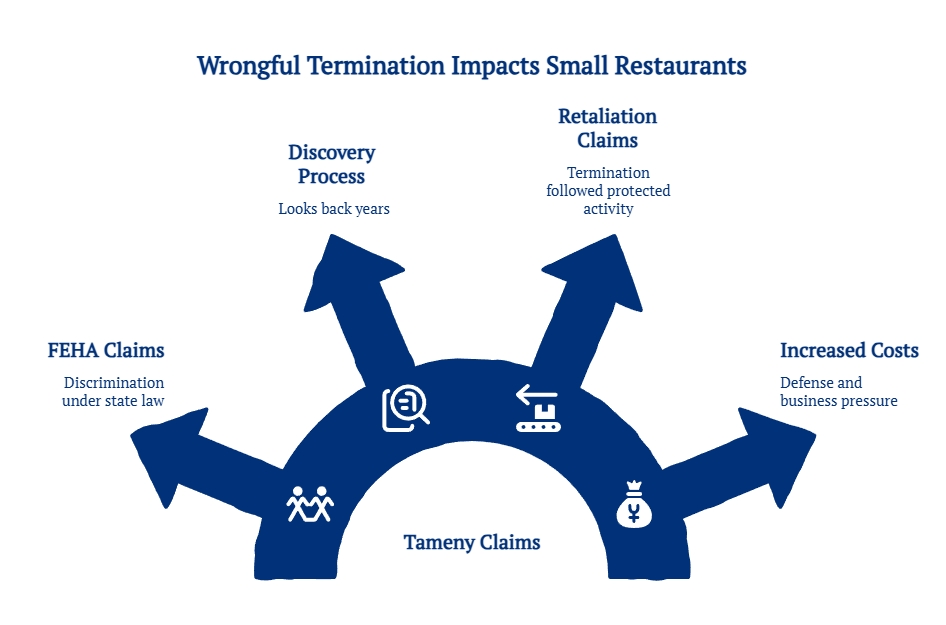
Under California law, wrongful termination disputes, specifically ‘Tameny’ claims (wrongful discharge in violation of public policy) and statutory claims under the Fair Employment and Housing Act (FEHA), frequently extend their factual scope well beyond the final separation decision. While common law Tameny claims apply to almost all employers regardless of size, statutory discrimination claims under FEHA generally require the employer to have five or more employees. Consequently, the legal discovery process often looks back years into the employment history to establish patterns of conduct. The complaint may allege that a termination followed protected activity, such as a workplace complaint involving wages, breaks, harassment, discrimination, leaves of absence, or safety concerns. In that setting, the plaintiff may try to frame the discharge as part of a retaliation claim, a discrimination theory, or a broader pretext narrative.
For small restaurant employers, that framing may be especially difficult to contain. A restaurant owner, operating manager, shift supervisor, or member of company leadership may have played a direct role in the events that now receive scrutiny. In practice, the same people who oversee staffing, service quality, customer issues, and daily operations may also become central witnesses in the dispute. That overlap may increase both the cost of defense and the pressure on the business.
Legal Fees Are Only One Part of the Total Business Cost
Legal fees may become substantial in wrongful termination litigation, particularly where the allegations require written discovery, motion practice, depositions, extensive document review, or analysis of overlapping legal theories. Even so, hourly billing usually reflects only one part of the total burden.
The larger cost may come from the business consequences of active litigation. Owners and managers may need to spend time reviewing records, reconstructing conversations, and explaining why a termination decision was made when it was made. Management may also need to revisit emails, text messages, disciplinary records, scheduling changes, complaint history, and communications among supervisors. For a small restaurant employer, that time may come directly from operations, employee oversight, vendor coordination, and customer-facing responsibilities.
Owner Time, Manager Time, and Operational Disruption Can Become Major Expenses
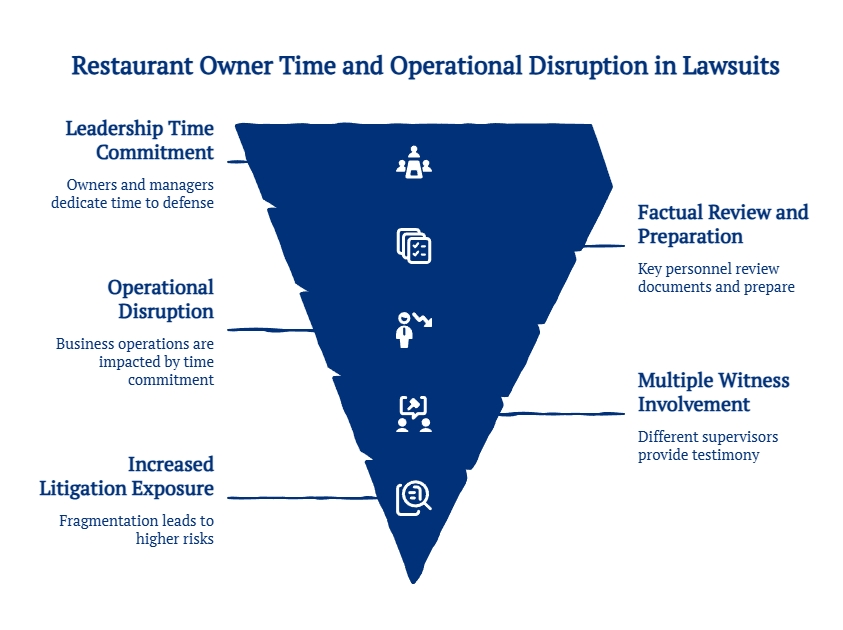
In many restaurant businesses, leadership time is one of the least replaceable resources. A lawsuit may require restaurant owners, operators, supervisors, and managers to participate in repeated meetings, factual review, and preparation connected to the defense. Even where the employer maintains that the discharge was based on a legitimate business reason, the process of defending that decision may become expensive because key decision-makers are also responsible for keeping the business running.
That burden may become heavier when different supervisors handled different parts of the employment relationship. One manager may have addressed performance concerns. Another may have responded to a complaint. A business owner may have approved the final termination decision. As a result, the dispute may involve multiple witnesses, multiple communications, and multiple explanations that the plaintiff may attempt to compare for inconsistency. For a small restaurant employer, that kind of fragmentation may increase both operational strain and litigation exposure.
Review of Records, Communications, Timing, and Competing Narratives Can Increase the Burden of Defense
Wrongful termination cases often become fact-intensive because the dispute may center on whether the employer’s stated reason was consistent with the broader factual record. A court, jury, or agency may evaluate not only the stated rationale for discharge, but also whether earlier communications, disciplinary history, policy application, and management conduct align with that rationale.
Timing remains a strategic focal point in California courts, where ‘temporal proximity’ can be sufficient to establish a prima facie case of retaliation. Even if an employer provides a legitimate, non-discriminatory reason for the discharge, a short interval between a protected act (like requesting a rest break or reporting a safety hazard) and the termination can create a ‘triable issue of fact.’ This often prevents the employer from winning the case early through a Motion for Summary Judgment, forcing the business into expensive trial preparation or a higher settlement. Timing issue does not decide the case by itself, but it may increase scrutiny when combined with alleged inconsistencies, shifting explanations, uneven policy enforcement, or informal supervisor communications.
A brief illustration shows why the cost may rise so quickly. A restaurant employer terminates an employee after management identifies a legitimate business concern. The later complaint alleges that the discharge followed a protected complaint and that the employer’s explanation was not the true reason for the decision. In that setting, the dispute may expand from a single termination event into a broader credibility contest involving motive, causation, timing, and pretext.
Overlapping Allegations Can Increase Litigation Complexity and Expense
A wrongful termination claim often does not remain isolated. Depending on the allegations, a single complaint often leverages California Labor Code § 1102.5 (the general whistleblower protection statute), which carries a high burden for employers to rebut by ‘clear and convincing evidence’. Furthermore, wrongful termination suits in the California restaurant industry are increasingly paired with representative actions under the Private Attorneys General Act (PAGA). This overlap allows a single termination dispute to balloon into a multi-plaintiff audit of the restaurant’s entire payroll and break history, dramatically increasing defense complexity and potential settlement values.
Why Small Restaurant Employers Often Need Experienced California Defense Attorney Early
At a high level, the business cost of defending a wrongful termination lawsuit often includes legal expenses, management distraction, review of internal records and communications, reputational strain, and uncertainty that affects day-to-day operations. For small restaurant employers, those pressures may be intensified by lean management structures, informal workplace communications, and the fact that owners and supervisors are often deeply involved in the events that later become part of the litigation record.
Experienced California defense attorneys often matter early in this setting because active disputes may escalate quickly, and the issues under review may extend far beyond the termination itself to motive, causation, pretext, policy application, and the defensibility of management decision-making.
Disclaimer:
This content is for informational purposes only. Laws, definitions, and deadlines change. Verify current requirements through official California sources. This content is not legal advice. No attorney-client relationship is formed through this content. Please consult a qualified attorney in your jurisdiction for legal advice specific to your situation.
Protect Your Business | The Akopyan Law Firm, A.P.C. | Top Gun Employment Lawyers
Have you been sued by an employee? Are you overwhelmed by the complexities of employment law? If so, give us a call. The Akopyan Law Firm, A.P.C. assists small business owners throughout Southern California. Our seasoned employment defense lawyers stand ready to help employers quickly and efficiently resolve employment disputes. We are ready to aggressively and skillfully defend against any employment case, but understand that in most situations avoiding the expense of litigation is in the client’s best interest.
Take the First Step Protecting Your Future: Call us today to speak with one of our experienced employment lawyers.
Contact Us Today:
- Phone: (818) 509-9975
Office Locations in California: Los Angeles, Bakersfield, Costa Mesa, Temecula, Rancho Cucamonga, Oxnard, Culver City, and San Diego.