

📌 Key Takeaways
- A termination soon after a request for reasonable accommodation or a request for job-protected CFRA/FMLA leave may warrant legal scrutiny because timing can implicate statutory duties and prohibitions.
- Timing alone rarely establishes an unlawful employment practice. Attorneys typically evaluate timing together with documents, communications, and the employer’s stated reasons.
- Common indicators reviewed in practice include temporal proximity, inconsistent rationale, interactive-process breakdown, request-linked hostility, and potential interference with leave rights.
- Because these issues are fact-specific, a qualified California employment attorney typically reviews the sequence, the record, and the applicable statutes.
A termination that occurs soon after an employee requests reasonable accommodation or requests job-protected CFRA or FMLA leave can create a timeline that attorneys often scrutinize. Timing alone does not establish a violation of the law, but it may raise questions about whether statutory duties were met and whether protected rights played a role in the decision.
~ ~ ~ ~ ~ ~ ~ ~ ~ ~ ~ ~ ~ ~ ~ ~ ~ ~
Under California law, the Fair Employment and Housing Act (FEHA) addresses reasonable accommodation, undue hardship, and an employer’s duty to engage in a timely, good-faith interactive process. [Cal. Gov. Code § 12940(m) and Cal. Gov. Code § 12940(n)]
Under federal law, the Americans with Disabilities Act (ADA) addresses reasonable accommodation and undue hardship and often provides baseline language used as context in California disputes. 42 U.S.C. § 12112(b)(5)(A).
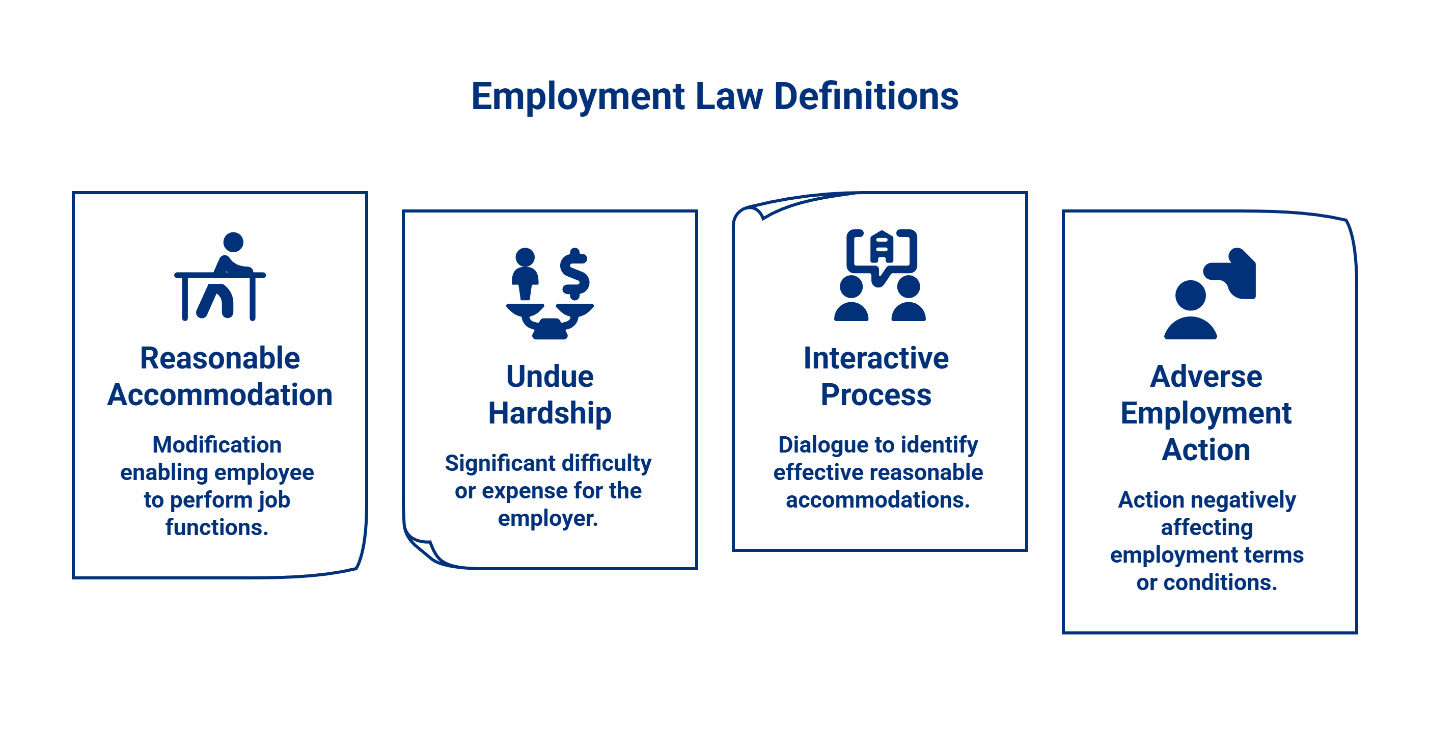
Definitions:
- Reasonable accommodation refers to a modification or adjustment that enables a qualified employee with a disability to perform essential job functions, absent undue hardship.
- Undue hardship refers to significant difficulty or expense under the applicable legal standard, assessed case-by-case.
- Interactive process refers to a timely, good-faith dialogue between employer and employee to identify effective reasonable accommodations.
- Adverse employment action refers to an action that negatively affects the terms or conditions of employment, including termination.
When a termination follows an accommodation request, attorneys often examine whether the employer engaged in the interactive process and whether the employer’s stated rationale is consistent with the record.
CFRA and FMLA as Distinct Statutory Schemes That Can Overlap
The California Family Rights Act (CFRA) is a California law, and the Family and Medical Leave Act (FMLA) is a federal law. In some circumstances, an employee’s leave may be covered by both laws, but the laws remain distinct.
Under California law, CFRA addresses discharge or discrimination tied to the exercise of CFRA rights. [Cal. Gov. Code § 12945.2(k]. CFRA also addresses interference, restraint, or denial of CFRA rights. [Cal. Gov. Code § 12945.2(q)].
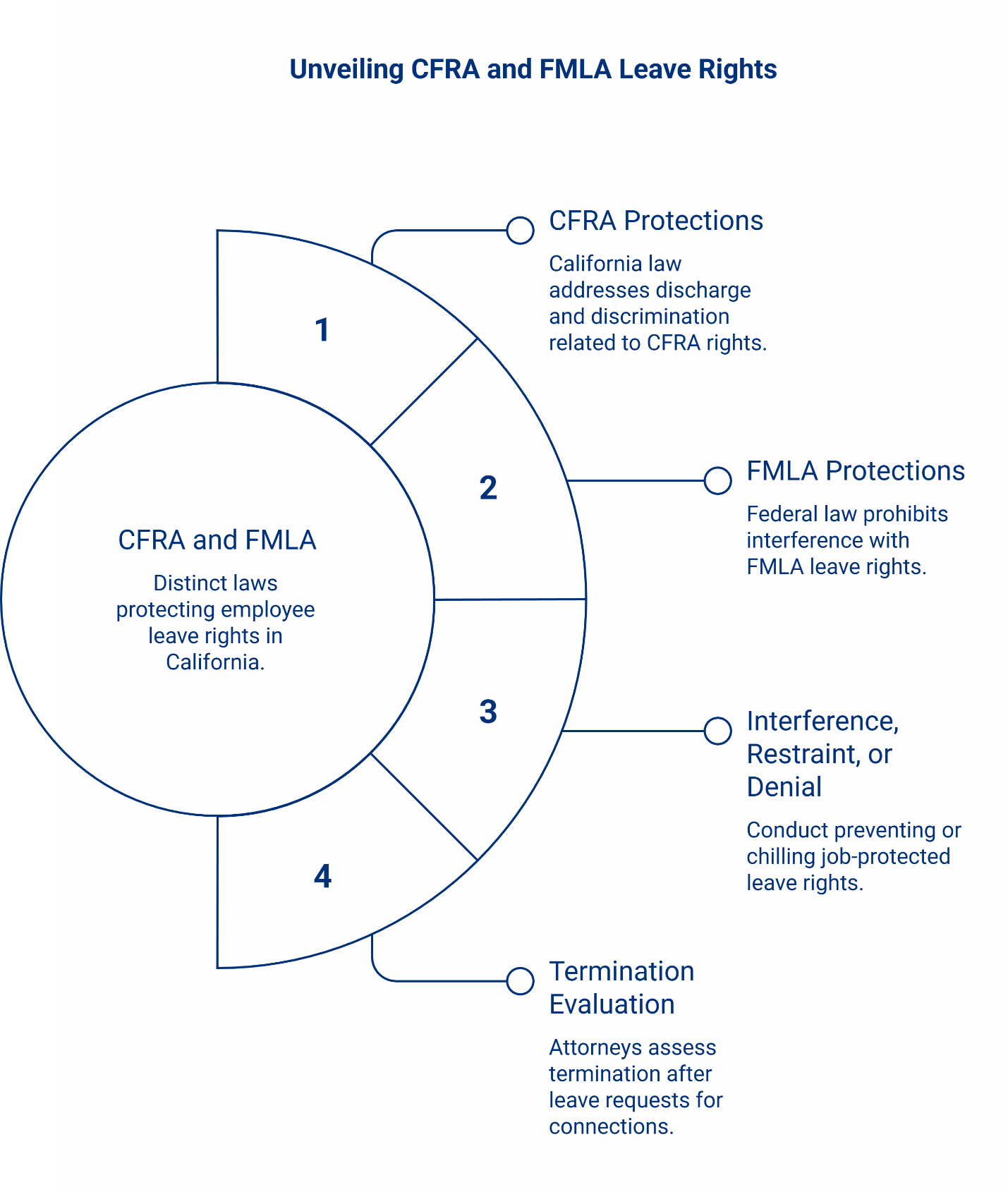
Under federal law, the FMLA includes prohibited-act language that uses an interference, restraint, or denial framework. 29 U.S.C. § 2615(a).
The phrase “interference, restraint, or denial of rights” generally describes conduct the law may treat as improper when it prevents or chills job-protected leave rights under the applicable statute.
When a termination follows a request for job-protected leave, attorneys often evaluate the sequence, the employer’s stated reasons, and whether the leave request (or leave status) appears connected to the adverse action.
Common Patterns Attorneys Evaluate
An employee may feel surprised when an employer terminates employment soon after an accommodation request or a request for job-protected leave instead of engaging in discussion. Many employees look for clarity about what timing may mean in legal terms. Employment attorneys in California often evaluate objective features of the sequence, including:
- Temporal proximity: A short time gap between a request and termination.
- Inconsistent rationale: Materially shifting explanations, or reasons that conflict with earlier written or verbal communications.
- Interactive-process breakdown: A failure to engage in a timely, good-faith interactive process after an accommodation request leading to failure-to-engage claim under FEHA. [Cal. Gov. Code § 12940(n)].
- Request-linked hostility: Negative treatment that appears tied to the family medical request, which may be relevant to a retaliation analysis depending on the facts and the statute at issue.
- Potential interference, restraint, or denial of leave rights: Conduct that resembles interference with job-protected leave and tracks the statutory framing in [Cal. Gov. Code § 12945.2(q)] and 29 U.S.C. § 2615(a).
These patterns are illustrative rather than exhaustive. When multiple indicators appear together, attorneys may evaluate whether the timing supports an inference of retaliation, interference, or failure to engage in the interactive process, depending on the record.
A fact-specific evaluation typically requires review by a qualified California employment attorney because statutory duties operate through details, documentation, and context.
Hypothetical Examples
Example A (interactive process): An employee provides a doctor’s note requesting a modified schedule and lifting restriction. The employer ends the discussion after one brief meeting, does not explore alternative adjustments, and issues a termination letter two weeks later citing “attendance” without addressing the restriction. Different facts can change the analysis.
Example B (CFRA concept): An employee submits a written request for job-protected CFRA leave to care for a family member, including proposed leave dates. Within days, the employee receives a new disciplinary write-up that conflicts with prior positive evaluations, and the employer later provides shifting explanations for termination. Different facts can change the analysis.
Example C (overlap concept): An employee requests workplace accommodation and also requests time away that may qualify as job-protected leave. After the requests, the employee’s hours are reduced and the employee is terminated shortly after returning. Depending on the facts, FEHA, CFRA, the FMLA, or multiple frameworks may be implicated. Different facts can change the analysis.
Limits and Caveats
A termination can involve performance concerns, policy enforcement, layoffs, or other explanations that the law may treat as legitimate depending on context. Timing can be relevant, but it rarely answers the legal question by itself.
FEHA and CFRA use “unlawful employment practice” as statutory terminology, but whether conduct meets that label depends on the specific facts and the governing legal standard.
Disclaimer:
This content is for informational purposes only. Laws, definitions, and deadlines change. Verify current requirements through official California sources. This content is not legal advice. No attorney-client relationship is formed through this content. Please consult a qualified attorney in your jurisdiction for legal advice specific to your situation.
Protect Your Rights | The Akopyan Law Firm, A.P.C. | Top Gun Employment Lawyers
Have you been wrongfully terminated from your job? Have you suffered discrimination, harassment, or retaliation in the workplace? Has your employer violated wage and hour laws? If so, we can help. The Akopyan Law Firm, A.P.C. is dedicated to protecting and enforcing employees’ rights throughout Southern California. With a 97% success rate and millions recovered for our clients, our team of experienced and talented employment lawyers can fight to secure the justice you deserve.
Take the First Step Towards Securing Justice: Call us today to speak with one of our experienced employment lawyers. The firm offers case evaluations free of charge.
Contact Us Today:
- Phone: (818) 509-9975
- Office Locations: Los Angeles, Bakersfield, Costa Mesa, Temecula, Rancho Cucamonga, Oxnard, Culver City, and San Diego in California.
Important: Contacting the Akopyan Law Firm, A.P.C. does not create an attorney-client relationship, but all communications will remain private and confidential. Each case is unique. The Akopyan Law Firm, A.P.C., does not guarantee any outcome.