Public policy wrongful termination claims can create serious exposure for California restaurant employers because the plaintiff may allege that the discharge violated a fundamental public policy reflected in California law. In practice, the dispute often extends beyond the separation itself. The complaint may focus on what the employee allegedly did before the termination, what management knew, how the stated reason was communicated, and whether the timing permits an inference of improper motive.
Why Public Policy Can Become the Basis of a Termination Claim
Under California law, generally, a public policy wrongful termination claim may arise when a plaintiff alleges that an employer discharged an employee for a reason that contravenes an important public policy embodied in statute, regulation, or constitutional principle. In that setting, the termination is not viewed only as an internal employment decision. The plaintiff may frame it as a decision that allegedly conflicts with a policy California treats as fundamental.
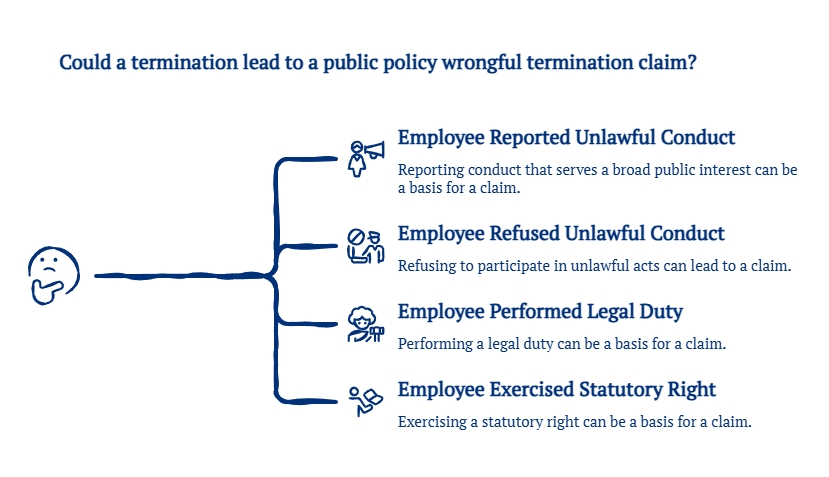
The complaint may assert, for example, that the employee was terminated after reporting suspected unlawful conduct that serves a broad public interest rather than a purely private one, refusing to participate in conduct the employee believed was unlawful, performing a legal duty, or exercising a statutory right. Under California law, a ‘Tameny’ claim requires that the policy in question must ensure the benefit of the public at large, rather than serving merely the interests of the individual employee or employer. Depending on the facts, that theory may place the employer’s motive, causation, and stated rationale at the center of the dispute.
Why Restaurant Employers Often Face Fact-Intensive Exposure
Restaurant employers operate in fast-moving workplaces where multiple supervisors may interact with the same employee, staffing decisions may develop quickly, and management communications may be informal. In many disputes, those features can create credibility issues once a plaintiff challenges a termination as violating public policy.
For example, a plaintiff may point to proximity between a workplace complaint and the discharge, a shift in the employer’s stated explanation, or a departure from how similar conduct was handled before. A plaintiff may also rely on inconsistent documentation, uneven policy application, or conflicting management accounts to argue that the stated reason was pretextual. Even where the employer asserts a legitimate business reason, the trier of fact may evaluate whether the surrounding facts support that position in a consistent and defensible way.
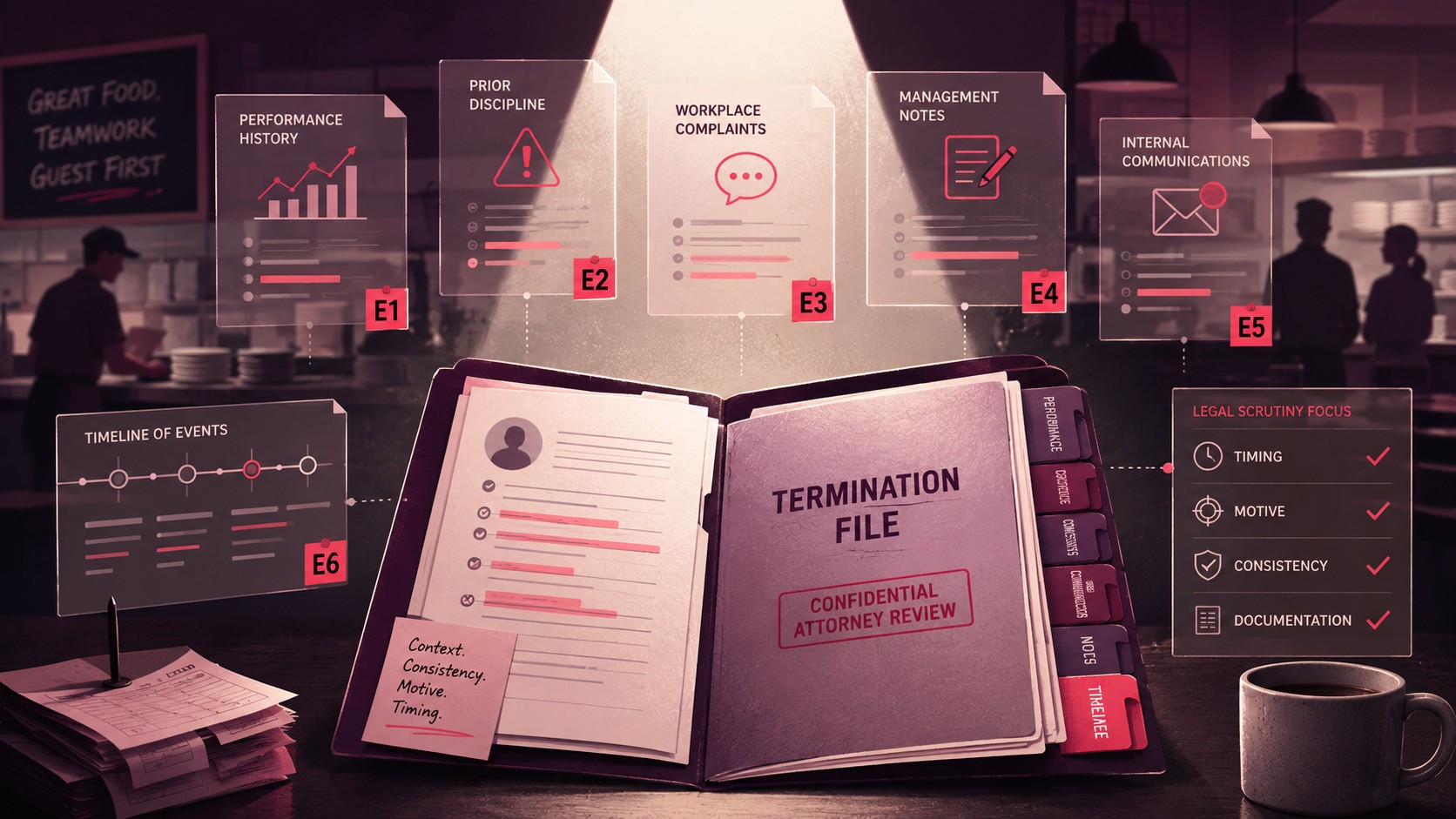
That is one reason restaurant-employer disputes often become more complicated than the underlying termination decision initially appeared. A single discharge may lead to scrutiny of performance history, prior discipline, internal communications, and whether management applied the same standards uniformly across employees. In that context, wrongful termination exposure may turn less on labels and more on how the facts are framed in the litigation.
The Allegations That Commonly Appear in These Cases
In many cases, the plaintiff does not rely on public policy theory alone. The complaint may pair a public-policy wrongful termination claim with retaliation, whistleblower, discrimination, leave-related, or wage-and-hour allegations. That overlap can increase complexity because the same sequence of events may be used to support several legal theories at once.
For restaurant employers, that overlap matters because workplace disputes often arise in settings involving payroll concerns, break-related complaints, safety issues, scheduling disputes, leave concerns, or management conduct. The article does not suggest that every such complaint creates liability. It does mean that once a plaintiff alleges protected activity or protected conduct, the termination decision may receive greater scrutiny as part of a broader employment dispute. Related exposure may also intersect with unlawful retaliation and, in some disputes, whistleblower retaliation.
Why Motive, Timing, and Consistency Often Become Central
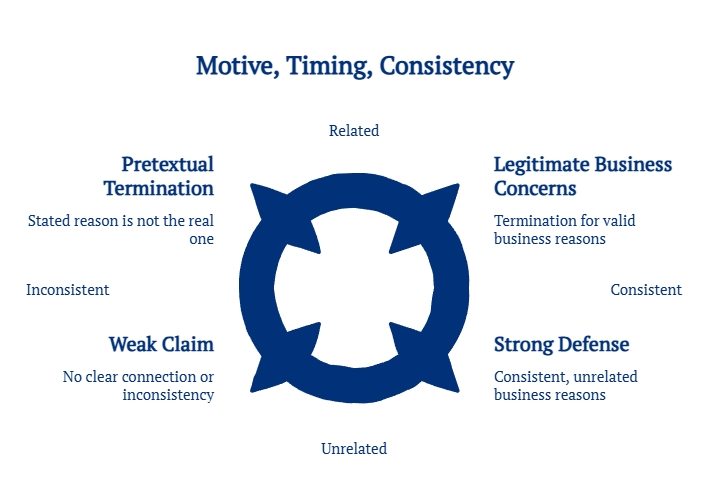
From an employer-defense perspective, these claims often turn on causation. The plaintiff may argue that the timing of the discharge, the sequence of management decisions, or the way the reason for termination changed over time supports an inference that the stated rationale was not the real one. By contrast, the employer may argue that the termination resulted from legitimate business concerns unrelated to any alleged protected conduct.
In that setting, consistency often becomes a major issue. A plaintiff may emphasize differences between written records and later testimony, variations in how supervisors described the decision, or departures from established policy. The legal significance of timing may also become more pronounced where the termination closely followed a complaint, a refusal to engage in allegedly unlawful conduct, or another event the plaintiff characterizes as protected. None of those facts is automatically dispositive. Even so, they often shape how a court, jury, or agency evaluates motive and pretext.
Why These Claims Can Create Immediate Business Pressure
Public policy wrongful termination disputes may affect more than the pleadings. For small or closely held restaurant businesses, the claim may create management distraction, reputational stress, and operational pressure at the same time. Owners, operators, and company leadership may need to address document demands, witness issues, and litigation communications while continuing to run daily service operations.
That burden can be especially significant where the dispute involves multiple supervisors, overlapping legal theories, or allegations that call the employer’s decision-making into question. In many cases, the business pressure comes not only from the legal theory itself, but also from the amount of time and attention required to defend the termination as a coherent, non-pretextual, and factually supported decision.
Why Defense-Side Legal Review Often Matters
At a high level, public policy wrongful termination claims can be difficult for restaurant employers because they combine legal doctrine, factual narrative, and business disruption in the same dispute. A termination that management viewed as routine may later be framed as retaliatory, pretextual, or contrary to an important public policy recognized by California law. In active disputes, that kind of allegation often warrants prompt defense-side legal review by experienced employment attorneys, particularly where the complaint involves protected activity, disputed motive, inconsistent records, or closely timed events.
Disclaimer:
This content is for informational purposes only. Laws, definitions, and deadlines change. Verify current requirements through official California sources. This content is not legal advice. No attorney-client relationship is formed through this content. Please consult a qualified attorney in your jurisdiction for legal advice specific to your situation.
Protect Your Business | The Akopyan Law Firm, A.P.C. | Top Gun Employment Lawyers
Have you been sued by an employee? Are you overwhelmed by the complexities of employment law? If so, give us a call. The Akopyan Law Firm, A.P.C. assists small business owners throughout Southern California. Our seasoned employment defense lawyers stand ready to help employers quickly and efficiently resolve employment disputes. We are ready to aggressively and skillfully defend against any employment case, but understand that in most situations avoiding the expense of litigation is in the client’s best interest.
Take the First Step Protecting Your Future: Call us today to speak with one of our experienced employment lawyers.
Contact Us Today:
- Phone: (818) 509-9975
Office Locations in California: Los Angeles, Bakersfield, Costa Mesa, Temecula, Rancho Cucamonga, Oxnard, Culver City, and San Diego.