📌 Key Takeaways
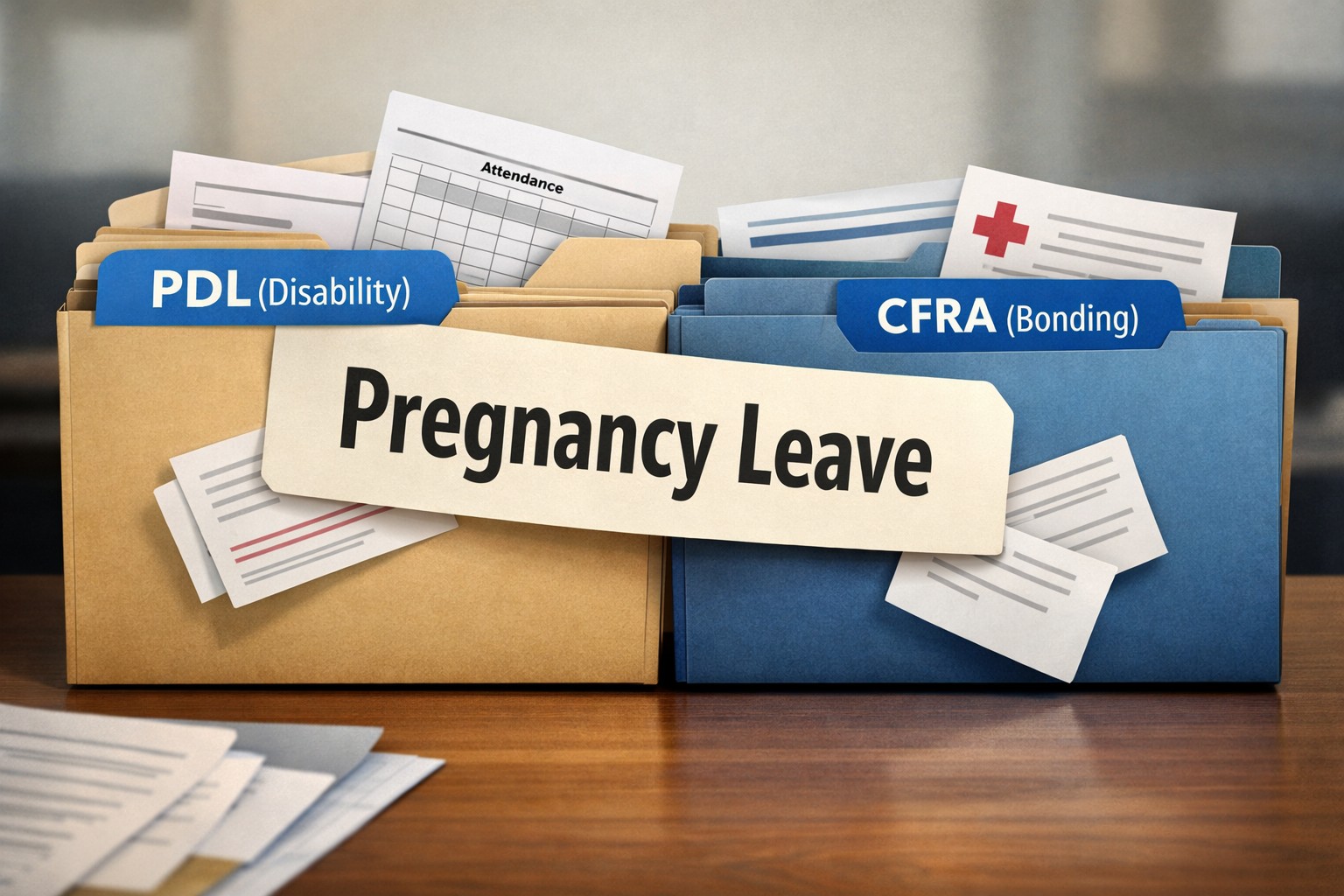
Confusion between the informal workplace phrase “pregnancy leave” and California’s distinct legal protections—Pregnancy Disability Leave (PDL) and CFRA child bonding leave—can affect reasonable accommodation discussions, attendance records, and how an employer documents discipline or termination decisions.
- Workers may use the phrase “pregnancy leave” to describe pregnancy-related disability, childbirth recovery, bonding time, or employer-provided benefits, which can obscure which job-protected rights apply in a particular situation.
- PDL applies when an employee is disabled by pregnancy, childbirth, or a related medical condition and cannot perform essential functions safely, and it can provide up to four months of leave per pregnancy
- CFRA provides job-protected child bonding leave to bond with a new child and is legally distinct from disability leave, even when taken immediately after pregnancy-related disability ends.
- When employer labels all leave as generic “maternity leave,” attendance tracking, performance documentation, and termination paperwork may fail to reflect that some absences were pregnancy-disability-related and potentially protected by PDL.
Clear terminology helps align workplace records and decisions with California’s rules on pregnancy-related disability leave, accommodation duties, and bonding leave.
~ ~ ~ ~ ~ ~ ~ ~ ~ ~ ~ ~ ~ ~ ~ ~ ~ ~
In many California workplaces, people use “pregnancy leave” as a catch-all phrase. Under California law, that phrase can refer to more than one legal protection, including Pregnancy Disability Leave (PDL) and CFRA job-protected child bonding leave.
What workers often mean when they say “pregnancy leave”
In practice, “pregnancy leave” may refer to several different situations rather than a single legal category, including:
- Time away from work before birth because pregnancy-related symptoms make it unsafe to perform essential functions.
- Time away from work for labor, delivery, and medically necessary recovery after childbirth (which may be covered by PDL when the employee is medically disabled during that period).
- Ongoing time away from work after childbirth when a pregnancy-related medical condition continues and the employee still cannot perform essential functions safely.
- Time away from work after recovery to bond with a new child.
- An employer policy labeled “maternity leave” or “pregnancy leave,” even when that policy combines statutory rights, paid benefits, and internal programs.
Because the same phrase may be used for disability-related leave, bonding leave, and employer-provided benefits, a worker may not know whether the situation is primarily a PDL designation issue, a CFRA bonding issue, a reasonable accommodation issue, or a combination of these.
What Pregnancy Disability Leave (PDL) means under California law
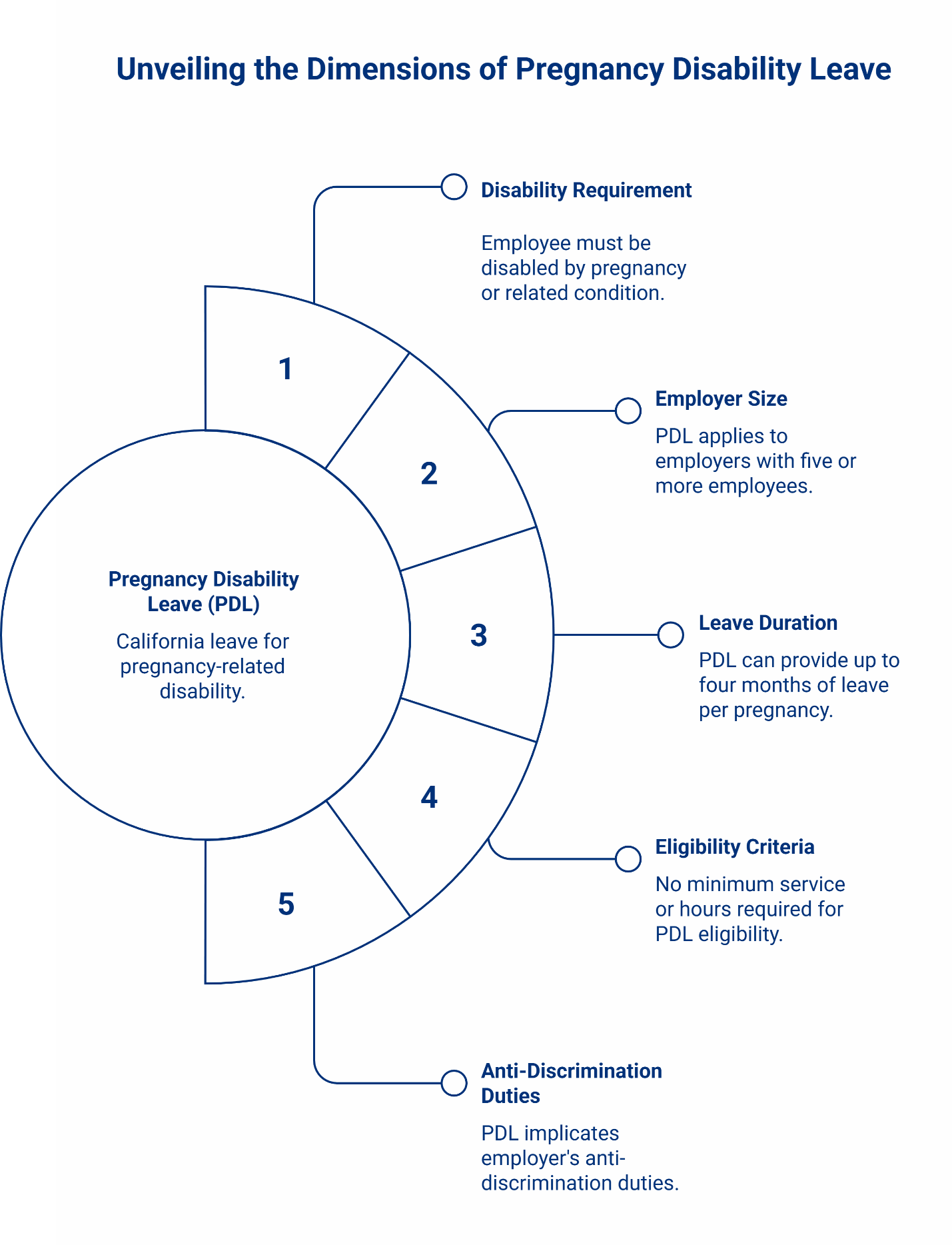
Pregnancy Disability Leave (PDL) is a California leave right that applies when an employee is disabled by pregnancy, childbirth, or a related medical condition and therefore cannot perform essential functions or cannot perform them safely.
In general terms:
- PDL is available when the employee is disabled by pregnancy, childbirth, or a related medical condition—not simply because the employee is pregnant.
- PDL generally applies to employers with five or more employees.
- PDL can provide up to four months of leave per pregnancy.
- PDL is not typically framed as requiring a minimum length of service or minimum hours worked to qualify, though related rights and benefit coordination can vary depending on the circumstances.
Pregnancy-related disability can also implicate the employer’s duties under California anti-discrimination law, including the duty to consider reasonable accommodation and to engage in a timely, good-faith interactive process where appropriate. Depending on the facts, issues such as retaliation or interference may also be relevant when an employee seeks job-protected leave or accommodation.
Why PDL is different from CFRA job-protected child bonding leave
A common source of confusion is the difference between disability leave and bonding leave.
- CFRA child bonding leave is job-protected leave to bond with a new child after birth, adoption, or foster placement. CFRA bonding leave is not limited to pregnancy and can generally be taken within one year of the child’s arrival, subject to eligibility and other rules.
- PDL, by contrast, addresses pregnancy-related disability, not bonding. The core question under PDL is whether pregnancy, childbirth, or a related medical condition prevents the employee from performing essential functions safely.
Does PDL cover time off to bond with a baby?
Once a health care provider releases the employee from pregnancy-related disability, additional time off is typically analyzed under CFRA child bonding leave (if the employee is eligible) or an employer policy. In many situations, an employee may take PDL for the disability period and then take CFRA bonding leave afterward, but the availability and sequencing depend on the specific facts, eligibility rules, and how leave is designated.
Why “maternity leave” and “pregnancy leave” labels often cause problems
Many handbooks and workplace conversations use “maternity leave” or “pregnancy leave” without distinguishing among:
- PDL (pregnancy-disability-related leave).
- CFRA job-protected child bonding leave.
- FMLA leave (where it applies).
- Separate employer programs that may run alongside statutory rights.
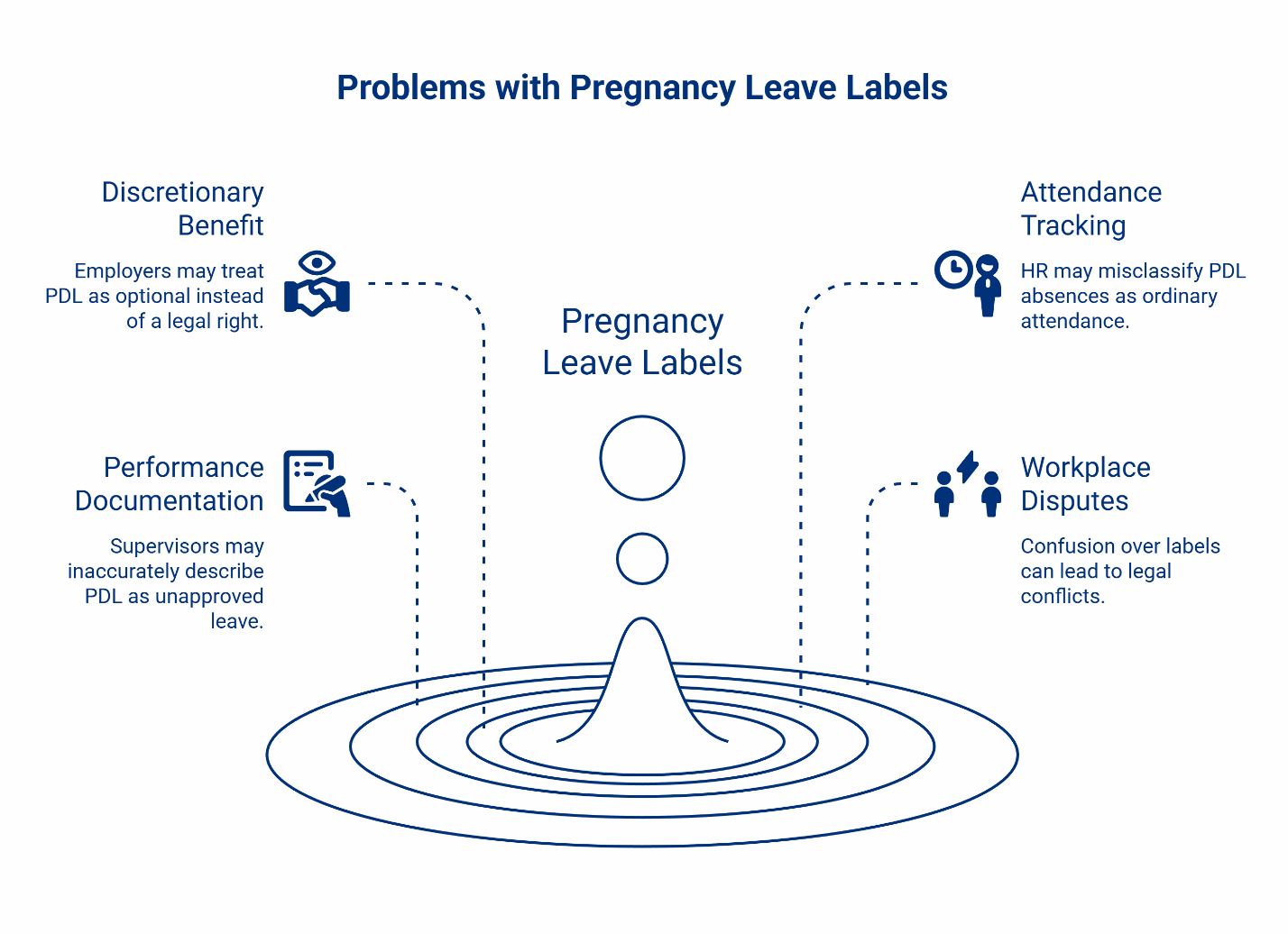
When an employer collapses these categories into a single informal label, several problems can follow:
- The employer may treat job-protected PDL as a discretionary benefit instead of recognizing it as a legal entitlement.
- HR may assign a single “maternity leave” code in the attendance system, which can cause pregnancy-disability-related absences to be tracked as ordinary attendance occurrences.
- A supervisor or HR representative may describe pregnancy-disability-related time off as “unapproved leave” or “personal time” in performance documentation or termination paperwork, which can obscure the legal significance of the underlying medical condition.
This is one of the most common ways confusion shows up in workplace records and later disputes.
When the central issue is reasonable accommodation
In physically demanding jobs, pregnancy-related limitations often involve temporary restrictions rather than complete time off. Health care providers may recommend restrictions such as:
- Avoiding heavy lifting, climbing, or working at heights.
- Reducing extended standing, bending, or repetitive physical motions.
- Limiting overtime or night shifts that increase physical strain.
When pregnancy-related limitations rise to the level of a protected medical condition, the employer may have a duty to consider reasonable accommodation. Conflict often arises when:
- A supervisor treats medical restrictions as misconduct or “refusal to work” rather than a potential accommodation request.
- Management states that “every position is full duty” and does not explore temporary modifications, alternative assignments, or other adjustments.
Depending on the facts, discipline that follows an accommodation request or pregnancy-disability disclosure may support claims involving disability discrimination, failure to accommodate, or retaliation.
How mixed terminology can affect discipline, attendance, and termination records
The labels an employer uses for pregnancy-disability-related absences and restrictions can shape how records are created and later interpreted. Patterns that appear in disputes include:
- Attendance points assessed during job-protected PDL time. An employer may record pregnancy-disability-related absences as ordinary “occurrences,” rather than designating the leave as PDL and treating those absences accordingly.
- Write-ups framed as performance issues rather than accommodation issues. An employer may document “refusing assignments” or “not meeting expectations” when the underlying issue is that the employee cannot safely perform certain tasks due to pregnancy-related disability and has requested restrictions.
- Termination documentation relying on informal labels. An employer may justify termination by referencing “too much time away on maternity leave” or “ongoing pregnancy leave problems” without clearly distinguishing among PDL, CFRA bonding leave, scheduling issues, and accommodation duties.
For related background on pregnancy-related adverse actions, you may also review an educational resource on pregnancy discrimination.
Illustrative scenarios in physically demanding and hands-on jobs
The following generalized examples are illustrative only. They show how informal labels, leave designation, and accommodation duties can intersect in hands-on jobs.
Scenario A: Warehouse attendance points and informal “pregnancy leave” labels
A warehouse employee becomes disabled by pregnancy and provides medical documentation recommending a period of time off followed by intermittent absences. A supervisor tells the employee to “just take pregnancy leave,” but HR does not designate the absence as PDL and does not adjust the attendance-point system to account for pregnancy-disability-related absences. The attendance system continues to assign points, and the employer later documents termination as neutral enforcement of an attendance policy. The record, however, may reflect that job-protected pregnancy-disability-related absences were treated as attendance violations rather than designated and handled as PDL.
Scenario B: Retail scheduling rigidity and misnamed leave
A retail employee needs schedule changes and medically supported time off during a period of pregnancy-related disability. A manager states that “pregnancy leave starts after the baby is born” and tells the employee that earlier absences will be counted as attendance violations. The employee provides medical documentation, the employer records the absences as violations, and the employer later cites the attendance record as the basis for termination. In that sequence, the key questions may include whether the employer properly designated job-protected PDL time and whether the employer responded appropriately to disability-related needs.
Quick terminology recap: PDL, CFRA bonding leave, and “pregnancy leave”
- Pregnancy Disability Leave (PDL) is California leave available when an employee is disabled by pregnancy, childbirth, or a related medical condition, up to a total of four months per pregnancy (as measured by the employee’s normal hours in one-third of a year).
- CFRA child bonding leave is job-protected leave to bond with a new child and has separate eligibility and timing rules.
- “Pregnancy leave” and “maternity leave” are often informal workplace labels that may combine PDL, CFRA bonding leave, FMLA leave (where applicable), and employer-provided benefits into one phrase. When an employer relies on informal labels instead of statutory categories, the employer may mishandle leave designation, accommodation discussions, or discipline records.
Disclaimer:
This content is for informational purposes only. Laws, definitions, and deadlines change. Verify current requirements through official California sources. This content is not legal advice. No attorney-client relationship is formed through this content. Please consult a qualified attorney in your jurisdiction for legal advice specific to your situation.
Protect Your Rights | The Akopyan Law Firm, A.P.C. | Top Gun Employment Lawyers
Have you been wrongfully terminated from your job? Have you suffered discrimination, harassment, or retaliation in the workplace? Has your employer violated wage and hour laws? If so, we can help. The Akopyan Law Firm, A.P.C. is dedicated to protecting and enforcing employees’ rights throughout Southern California. With a 97% success rate and millions recovered for our clients, our team of experienced and talented employment lawyers can fight to secure the justice you deserve.
Take the First Step Towards Securing Justice: Call us today to speak with one of our experienced employment lawyers. The firm offers case evaluations free of charge.
Contact Us Today:
- Phone: (818) 509-9975
- Office Locations: Los Angeles, Bakersfield, Costa Mesa, Temecula, Rancho Cucamonga, Oxnard, Culver City, and San Diego in California.
Important: Contacting the Akopyan Law Firm, A.P.C. does not create an attorney-client relationship, but all communications will remain private and confidential. Each case is unique. The Akopyan Law Firm, A.P.C., does not guarantee any outcome.